
The first half of 2026 has been a period of significant upheaval for global business leaders. A confluence of escalating geopolitical conflicts, persistent trade disruptions, and unpredictable policy shifts has forced a strategic recalibration across industries. What began the year with ambitious agendas focused on market expansion, product innovation, and technological investment has, by August, narrowed considerably. A mid-year survey by Chief Executive magazine reveals that CEOs are now overwhelmingly prioritizing revenue and market-share growth to navigate the volatile landscape, with Artificial Intelligence (AI) emerging as a critical tool in this sharpened focus.
The Year’s Dramatic Turnaround: From Ambitious Plans to Focused Survival
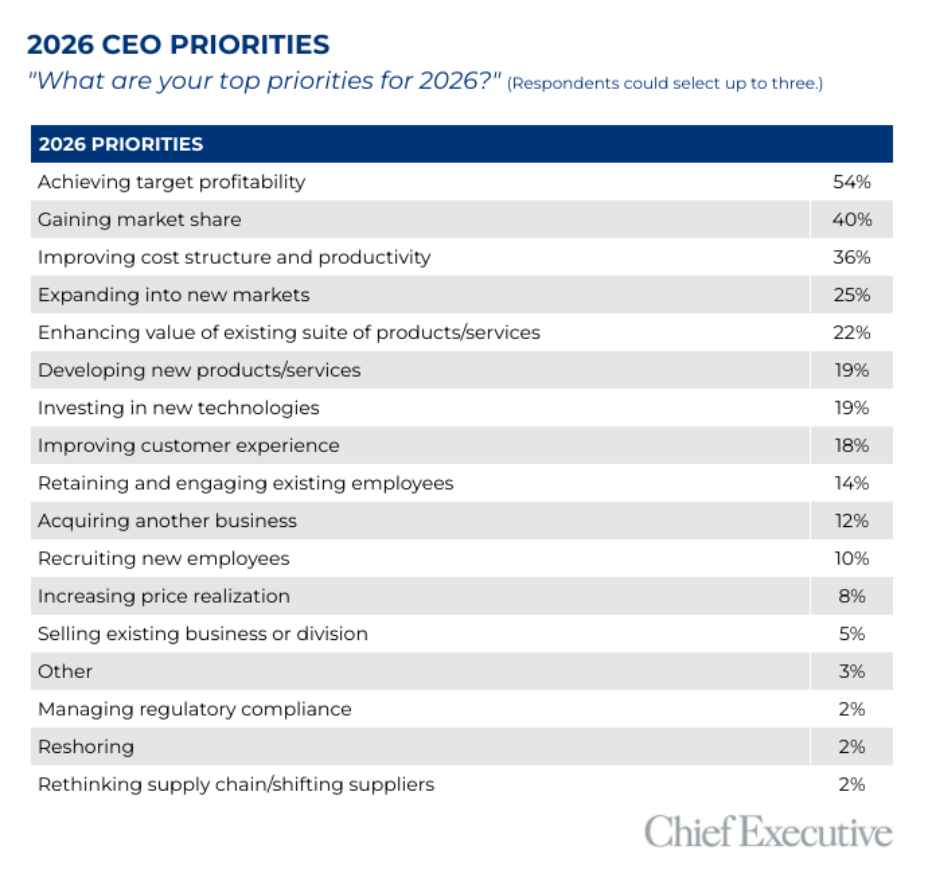
At the dawn of 2026, the outlook for corporate leaders was decidedly optimistic. Chief Executive‘s initial survey captured a landscape brimming with forward-looking strategies. CEOs articulated intentions to penetrate new geographical markets, spearhead groundbreaking product development, refine existing offerings for enhanced customer value, make substantial investments in cutting-edge technology, elevate the customer experience to new heights, and drive significant gains in organizational productivity. This expansive vision reflected a confidence in a stable global economic environment and a belief in the power of innovation to propel businesses forward.
However, the subsequent eight months have been anything but stable. A series of geopolitical flashpoints, ranging from heightened tensions in Eastern Europe and the Middle East to new trade disputes emerging in Asia, have injected a pervasive sense of uncertainty. Concurrently, domestic policy landscapes in major economies have experienced what many describe as "policy whiplash," with sudden regulatory changes and unexpected fiscal pronouncements creating a challenging operating environment. These external pressures have inevitably reshaped corporate strategies.
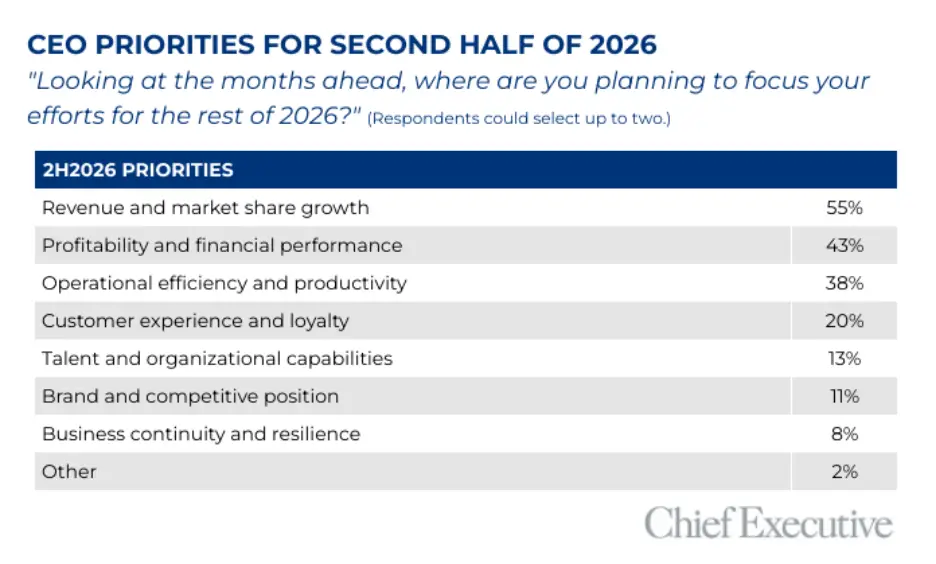
When Chief Executive revisited its survey in early August, polling 285 CEOs for its August CEO Confidence Index, the responses indicated a significant narrowing of focus. The question of where CEOs planned to direct their energy for the remainder of the year yielded a more concentrated set of priorities. Revenue and market-share growth emerged as the undisputed frontrunner, with a commanding 55 percent of respondents identifying it as their primary objective. This was closely followed by profitability and overall financial performance, cited by 43 percent, and operational efficiency and productivity, which garnered 38 percent of the votes. All other previously ambitious goals, from broad market entry to deep technological integration, now fall significantly behind these core financial and growth imperatives.
AI: The New Engine of Growth and Efficiency
While the shift in stated priorities is clear, the underlying strategies are more nuanced. The January and August surveys, though not directly comparable due to differing question formats (January allowed up to three priorities from a broader list, while August asked for two broader areas), collectively suggest a strategic pivot. The groundwork laid in January for innovation and expansion is now being channeled into more immediate, results-oriented objectives. In this context, Artificial Intelligence (AI) has rapidly ascended from a promising technology to a vital component of the current growth push.
Several CEOs underscored the necessity of aligning organizational structures with the accelerated pace of growth. One executive articulated the challenge as "managing growth pace against operational structures and consistencies," highlighting the tension between rapid expansion and the need for robust, reliable internal frameworks. AI is increasingly viewed as a solution to bridge this gap.
For many, AI is not merely a tool for automation but a strategic imperative for creating new revenue streams. One CEO, whose focus for the latter half of 2026 is firmly on revenue growth and operational efficiency, candidly explained the necessity to "spin up new business lines in AI to make up for legacy product stagnation." This sentiment reflects a broader industry trend where companies with mature product lines are actively seeking to leverage AI to develop next-generation offerings and services, thereby offsetting declining revenues from older products.
Bill Estes, president of Geokon, a manufacturer specializing in geotechnical and structural instrumentation, has witnessed this transformation firsthand. He noted, "Adoption of AI is significantly improving efficiency and data intelligence." This points to AI’s dual role: streamlining existing operations and unlocking deeper insights from data, which can then inform strategic decision-making and product development.
At Wayne Bank, a financial institution based in Honesdale, Pennsylvania, CEO Jim Donnelly is employing technology, with a significant emphasis on AI, to enhance business efficiency. "We are working to make the business more efficient through the implementation and scaling of new technology to help minimize operational constraints," Donnelly stated. This proactive approach to integrating AI in core banking operations aims to reduce overhead, improve customer service delivery, and ultimately bolster profitability in a competitive financial landscape.
The current AI-driven focus builds directly upon the priorities that CEOs initially set for the year. The drive to enter new markets, enhance existing products and services, develop novel offerings, invest in new technologies, and improve customer experience are all being re-examined through the lens of AI’s capabilities.
Paul Riedl, Jr., CEO of River Run, a managed IT and cybersecurity services firm headquartered in Glendale, Wisconsin, emphasizes the imperative for businesses to master AI’s application to accelerate growth. "Our business is affected by AI," he stated, warning that the competitive pressure stemming from AI adoption will only intensify. His strategic focus for the coming months is clear: "AI implementation and getting people to use it as a tool to leap forward." This highlights the human element in AI adoption – not just deploying the technology, but ensuring the workforce is equipped and motivated to leverage it effectively for competitive advantage.
The Understated Priorities: Talent, Resilience, and Brand
Perhaps as revealing as the surge in focus on revenue and AI is what has fallen to the bottom of the priority list. Talent and organizational capabilities, a perennial concern for businesses, registered as a top-two focus for only 13 percent of CEOs surveyed. This is particularly striking given that workforce-related issues continue to be a prominent theme throughout the survey results.
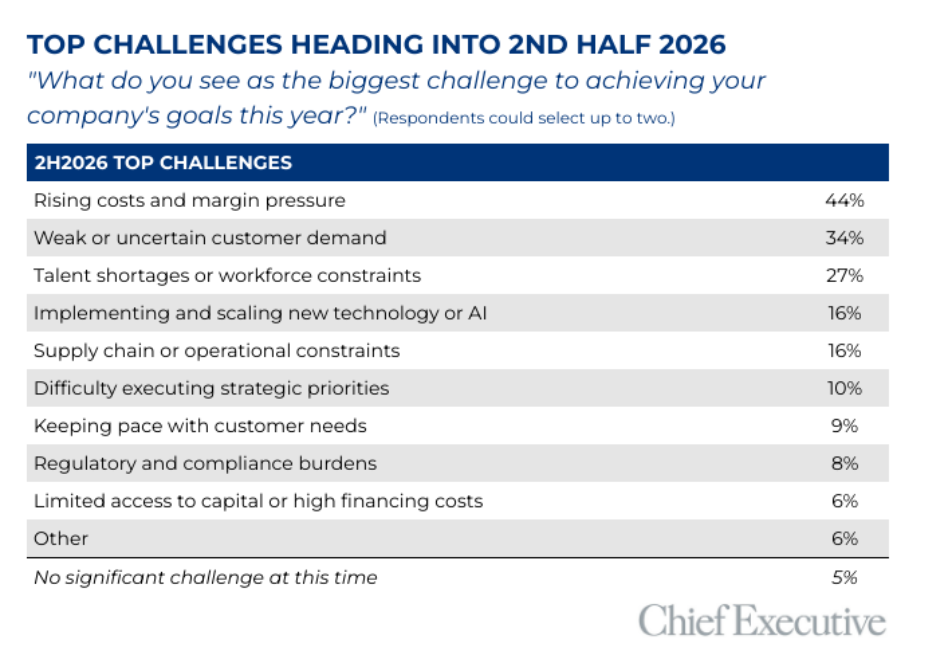
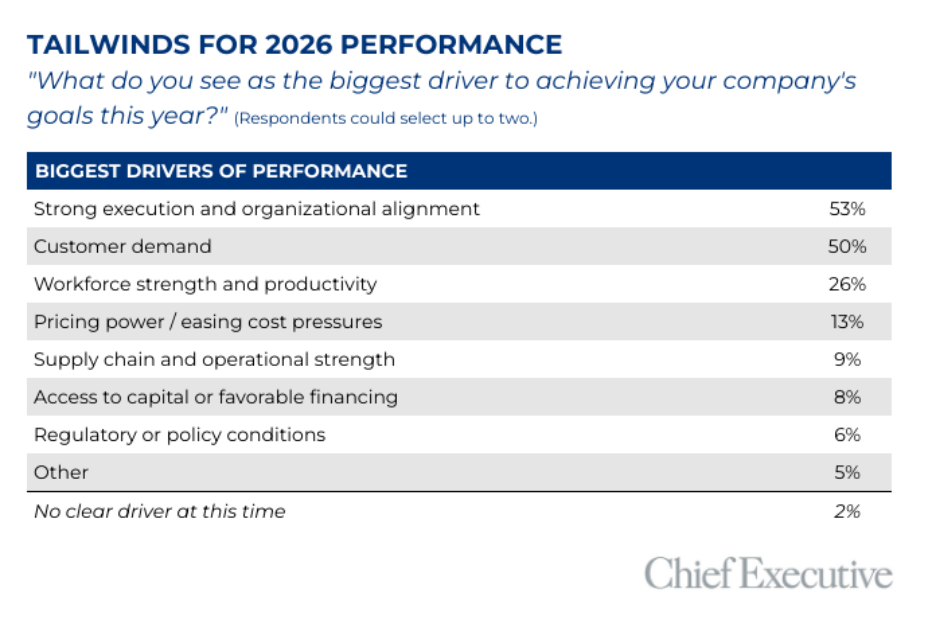
A significant portion of respondents – 27 percent – identified talent shortages or workforce constraints as one of the most substantial challenges hindering their progress. Furthermore, 26 percent cited workforce strength and productivity as a key driver for achieving their goals, while 22 percent flagged workforce availability and labor costs as a major external risk.
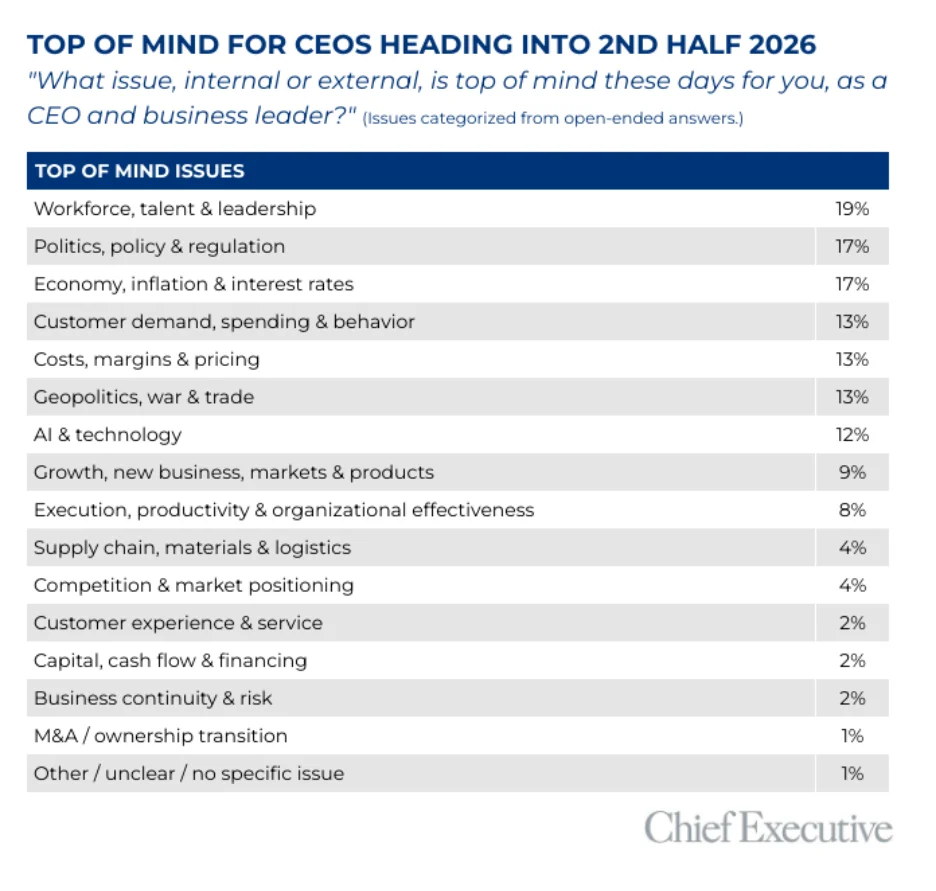
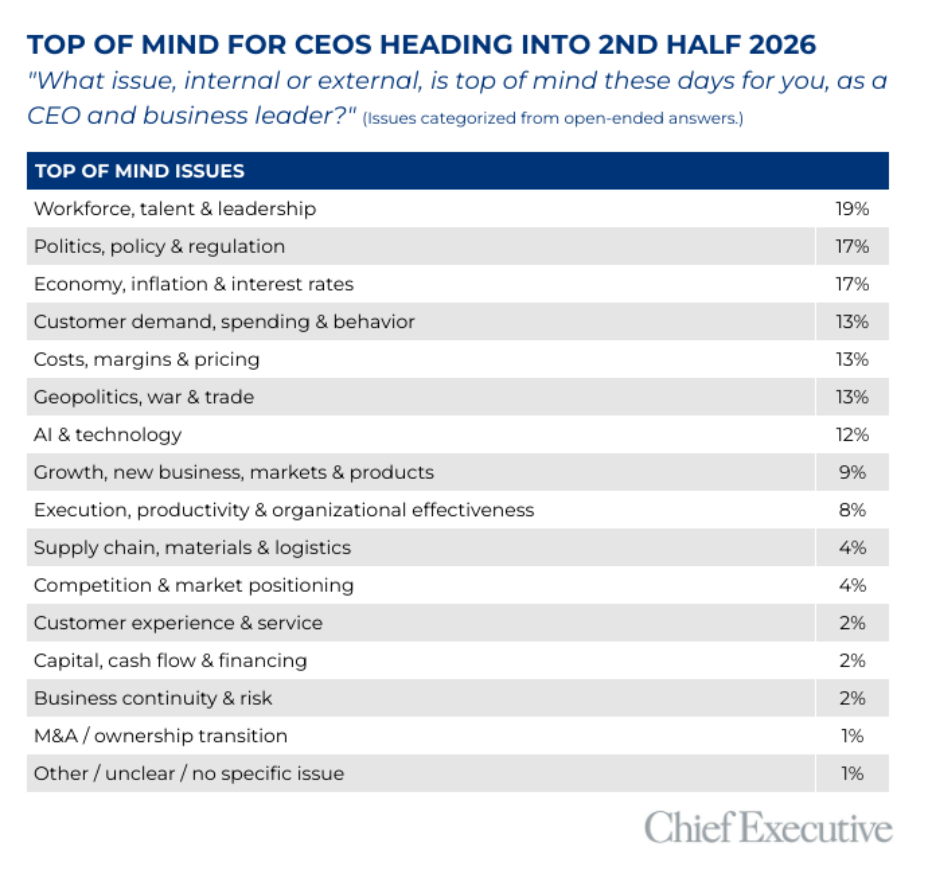
The discrepancy between the perceived importance of talent as a challenge and its low ranking as a stated priority is stark. When CEOs were asked, in an open-ended format, about the single issue occupying their top-of-mind thoughts, whether internal or external, "workforce," "talent," and "leadership" emerged as the most frequently cited themes, appearing in 19 percent of responses. This suggests that while talent issues are a significant concern, they are not being translated into explicit strategic priorities for the remainder of the year, perhaps due to the overwhelming pressure to deliver immediate financial results.
Gladiola Unzueta, founder and CEO of MultiGla Strategies, a firm providing integrated financial services and business consulting, views talent as a critical differentiator for future success. "The companies that will lead in the coming years will not simply adopt new technology; they will build strong cultures, invest in their people, and remain adaptable," she asserted. Unzueta believes that while AI is transforming business, "trust, leadership, and execution will continue to be the true competitive advantages." This perspective suggests a potential blind spot for companies overly focused on technology at the expense of their human capital.
Chris Burkhard, president and founder of Placers Staffing & Recruitment, observes an acceleration in the hiring and firing cycles within the market. "There is a normalization to the market churn that is just beginning," he commented, adding that labor shortages and skill gaps are making workforce strategy increasingly relevant again. Burkhard’s view directly challenges the notion that AI can fully supplant human roles, stating, "AI falls short in replacing humans."
The CEOs who are explicitly prioritizing talent tend to be those with more optimistic growth projections. Nearly 90 percent of these leaders expect revenue to increase this year, a figure that stands in contrast to the 73 percent among CEOs who did not select talent as a top priority. Similarly, 63 percent of talent-focused leaders anticipate adding headcount, compared to 44 percent of their counterparts. This correlation suggests that investing in talent may be a leading indicator of robust growth strategies.
Business continuity and resilience also appear to be taking a backseat. Only 8 percent of CEOs designated this as a top area of focus, despite a significant portion of respondents acknowledging its importance as a risk. Forty-five percent of CEOs identified inflation and economic conditions as major external risks, while 39 percent cited geopolitical conflict or trade disruption. The apparent disconnect between the acknowledgment of systemic risks and the prioritization of proactive measures for continuity suggests a gamble on the assumption that current operational models will weather the storm.
Another area receiving less direct attention is competitive positioning. Only 11 percent of CEOs selected brand and competitive position as a top focus. Yet, 25 percent of respondents identified competition and market disruption as a major external risk. When asked about top-of-mind issues, AI and technology were raised by 12 percent of CEOs, with many expressing concerns about AI-driven disruption, evolving business models, and the urgent need for adaptation. This suggests that while the threat of competitive disruption is recognized, the strategic response in terms of brand and positioning is not a primary focus.
Persistent Challenges and a Divergent Demand Landscape
Despite the strategic pivots and the emergence of AI as a key enabler, several persistent challenges continue to loom large for corporate leaders. Rising costs and margin pressure remain the most frequently cited obstacle to achieving company goals, impacting 44 percent of CEOs. Weak or uncertain customer demand follows closely at 34 percent, with talent shortages or workforce constraints cited by 27 percent.
The demand landscape itself presents a bifurcated picture. While half of the polled CEOs identified strong customer demand as a significant tailwind propelling their growth efforts, a substantial third perceive weak or uncertain demand as a formidable challenge. Anecdotal evidence supports this divergence. One CEO reported, "Demand is accelerating," while another observed that "the market has remained stronger than expected for longer than expected." Conversely, some businesses are experiencing the inverse effect. One respondent lamented that "high costs/inflation is finally shrinking consumer demand," illustrating the direct impact of economic pressures on consumer spending power.
External risks, even with the intense focus on internal growth drivers, continue to be a significant concern. Inflation and economic conditions remain at the forefront, followed by geopolitical conflict or trade disruption, competition and market disruption, workforce availability and labor costs, and changing customer behavior. These external factors create a complex and unpredictable operating environment, requiring businesses to be both agile and resilient.
Looking ahead to the close of 2026, the prevailing sentiment among CEOs is one of determined focus on tangible outcomes. Fifty-five percent of leaders are concentrating their efforts on revenue and market-share growth, reinforcing the central theme of the August survey. Complementing this drive for growth, 53 percent of CEOs cited strong execution and organizational alignment as one of the most critical drivers for achieving their objectives. This indicates a recognition that strategic goals, no matter how well-defined, require meticulous operational implementation and cohesive teamwork to be realized, especially in the face of the multifaceted challenges that have defined the first half of this turbulent year.








