
The competitive arena for human resources technology has significantly intensified with Gloat’s recent strategic entry into the AI Agents for HR sector. This move by the skills intelligence and talent marketplace pioneer signals a maturing market where established players and innovative startups alike are vying to define the future of HR operations through artificial intelligence. Gloat’s offering, branded as Gloat Agentic HR, aims to empower organizations to rapidly develop and deploy AI agents that seamlessly integrate with popular communication and AI platforms like Microsoft Copilot, Teams, and Slack, while leveraging existing enterprise business rules and security protocols embedded within core HR systems such as Oracle, Workday, and SuccessFactors.
This development arrives at a pivotal moment, as businesses grapple with the complexities of integrating AI into their workforce management strategies. The proliferation of AI agents promises to automate tasks, provide personalized employee experiences, and unlock deeper insights into talent dynamics. However, the successful implementation of these agents hinges on their ability to connect with and understand the intricate web of data and processes that underpin modern enterprise HR functions.
The Evolving Architecture of AI Agents in HR
To understand the significance of Gloat’s announcement, it’s crucial to examine the layered architecture of agentic AI as it applies to the HR domain. This framework outlines how different technological components interact to enable intelligent automation and personalized employee experiences.
Layer 1: Systems of Record
At the foundational level are the "systems of record"—the robust, often legacy, applications that store, manage, and update an organization’s critical data. This category predominantly includes Human Capital Management (HCM) systems like Workday, SAP, Oracle, and UKG, alongside broader Enterprise Resource Planning (ERP) systems. These platforms are built upon complex databases housing sensitive information about financials, customers, employees, inventory, and products. They represent the authoritative source of truth for an organization’s operational and human capital data.
Layer 2: Cross-System Applications and Employee Experience Platforms
Sitting atop these systems of record is a layer of cross-system applications. Recognizing that no single vendor can fulfill every business need, organizations have historically developed a complex ecosystem of specialized applications. These include portals, mobile applications, and intricate workflows that bridge multiple systems. The average large enterprise utilizes approximately 400 such applications, with over 100 directly impacting employee interactions.
Over the past two decades, as businesses migrated from on-premises infrastructure to cloud-based solutions, this ecosystem has expanded dramatically. Companies like ServiceNow, a global leader in digital workflow solutions, have emerged as dominant players in managing this layer, experiencing significant growth, with annual revenues exceeding $13.5 billion and a growth rate of 20% year-over-year. Furthermore, employee experience platforms such as Microsoft Viva, Zoom’s Workvivo, Firstup, and Staffbase, along with tools built on Google and Slack, are widely adopted. However, many of these platforms were not initially designed with "agentic" capabilities in mind.
Layer 3: Agentic AI Tools
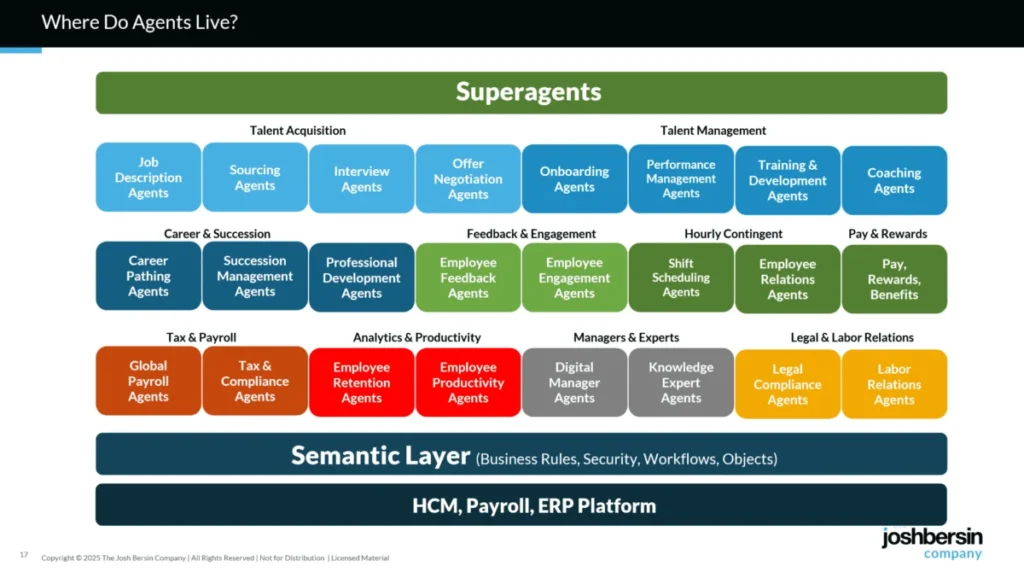
The third layer represents the burgeoning field of AI agents. Unlike static portals or predefined workflows, agents possess intelligence about individual users and can perform actions on their behalf. The HR technology landscape is now witnessing an influx of hundreds of agent tools. These range from offerings by nimble startups to capabilities embedded within existing enterprise systems, all designed to facilitate the creation of cross-functional solutions for workforce management.
Layer 4: Superagents and Orchestration
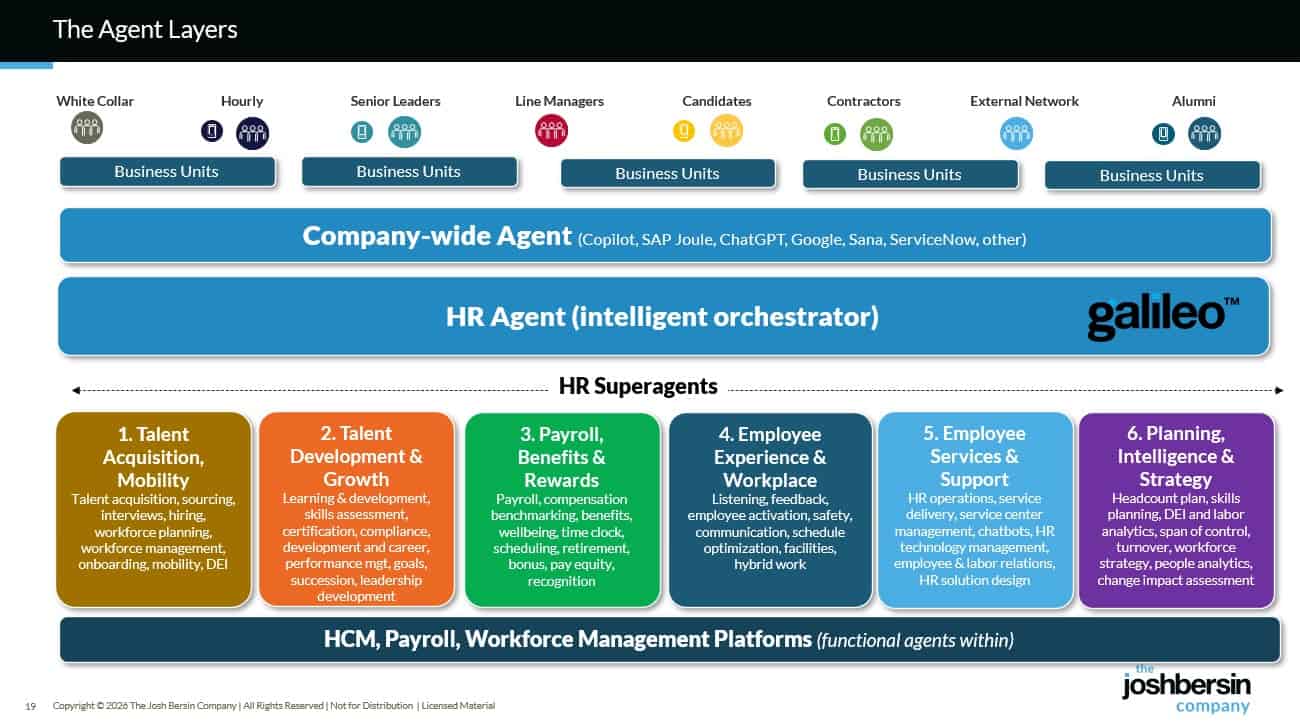
Crowning this architecture are "Superagents." These advanced tools are designed to orchestrate and integrate various functional agents, providing users with an even more intuitive and seamless "walk-up-and-use" experience. They act as intelligent orchestrators, consolidating the capabilities of individual agents into cohesive, problem-solving units.
The rapid expansion of this agent ecosystem has led to a proliferation of tools, including Sana (integrated with Workday), Oracle Agent Studio, Microsoft Copilot Studio, Leena.ai, ServiceNow (enhanced by its acquisition of MoveWorks), SAP Joule Studio, and foundational AI models from industry giants like Anthropic, OpenAI, and Google. Tools like Galileo, described as an AI advisor or HR professional agent, are emerging to provide employees with a direct interface for asking questions, receiving answers, and accessing the underlying agent network.
The Operationalization of AI Agents: Navigating Complexity
While the promise of AI agents is compelling, their practical implementation is fraught with challenges. The integration of these intelligent tools into an organization’s existing operational framework requires careful consideration of business rules, security protocols, and the complexities of legacy systems.
For instance, a payroll reconciliation agent offered by major HCM vendors like Workday, SAP, or Oracle, while capable of monitoring payroll transactions, tax liabilities, time-card data, and employee status changes, cannot function effectively without being meticulously "trained" on the company’s specific rules and security parameters. Furthermore, to address more sophisticated use cases such as pay equity analysis or performance-based adjustments, these agents must possess the ability to communicate and collaborate with other agents.
This highlights the critical importance of "agent architecture"—the underlying design that dictates how agents interact and share information. Consider a scenario where an organization aims to redeploy 5,000 employees from existing roles to new positions. An agent designed for this purpose would need to analyze job fit, identify skill gaps, and assess redeployment potential before any significant layoffs or new hires occur. Such an agent would necessitate seamless communication with multiple other agents, each managing different facets of workforce data and planning.
Gloat’s own experience with developing agents, such as those within its Galileo platform, illustrates this complexity. A workforce redeployment agent, for example, must not only understand skill and job requirements but also provide coaching to employees and managers regarding their options. This "Superagent" must also be aware of available training programs, location-specific considerations, licensing requirements, union agreements, and compensation structures. The intricate nature of these interdependencies underscores the sophistication required for effective agent deployment.
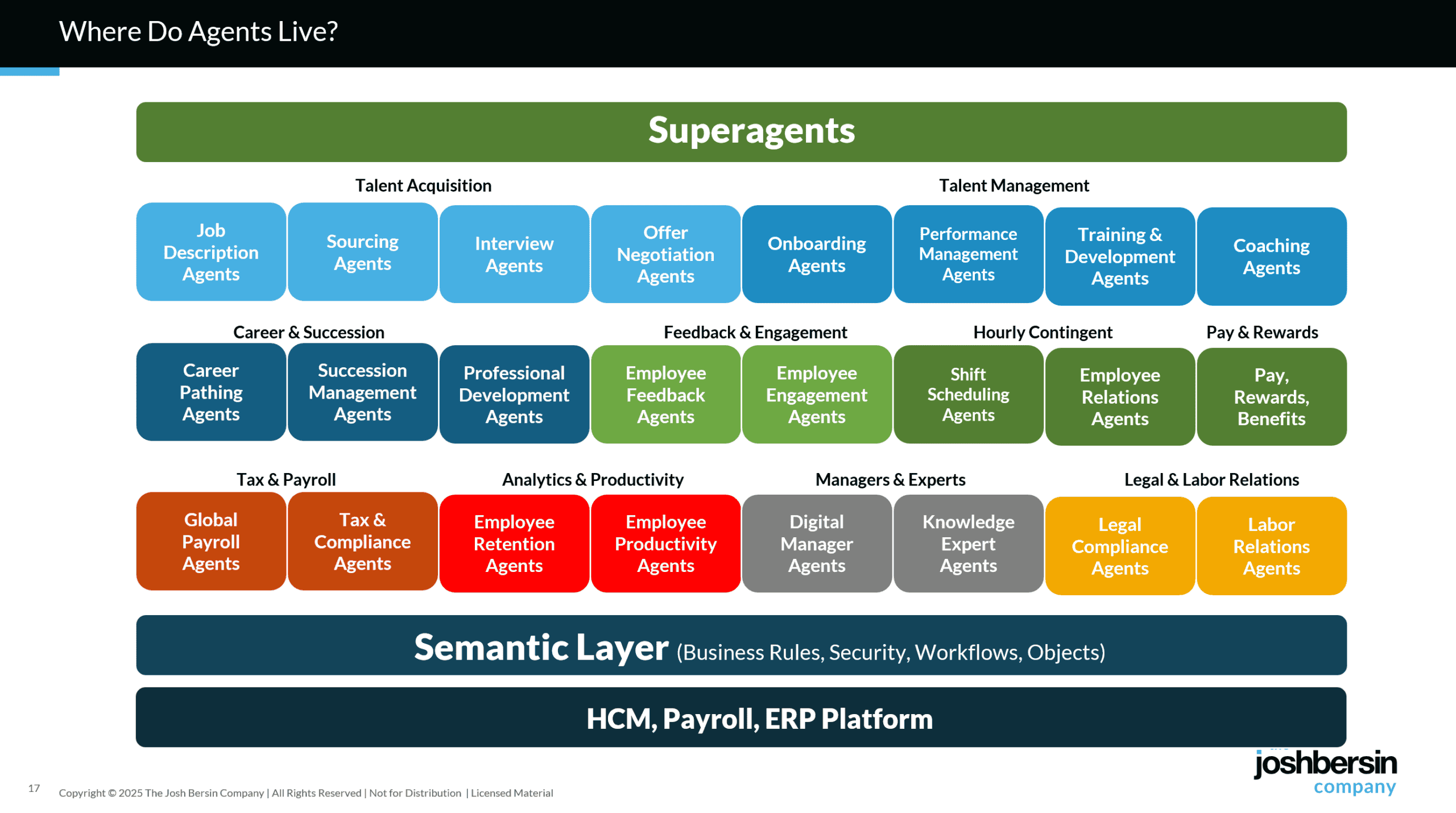
Beyond workforce redeployment, common use cases for agentic AI in HR span global onboarding, promotion processes, annual performance reviews and compensation cycles, talent acquisition, employee certification management, and time and schedule optimization.
The Fierce Competition for Enterprise Agent Dominance
The race to develop and deploy effective AI agents for the enterprise is characterized by intense competition, with every major HR vendor actively participating. While some vendors are focusing on simpler coaching tools, others are developing comprehensive platforms that extend much further. Leading vendors, including Workday, Oracle, SAP, and ServiceNow, are investing heavily in AI studios designed to simplify agent creation and deployment.
However, the central battleground is not solely about acquiring or building individual agents. The more significant challenge lies in the ability to seamlessly stitch these agents together, ensuring they operate harmoniously within an organization’s existing business rules, security frameworks, and unique business "objects." These objects can range from comprehensive career frameworks to detailed performance review models, representing the core logic and value proposition of a company. As business strategies evolve, these rules and objects must also adapt, necessitating a flexible approach to agent integration.
The ideal solution would avoid hard-coding these dynamic business rules directly into agents. Instead, agents should access a "semantic layer" that accurately reflects and maintains this information. HCM vendors, by virtue of their core offerings, already possess sophisticated semantic layers, such as Workday’s Business Process Framework. Their strategic imperative is now to integrate these layers into their agent development tools. Consequently, any HR agent or agent development tool will aspire to leverage this crucial semantic layer, potentially reshaping the SaaS landscape.
Gloat’s Strategic Intervention: The Loomra Platform
Gloat’s latest offering aims to disrupt this dynamic by providing a pathway to bypass the limitations of traditional, legacy approaches. The company has introduced an "agent-driven auto-discovery ‘injector’" named Loomra. This innovative technology is designed to mine an organization’s entities, workflows, and business rules, maintaining them in sync with ongoing changes within the core HCM system. Loomra effectively replicates the intricate rules and objects present in an HCM system, thereby enabling the straightforward development of applications and agents built upon this contextual foundation.
Following the deployment of Loomra, Gloat offers an intuitive agent builder that allows users to visually construct their own agents. These custom-built agents can then be directly integrated into popular platforms like Microsoft Teams, Copilot, and Slack. Gloat has already developed pre-built agents for critical HR functions, leveraging its existing expertise in areas such as workforce redeployment, career development, internal talent sourcing, succession planning, and learning and reskilling initiatives.
Workforce Context as the Differentiating Factor
What truly sets Gloat’s Agentic HR platform apart is the underlying "workforce context layer" powered by Loomra. Built upon nearly a decade of enterprise-scale workforce data, Loomra meticulously models skill adjacencies, career trajectories, organizational patterns, and intricate workforce relationships across millions of employees globally.
This robust contextual understanding enables Gloat’s agents to transcend simple information retrieval. Instead of merely responding to queries like "show me employees who know Python," these agents can intelligently reason about which employees are best positioned to transition into AI engineering roles within the current year, which teams are most susceptible to future skill gaps, and where talent should be strategically redeployed as business priorities shift.
Comparative Analysis: Gloat’s Position in a Crowded Market
Gloat’s approach presents a compelling proposition: organizations can "start with Gloat" to accelerate their AI agent adoption without waiting for legacy vendors to develop the necessary functionalities. The platform’s open architecture facilitates integration with other internal systems, and its unique context engine, Loomra, offers a significant advantage. To date, it is not widely apparent that other major HCM vendors have developed comparable systems.
However, Gloat operates within a fiercely competitive market. Organizations with significant investments in specific platforms are likely to gravitate towards their native solutions. ServiceNow users will likely favor ServiceNow’s agent capabilities, Workday customers will turn to Sana, Oracle users to the Oracle AI Studio, and SAP customers to Joule Studio. Gloat’s success will depend on its ability to demonstrate that its tools are not only easier to use and fully integrated with existing HCM systems but also demonstrably more context-aware than competing solutions. As the enterprise shifts from "systems of record" to "systems of context," Gloat has the potential to emerge as a leader in this new paradigm.
Future Outlook: The Evolution of Application Development Tools
The trajectory of application development tools has historically shown a tendency for companies to adopt toolsets that align with their existing technological infrastructure. New platforms, from early web development tools like Dreamweaver and Cold Fusion to modern AI development environments such as Microsoft’s GitHub Copilot and Anthropic’s Cowork, consistently emerge.
Gloat’s innovative platform represents a significant advancement in the agent industry, pushing the boundaries of what is possible in HR automation and intelligence. The company’s early customer adoption and the real-world impact of its solutions will be closely watched. As the market continues to mature, the ability of platforms like Gloat’s to seamlessly integrate deep workforce context with actionable AI capabilities will be a key determinant of their long-term success.
The ongoing evolution of agentic AI in HR signals a transformative period for talent management, promising enhanced efficiency, personalized employee experiences, and more strategic workforce planning. The coming months and years will reveal how effectively Gloat and its competitors navigate this dynamic landscape and redefine the future of work.







