In an increasingly competitive global talent market, the strategic application of salary benchmarking data has emerged as a critical differentiator for organizations seeking to attract and retain top talent. Merely identifying market rates is no longer sufficient; the real advantage lies in how this intelligence is translated into compelling job advertisements and ultimately, successful employment offers. This nuanced approach is vital at a time when employers face unprecedented challenges in securing skilled professionals.
The Evolving Landscape of Talent Acquisition and Compensation
The global talent landscape is characterized by a significant shortage of skilled workers, a trend exacerbated by rapid technological advancements and shifting workforce demographics. According to ManpowerGroup’s 2026 Global Talent Shortage Survey, a staggering 72% of employers report difficulty finding skilled talent. This figure represents a turning point, underscoring the intensity of competition for qualified individuals, particularly in emerging fields like artificial intelligence (AI), where specialized skills command a premium.
Beyond the sheer scarcity, several factors contribute to the complexity of modern talent acquisition:
- Post-Pandemic Shifts: The COVID-19 pandemic irrevocably altered employee expectations regarding work flexibility, well-being, and purpose. Hybrid and remote work models have become standard in many industries, influencing compensation strategies and widening the geographic talent pool.
- Inflationary Pressures: Persistent inflation in many economies has heightened candidates’ focus on competitive compensation packages that maintain their purchasing power. What was considered a fair salary a year ago may no longer be adequate.
- Increased Transparency Demands: There is a growing global movement towards pay transparency. Legislation in various jurisdictions, including several U.S. states (e.g., Colorado, New York, California) and the European Union’s Pay Transparency Directive, mandates or encourages the disclosure of salary ranges in job postings. This trend makes accurate, market-aligned benchmarking not just a best practice, but often a legal necessity.
- Candidate Empowerment: In a candidate-driven market, job seekers are more informed and selective. They actively research potential employers, scrutinize compensation packages, and compare offers meticulously. A vague or uncompetitive offer can deter strong candidates before the interview process even begins.
In this environment, organizations cannot afford to treat salary benchmarking as a perfunctory exercise. It must be an integral, dynamic component of the talent acquisition strategy, informing every stage from initial job posting to final offer negotiation.
Understanding Salary Benchmarking: Beyond the Raw Numbers
Salary benchmarking is the systematic process of comparing an organization’s compensation and benefits structure against external market data. Its primary objective is to ascertain whether current or proposed pay rates are fair, competitive, and justifiable in the broader labor market. This process provides empirical evidence to position an offer deliberately – whether aiming to lead the market, match it, or strategically fall slightly below while compensating with other benefits.
It is crucial to distinguish salary benchmarking from a general pay review. While both are related to compensation, benchmarking is primarily an evidence-gathering exercise focused on external market comparisons. A pay review, conversely, is an internal process that uses this evidence (among other factors like internal equity, performance, and budget) to make decisions about adjustments to existing employee salaries or overall compensation structures. While often conducted concurrently, benchmarking should ideally be an ongoing activity, particularly when setting offers for hard-to-fill roles or entering new markets, independent of the annual pay cycle.
The fundamental question salary benchmarking seeks to answer for hiring is direct: "Will a highly qualified candidate, upon reviewing this compensation figure, be motivated to apply for this position?"
How Does Salary Benchmarking Work?
The operational mechanics of salary benchmarking involve several key steps:
- Role Matching: The first step is to accurately match the internal role to comparable positions in the external market. This goes beyond mere job titles, focusing instead on the actual duties, responsibilities, required skills, experience level, and scope of influence. A "Marketing Manager" in one company might be equivalent to a "Senior Marketing Specialist" or "Director of Marketing" in another, highlighting the need for detailed analysis of job descriptions.
- Data Sourcing: Reliable salary data is typically sourced from a combination of channels:
- Traditional Salary Surveys: These are often provided by consulting firms (e.g., Mercer, Aon, Willis Towers Watson, Radford) and collect data from participating companies, offering robust, aggregated insights, often with detailed breakdowns by industry, revenue size, and job family.
- Live Job Advert Data: Platforms like HR DataHub (as mentioned in the original article) or large job boards (Glassdoor, LinkedIn, Indeed) collect and analyze real-time data from active job postings. This offers a highly current view of what employers are currently offering to attract talent.
- Public Data/Crowdsourced Data: Websites like Glassdoor, Levels.fyi, or government labor statistics provide aggregated data, though quality can vary depending on the source.
- Filtering and Refinement: Once raw data is gathered, it is filtered by critical factors that influence compensation:
- Location: Geographic variations in cost of living and local labor market dynamics significantly impact pay. A role in New York City will command a different salary than an identical role in a rural area.
- Industry: Certain industries (e.g., tech, finance) typically offer higher compensation for similar roles compared to others (e.g., non-profit, retail).
- Specific Skills: Niche, in-demand skills (e.g., specific programming languages, AI/ML expertise, cybersecurity) can command a significant premium regardless of the base role.
- Company Size/Revenue: Larger, more profitable companies often have higher compensation budgets.
- Output Analysis: The output is typically a compensation range, often presented in quartiles (25th, 50th/median, 75th percentile). This range illustrates the spread of what employers pay for similar roles, allowing the organization to make an informed decision about where to position its offer relative to the market. Fresh, accurately matched data provides the strongest foundation for defending compensation decisions to both hiring managers and candidates.
Strategic Application: From Job Ad to Accepted Offer
The journey of salary benchmarking data is not complete until a candidate accepts an offer. Its strategic value is realized at multiple touchpoints:
- Live Market Range: The initial data collection phase establishes a competitive range for a specific role and location. This is the foundational input.
- Job Advert: This market range is then translated into a published salary range and a compelling "reward story" within the job advertisement. This is the candidate’s first encounter with the organization’s compensation philosophy.
- Accepted Offer: The culmination is an offer that resonates with the candidate, addressing their expectations and ultimately leading to their acceptance over competing proposals.
This integrated approach transforms raw data into a powerful tool for talent acquisition.
Key Strategies for Effective Salary Benchmarking and Offer Construction
Transforming salary benchmarking data into offers that consistently win candidates requires a multi-faceted approach:
-
Benchmark the Total Reward Package, Not Just Base Pay:
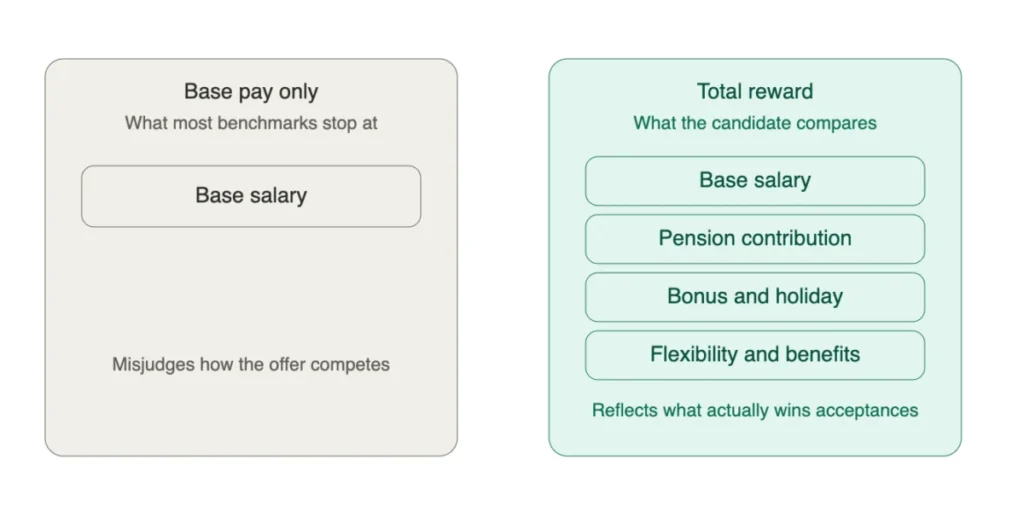
Candidates evaluate more than just the base salary; they assess the entire "total reward" package. A robust retirement contribution match, comprehensive health benefits, generous paid time off (PTO), flexible working arrangements (hybrid/remote), professional development opportunities, and even the cost of commute all contribute to the perceived value of an offer. For instance, a role paying $48,000 with a strong 401(k) match and full remote flexibility can often be more appealing than a $50,000 role requiring five days in-office with minimal benefits. Research from organizations like Willis Towers Watson consistently shows that non-monetary benefits and flexibility are increasingly critical drivers of candidate choice, often ranking alongside or even above base salary for many professionals. Failing to benchmark these elements leads to a misjudgment of an offer’s true competitiveness. -
Publish a Clear, Market-Aligned Salary Range in Job Advertisements:
In today’s transparent market, publishing a specific, market-aligned salary range in job advertisements is rapidly becoming standard practice, driven by both candidate expectation and legal mandates. A vague phrase like "competitive salary" now often signals a lack of transparency or a potentially uncompetitive offer, causing strong candidates to bypass the posting. A clear range, derived from robust benchmarking, communicates that the organization has done its due diligence and understands the market value of the role. This fosters trust and acts as an effective initial filter, attracting candidates whose expectations align with the offer while discouraging those who are significantly out of range. Job description software, such as Ongig’s, is increasingly used by teams to ensure compliant and transparent salary details are integrated seamlessly into postings. -
Craft a Compelling Reward Story:
A salary range, by itself, is merely a set of numbers. To truly engage candidates, it must be accompanied by a compelling "reward story." This narrative explains the rationale behind the compensation package and highlights its overall value proposition. If the salary sits slightly below market median but is offset by exceptional benefits, rapid career progression, or a unique company culture, these elements must be clearly articulated. For example, a role with a slightly lower base might come with significant equity potential, an accelerated promotion track, or unparalleled learning opportunities. The key is authenticity; the reward story must be consistent with the reality of the role and the company culture. Inconsistencies or overstatements can quickly erode trust during the interview process, leading to candidate disengagement. -
Leverage Non-Base Pay Levers When Salary is Capped:
In many organizations, base salary budgets are constrained. The Conference Board’s 40th annual Salary Increase Budgets survey indicates that U.S. companies planned average salary budget increases of 3.4% in 2026. This modest increase means that simply outbidding rivals on base pay is often not feasible or sustainable. Therefore, strategic compensation professionals must benchmark and utilize other "levers" within the total reward package. These can include:- Enhanced Retirement Contributions: A more generous 401(k) or pension match.
- Clearer Bonus Structures: Transparent, achievable performance bonuses or profit-sharing.
- Additional Paid Time Off: More vacation days, personal days, or extended parental leave.
- Flexibility: Options for remote work, flexible hours, or compressed workweeks, which often cost little but are highly valued.
- Professional Development: Budget for certifications, courses, or conferences.
- Employee Discounts/Perks: Especially impactful in retail or consumer-facing sectors, leveraging the employer brand.
By understanding what candidates value most and where the budget can be strategically reallocated, organizations can construct highly attractive offers even with a fixed base salary cap.
-
Prioritize Investment in Hard-to-Fill Roles:
A common pitfall is to distribute salary increase budgets evenly across the organization, a practice reportedly followed by 83% of U.S. employers according to Mercer. This "even split" approach can inadvertently starve critical, hard-to-fill roles of necessary investment. Strategic benchmarking during recruitment allows organizations to identify precisely which roles are lagging the market and which are competitively priced. For instance, a team-lead role lagging the market by 8% will likely experience significant candidate attrition, whereas an administrative role sitting comfortably at the median might not. By directing additional budget and recruitment effort towards these high-demand, under-compensated roles, organizations can optimize their compensation spend and improve their hiring success rates. This data-driven allocation ensures resources are applied where they have the greatest impact.
The Power of Live Job Advert Data for a Sharper Strategy
Traditional salary surveys provide valuable insights into what roles paid when the data was collected, often reflecting historical trends. However, for active hiring, particularly in dynamic markets, this data can quickly become stale. Live job advert data, in contrast, offers a real-time snapshot of what employers are currently offering to attract candidates. This distinction is critical when setting individual offers in a fast-moving talent market.
While advertised data reflects what employers are presenting to the market rather than what current employees actually earn, and may not include formal leveling, its currency makes it highly relevant for recruitment. It provides a direct view of the competitive landscape a candidate is navigating today. This allows organizations to pull current salary ranges by specific role and location, and critically, to weigh a base-pay-only offer against the fuller total-reward picture that candidates are evaluating. The divergence between a narrow focus on base pay and a comprehensive total reward comparison often determines the success or failure of an offer.
Navigating Regional and Skill-Based Disparities: A Worked Example
Consider the scenario of hiring a Regional Operations Manager in two distinct markets: New York City and across a wider national footprint. Relying on a single national survey average for both could lead to significant strategic errors – overpaying in one market while failing to attract talent in another.
Live market data reveals these crucial differences. According to Glassdoor, a Regional Operations Manager in New York City averages $133,235, with a typical range of $105,323 to $171,087 (25th to 75th percentile). Nationally, the same role averages $123,905, with a range of $98,293 to $158,695.
This represents approximately a $10,000 gap at the midpoint, and notably, the bottom of New York’s range ($105,323) is above the national median ($123,905). This data dictates two distinct compensation strategies:
- For the National Market: An organization can confidently set a base salary near the $124,000 midpoint, augmenting it with a strong benefits package and a clear career progression path to a senior operations role. This competitive range is then published in the job advertisement.
- For New York City: The $124,000 national figure would be perceived as significantly low, effectively screening out qualified candidates. Here, the base salary must be positioned towards the upper end of the New York-specific range, with the job advertisement emphasizing the robust total package and specific progression opportunities within the organization.
This example illustrates that similar roles require tailored offers, each meticulously constructed based on the realities of its specific market. This approach ensures competitive offers in each location without unnecessary overpayment, as the compensation presented aligns directly with the market candidates are evaluating. The same logic applies internationally, where tools like HR DataHub allow for granular filtering of live job advert data by role and location, moving beyond blended averages to precise market-specific pricing.
Common Pitfalls in Compensation Strategy
Despite the clear benefits, organizations frequently make avoidable errors in their salary benchmarking and compensation strategies:
- Benchmarking Only Base Pay: Overlooking the total reward package leads to an incomplete and often misleading assessment of market competitiveness.
- Relying on Stale or Generic Data: Using outdated survey data or broad industry averages without filtering by specific location, skills, and company size can result in uncompetitive offers.
- Ignoring Geographic and Skill-Based Nuances: Treating all locations or skill sets uniformly, despite clear market variations, leads to misallocation of resources and missed opportunities.
- Failing to Communicate the "Reward Story": Simply stating a salary figure without articulating the full value of the compensation package and career opportunities undermines its attractiveness.
- Benchmarking as a Reactive Measure: Conducting benchmarking only after losing a critical candidate means the organization is always playing catch-up, rather than proactively attracting talent.
- Lack of Internal Equity Consideration: While external competitiveness is vital, ignoring internal pay disparities can lead to morale issues, increased turnover among existing staff, and a perception of unfairness.
- Over-reliance on a Single Data Source: Using only one type of data (e.g., only traditional surveys or only live job ads) can provide a skewed perspective. A holistic approach often combines multiple reliable sources.
Broader Implications for Organizational Success
Effective salary benchmarking extends its benefits far beyond individual hires, impacting several critical areas of organizational health:
- Retention: The same market view that informs competitive offers for new hires is crucial for retaining existing talent. Proactive benchmarking can identify roles where internal pay has fallen behind the market, allowing organizations to make preemptive adjustments. Addressing lagging compensation before an employee receives an outside offer is significantly more cost-effective than attempting to counter a resignation.
- Internal Equity: While benchmarking focuses on external competitiveness, the insights gained can also inform internal pay structures. Understanding external market rates helps ensure that internal pay progression and differentials are fair and defensible, mitigating potential issues of pay compression or perceived inequity.
- Employer Brand: A reputation for offering fair, transparent, and competitive compensation significantly enhances an organization’s employer brand. This attracts a higher caliber of candidate and positions the company as an employer of choice. Conversely, a reputation for low pay or lack of transparency can severely damage an employer brand.
- Compliance: With the proliferation of pay transparency laws, robust and ongoing salary benchmarking is essential for legal compliance. Organizations must be able to demonstrate that their advertised ranges are based on legitimate market data and are applied equitably.
Conclusion
In an era defined by acute talent shortages and heightened candidate expectations, the role of salary benchmarking has evolved from a simple data collection exercise to a strategic imperative. The number presented in a job advertisement is far more than a figure; it is a critical communication tool that signals an organization’s diligence, its understanding of market value, and its commitment to fair compensation.
By adopting a holistic approach that benchmarks the entire total reward package, leverages live market data, crafts compelling reward stories, strategically utilizes non-base pay levers, and prioritizes investment in hard-to-fill roles, organizations can significantly enhance their ability to attract, engage, and ultimately secure the talent essential for future success. Those that master this strategic application of salary data will not only fill critical roles more efficiently but also build a stronger, more resilient workforce capable of navigating the challenges of tomorrow.