
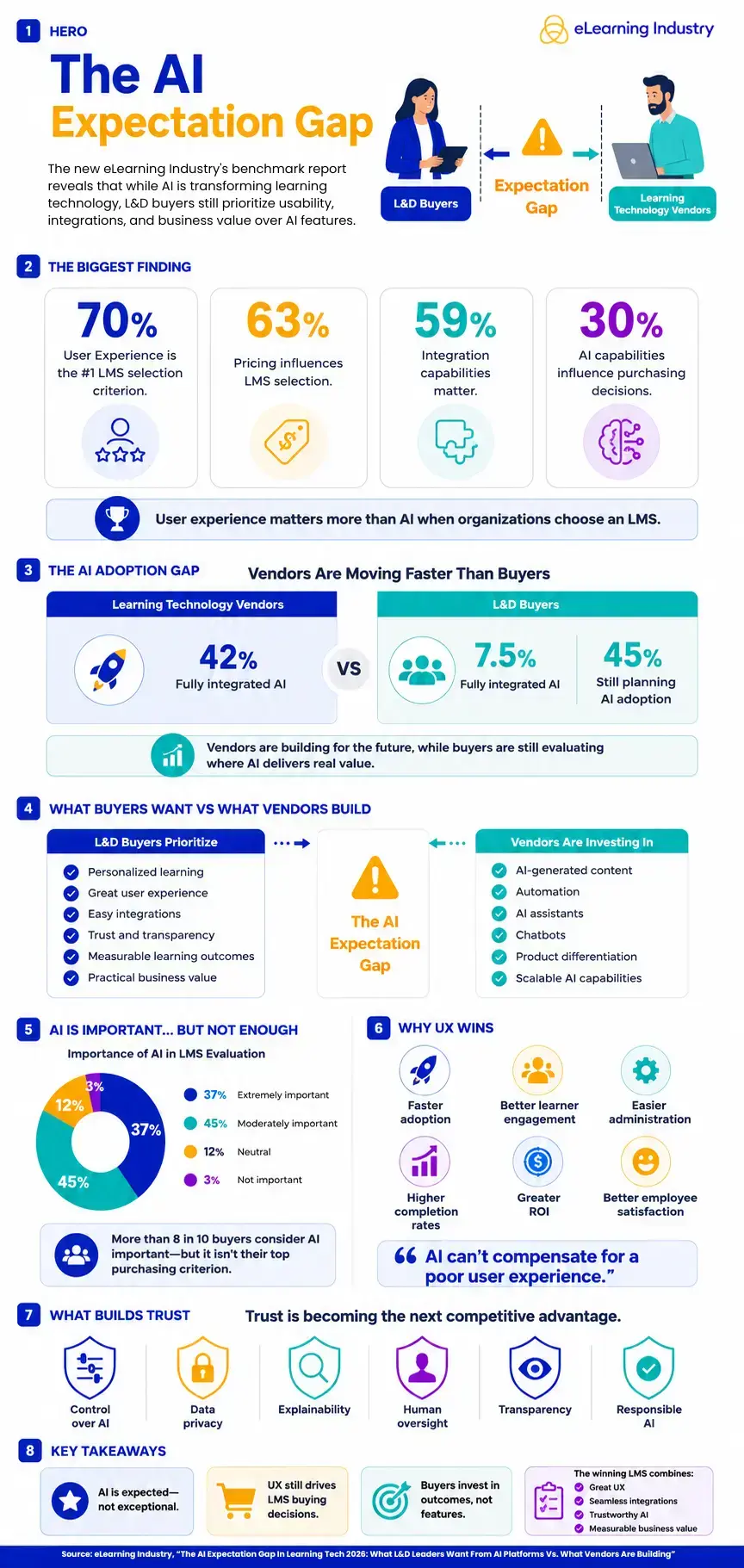
While the previous three years were defined by a "gold rush" toward generative AI features, the current year marks a return to foundational excellence. The report highlights that User Experience (UX) remains the undisputed priority for 70% of L&D buyers. This is followed closely by pricing (63%) and integration capabilities with existing enterprise systems (59%). In a surprising turn, specific AI capabilities were cited as a top selection priority by only 30% of respondents. This data suggests that while AI is viewed as an essential background utility, it is no longer the primary differentiator in the high-stakes LMS procurement process.
The Evolution of LMS Procurement: A Chronological Context
To understand the 2026 shift, it is necessary to examine the trajectory of the learning technology market over the last decade. From 2015 to 2020, LMS selection was largely driven by content libraries and mobile accessibility. The COVID-19 pandemic accelerated the need for cloud-based scalability and virtual classroom integrations. By 2023, the emergence of Large Language Models (LLMs) triggered a frenzy among vendors to integrate automated content creation and chatbots.
However, by late 2025, many organizations realized that "feature bloat"—the accumulation of complex AI tools that employees rarely used—was negatively impacting the bottom line. This led to the current "Pragmatic Era" of 2026. Today, the focus has moved away from what a system can do in a laboratory setting to how it performs within the daily workflow of a diverse workforce. The current market maturity reflects a realization that technology is only as effective as its adoption rate.
Dissecting the 2026 Selection Hierarchy
The 2026 benchmark data provides a clear hierarchy of what modern organizations value when investing their training budgets. This hierarchy reveals a focus on operational efficiency and long-term sustainability over short-term innovation.
1. The Primacy of User Experience (70%)
User Experience (UX) has moved beyond simple aesthetics. In 2026, UX is viewed as a mission-critical factor for learner retention. High-friction interfaces lead to "platform fatigue," where employees avoid mandatory training due to navigation difficulties. For administrators, a poor UX translates into increased support tickets and manual data entry. L&D leaders now demand "zero-friction" environments where the distance between a learner and their required knowledge is minimized.
2. Pricing and Total Cost of Ownership (63%)
Economic pressures and the need for clear Return on Investment (ROI) have pushed pricing to the second most important criteria. Buyers are no longer looking at the initial licensing fee alone; they are calculating the Total Cost of Ownership (TCO), which includes implementation, training for admins, and the cost of third-party integrations. There is a growing resistance to "AI surcharges," where vendors charge premium rates for automated features that have not yet proven their business value.

3. Ecosystem Integration (59%)
The modern enterprise operates on a stack of interconnected tools, including HR Information Systems (HRIS), Customer Relationship Management (CRM) platforms like Salesforce, and collaboration tools like Microsoft Teams or Slack. An LMS that exists in a silo is now considered a liability. Buyers prioritize platforms that offer robust API support and "out-of-the-box" integrations to ensure that learning data flows seamlessly into performance management and business intelligence systems.
4. Advanced Analytics and Strategic Reporting (46%)
As L&D departments are increasingly asked to prove their impact on the company’s bottom line, analytics have become essential. Modern buyers require more than just "completion rates." They seek predictive analytics that can identify skill gaps before they become problematic and correlation engines that show how training interventions affect specific Key Performance Indicators (KPIs).
The AI Expectation Gap: A Market Disconnect
A central finding of the 2026 report is the widening "AI Expectation Gap." This phenomenon describes the disconnect between what vendors are building and what buyers are actually implementing. The data shows that 42% of LMS vendors claim to have fully integrated AI into their core architecture. Conversely, only 7.5% of L&D buyers report that they have fully deployed these AI features across their organizations.
This gap is attributed to several factors:
- Organizational Readiness: Many companies lack the data infrastructure or internal expertise to manage AI-driven learning paths.
- Data Privacy and Governance: Strict global regulations regarding data residency and algorithmic bias have made legal departments cautious about approving AI-heavy platforms.
- Change Management: The human element of transitioning to AI-assisted learning is often underestimated, leading to slow internal adoption.
Market analysts suggest that vendors who focus on "invisible AI"—features that work behind the scenes to improve search, recommendation, and translation without requiring a new learning curve—are seeing higher success rates than those promoting flashy, front-facing AI avatars or complex co-authoring tools.
The Role of Trust and Responsible AI
As the market stabilizes, "Trust" has emerged as a competitive advantage. In 2026, LMS evaluation criteria include a deep dive into the vendor’s ethical AI framework. Buyers are asking critical questions: How is the data used to train the AI? Is there a "human-in-the-loop" for content moderation? Can the system explain why it recommended a specific course to a specific user?
The report indicates that 82% of L&D professionals consider AI "important" in a general sense, but their willingness to purchase is contingent on transparency. This shift has forced vendors to move away from "black box" algorithms toward "Explainable AI" (XAI), where the logic behind automated decisions is accessible to administrators.
Personalization: The Only AI Feature That Truly Matters?
While overall interest in AI as a broad category is lower than expected, "Personalized Learning" remains a high priority for 65% of buyers. This suggests that the market has identified the specific value proposition of AI that it is willing to pay for.
Personalization in 2026 is no longer just about "Netflix-style" recommendations. It involves dynamic learning paths that adjust in real-time based on a learner’s performance, pre-existing knowledge, and career aspirations. This targeted application of AI aligns with the top priority of User Experience, as it makes the platform more relevant and less overwhelming for the individual user.
A Practical Framework for LMS Evaluation in 2026
For organizations navigating this complex market, the report suggests a multi-dimensional evaluation framework that prioritizes long-term health over immediate technical prowess.
- Usability Audit: Conduct hands-on testing with both tech-savvy and tech-averse employees to ensure the UX meets the 70% priority threshold.
- Integration Mapping: Document all existing software that must "talk" to the LMS and require vendors to demonstrate successful data transfers.
- Financial Modeling: Look beyond the seat price. Factor in the cost of content migration, internal support, and potential "hidden" fees for AI usage.
- Scalability and Performance: Ensure the platform can handle global growth, multi-language support, and peak usage periods without latency.
- Governance and Ethics Review: Evaluate the vendor’s data security protocols and their commitment to responsible AI development.
Conclusion: The Path Forward for Learning Technology
The 2026 LMS market is characterized by a "return to basics" powered by sophisticated technology. The data from eLearning Industry proves that while AI has permanently changed the landscape, it has not replaced the fundamental needs of the human learner. The most successful organizations are those that view AI as a supportive pillar rather than the entire foundation.
As we move toward 2027, the winners in the LMS space will be the vendors who can bridge the "Expectation Gap" by delivering platforms that are intuitively easy to use, financially transparent, and seamlessly integrated into the broader corporate ecosystem. For the L&D buyer, the message is clear: prioritize the experience of your people over the specifications of the software. In the end, a platform’s value is not measured by its processing power, but by the tangible growth and performance of the workforce it serves.






