
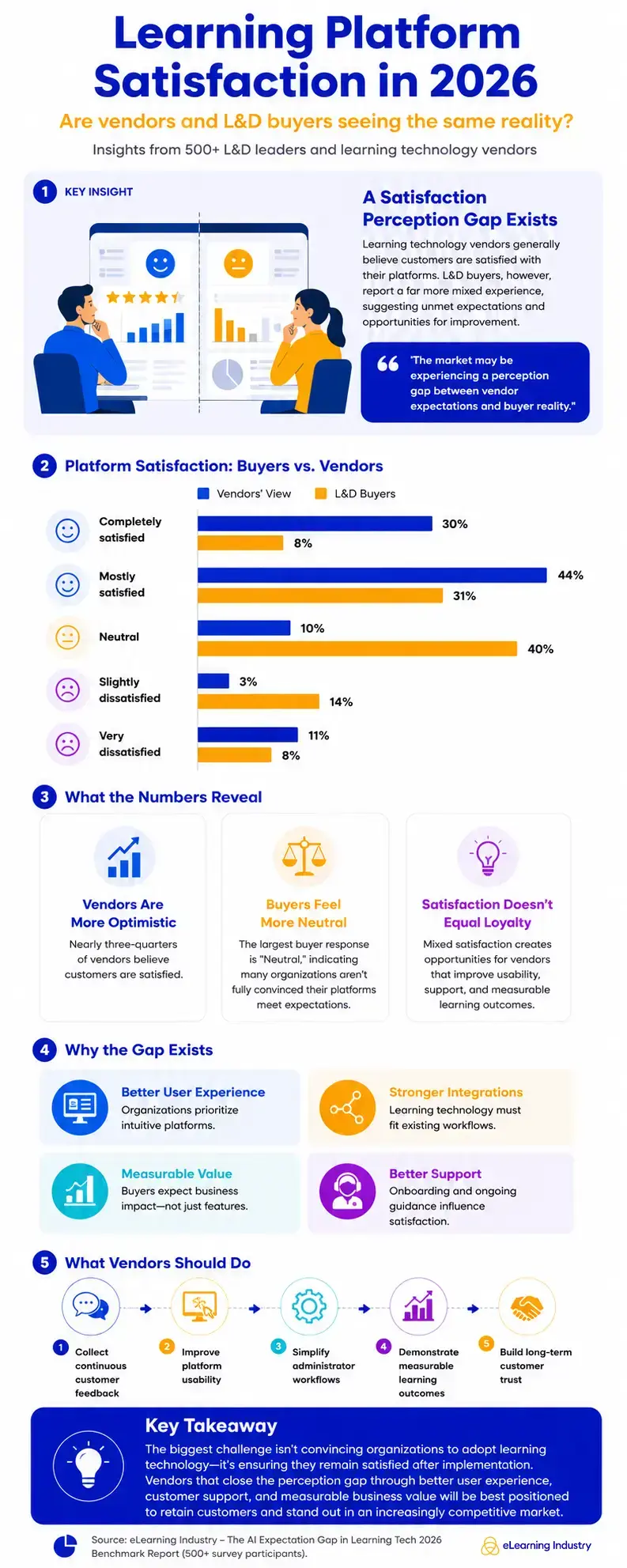
The State of the Market: Bridging the Expectation Gap
According to the 2026 benchmark report from eLearning Industry, which surveyed over 500 Learning and Development (L&D) buyers and technology vendors, there exists a notable "expectation gap" between the tools being developed and the tools being utilized on the ground. For years, the narrative within the EdTech sector has suggested that the LXP—often described as the "Netflix of learning"—would inevitably replace the LMS. However, the data reveals a starkly different picture: 70% of L&D buyers continue to utilize an LMS as their primary learning vehicle. In contrast, only 16% of organizations report using an LXP as a standalone or primary solution.
This discrepancy highlights a significant disconnect. While 31% of vendors are aggressively building and marketing LXP capabilities—leveraging AI-driven content discovery and social learning features—the majority of corporate buyers remain tethered to the functional reliability of the LMS. This suggests that while vendors are looking toward a future of self-directed, decentralized learning, organizational leaders are still prioritizing the immediate operational needs of compliance, tracking, and structured onboarding.
Defining the Divergence: Architecture and Intent
To understand why the market has not shifted as rapidly as predicted, it is essential to distinguish between the two architectures. The Learning Management System (LMS) was born out of the need for administrative control. Its primary functions are to deliver, manage, and track formal training. It is the "system of record" for an organization’s intellectual development, ensuring that employees meet regulatory requirements and that the company can provide an audit trail of completed certifications. The LMS is inherently top-down; administrators assign content, and learners consume it within a rigid framework.
The Learning Experience Platform (LXP), by contrast, is a "system of engagement." It is designed to be learner-centric, focusing on the quality of the user experience and the relevance of the content. Rather than relying solely on assigned courses, an LXP uses algorithms, machine learning, and user-generated content to provide a personalized feed of learning opportunities. If the LMS is a library where the librarian tells you what to read, the LXP is a smart digital bookstore that suggests your next favorite book based on your interests and career goals.
Why the LMS Maintains Dominance in Enterprise Learning
The continued dominance of the LMS is not merely a result of institutional inertia; it is a reflection of the high-stakes nature of corporate compliance. In highly regulated sectors such as healthcare, finance, aerospace, and manufacturing, the ability to prove that an employee has completed specific safety or legal training is not an optional feature—it is a legal necessity.

The 2026 report indicates that "operational fit" and "integration" are the top priorities for L&D buyers. An LMS typically integrates seamlessly with Human Resources Information Systems (HRIS), allowing for automated enrollment based on job titles or departments. When an employee is hired or promoted, the LMS automatically triggers the necessary compliance workflows. For many organizations, the risk of moving away from these structured, automated systems is too great, especially when the alternative (the LXP) often lacks the robust reporting tools required for rigorous auditing.
Furthermore, the LMS has evolved. Modern Learning Management Systems have adopted many of the UI/UX improvements once exclusive to LXPs. By incorporating mobile-first designs, gamification, and better search functionality, the "modern LMS" has effectively closed the gap, providing enough of a "good" experience to satisfy users while maintaining the "necessary" controls for administrators.
The Vendor Bet: Why LXPs Represent the Future
Despite the current reliance on LMS technology, vendors are investing in LXP capabilities at nearly twice the rate of buyer adoption. This forward-looking investment is driven by the changing nature of work. As the half-life of skills continues to shrink, organizations are realizing that compliance training alone is insufficient for maintaining a competitive edge. There is a growing need for "upskilling" and "reskilling"—processes that are better served by the flexible, content-rich environment of an LXP.
Vendors are betting on the "AI Expectation Gap" closing over the next several years. They are building platforms that can analyze an employee’s performance data, identify skill gaps, and automatically suggest micro-learning modules to bridge those gaps. This proactive approach to development is something a traditional, reactive LMS struggles to achieve. The industry’s push toward LXPs is an attempt to solve the engagement crisis; many employees view traditional LMS training as a "chore" to be completed, whereas an LXP aims to make learning an integrated part of the daily workflow.
The Hybrid Approach: Building an Integrated Ecosystem
The most significant trend identified in the 2026 research is the move toward a "connected learning ecosystem" rather than a single-platform solution. Forward-thinking organizations are no longer asking "LMS or LXP?" but are instead asking "How do they work together?"
In this hybrid model, the LMS remains the foundational layer for compliance and mandatory training. It serves as the secure vault for records and certifications. The LXP is then layered on top as an engagement interface, pulling in content from the LMS as well as external sources like LinkedIn Learning, Coursera, or internal subject matter experts. This allows the organization to satisfy the needs of the legal department (via the LMS) while satisfying the needs of the modern learner (via the LXP).
This integrated strategy addresses the primary concerns of L&D leaders: usability and value. By utilizing an LXP for daily skill development, companies see higher engagement rates and better knowledge retention. By maintaining the LMS, they ensure that the business remains protected from a compliance standpoint.
Strategic Implications for L&D Leaders
For organizations currently evaluating their technology stack, the 2026 benchmark report offers several key takeaways. First, the "shiny object syndrome" surrounding AI and LXP features should be tempered by a realistic assessment of the organization’s maturity. If an organization cannot currently track basic compliance, an LXP will not solve its problems; it will likely only add complexity.
Second, the importance of data integration cannot be overstated. The report found that buyers value platforms that talk to their existing software more than they value cutting-edge AI features. A platform that exists in a silo, no matter how advanced its recommendation engine, will ultimately fail to deliver measurable business results if it cannot be linked to performance outcomes.
Finally, the shift toward "learner-led" development requires a cultural change, not just a technological one. An LXP is only effective in an environment where employees are given the time and incentive to pursue self-directed learning. Without a culture that supports development, the most advanced LXP will simply become another expensive, underutilized software subscription.
Conclusion: The Convergence of Management and Experience
As we look toward the remainder of the decade, the distinction between the LMS and the LXP is likely to become increasingly academic. We are entering an era of "Platform Convergence," where the best features of both systems are being merged into unified suites. The "Management" of the LMS is becoming more "Experiential," and the "Experience" of the LXP is becoming more "Manageable."
The future of workplace learning is not a winner-take-all battle between two types of software. Instead, it is the development of a holistic environment that supports the dual needs of the modern corporation: the need for rigorous, verifiable compliance and the need for agile, personalized growth. Organizations that recognize this duality and invest in integrated ecosystems will be the ones best positioned to navigate the complexities of the future workforce, ensuring that their employees are not just "trained," but truly "empowered."






