Manufacturing activity remained stagnant in September, a stark contrast to the significant decline in forecasts by other CEOs. This resilience, however, masks a growing chasm between industrial and consumer-focused manufacturing segments, as highlighted by Chief Executive’s latest CEO Confidence Index. While the manufacturing sector as a whole now edges ahead of its non-manufacturing counterparts in terms of current and future business outlook, this achievement is primarily a result of others’ diminished expectations rather than an acceleration in manufacturing itself.
September Sees Manufacturing Outpace Broader CEO Sentiment
The latest Chief Executive CEO Confidence Index, based on a survey of over 150 U.S. CEOs conducted between September 1st and 3rd, reveals a notable shift in sentiment. Manufacturing CEOs rated current business conditions at an average of 5.8 out of 10, a figure that mirrors August’s high for the year and represents a 9 percent increase from the 5.3 recorded in January. This stability in the manufacturing sector is particularly significant when compared to the non-manufacturing segment. CEOs in non-manufacturing industries saw their confidence in current conditions fall by 6 percent, dropping to 5.7 from 6.1 in the preceding month.
For much of 2026, manufacturing confidence had consistently lagged behind the broader CEO population, averaging 5.6 on current conditions compared to 5.7 for CEOs across all sectors. The September data marks a turning point, with manufacturing not only matching but surpassing the overall average. This development is not attributable to an improvement in manufacturing’s performance, but rather to a significant pullback in sentiment from other sectors, particularly services and retail, which have been more sensitive to shifting economic winds and policy uncertainties.
Future Outlook: Manufacturers Cautiously Optimistic Amidst Broader Uncertainty
Looking ahead, manufacturers have also demonstrated greater resilience, though with a slight moderation in their optimism. Their 12-month outlook eased marginally to 6.0 from 6.1 in August. In contrast, non-manufacturing CEOs experienced a more substantial decline in their forward-looking confidence, falling to 5.8 from 6.1 – the lowest year-ahead reading for this group since March.
This divergence is further underscored by the proportion of CEOs expecting improved conditions over the next 12 months. Forty-seven percent of manufacturers anticipate better economic conditions, an increase from 41 percent in August. This stands in sharp contrast to the 31 percent of non-manufacturers who share this optimistic outlook. This suggests that while manufacturers are tempering their expectations slightly, they remain fundamentally more hopeful about the future trajectory of their businesses and the broader economy compared to their counterparts in other industries.
Drivers of Outlook: Demand vs. Policy
The underlying reasons for these differing outlooks provide crucial insights into the current economic landscape. For manufacturers, "demand" emerges as the primary driver of their future outlook, cited by 51 percent of respondents. This indicates a reliance on the purchasing power of their downstream customers and the overall health of sectors that consume manufactured goods.
Conversely, non-manufacturing CEOs appear to be more heavily influenced by external policy and political factors. Forty-four percent of these CEOs point to policy or politics as a significant influence on their forecasts. This sensitivity to the Beltway environment is particularly pronounced among non-manufacturers who foresee deteriorating conditions, with 59 percent attributing their pessimism to government actions or geopolitical developments. Manufacturers, when anticipating a downturn, tend to spread their concerns across a wider array of factors, including rising costs, geopolitical instability, and demand fluctuations, suggesting a more multifaceted risk assessment.

A Widening Divide: Industrial vs. Consumer Manufacturing
Beneath the aggregate manufacturing figures lies a more complex and concerning trend: a widening split between industrial goods manufacturers and consumer goods producers. Industrial goods manufacturers reported strong current conditions, rating them at 6.0, and projected an even more robust outlook for the year ahead at 6.2. This segment of manufacturing appears to be benefiting from specific demand drivers.
In stark contrast, consumer goods producers are navigating a significantly tougher environment. They rated current conditions at a much lower 5.1 and forecast a modest improvement to 5.5 over the next year. The gap in current conditions between these two sub-sectors widened to 0.9 points in September, up from 0.7 in August, signaling a growing disparity in their operational realities.
Spotlight on Industrial Manufacturing:
The resilience of the industrial manufacturing sector is being fueled by concentrated demand. A CEO of a mid-sized industrial manufacturer in New Jersey pointed to "data centers and general construction pick up" as key drivers of their positive outlook. This suggests that investments in infrastructure, technology, and the ongoing demand for commercial and residential building are providing a significant tailwind for companies producing heavy machinery, components, and raw materials essential for these projects. The expansion of data center capacity, driven by the insatiable appetite for cloud computing and artificial intelligence, represents a powerful, albeit specific, engine of growth.
Challenges for Consumer Goods Manufacturers:
Consumer goods producers, however, are painting a different economic picture. The CEO of a mid-sized consumer manufacturing firm in Michigan, operating as a contract manufacturer for major brands, stated, "All of them are much softer in demand than originally forecasted." This sentiment indicates a broader consumer retrenchment or a shift in purchasing habits, impacting the order books of companies that produce goods ranging from electronics and apparel to household items. This softness in demand can be attributed to a variety of factors, including persistent inflation eroding purchasing power, rising interest rates making financing more expensive for consumers, and a general sense of economic uncertainty leading to more cautious spending.
Cost Pressures and Global Headwinds:
For some manufacturers, particularly in the consumer goods segment, cost pressures are intensifying. The CEO of a small consumer manufacturer in Massachusetts highlighted the impact of geopolitical events on energy prices: "Geopolitics have increased the cost of energy dramatically and is affecting many parts of the business." Fluctuations in global energy markets, often exacerbated by geopolitical tensions, can ripple through the entire supply chain, increasing operational costs for production, transportation, and logistics.
Companies with a significant international footprint are also facing cumulative headwinds. A CEO of a mid-sized industrial manufacturer in North Carolina articulated the multifaceted challenges: "Uncertainty in the marketplace due to [the] Iran war, tariffs, inflation and interest rates continue to cause a drag on our business." This statement encapsulates the complex web of global risks that can impede international trade, increase import and export costs, and dampen overall business confidence. The ongoing conflict in the Middle East, coupled with ongoing trade disputes and persistent inflation, creates a climate of unpredictability that can deter investment and stifle growth for globally exposed businesses.
Economic Outlook Divergence: A Tale of Two Sectors

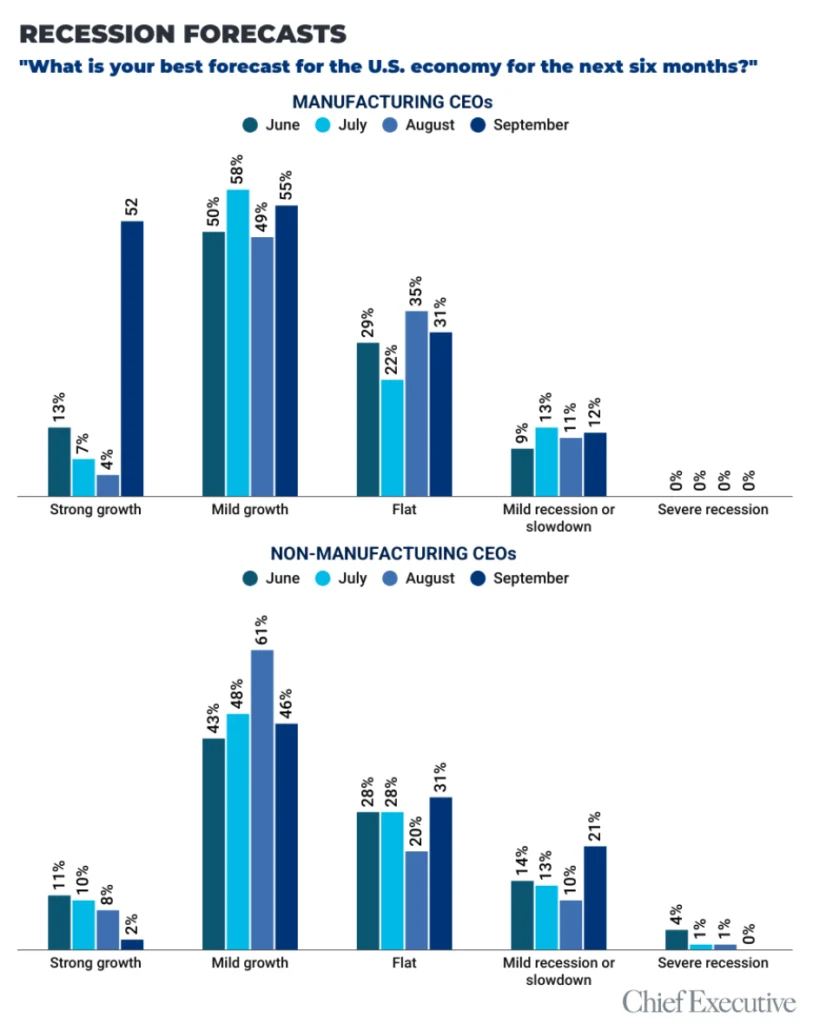
When examining the six-month economic outlook, the divergence between manufacturers and CEOs in other sectors becomes even more pronounced. Fifty-seven percent of manufacturers forecast some form of economic growth, an increase from 54 percent in August, while the proportion expecting flat conditions declined to 31 percent from 35 percent. Notably, recession forecasts remained stable at around 12 percent, with no manufacturer predicting a severe recession for the second consecutive month. This suggests a degree of confidence that, while growth may be modest, a deep downturn is unlikely for the manufacturing sector.
In contrast, non-manufacturers saw a significant reversal of their August optimism. The percentage forecasting growth plummeted from 69 percent to 48 percent. Simultaneously, the share of non-manufacturing CEOs expecting a mild recession or slowdown doubled from 10 percent to 21 percent. This sharp decline in sentiment among non-manufacturers underscores their heightened sensitivity to economic slowdowns and policy shifts.
Shifting Optimism and Rising Cost Expectations
Despite the overall positive trend in manufacturers’ outlook, their prediction of strong growth is thinning. Only 2 percent of manufacturers predict robust economic expansion, down from 4 percent in August, with the vast majority (86 percent) clustering their expectations around mild growth or flat conditions. This suggests a recalibration of ambitions towards more sustainable, albeit less spectacular, growth trajectories.
Concurrently, cost expectations are on the rise within the manufacturing sector. Manufacturers now anticipate headline CPI to average 3.7 percent over the next 12 months, up from 3.5 percent in August. Furthermore, a significant 35 percent of manufacturers expect inflation to run at 4 percent or higher, indicating growing concerns about input costs and their potential impact on profitability. This sustained inflationary pressure, even if moderate, requires manufacturers to carefully manage pricing strategies and operational efficiencies.
International Exposure: A Narrowing Gap
The gap between manufacturers with international operations and those solely focused on the domestic market narrowed in September. Firms with global operations rated current conditions at 5.7, unchanged from August. Domestic-exclusive firms, however, saw their ratings dip from 6.1 to 5.9, reducing the gap from 0.4 points to 0.2. This convergence is not due to an improvement in the performance of internationally exposed firms, but rather a slight decline in the sentiment of domestic-only businesses. Nevertheless, U.S.-only CEOs continue to express greater optimism about the year ahead, forecasting 6.2 compared to 5.9 for their international counterparts, suggesting that domestic demand, while showing signs of cooling, still offers a more predictable environment.
The Year Ahead: Revenue Stable, Profitability Under Pressure
Looking towards the end of the year, manufacturers’ revenue expectations have remained largely consistent with August figures. However, their profit expectations have seen a more significant shift, indicating a growing squeeze on margins. The gap between revenue and profit expectations widened from 7 percentage points in August to 12 percentage points in September. While revenue projections have held steady, there is less anticipation of growing margins.
This tightening profit outlook is reflected in the increased number of manufacturers bracing for declining profits. One in five manufacturers now expects profits to fall this year, a rise from one in six in August. More alarmingly, the proportion anticipating a substantial drop of 20 percent or more has more than doubled, from 4 percent to 10 percent within the same period. A CEO of a large industrial manufacturer in Indiana aptly summarized this concern: "Ability to price will get more scrutiny." This suggests that manufacturers are finding it increasingly difficult to pass on rising costs to their customers, leading to a compression of profit margins.
Hiring and Investment Remain Resilient

Despite the pressures on profitability, the immediate impact has not yet significantly curtailed hiring or investment plans. Capital spending intentions have remained essentially flat, indicating a continued commitment to maintaining and upgrading operational capabilities. Furthermore, the share of manufacturers planning to expand their workforce rose to 49 percent from 45 percent in August. However, it is noteworthy that 39 percent of manufacturers still expect their payrolls to remain unchanged, representing the single largest response, which suggests a cautious approach to significant headcount increases.
Working Capital Under Pressure: A Divergent Strategy
New survey questions this month shed light on manufacturers’ approach to working capital and liquidity management, revealing distinct strategies compared to non-manufacturing sectors. When asked about their primary working capital and liquidity priorities over the next 12 months, inventory reduction emerged as a significant focus for manufacturers. Fifty-six percent of manufacturers are actively working to reduce inventory levels, a much higher proportion than the 21 percent of non-manufacturers undertaking similar initiatives.
Manufacturers are also more inclined to extend supplier payment terms, with 31 percent pursuing this strategy compared to 20 percent of non-manufacturers. This suggests a deliberate effort to optimize cash flow by freeing up capital tied up in inventory and managing outgoing payments.
Conversely, non-manufacturers are prioritizing the buildup of cash reserves, with 57 percent focusing on this objective, compared to 44 percent of manufacturers. This difference in focus highlights the distinct risk profiles and operational demands of each sector.
Trade Policy and Funding Challenges:
For some manufacturers, trade policies have directly translated into liquidity challenges. A CEO of a large industrial manufacturer in Illinois succinctly stated, "Tariffs threatening cash." The imposition of tariffs can increase the cost of imported raw materials or components, while also potentially reducing export competitiveness, both of which can negatively impact cash flow.
Smaller firms, in particular, are reporting limited access to traditional funding sources. The CEO of a small industrial manufacturer in Utah commented on the ongoing difficulties, stating, "Traditional or bank funding for small business is an ongoing issue, as it is simply not available." This lack of accessible financing can exacerbate liquidity pressures and hinder the ability of smaller businesses to invest in growth or navigate economic downturns.
About the CEO Confidence Index:
Since its inception in 2002, Chief Executive Group has been diligently polling hundreds of U.S. CEOs across a diverse range of organizations and industries. This ongoing effort compiles the data for the CEO Confidence Index, a vital barometer that tracks the pulse of business sentiment. The Index measures confidence in both current and future business environments by aggregating CEOs’ observations on various economic and business indicators. For comprehensive details on the Index and access to historical data, readers are encouraged to visit ChiefExecutive.net/category/CEO-Confidence-Index/.