
In the fiercely competitive landscape of modern talent acquisition, the period between a candidate accepting an offer and their first day on the job has emerged as a critical battleground for organizations. Far too often, companies operate without a structured process during this vulnerable phase, learning of a candidate’s decision to renege only after the fact. By the time a promising hire goes silent, their decision is frequently already made, leaving talent teams scrambling to backfill positions and incurring significant costs and operational disruptions. This reactive approach, characterized by a lack of insight into candidate sentiment, stands in stark contrast to the data-driven strategies now being embraced by leading organizations. The fundamental shift required is to view engagement signals not as post-mortem diagnostics, but as crucial leading indicators of a candidate’s commitment and satisfaction.
The Silent Crisis: Understanding Candidate Renege in a Competitive Market
Candidate reneging, or the withdrawal of an accepted offer, is a growing concern for businesses across industries. While precise figures can vary, industry reports from sources like the National Association of Colleges and Employers (NACE) and various HR consulting firms suggest that renege rates can range from 10% to upwards of 20% in certain sectors, particularly for highly sought-after roles in technology, healthcare, and specialized engineering. This phenomenon is exacerbated by a tight labor market where candidates often receive multiple competing offers, coupled with the increasing prevalence of remote work which can sometimes dilute early connections with a new employer.
The implications of a reneged offer extend far beyond the immediate inconvenience of an open headcount. Financially, the costs are substantial. Estimates from organizations like the Society for Human Resource Management (SHRM) indicate that the cost of replacing an employee can be 1.5 to 2 times their annual salary, factoring in recruitment fees, advertising, interviewing, background checks, and onboarding. For a senior role, this could easily amount to hundreds of thousands of dollars. Operationally, reneges lead to project delays, increased workload for existing team members, reduced team morale, and a potential loss of productivity. Furthermore, a high renege rate can damage an employer’s brand reputation, making it harder to attract top talent in the future. The absence of a proactive system means that many organizations are effectively managing this critical period in the dark, only reacting when the negative consequences are unavoidable.
The Paradigm Shift: From Reaction to Proactive Engagement
The solution lies in a strategic pivot from a reactive stance to a proactive, data-informed engagement model. Instead of waiting for a "renege email," successful talent acquisition teams are continuously monitoring candidate engagement, using predictive analytics to identify potential flight risks before they materialize. This approach recognizes that the pre-start period is not a passive waiting game, but an active phase requiring deliberate cultivation of the candidate relationship.
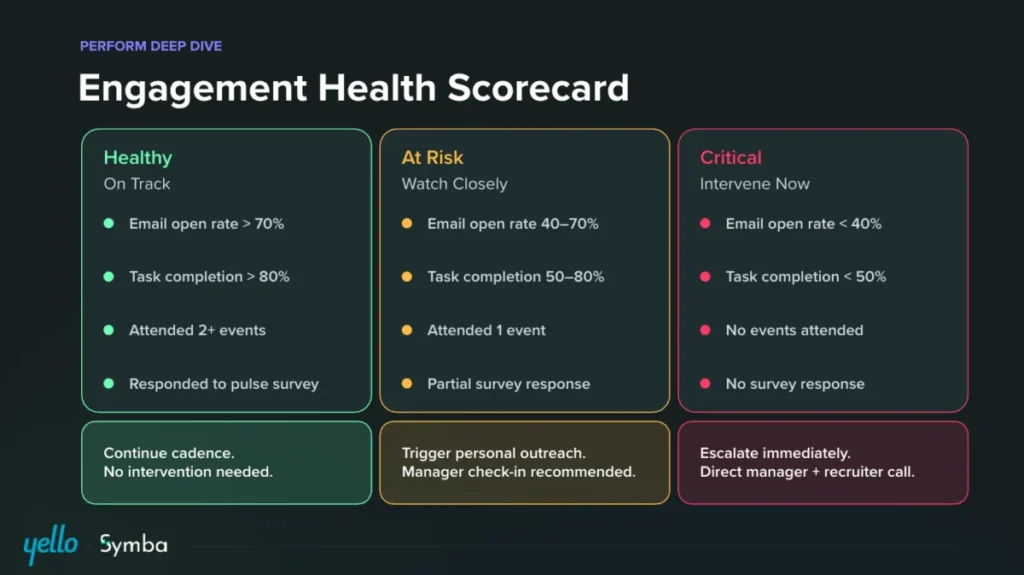
The core of this proactive strategy is the implementation of an "Engagement Health Scorecard." This sophisticated tool categorizes candidates into distinct groups based on their behavior and interaction patterns during the critical pre-start phase, typically spanning from offer acceptance to the onboarding commencement. By establishing clear thresholds and recommended actions for each category, organizations can deploy targeted interventions that address specific levels of engagement, ensuring no candidate slips through the cracks unnoticed.
The Engagement Health Scorecard: A Detailed Framework for Retention
The Engagement Health Scorecard typically segments candidates into three primary tiers: Healthy, At-Risk, and Critical. Each tier is defined by specific behavioral metrics and triggers tailored intervention strategies designed to reinforce commitment and address potential concerns.
1. Healthy Candidates: Sustaining Momentum and Reinforcing Commitment
- Behavioral Indicators: Healthy candidates consistently demonstrate strong engagement. This includes email open rates exceeding 70%, timely completion of pre-boarding tasks (e.g., background checks, paperwork), active participation in multiple pre-start events (virtual meet-and-greets, informational webinars), and prompt, thorough responses to surveys designed to gauge their sentiment and readiness. Their activity levels indicate a clear enthusiasm for joining the organization.
- Strategic Rationale: These candidates are enthusiastic and aligned, but their engagement still needs to be nurtured. The goal is to maintain this positive momentum and continue building their connection to the company culture and their future team. This phase is crucial for preventing any unforeseen doubts from creeping in.
- Recommended Actions: For healthy candidates, the primary action is to "continue the cadence and stay the course." This involves maintaining a consistent schedule of informative communications, sharing exciting company updates, providing access to resources that deepen their understanding of their role and the company, and ensuring a seamless experience with any administrative tasks. This steady stream of positive engagement reinforces their decision and fosters a sense of belonging even before their official start date. Personalized welcome messages from future colleagues, invitations to informal online coffee chats, or even sharing relevant industry news can further cement their connection. The aim is to make them feel valued and excited, ensuring their initial enthusiasm translates into long-term commitment.
2. At-Risk Candidates: Early Intervention for Shifting Dynamics
- Behavioral Indicators: At-Risk candidates exhibit declining engagement signals. Their email open rates typically fall within the 40-70% range, indicating a potential decrease in interest or a growing distraction. They might show limited attendance at pre-start events, complete survey responses partially or late, or exhibit general inactivity in areas where healthy candidates are actively participating. These subtle shifts are red flags that warrant immediate attention.
- Strategic Rationale: This category represents a critical juncture. The candidate’s commitment is wavering, but often not yet solidified towards a renege. Prompt and personal intervention at this stage can often turn the situation around, addressing underlying concerns before they escalate. The key is to demonstrate that the organization notices and cares about their individual journey.
- Recommended Actions: At-Risk candidates require personalized outreach within 48 hours of being identified. A direct message from the program manager, recruiter, or even a future team member, explicitly referencing their observed engagement patterns (e.g., "noticed you missed our last webinar, wanted to check in"), can be highly effective. This outreach should feel individual and empathetic, rather than a generic mass communication. Offering a personalized invitation to the next event, perhaps with a specific colleague they’d enjoy meeting, or a one-on-one virtual coffee chat, can re-engage them. Crucially, a proactive check-in from the hiring manager is often a powerful intervention. This direct, personal touch from their future leader can reconfirm the value of the role, address any nascent concerns, and reinforce the human connection that might be diminishing. Often, a brief conversation can uncover simple misunderstandings or minor anxieties that, if left unaddressed, could lead to a full renege.
3. Critical Candidates: Immediate Escalation and Direct Dialogue
- Behavioral Indicators: Critical candidates display almost no engagement whatsoever. Their email open rates plummet below 40%, they show no attendance at any pre-start events, provide no survey responses, and have exhibited no activity for three or more weeks. This severe disengagement signals a high probability of a renege, or that the decision has already been made.
- Strategic Rationale: This is the highest alert level. While the chances of retention are lower, immediate and direct intervention is still essential. The goal is to understand the root cause of the disengagement and, if possible, salvage the situation. Even if the candidate ultimately reneges, understanding why provides valuable feedback for improving future processes.
- Recommended Actions: Critical candidates demand immediate escalation. The most impactful action is a direct call from the hiring manager. This isn’t a casual check-in; it’s a serious conversation aimed at understanding "what’s going on." The hiring manager’s direct involvement underscores the organization’s commitment and the importance of the candidate to the team. Simultaneously, the recruiter should initiate a personal touchpoint, leveraging their existing relationship to create a safe space for the candidate to express their concerns. Common root causes at this stage include a competing offer that has reached an advanced stage, a significant personal circumstance (e.g., family illness, relocation issues), or profound uncertainty about the role or company culture. Catching these issues in time, even at this late stage, can still allow for negotiation, problem-solving, or reassurance that might prevent a complete loss. For example, if it’s a competing offer, the organization might have an opportunity to make a counter-offer or highlight unique benefits. If it’s a personal circumstance, flexibility or support might be offered. The key is to open a direct, honest dialogue.
The Strategic Imperative: Data-Driven Talent Acquisition
The fundamental difference between organizations that successfully retain candidates and those that are perpetually scrambling to backfill positions lies in their approach to data. The first group views data continuously, integrating insights from the Engagement Health Scorecard into their talent acquisition strategy in real-time. They are not merely reacting when a renege email arrives; they are proactively managing the entire candidate journey.
This data-driven approach is increasingly facilitated by advanced talent acquisition technologies, including Applicant Tracking Systems (ATS) integrated with Candidate Relationship Management (CRM) platforms. These systems can automate the tracking of engagement metrics, flag candidates entering "At-Risk" or "Critical" categories, and even suggest appropriate interventions based on predefined playbooks. This technological backbone transforms pre-boarding from an administrative chore into a strategic retention function.
Beyond simply preventing reneges, a robust engagement program yields numerous benefits. It significantly enhances the candidate experience, fostering a positive perception of the employer brand. Candidates who feel valued and supported from offer acceptance onwards are more likely to become productive employees faster and to advocate for the company. It also contributes to stronger internal alignment between recruiting teams, hiring managers, and HR, as everyone plays a defined role in candidate nurturing.
Implementation and Continuous Improvement: The Playbook for Success
Implementing an effective Engagement Health Scorecard requires more than just defining tiers; it necessitates a comprehensive system. Resources like "The KEEP Playbook" (as referenced in the original context) illustrate the components of such a system:
- Full Engagement Health Scorecard with Thresholds: Clearly defined metrics and the specific cut-off points for each tier.
- Step-by-Step Intervention Playbook: Detailed scripts, templates, and protocols for each recommended action, ensuring consistency and effectiveness across the talent team. This includes guidance on what to say, who should say it, and when.
- Post-Cycle Review Template: A structured process for analyzing program performance after each hiring cycle. This template allows organizations to review renege rates, identify common causes, assess the effectiveness of different interventions, and refine their scorecard thresholds and action plans. This iterative process of review and refinement is crucial for continuous improvement and adapting to evolving market conditions.
Broader Implications for Organizational Success
The adoption of proactive candidate engagement strategies, epitomized by the Engagement Health Scorecard, represents a fundamental shift in how organizations approach talent management. It elevates pre-boarding from a logistical task to a strategic imperative directly impacting business outcomes. By minimizing renege rates, companies reduce recruitment costs, improve operational efficiency, and accelerate time-to-productivity for new hires. More importantly, it strengthens the employer brand, positioning the organization as one that truly values its people from the very first interaction.
In an era where talent is a primary differentiator, the ability to effectively attract, engage, and retain top candidates is paramount. Companies that invest in sophisticated, data-driven pre-boarding programs are not merely solving an immediate problem; they are building resilient talent pipelines, fostering a superior candidate experience, and ultimately securing a competitive advantage in the global race for talent. The future of talent acquisition is proactive, personalized, and powered by intelligent engagement.






