The modern talent acquisition landscape presents a significant paradox for organizations with 1,000 to 5,000 employees. These companies, often experiencing growth rates that rival larger enterprises, are frequently constrained by talent acquisition teams that cannot scale proportionally. This creates a critical bottleneck, commonly referred to as the "human scale ceiling," where the sheer volume of applications and open requisitions overwhelms existing resources. This challenge is precisely what advanced AI interviewing solutions aim to address, moving beyond simple time-saving to become genuine capacity multipliers.
The typical Thursday afternoon for a talent acquisition professional in this segment might look like this: a queue of 200 applications, 15 open requisitions, and a critical hiring manager sync scheduled in three hours. To compound the pressure, a top candidate may have just accepted an offer elsewhere while the team was still in the process of scheduling a preliminary screening. This scenario highlights the acute need for tools that can efficiently manage high-volume hiring without compromising the quality of the candidate experience or the rigor of the evaluation process.
The AI Interviewer Landscape: Categorizing Solutions and Their Limitations
Not all AI interviewing tools are created equal, and their effectiveness is heavily dependent on the specific hiring context. Understanding the different categories of AI interviewers is crucial for organizations seeking to optimize their recruitment processes. Four primary categories emerge, each with its own strengths and weaknesses when applied to the unique demands of mid-market companies:
-
Live/Conversational AI Interviewers: These tools are best suited for high-volume roles in sectors like retail, healthcare, and manufacturing, where rapid candidate engagement and speed are paramount. Their primary limitation for larger organizations lies in the variability of skills assessment depth and bias audit documentation across different providers. This can create compliance exposure for companies that require robust, legally sound AI interviewing at scale. Implementation is typically straightforward, often taking weeks with minimal IT involvement.
-
One-Way Asynchronous Video Interview Tools: These platforms cater to early interview stages, allowing hiring managers to review recorded candidate responses at their convenience. A significant drawback for scaling organizations is the potential for lower candidate completion rates without real-time interaction. Furthermore, some tools incorporate facial expression or tone analysis, raising compliance concerns for organizations prioritizing AI interviewing without biometric analysis. While setup is generally low, limited Applicant Tracking System (ATS) integration can lead to manual follow-up work for lean talent teams.
-
Coding and Technical Assessment Platforms: These specialized tools are designed for software engineering and IT roles, focusing on demonstrable technical skills rather than resume credentials alone. Their inherent limitation is their narrow scope; organizations still require separate solutions for non-technical positions, adding vendor contracts and coordination overhead. Implementation is moderate, requiring role-specific configuration and a separate contract that often sits alongside existing hiring tools rather than integrating seamlessly.
-
All-in-One Enterprise Suites on Large HCM Stacks: These comprehensive solutions are typically aimed at very large organizations with dedicated IT departments and substantial, multi-year transformation budgets. For mid-market companies, AI interviewing within these suites often functions as a secondary module rather than a purpose-built capability. Integration cycles can extend beyond what mid-market buying committees realistically have the bandwidth for, demanding significant involvement from system integrators and sustained internal project resources.
The Measurable Impact of Eightfold AI Interviewer: Built for Volume, Sized for Teams
Eightfold AI Interviewer distinguishes itself by being designed from the ground up as an AI-Native Talent Intelligence solution, with its AI Interviewer functioning as a core component rather than an add-on module. The platform aims to set a new standard, offering what it terms the "nine o’clock interview" for every candidate – a consistent, rigorous, and unbiased evaluation conducted around the clock.
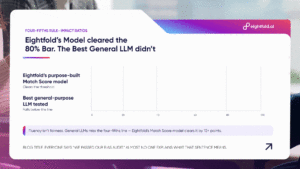
For organizations with 1,000 to 5,000 employees, this translates into tangible benefits. Early customer deployments have indicated a dramatic reduction in time-to-hire, compressing it from an average of 42 days to as little as 5 days. Unlike generalized AI tools, Eightfold’s AI Interviewer is trained on domain intelligence derived from over a billion career profiles. This extensive dataset allows it to identify adjacent skills and latent potential that traditional keyword matching and resume parsing often miss, a capability Eightfold terms "Sees What Others Miss." This sophisticated understanding of candidate capabilities ensures that the right individuals are identified for roles, not just those who best match resume keywords. The platform’s ability to learn from every hiring decision and immediately apply that learning compounds its execution efficiency over time.
A cornerstone of the Eightfold AI Interviewer’s design is its human-in-the-loop approach. While the AI conducts, evaluates, and summarizes interviews based on demonstrated skills, human talent teams retain ultimate authority over advancement decisions. This deliberate design ensures that AI acts as an intelligent assistant, providing comprehensive insights while human recruiters make the final calls. Crucially, the platform focuses solely on interview content, eschewing facial recognition, biometric data, or appearance-based signals. This commitment to content-only evaluation makes compliance-safe AI interviewing achievable without introducing additional legal exposure, a significant concern for organizations navigating evolving privacy regulations. This approach has been observed to enhance candidate satisfaction, a critical factor for companies competing on more than just compensation.
Expanding Capabilities for Specialized Hiring Needs
The functional scope of Eightfold AI Interviewer extends beyond general roles. Specialized coding and functional interview capabilities are integrated to support technical, healthcare, legal, and industrial hiring. Furthermore, built-in anti-fraud and identity verification features provide added assurance, particularly for high-volume or distributed positions.
For talent leaders concerned about compliance in 2026 and beyond, Eightfold AI Interviewer holds key certifications, including SOC 2, ISO 27001, and ISO 42001. These attestations provide documented evidence of robust security controls and AI governance standards, which are increasingly scrutinized by regulatory bodies and internal legal teams. The "Mid-Market AI Hiring Playbook" offers further guidance on how organizations of this size are leveraging these advanced capabilities.
Compliance, Bias Mitigation, and a Practical Framework for Responsible AI
A central tenet of Eightfold’s approach is a commitment to responsible AI. This is demonstrated through a focus on compliance-trained processes and bias removal as foundational elements, not mere features. The platform’s certifications, including SOC 2, ISO 27001, and ISO 42001, offer talent teams concrete documentation to present during vendor approval cycles, addressing concerns from legal, IT security, and procurement departments.
Organizations seeking to implement AI interviewing solutions must ask critical questions to differentiate genuine capability from marketing claims. For companies in the 1,000 to 5,000 employee range, these questions should focus on specific requirements that align with their operational realities:
- Compliance and Bias Mitigation: Does the AI interviewer provide documented variance data for bias audits, and does it hold recognized certifications like SOC 2, ISO 27001, and ISO 42001? A clear policy against biometric or tone analysis is essential to mitigate regulatory exposure.
- Human Oversight and Control: How does the AI ensure that human recruiters remain in control of hiring decisions? The AI should provide structured interviews and insights, with advancement decisions always resting with human reviewers.
- Candidate Experience and Satisfaction: What documented candidate satisfaction data or Net Promoter Score (NPS) can the vendor provide, especially at similar hiring volumes? Structured, skills-based interviews can enhance, rather than degrade, the candidate experience.
- Integration and Implementation Speed: How quickly can the AI interviewer be implemented for an organization of this size? Purpose-built solutions typically launch in weeks, contrasting with the multi-year integration cycles of modules within large HCM suites.
- Specialized Role Support: Can the AI interviewer support specialized technical and clinical hiring, or is it limited to general roles? A single platform supporting diverse interview formats can standardize processes and reduce vendor complexity.
Addressing Key Concerns: An FAQ for Talent Leaders
How does an AI interviewer keep humans in control of hiring decisions?
The AI conducts structured interviews and provides synthesized insights on candidate responses. However, the ultimate authority for advancement decisions remains with human reviewers. The AI acts as a capacity multiplier, freeing up recruiting teams to focus on strategic decision-making.
How is bias measured and controlled in AI interviewing?
Responsible platforms publish bias-audit results that demonstrate documented variance data. The most equitable systems avoid facial-expression and tone analysis, as these can introduce subjective variables that compromise fair assessment.
How quickly can we implement an AI interviewer for an organization of 1,000 to 5,000 employees?
Purpose-built AI interviewers designed for mid-market organizations are typically operational within weeks. This timeline stands in stark contrast to the multi-year integration cycles often required for AI modules layered onto extensive HCM systems.
How do we protect the candidate experience when using AI interviewing?
Published candidate satisfaction data, such as NPS scores, offers the clearest measure of impact. Structured, skills-based interviews can actually improve the candidate experience by providing clarity and fairness. Vendors should be able to provide documented satisfaction data.
How does identity verification work in AI interviewing without facial-expression or tone analysis?
Identity verification features confirm candidate authenticity through methods like document validation and behavioral signals, rather than relying on facial recognition or vocal-tone scoring. This approach aligns with compliance-safe AI interviewing practices and protects applicant privacy by limiting exposure to emerging biometric data regulations.
What compliance certifications should an AI interviewer hold for mid-size organizations in 2026?
For mid-size organizations, an AI interviewer should possess at least SOC 2, ISO 27001, and ISO 42001 certifications. ISO 42001 is particularly significant as it specifically addresses AI management systems. These certifications provide documented evidence for legal, IT security, and procurement reviews. Organizations in regulated industries should verify vendor certifications against their specific regulatory requirements.
Is AI interviewing legally compliant for organizations across the United States in 2026?
AI interviewing is legally compliant when platforms avoid biometric and paralinguistic inference, maintain documented bias-audit results, and ensure human reviewers hold authority over advancement decisions. Jurisdictions like Illinois, New York City, and Maryland have implemented or proposed specific regulations, making compliance dependent on tool configuration and vendor claims. Platforms that offer documented bias-audit results, candidate disclosures, and accommodation pathways provide a stronger legal foundation. Adherence to certifications like SOC 2 and ISO 42001, alongside local regulatory requirements, is crucial. Eightfold’s "compliance trained. bias removed" approach, characterized by no biometric inference and human-in-the-loop decision-making, forms the bedrock of its compliance strategy.
How does an AI interviewer handle high-volume seasonal hiring spikes without adding recruiter headcount?
A purpose-built AI interviewer can absorb seasonal volume surges by conducting concurrent interviews around the clock, without increasing coordination burdens on recruiters. This is particularly vital in sectors like retail, manufacturing, and logistics where demand can fluctuate significantly. Unlike staffing agency models, an AI interviewer maintains a consistent cost structure regardless of volume. Key verification points include assessing concurrent interview capacity and ensuring consistent candidate response times during peak loads.
What is the difference between AI interviewing and AI interview proctoring tools?
AI interviewing tools conduct structured, skills-based conversations to generate insights for human reviewers, serving as a capacity multiplier. AI interview proctoring tools, conversely, monitor candidates during assessments for signs of dishonesty using behavioral or biometric signals like eye-tracking or tone analysis. These two categories address different needs and carry distinct compliance risks. AI interviewing platforms that verify identity through document validation rather than biometric inference present significantly lower regulatory risk compared to proctoring tools relying on paralinguistic or facial analysis.
Can an AI interviewer support specialized technical and clinical hiring, or is it limited to general roles?
Modern AI interviewers extend beyond general roles when they incorporate specialized interview formats. For example, Eightfold’s AI Interviewer includes coding and functional interview capabilities for technical, healthcare, legal, and industrial roles. This is critical for mid-size organizations hiring across diverse functions, as relying on separate vendors for specialized assessments adds integration complexity and candidate friction. A single platform supporting both general and specialized formats allows for process standardization, reduced vendor count, and consistent bias-audit governance.
The Human Element Amplified: The Future of AI in Hiring
Ultimately, successful enterprise-scale hiring is not merely about processing resumes faster; it’s about empowering recruiters to focus on people rather than administrative tasks. A purpose-built AI interviewer fundamentally alters this dynamic by conducting skills-based conversations across multiple languages at any hour, thereby equipping lean talent teams with the capacity to manage enterprise-level hiring volumes without increasing headcount. The crucial aspect remains that every advancement decision rests with a human reviewer, with AI providing the necessary insights.
This foundation of being "compliance trained" and "bias removed" is not an optional feature but a core principle. As organizations face increasing scrutiny over automated tools’ interactions with candidates, this standard is becoming paramount. Meeting the specific requirements of an AI interviewer for organizations with 1,000 to 5,000 employees transcends mere speed. Fairness, an exceptional candidate experience, and the deliberate exclusion of biometric or tone analysis are critical determinants of whether an AI interviewing program builds trust or erodes it. Organizations that successfully implement these principles not only fill roles more efficiently but also cultivate a reputation as employers where candidates feel respected from their very first interaction.
For organizations looking to understand how these capabilities can be applied to their specific roles, hiring volumes, and objectives, a live demonstration of Eightfold AI Interviewer offers a practical pathway to explore its potential.