The conversation surrounding Artificial Intelligence (AI) and hiring bias often gets distilled to a binary outcome: "passed" or "didn’t pass." However, this simplistic view overlooks the intricate methodologies and nuanced interpretations essential for a genuine understanding of AI fairness in recruitment. Audits, the primary mechanism for assessing this fairness, examine specific systems, candidate populations, and timeframes, yielding conclusions relevant only to those defined parameters, not universal pronouncements on every role or future deployment. The legal groundwork for such evaluations predates AI itself, with the Uniform Guidelines on Employee Selection Procedures, established in 1978, providing the foundational "four-fifths rule" that remains a cornerstone of current bias auditing practices.
The Multifaceted Nature of Bias: Why One Test Doesn’t Fit All
A critical aspect often missed is that not all disparities in hiring outcomes are the same problem, and a comprehensive audit must differentiate between them. Treating various forms of bias as interchangeable can lead to misdiagnosis and ineffective remediation. Effective audits categorize and test for specific types of bias, recognizing that a test designed to detect one form may be entirely ineffective against another. This inherent complexity explains why a single, aggregated score rarely encapsulates the full story of an AI hiring tool’s fairness.
The following table illustrates the distinct types of bias, their common manifestations in hiring processes, and the specific testing methodologies employed to detect them:
| Bias Type | Where It Manifests | The Test That Catches It |
|---|---|---|
| Historical/Representation | Underrepresentation of certain career paths in training data | Comparison of subgroup coverage against outcomes |
| Proxy-Variable | Indirect correlation between protected traits and data points (e.g., ZIP code, school, career gaps) | Proxy analysis coupled with counterfactual pairs |
| Aggregation | Overall average masking significant subgroup-level disparities | Reporting disaggregated results, not blended averages |
| Interaction/Automation | Over-reliance on AI output without critical human review | Review of override rates and advancement patterns |
This categorization underscores why a singular headline number from an audit is insufficient. A test calibrated to identify historical underrepresentation, for instance, may fail to detect bias introduced through proxy variables or aggregation issues. Understanding these distinctions is paramount for stakeholders seeking to implement and trust AI in their hiring workflows.
The Four-Fifths Rule: The Mathematical Backbone of Bias Auditing
At its core, the four-fifths rule is a straightforward arithmetic calculation. It involves comparing the "selection rate" – the proportion of candidates from a specific group who advance to the next stage of the hiring process – against the selection rate of the group with the highest advancement rate. If any subgroup’s selection rate falls below 80% of the highest rate, the disparity is flagged as potential adverse impact, triggering further scrutiny.
To illustrate with a concrete example: if 50% of male applicants advance to the interview stage, and only 30% of female applicants do, women’s advancement rate is 60% of the men’s rate (30% / 50% = 0.60). This 60% is well below the 80% threshold, indicating a potential adverse impact that warrants investigation. It is crucial to note that the four-fifths rule identifies the existence of a statistically significant gap but does not, by itself, explain its cause.
Companies like Eightfold.ai, a leader in AI-powered talent intelligence, utilize this rule as a foundational element of their bias audit processes. Their methodology, which is transparently published, details how this comparison is conducted across various protected categories. The emphasis is on presenting the underlying data and methodologies, rather than relying on isolated headline figures, to provide a robust picture of fairness.
Beyond Simple Comparison: Counterfactual Pairs for Algorithmic Accountability
While the four-fifths rule effectively identifies disparities, it doesn’t definitively pinpoint whether the AI algorithm itself is the source of the bias or if the observed gap is a reflection of the applicant pool’s composition at a given time. To address this, a second, distinct testing methodology is required: counterfactual pairing.
This technique involves creating two identical candidate profiles, differing only in a characteristic linked to a protected trait (e.g., a gender-associated name). Both versions are then processed by the AI system. If the evaluation or recommendation changes despite identical qualifications, it isolates the algorithm’s inherent influence on the outcome, independent of applicant pool demographics.
A truly rigorous audit will not perform this test in isolation but will replicate it extensively across various roles, seniority levels, and demographic signals. The aggregate results of these repeated comparisons provide a more definitive measure of the algorithm’s impact. This approach moves beyond metaphorical "black box" analysis to a specific, repeatable procedure yielding quantifiable results. Audits that omit this counterfactual testing only address half of the fairness equation.
The Critical Role of Sample Size in Audit Validity
The statistical significance of any bias audit is heavily dependent on sample size. Small applicant pools for specific demographic groups can dramatically distort advancement rates, making a single candidate’s outcome appear statistically significant when it is not. For instance, if only six candidates from a particular demographic apply for a role, the advancement of just one individual could shift the group’s entire advancement rate by 15-20 percentage points, creating a misleading impression of impact.

Consequently, robust audits establish minimum sample size thresholds. Below these thresholds, a rate for a particular group will not be published. While this may appear evasive to those unfamiliar with the statistical underpinnings, it is a more honest approach than presenting a seemingly precise statistic derived from insufficient data. Publishing a number only when the sample size can reliably support the claim, and clearly stating when it cannot, demonstrates a commitment to statistical integrity over superficial presentation.
Distinguishing Independent Audits: Practice vs. Paper
The term "independently audited" is frequently used, often loosely. True independence in this context requires adherence to three conditions:
- No Contingent Fees: The auditor’s compensation should not be tied to achieving a favorable outcome for the vendor.
- Independent Methodology Design: The auditor should develop its own testing methodology, rather than merely executing a pre-written script provided by the AI vendor.
- Auditor Certification: The auditing entity itself should be certified by a recognized body that scrutinizes auditors, not just their reports. This third condition is often overlooked and is difficult for external parties to verify without explicit disclosure of the auditor’s credentials.
Furthermore, a single audit of a resume-matching model, for example, cannot be extrapolated to validate the fairness of a distinct tool, such as a conversational AI used for interviews. These tools perform fundamentally different functions and require their own independent audits.
Seven Steps to Transform Claims into Verifiable Evidence
Transforming a claim of AI fairness into verifiable evidence requires a structured, traceable process. Each conclusion must be supported by a clear record. The seven essential steps include:
- Clear Definition of the System Under Review: Precisely identifying the AI tool, its specific function, and the scope of its application.
- Selection of Relevant Protected Characteristics: Identifying all legally protected categories and other relevant demographic groups for analysis.
- Specification of the Audit Methodology: Detailing the statistical tests, algorithms, and data analysis techniques to be employed.
- Definition of the Candidate Population and Timeframe: Clearly outlining the specific applicant pool and the period over which the audit is conducted.
- Execution of the Testing Protocol: Systematically applying the defined methodology to the specified data.
- Analysis and Interpretation of Results: Rigorously examining the data to identify any adverse impacts or disparities.
- Documentation and Reporting: Producing a comprehensive report that includes the methodology, data, findings, and limitations of the audit.
Functionally distinct AI tools necessitate separate audits following this comprehensive process. A description of how a system is designed to work, while informative, is not a substitute for empirical testing of its outcomes. Similarly, a table of results lacking a clear methodology is merely a claim, not evidence of fairness.
Purpose-Built Models Versus General LLMs: A Comparative Lens on Bias
When evaluating AI bias, it’s critical to distinguish between purpose-built hiring models and general-purpose Large Language Models (LLMs). While LLMs are increasingly capable, their design objectives differ significantly from those of AI systems specifically engineered for talent acquisition. General LLMs are often trained to achieve fluency and broad contextual understanding, not necessarily to optimize for fairness in a recruitment context.
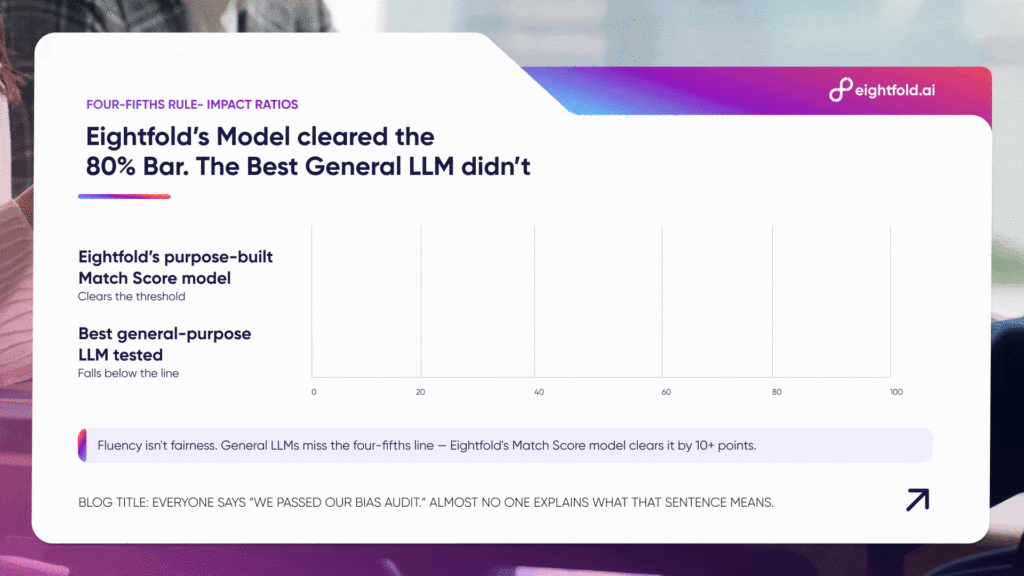
Internal research conducted by Eightfold.ai, for instance, has shown that while their purpose-built matching model achieved an intersectional impact ratio of 0.906, a leading general-purpose LLM scored only 0.773 on the same metric. This disparity suggests that models trained primarily for conversational fluency may exhibit structural under-scoring issues, not just occasional errors, when applied to hiring tasks. It is vital to differentiate between such internal research findings and formal, third-party published bias audits when assessing AI tool performance.
A Passing Result: A Snapshot in Time, Not a Permanent Certification
The outcome of an AI bias audit is not a static certification of perpetual fairness. AI models are dynamic systems, constantly interacting with evolving data and candidate pools. A model trained on historical data, when applied to a contemporary applicant pool that differs in composition, effectively becomes a "different system in practice," even if the underlying code remains unchanged.
This reality necessitates ongoing re-evaluation. Regulations like New York City’s Local Law 144 mandate annual audits, recognizing that a single audit at launch is insufficient to guarantee ongoing fairness. An audit without a defined re-testing schedule provides only a historical snapshot, accurate for its moment but silent on future performance.
Accountability Framework: Defining Roles in Post-Audit Responsibilities
Publishing audit results does not absolve individuals or organizations of responsibility; rather, it clarifies it. A credible governance model explicitly defines roles and their respective accountabilities:
| Role | Owns | Cannot Do |
|---|---|---|
| Independent Auditor | Testing and documented findings | Set fees contingent on the result |
| Talent & Product Leaders | Workflow context and the tested version of the AI | Shape or approve their own results |
| Legal & Compliance | Disclosure review, regulatory exposure | Alter the underlying findings |
| Executives | Funding remediation and oversight | Condition fees on favorable outcomes |
Ultimately, human decision-makers remain accountable for all material hiring decisions, irrespective of AI recommendations. A favorable audit result serves as evidence supporting human judgment, not a replacement for it.
Unanswered Questions: Beyond the Audit Report
Understanding the rigorous methodology behind AI bias audits empowers stakeholders to critically evaluate published findings. However, it doesn’t provide a roadmap for dealing with vendors who have not published such audits, nor does it detail the specific questions that can differentiate genuine answers from evasive deflections during vendor evaluations. Identifying red flags before signing a contract requires a separate, but equally critical, checklist. This vendor evaluation process, distinct from the audit methodology itself, is the next crucial step for organizations seeking to responsibly integrate AI into their hiring practices.