Cal Farley’s Boys Ranch, a venerable institution dedicated to transforming the lives of at-risk youth, has significantly optimized its recruitment operations through the strategic adoption of Workable, an advanced applicant tracking system. This pivotal shift has enabled the organization to complete 81 hires in 2025, dramatically reduce its time-to-hire to an average of one to two weeks for crucial roles, and efficiently manage an exceptionally high volume of applications with a lean four-person recruiting team. The technological integration has not only streamlined internal processes but has also directly bolstered the Ranch’s capacity to deliver essential care and stability to the children it serves, underscoring the profound impact of efficient human capital management on mission-driven non-profit organizations.
Understanding Cal Farley’s Boys Ranch: A Unique Mission and Environment
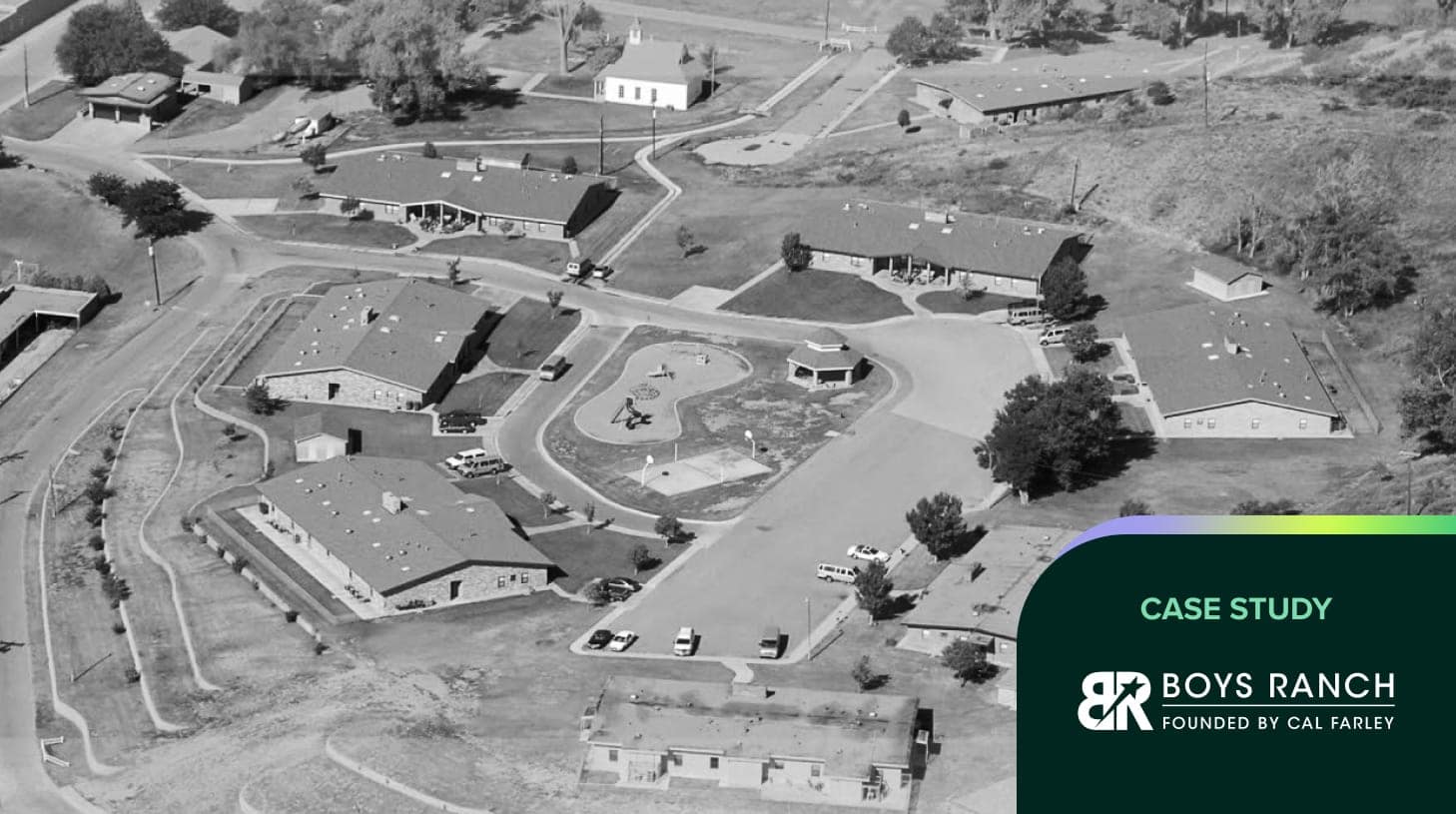
For over 85 years, Cal Farley’s Boys Ranch has stood as a beacon of hope, providing a safe and nurturing environment for young individuals in need. Located approximately 35 miles northwest of Amarillo, Texas, the organization operates a sprawling residential campus that staff affectionately describe as "its own little city." This unique community provides comprehensive care for at-risk and displaced youth aged 5 to 18, encompassing living facilities, accredited schooling, therapeutic services, and a stable, structured upbringing. Currently, the Ranch serves approximately 150 residents and employs a dedicated team of around 330 staff members across its extensive campus and a satellite office in downtown Amarillo. Beyond the physical confines of the Ranch, its commitment extends to supporting families and alumni, fostering long-term positive outcomes. The mission of Cal Farley’s is inherently people-centric, making the recruitment and retention of highly qualified, compassionate staff paramount to its success and the well-being of the children in its care.
The Pre-Workable Era: Navigating Complex Hiring Challenges
Prior to the implementation of Workable, the recruitment landscape at Cal Farley’s Boys Ranch was characterized by a unique set of complexities and operational bottlenecks. The organization’s diverse staffing needs spanned a wide array of functions, from direct care roles such as house parents and youth care workers to essential operational and administrative positions like daycare staff and gift processors. Each role carried distinct requirements, with the "house parent" position standing out as particularly mission-critical. These individuals are responsible for providing round-the-clock supervision, mentorship, and a family-like environment for residents, often requiring them to relocate directly to the ranch. This specific demand, coupled with the necessity for exceptional personal and professional attributes, made identifying genuinely suitable candidates a significant challenge.
The inherent sensitivity and responsibility of working with vulnerable youth also necessitated an exhaustive and multi-stage hiring process. Once a candidate received a conditional offer, extensive background checks, including criminal history, child abuse registries, and personal references, added considerable time to the overall timeline. This meticulous vetting, while absolutely essential, prolonged the hiring cycle, creating a delicate balance between due diligence and the urgent need to fill critical vacancies.
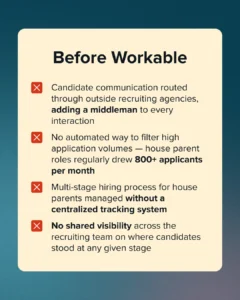
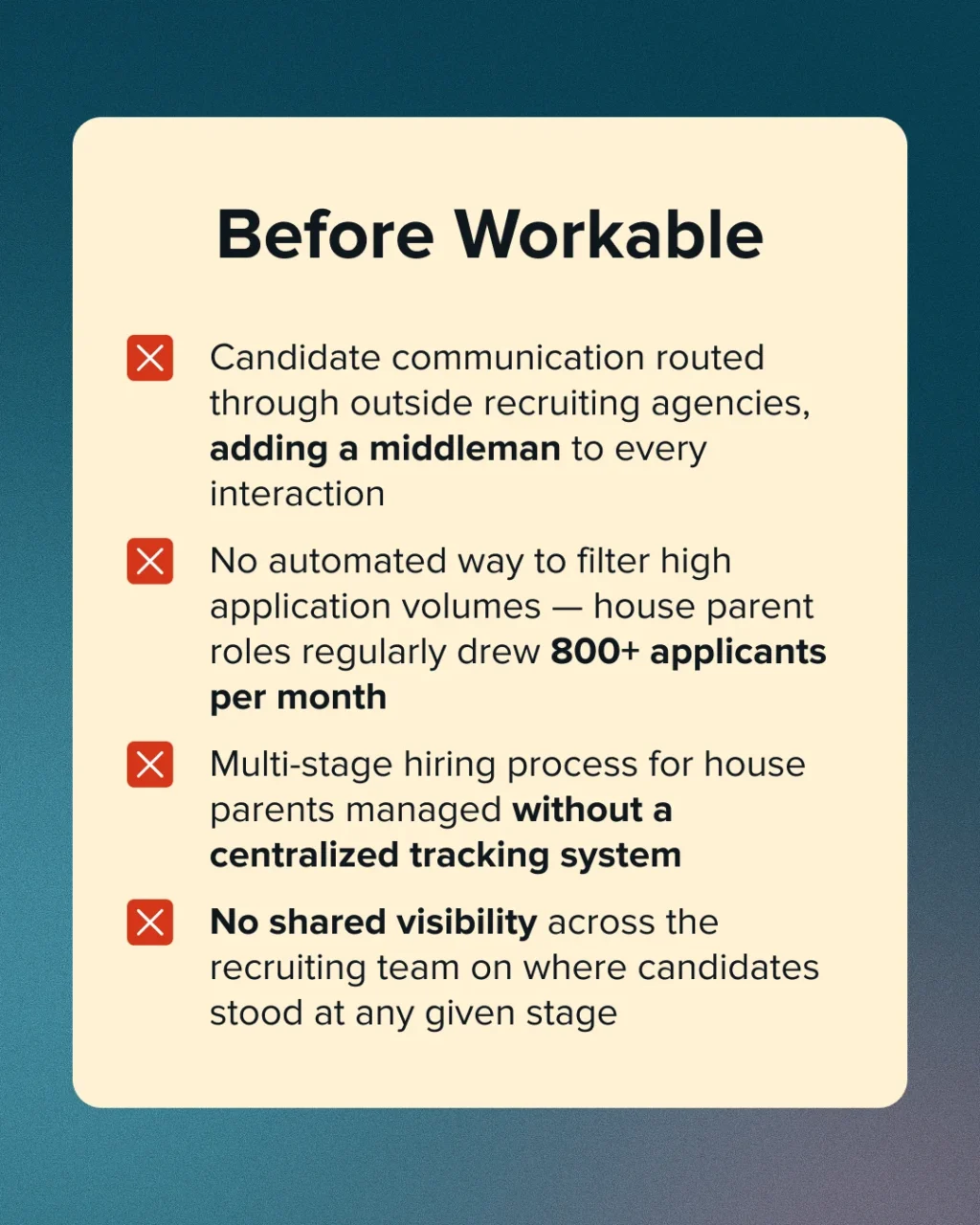
Furthermore, the recruitment process for candidates sourced through external agencies introduced an additional layer of complexity. Communication often flowed through email intermediaries, creating fragmented threads, slowing down responses, and increasing the potential for miscommunication or delays. This lack of direct, centralized communication not only created friction but also extended the path from initial contact to a finalized hire. With a lean recruiting team of just four individuals tasked with managing all hiring activities, the absence of a robust, centralized system meant that high application volumes posed a significant operational risk. Manual screening, tracking candidates across disparate spreadsheets and email chains, and coordinating interviews became an increasingly cumbersome and inefficient endeavor, threatening to overwhelm the team and delay the placement of vital personnel. The consequence of these inefficiencies was often felt directly in the ability to maintain optimal staffing levels, potentially impacting program continuity and the quality of care for the residents.
The Strategic Shift: Why Workable Was Chosen
Recognizing that their manual and fragmented recruitment processes were unsustainable in the face of growing demand and a competitive labor market, Cal Farley’s Boys Ranch embarked on a strategic initiative to modernize its talent acquisition efforts. The decision to adopt Workable was born out of a clear need to inject order, speed, and efficiency into an operation that had become increasingly difficult to manage without dedicated technological support. The leadership understood that investing in a purpose-built applicant tracking system was no longer a luxury but a necessity to sustain their mission effectively.
The primary drivers behind selecting Workable were its comprehensive suite of features designed to address the core pressures the recruiting team faced. The platform’s promise of enhanced pipeline visibility offered a clear solution to the challenge of tracking numerous candidates through multi-stage processes. Its robust candidate communication capabilities aimed to eliminate the friction caused by external intermediaries and decentralized messaging. Crucially, Workable’s automation features were identified as a critical tool to alleviate the burden of manually screening hundreds of applications and managing a large volume of open roles, freeing up the team to focus on qualitative candidate assessment rather than administrative tasks. The goal was to transform a reactive, often chaotic, process into a proactive, streamlined, and strategically managed recruitment function. Megan Lara, who leads recruiting at Cal Farley’s Boys Ranch, was instrumental in identifying the pain points and championing the adoption of a system that could provide a shared operational hub for the entire hiring journey.
Workable’s Impact: A New Paradigm for Recruitment
The implementation of Workable ushered in a new era of recruitment efficiency and effectiveness at Cal Farley’s Boys Ranch, fundamentally reshaping how the organization identifies, engages, and hires talent.
-
Automated Efficiency: Managing Unprecedented Applicant Volume:
The scale of applicant interest in roles at Cal Farley’s Boys Ranch is substantial, particularly for the vital house parent positions. In a single month, February, the organization received 854 applications for house parent roles alone, with a remarkable 480 – roughly 57% – meeting the initial qualification criteria. This trend continued into March, where between the 1st and 18th, 884 applicants were processed, 504 of whom were deemed qualified. Managing such immense volumes manually would have been an insurmountable task for the four-person recruiting team. Workable’s auto-disqualification feature proved to be a decisive mechanism in managing this influx. Candidates whose application responses fell outside defined, non-negotiable criteria were automatically filtered out, allowing the recruiting team to concentrate their invaluable time and attention exclusively on viable prospects. This automation alone is estimated to have saved hundreds of hours in manual screening each month, drastically improving the team’s capacity and focus. -
Streamlined Candidate Journey: The Power of Pipeline Management:
The hiring journey for a house parent is one of the most involved within the organization, often requiring candidates to navigate numerous stages – from initial application and screening to multiple interviews, background checks, and orientation – before a final offer can be extended. Workable’s intuitive pipeline feature became central to the team’s operational strategy. "House parent applicants do go through so many stages," Megan Lara observed, emphasizing, "The pipeline really helps us keep everyone sorted." This visual, stage-by-stage tracking system provides clear visibility into each candidate’s progress, ensuring no applicant falls through the cracks and that the team maintains a consistent, coordinated approach. Paired with the platform’s comments feature, which allows team members to log status updates, share feedback, and communicate internally, Workable functions as a shared operational hub, fostering seamless collaboration and real-time knowledge sharing across the recruiting team. This transparency has significantly reduced internal communication overhead and improved decision-making speed. -
Intelligent Prioritization: AI-Powered Candidate Scoring:
With hundreds of qualified applicants entering the pipeline each month, strategic prioritization is crucial. The team at Cal Farley’s leveraged Workable’s AI candidate scoring feature as an initial triage mechanism. This intelligent tool analyzes applicant profiles against job requirements and internal preferences, providing a quantitative score that helps recruiters quickly identify top-tier candidates. Recruiters prioritize reviewing higher-scored candidates first, allocating their most intensive efforts to those most likely to succeed. Lower scores are not dismissed but serve as a prompt for closer, more nuanced manual review, ensuring that no potentially strong candidate is overlooked due to an algorithmic bias. This blended approach – combining AI-driven insights with human judgment – empowers the four-person team to efficiently work through large applicant pools with greater speed and confidence, significantly reducing the time spent on initial candidate assessment. -
Seamless Handoffs: Empowering Department Managers:
For roles outside the highly specialized house parent track, such as daycare assistants, gift processors, and various operational positions, Workable’s share feature transformed the handoff process between the recruiting team and departmental hiring managers. Previously, recruiters would manually compile resumes and candidate information, often forwarding them via email, a process that was prone to delays and inconsistencies. Now, with a single action within Workable, candidate profiles and all relevant application materials are sent directly to department managers. This streamlined transfer eliminates manual compilation, reduces administrative burden, and ensures that hiring managers receive all necessary information promptly and in a consistent format. The result is a faster, cleaner, and more efficient handoff, fostering improved collaboration and accelerating hiring decisions across various departments. -
Direct and Transparent Communication: Eliminating Intermediaries:
One of the most tangible and impactful changes since adopting Workable has been the shift away from reliance on recruiting agency intermediaries for candidate communication. In the past, when a candidate was sourced through an outside agency, all correspondence – scheduling interviews, providing updates, extending offers – had to run through an additional party via email chains. This multi-step process was inherently slower, more error-prone, and notoriously difficult to track effectively. With Workable, the recruiting team now communicates directly with candidates within the platform itself. This centralization of communication offers several critical advantages: it is significantly faster, reduces the potential for miscommunication, provides a clear audit trail of all interactions, and vastly improves the overall candidate experience. Megan Lara succinctly captured this benefit: "With Workable, it’s so much easier and quicker to communicate with the candidates." This direct line of communication builds stronger relationships with applicants and reinforces Cal Farley’s commitment to transparency and efficiency.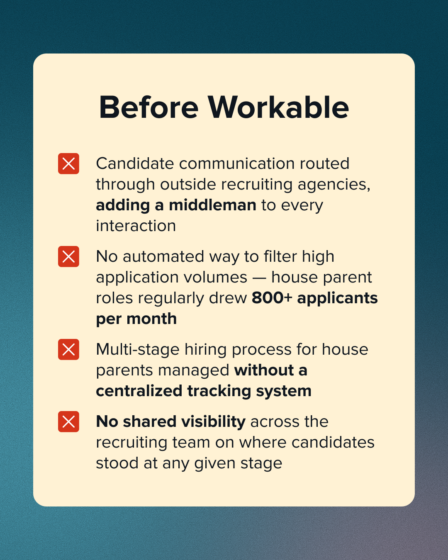
Tangible Business Outcomes and Strategic Implications
The quantitative and qualitative improvements brought about by Workable’s implementation have translated into significant business impact for Cal Farley’s Boys Ranch. In 2025, the organization successfully completed 81 hires while simultaneously managing an impressive 17 to 20 concurrent job postings, all handled by its dedicated four-person recruiting team. The reduction in time from application to offer, now averaging a swift one to two weeks, is a critical metric. This accelerated pace ensures that mission-critical positions, particularly those involving direct care for residents, are filled promptly, preventing extended vacancies that could impact program capacity and the well-being of the children.
The efficiency gained also means that the recruiting team can manage high-volume hiring without the need for additional headcount, allowing Cal Farley’s to allocate resources directly to its core programs. The team now handles its full hiring load with increased confidence and without the strain of capacity limitations that previously plagued their operations.
Equally important has been the ease of adoption of the Workable platform. New team members can be added as users and quickly find their footing, requiring minimal training. Megan Lara noted that the reporting functionality was the only area that required deliberate learning, highlighting the intuitive nature of the system for day-to-day operations. This ease of integration contributes to sustained efficiency and reduces onboarding time for new recruiting staff.
Megan Lara’s endorsement of Workable is unequivocal: "I would definitely recommend Workable. It’s helped us stay very organized and definitely fast-track getting candidates in, interviewed, and then hired. I don’t know how they did it before Workable." This statement underscores the transformative power of the platform, positioning it as an indispensable tool for the organization’s continued success.
Broader Implications for the Non-Profit Sector and HR Technology
The success story of Cal Farley’s Boys Ranch serves as a compelling case study for the broader non-profit sector. Many mission-driven organizations operate with lean administrative teams and often face unique recruitment challenges, including specialized roles, limited budgets for HR technology, and a high reliance on dedicated individuals. This case demonstrates that strategic investment in robust HR technology, such as an applicant tracking system, can yield substantial returns, not just in terms of efficiency and cost savings, but more importantly, in bolstering the organization’s core mission.
The ability to efficiently fill critical care roles directly impacts the number of children Cal Farley’s can serve and the quality of that service. For an organization where every house parent hire directly determines how many children can be served, the clarity of impact provided by Workable’s streamlined processes is arguably the most meaningful metric of all. This partnership exemplifies how modern HR technology can empower non-profits to overcome operational hurdles, enhance their organizational capacity, and ultimately amplify their positive societal impact, setting a precedent for others in the sector to explore similar technological transformations.