The laborious, error-prone process of manually crafting job descriptions (JDs) has become an unsustainable relic in the modern talent acquisition landscape. As of 2026, organizations continuing to rely on antiquated, unstructured workflows face a cascade of challenges, from spiraling costs and delayed hiring to significant legal and reputational risks. The shift towards automated, intelligent JD creation platforms is no longer a luxury but a strategic imperative for businesses aiming to attract top talent, ensure compliance, and optimize their recruitment efforts.
For decades, the creation of job descriptions often involved a disjointed process: a hiring manager drafting initial requirements, followed by multiple rounds of email exchanges, document revisions in various formats, and a protracted approval chain. This rudimentary approach, while once commonplace, is fundamentally incompatible with the speed, complexity, and regulatory demands of contemporary recruitment. Industry reports from early 2026 indicate that companies still employing manual JD workflows experience, on average, a 30% longer time-to-hire and incur up to 25% higher recruitment costs compared to their automated counterparts. The inherent lack of structure in manual processes breeds inefficiencies that permeate every stage of the talent acquisition pipeline, transforming a seemingly straightforward task into a significant operational bottleneck.
The Pervasive Drain of Sluggish Workflows and Approval Bottlenecks
One of the most immediate and tangible consequences of manual JD creation is the severe impact on speed and efficiency. The absence of standardized templates, centralized information, and integrated communication tools forces HR professionals and hiring managers into a perpetual state of information retrieval. Locating the "latest version" of a JD, identifying relevant compensation data, or recalling specific departmental requirements often devolves into an exhaustive scavenger hunt across emails, shared drives, and personal desktops. This fragmentation means that a process that should ideally take a few days frequently stretches into weeks, consuming valuable HR bandwidth that could be better utilized for strategic talent initiatives.
Beyond the initial drafting, manual workflows are notorious for creating debilitating approval bottlenecks. A job description requiring sign-off from two or three stakeholders can languish for weeks, simply awaiting a few digital or physical signatures. This delay is often attributed to a lack of automated reminders, clear workflow visibility, and centralized platforms where approvers can easily review and sanction documents. A survey conducted in Q1 2026 revealed that approximately 40% of recruitment delays are directly linked to stalled JD approvals, resulting in missed opportunities to engage with prime candidates who may move on to competitors. The cascading effect of these delays extends far beyond the JD itself, significantly prolonging the overall time-to-fill for critical roles and impacting organizational productivity.
Disconnected Collaboration and the Quest for Information
The collaborative nature of job description creation, involving input from hiring managers, talent acquisition leaders, DEI teams, compensation specialists, and legal counsel, is a cornerstone of effective recruitment. However, when this collaboration is scattered across disparate tools – email threads, chat applications, cloud documents with multiple versions, and offline discussions – chaos ensues. Conflicting feedback becomes common, version control becomes a nightmare, and the likelihood of errors significantly increases.
Imagine a scenario where a hiring manager provides feedback via email, the DEI team suggests edits in a separate document, and the compensation team offers input during a video call. Reconciling these diverse inputs into a single, coherent document without a centralized platform is a monumental task, often leading to rework and frustration. This lack of a single source of truth means teams spend an inordinate amount of time not on refining the JD content, but on administrative reconciliation, tracking changes, and ensuring everyone is working from the correct iteration. This fragmented approach not only slows down the process but also introduces a higher risk of miscommunication and content discrepancies.
Navigating the Labyrinth of Modern Compliance and Mitigating Bias
Perhaps one of the most critical reasons for abandoning manual JD processes by 2026 is the exponentially increasing complexity of compliance requirements. The regulatory landscape governing employment practices has grown more intricate, with new pay transparency laws, evolving data privacy regulations (such as GDPR or CCPA-like statutes expanding globally), and a patchwork of local, state, and national employment laws that must be meticulously adhered to. Manually updating and verifying each job description against this dynamic legal backdrop is not only time-consuming but also fraught with peril.
Organizations attempting to manage compliance manually are highly susceptible to oversights. For instance, failing to include mandated salary ranges in regions with pay transparency laws can result in fines, legal challenges, and a diminished applicant pool. Similarly, using outdated legal disclaimers or inadvertently violating fair hiring practices can expose companies to costly litigation and severe reputational damage. Legal experts in employment law warn that the financial penalties for non-compliance in 2026 could range from tens of thousands to millions of dollars per incident, underscoring the necessity of automated compliance checks.
Beyond legal compliance, the ethical imperative to create inclusive and unbiased job descriptions has become paramount. Unconscious bias, often embedded in language, can inadvertently deter qualified candidates from diverse backgrounds. Phrases like "digital native" might subtly bias against older applicants, while certain adjectives (e.g., "aggressive," "dominant") can disproportionately appeal to or deter specific genders. Manually identifying and eliminating these nuanced biases across numerous JDs is an almost impossible task. Studies indicate that job descriptions containing biased language can reduce the qualified applicant pool by as much as 20-30%, directly impacting an organization’s diversity goals and its ability to tap into a wider talent pool. Without sophisticated, AI-powered tools designed to detect and suggest alternatives for such language, companies risk perpetuating systemic biases within their hiring practices.
The Cost of Inconsistency and the Blind Spots of Manual Processes
Manual JD creation inherently leads to inconsistency. When each job description is drafted from scratch, or based on an ad-hoc collection of past documents, there’s no guarantee of a uniform structure, tone, or branding. This inconsistency can manifest in varying levels of detail, disparate formatting, or even contradictory messaging across different roles or departments. From a candidate’s perspective, inconsistent JDs can create confusion about the company’s culture, values, and even the basic requirements for a role, leading to a negative candidate experience and potentially deterring top talent. Furthermore, internal consistency is vital for legal defensibility and for ensuring equitable compensation structures across similar roles.
Moreover, manual processes leave organizations operating in the dark regarding their recruitment performance. Without a centralized system, it becomes exceedingly difficult to track key metrics, such as the effectiveness of specific JD language, the average time a JD spends in approval, or the impact of certain requirements on candidate diversity. This lack of real-time visibility prevents HR and TA leaders from making data-driven decisions. Questions like "Which job descriptions attract the most qualified candidates?" or "Where are the recurring bottlenecks in our JD creation process?" remain unanswered, hindering continuous improvement and strategic planning. A comprehensive JD platform, by contrast, centralizes all data, offering invaluable insights into workflow efficiency, content performance, and compliance adherence.
The Transformative Power of Job Description Software
The solution to these multifaceted challenges lies in the adoption of specialized job description software, such as Ongig Text Analyzer. These platforms are designed to centralize, streamline, and intelligently optimize the entire JD lifecycle.
-
Enhanced Speed and Efficiency: Automated platforms offer robust content libraries, customizable templates, and AI-powered drafting assistance. This significantly reduces the time spent on creating JDs from scratch, allowing teams to generate high-quality, comprehensive descriptions in a fraction of the time. Content optimization features ensure that JDs are not only clear but also engaging and searchable, improving their visibility to potential candidates.
-
Structured and Expedited Approvals: Modern JD software integrates automated approval workflows, digital signature capabilities, and configurable notification systems. This ensures that JDs move systematically through the necessary review stages, with clear accountability and reduced delays. Approvers receive instant alerts, can review documents on any device, and sign off efficiently, collapsing multi-week processes into days.
-
Seamless, Centralized Collaboration: By providing a single, cloud-based environment for all stakeholders, JD platforms eliminate collaboration chaos. Real-time co-editing, version control with audit trails, and integrated commenting features ensure that everyone works from the most current document, with all feedback consolidated and easily traceable. This fosters a more efficient and transparent collaborative environment.
-
Comprehensive JD Organization: A centralized cloud library acts as a single source of truth for all job descriptions. This enables instant search and retrieval, facilitates the reuse of approved content, and ensures that teams always access the latest, most compliant versions. This systematic organization drastically reduces the time spent searching for information and enhances overall productivity.
-
Robust Compliance and Risk Mitigation: Advanced JD software incorporates AI-powered compliance checks that scan documents for adherence to current local, national, and international regulations, including pay transparency laws. These tools proactively flag potential legal risks, outdated clauses, or missing mandatory information, significantly reducing an organization’s exposure to fines and litigation. Regular updates ensure the software remains current with evolving legal landscapes.
-
Ensuring Consistency and Brand Integrity: Through standardized templates, integrated style guides, and automated checks, JD software guarantees consistency across all published job descriptions. This not only reinforces employer branding but also ensures a professional and coherent message to candidates, enhancing the overall candidate experience and strengthening the organization’s reputation.
-
Fostering Inclusivity and Diversity: The most significant advancement in JD software is its ability to detect and mitigate unconscious bias. AI algorithms analyze language for gendered terms, ageist phrases, cultural biases, and other non-inclusive language, suggesting neutral alternatives. This proactive approach helps organizations craft JDs that appeal to a broader and more diverse talent pool, directly supporting diversity, equity, and inclusion initiatives.
-
Real-Time Visibility and Data-Driven Insights: By centralizing all JD-related data, these platforms provide unparalleled visibility into the entire hiring process. Dashboards offer insights into workflow performance, content effectiveness, compliance status, and even the impact of JD language on candidate demographics. This data empowers HR and TA teams to identify bottlenecks, optimize strategies, and demonstrate the tangible ROI of their recruitment efforts.
Strategic Transition: Auditing and Investment
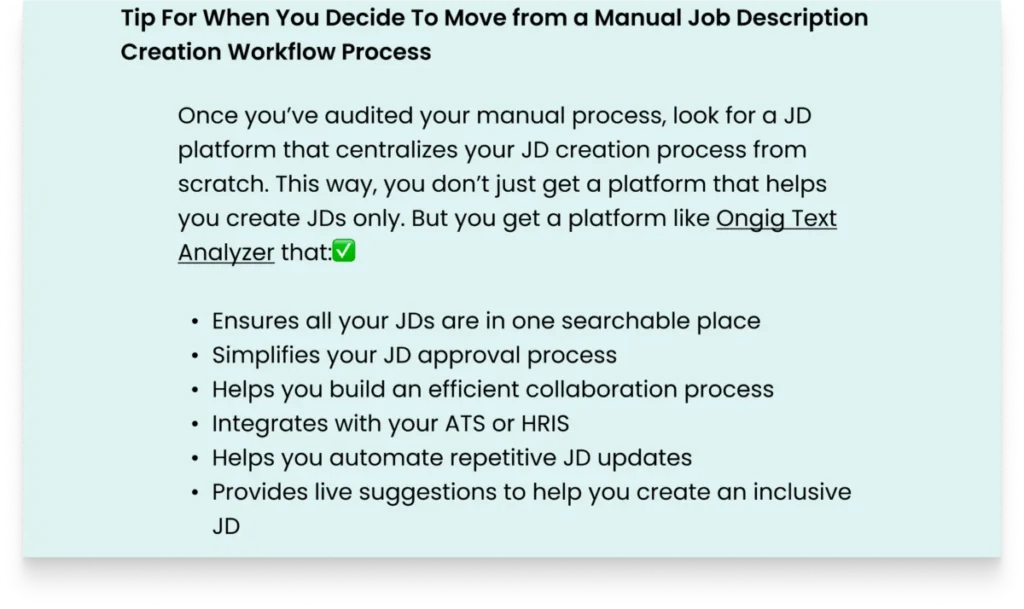
For organizations contemplating the shift from manual to automated JD creation, the first step is a thorough audit of existing processes. Pinpointing the exact pain points – whether it’s version control, approval delays, or compliance gaps – will inform the selection of the most appropriate software solution. The goal is to choose a platform that offers end-to-end centralization, covering drafting, collaboration, approval, publication, and analytics. A robust solution should integrate seamlessly with existing Applicant Tracking Systems (ATS) and Human Resources Information Systems (HRIS), enhancing rather than disrupting current recruitment technology stacks.
The argument that only large enterprises benefit from JD software is outdated. Even small and medium-sized organizations stand to gain immensely by freeing up valuable HR time, ensuring compliance, and attracting better talent. The immediate benefits are palpable: faster JD creation, streamlined approvals, and a significant reduction in administrative overhead, allowing HR teams to focus on strategic human capital management rather than manual drudgery.
In conclusion, the inefficiencies, risks, and limitations inherent in manual job description creation are no longer acceptable in the competitive and highly regulated talent landscape of 2026. Embracing intelligent JD software is not merely an operational upgrade; it is a fundamental strategic move that underpins effective talent acquisition, mitigates legal exposure, and cultivates a truly inclusive and equitable hiring environment. The time for manual processes has definitively passed; the future of talent attraction is automated, intelligent, and strategically driven.