A recent comprehensive analysis by Ongig, a leader in inclusive hiring technology, has identified "strong," "lead," and "independently" as the most prevalent masculine-biased words within job descriptions from January 1 to July 13, 2026. This critical finding, derived from a review of nearly 50,000 job postings, highlights an ongoing challenge in talent acquisition: the subtle linguistic cues that inadvertently deter female applicants and perpetuate gender imbalance in the workforce. The study emphasizes that replacing these and other similar terms with gender-neutral alternatives is not merely a matter of political correctness but a strategic imperative for companies aiming to enhance diversity and broaden their talent pipelines.
Unpacking the 2026 Findings: A Deep Dive into Linguistic Bias
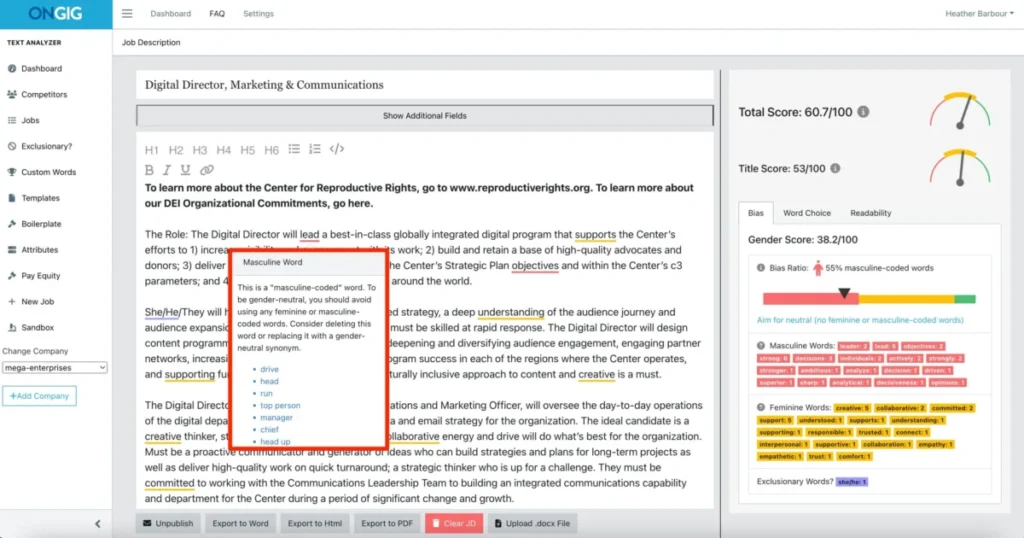
Ongig’s Text Analyzer software, a sophisticated tool leveraging social science and artificial intelligence research, meticulously scrutinized 48,246 random job descriptions from U.S.-based companies of varying sizes. The resulting data presents a clear picture of the most frequently flagged and subsequently swapped masculine-biased terms.
The top offenders, based on their frequency of being identified and replaced, are:
- Strong (42 times swapped): This word, often used to describe desired attributes like "strong leadership" or "strong technical skills," carries connotations of assertiveness and dominance that, while not inherently negative, are statistically perceived as more masculine. Gender-neutral alternatives include "able," "proven," "exceptional," "sound," "steady," "excellent," or "solid."
- Lead (26 times swapped): Frequently appearing in roles requiring direction or management, "lead" can imply a singular, authoritative figure. More inclusive terms like "drive," "head," "run," "chief," "manage," "steer," or "guide" emphasize collaboration or a broader scope of influence.
- Independently (13 times swapped): While autonomy is often a desirable trait, emphasizing "independent" work can subtly discourage candidates who thrive in collaborative environments or might interpret it as a lack of support. Alternatives such as "alone," "exclusively," "unaided," or "unsupervised" can be more neutral.
- Strengthen (12 times swapped): A newcomer to the top ranks, "strengthen" suggests robust, forceful improvement. More neutral verbs like "build," "reinforce," "improve," "develop," or "grow" convey progress without the same masculine undertones.
- Competitive (10 times swapped): This term often appears in relation to compensation or market positioning. However, it can also imply a highly aggressive, win-at-all-costs environment. "Attractive," "fair," "results-oriented," "enthusiastic," or "comparative" offer a softer, more inclusive framing.
- Leaders (10 times swapped): Similar to "lead," the plural "leaders" can evoke a traditional, hierarchical power structure. "Managers," "people," "stars," "pioneers," "principals," "mentors," or "top people" can be more inviting and less intimidating.
- Analyze (9 times swapped): While analytical skills are crucial, the word "analyze" itself, particularly in certain contexts, has shown a slight masculine leaning in linguistic studies. "Parse," "examine," "review," "study," "dissect," "break down," "research," or "evaluate" serve as effective, neutral synonyms.
- Champion (8 times swapped): Another new entry into the top ten, "champion" suggests a vigorous, often individualistic advocacy. "Support," "advocate for," "promote," or "back" convey similar meaning with a more collaborative or less aggressive tone.
- Analysis (7 times swapped): The noun form of "analyze," this term also carries a subtle bias. "Investigation," "study," "test," "testing," "research," or "data" are suitable replacements.
- Independent (7 times swapped): The adjective form of "independently," it implies self-reliance over team integration. "Self-directed," "autonomous," or "self-sufficient" maintain the meaning while being more gender-neutral.
Notably, "strong" and "lead" have consistently appeared on these lists in prior years, underscoring their entrenched presence in corporate vocabulary. However, the emergence of "strengthen" and "champion" suggests a dynamic shift in the lexicon of job descriptions, with new words gaining prominence in strategy-heavy and leadership-focused roles, yet still carrying subtle biases. Conversely, terms like "objectives" and "decisions," which featured in earlier analyses, have dropped out of the top ten, indicating that while they are still flagged, their frequency has decreased relative to others.
Methodology and the Evolution of Bias Detection
Ongig’s methodology relies on a proprietary masculine vocabulary library, meticulously curated from extensive social science research and cutting-edge artificial intelligence analysis. This library is continuously updated to reflect evolving linguistic patterns and societal perceptions. The Text Analyzer scrutinizes job descriptions in real-time, identifying words and phrases that have been statistically shown to appeal more strongly to one gender over another. By offering immediate, gender-neutral synonym suggestions, the tool empowers recruiters and hiring managers to craft more inclusive job advertisements effortlessly. This iterative approach to data collection and analysis ensures that Ongig’s insights remain relevant in the ever-changing landscape of language and recruitment.
The Business Imperative: Why Gender-Neutral Language Matters
The impact of gendered language on applicant behavior is not merely theoretical; it is empirically proven and carries significant business implications. Companies committed to diversity, equity, and inclusion (DEI) recognize that biased language can inadvertently narrow their talent pools, especially in industries traditionally dominated by men, such as engineering and finance.
A landmark study conducted in late 2022 by Ongig in partnership with a global employment website provided compelling evidence. The research, which analyzed the effect of gendered and other biased language on application rates, revealed that Ongig’s scoring was predictive of higher application rates across various industries. Specifically, job postings optimized for gender-neutral language saw an overall increase of 13% in total apply starts. More significantly, apply starts from female applicants surged by 21%. This robust data unequivocally demonstrated that the deliberate use of gender-sensitive language directly translates to a tangible boost in female application rates.
Further substantiating these findings, a pilot program involving a firm in the male-dominated engineering and finance sectors yielded remarkable results. After implementing Ongig’s Text Analyzer and updating their job advertisements to remove gender-biased words, the firm experienced a substantial 22% increase in female applicants. This practical application underscores the transformative power of linguistic adjustments in addressing long-standing gender imbalances.
Academic Foundations and Psychological Impact
The phenomenon of gendered language’s impact on job applications is well-documented in academic research. A foundational study, "Evidence That Gendered Wording in Job Advertisements Exists and Sustains Gender Inequality," published in the Journal of Personality and Social Psychology, provides critical insights. Led by researchers Danielle Gaucher, Justin Friesen, and Aaron C. Kay from Duke University and the University of Waterloo, this research demonstrated that exposure to masculine-biased language in job advertisements can make women feel a reduced sense of belonging in the advertised role and organization, thereby decreasing their interest in applying.
This effect is often attributed to psychological mechanisms such as stereotype threat and self-selection bias. Women, as a demographic group, are often observed to apply for jobs only when they feel they meet a high percentage of the stated qualifications, whereas men might apply even if they meet fewer. Masculine-coded language can amplify this self-filtering behavior, making women perceive a role as less suitable for them, even if they possess the requisite skills and experience. The "Gender Decoder," a free tool created by Kat Matfield based on this study, further popularized awareness of these linguistic biases.
Expert Commentary and Strategic Implications
Rob Kelly, CEO of Ongig and lead author of the recent analysis, commented on the findings: "Our latest data reaffirms that seemingly innocuous words can create significant, yet often invisible, barriers to entry for female talent. Companies committed to diversity must scrutinize their job descriptions with renewed vigilance, understanding that language is a powerful gatekeeper. It’s not about individuals being ‘strong’ or ‘leading,’ it’s about the aggregate impact of these words on a population."
Dr. Anya Sharma, a prominent Diversity, Equity, and Inclusion (DEI) consultant, emphasized the broader strategic implications: "Inclusive language isn’t merely about political correctness; it’s a strategic imperative. When job postings resonate broadly, organizations unlock access to a wider, more diverse talent pool, which directly correlates with innovation, better decision-making, and improved financial performance. This linguistic hygiene is a foundational step towards building truly equitable workplaces."
An HR Director from a major technology firm, who preferred to remain anonymous to discuss internal processes candidly, noted, "Implementing tools like Ongig’s Text Analyzer has been transformative for our talent acquisition strategy. We’ve seen a tangible shift in the demographics of our applicant pool, proving that small linguistic changes can yield significant results in our quest for a truly equitable workforce. It’s about removing unconscious hurdles."
Beyond Gender: A Holistic Approach to Inclusivity
While the current report focuses on masculine-biased words, the principles extend to a broader spectrum of inclusive hiring practices. Organizations are increasingly recognizing the importance of eliminating all forms of exclusionary language from job descriptions. This includes words that might deter non-binary individuals, people with disabilities, individuals from specific ethnic or racial backgrounds, and other underrepresented groups. By adopting a holistic approach to language, companies can foster an environment where all potential candidates feel seen, valued, and encouraged to apply.
Putting It Into Practice: A Call to Action
For organizations striving to cultivate diverse and inclusive workforces, the message is clear: language matters. Implementing tools like Ongig’s Text Analyzer, which flags biased words in real-time and suggests gender-neutral synonyms, can streamline the process of creating more inclusive job descriptions. Regular review and adaptation of hiring language, informed by ongoing research and data, will be crucial for staying ahead in the competitive talent market.
As the professional landscape continues to evolve, the demand for equitable opportunity will only intensify. By consciously crafting job advertisements that speak to all qualified candidates, companies can not only enhance their employer brand but also tap into a richer, more diverse pool of talent, ultimately driving innovation and sustainable growth. The journey towards true workplace equality begins with the words we choose.