The job search page on a company’s career site stands as a pivotal component of the candidate experience, serving as the primary digital interface between an aspiring applicant and a potential employer. In today’s hyper-competitive talent landscape, where skilled professionals have numerous options, the efficacy and user-friendliness of this digital gateway can significantly influence a company’s ability to attract, engage, and ultimately hire top talent. However, a widespread audit reveals that many organizations inadvertently undermine their recruitment efforts through a series of common, yet critical, errors embedded within their job search infrastructure. These missteps not only frustrate potential candidates but also severely impede a company’s visibility on search engines, directly impacting pipeline and traffic generation.
A recent analysis, exemplified by the career site of Ideal Industries—a reputable 107-year-old company with a solid Glassdoor rating of 3.8—underscores these prevalent issues. While Ideal Industries is highlighted here, it is crucial to understand that these observations are not unique to one organization but reflect systemic challenges across numerous solid employers. The inherent complexity often arises from the deep reliance on applicant tracking systems (ATS), which, while streamlining backend processes, frequently introduce front-end compromises that detach the candidate experience from the overarching brand identity.
The Evolving Landscape of Talent Acquisition and Digital Presence
The past decade has witnessed a dramatic shift in how job seekers discover and apply for roles. Gone are the days when newspaper ads or physical job boards were the primary channels. Today, the internet, particularly search engines and professional networking sites, dominates the initial stages of a job search. This digital transformation has placed an unprecedented emphasis on a company’s online presence, making its career site a critical brand touchpoint. A well-designed, optimized career site is no longer a luxury but a strategic necessity for attracting passive and active candidates alike.
However, many companies, in their haste to automate and manage high volumes of applications, have inadvertently outsourced crucial aspects of their digital candidate experience to their ATS providers. While ATS platforms are indispensable for managing recruitment workflows, their default configurations often prioritize functional efficiency over nuanced branding and search engine optimization (SEO). This creates a disconnect where a company’s carefully cultivated employer brand on its main website abruptly gives way to a generic, ATS-branded interface on its job search page. Studies consistently show that a seamless, branded experience significantly enhances candidate trust and application completion rates. Conversely, a disjointed or confusing interface can lead to high bounce rates, low conversion, and a diminished perception of the employer. For instance, research by Talent Board often indicates that positive candidate experiences correlate with higher application rates and greater willingness to recommend a company, regardless of hiring outcome.
Deep Dive: Five Pillars of a Flawed Job Search Experience
The identified pitfalls collectively contribute to a suboptimal candidate journey and hinder organic talent acquisition. Addressing these requires a concerted effort involving HR, marketing, and IT departments, often in collaboration with ATS providers.
1. The Domain Dilemma: When Your ATS Steals Your SEO Credit
One of the most fundamental yet overlooked mistakes is the use of an ATS provider’s URL (e.g., jobs.adp.com/idealindustries) instead of the company’s own branded domain (e.g., careers.idealindustries.com). From a candidate’s perspective, encountering an unfamiliar URL can be jarring, raising questions about authenticity and potentially eroding trust. They navigated to the company’s main site, expecting a consistent brand experience, only to be redirected to a third-party domain.
From an SEO standpoint, the implications are far more severe. Google’s algorithms are designed to credit traffic and authority to the domain that hosts the content. If the job search page resides on the ATS provider’s domain, then the ATS, not the employer, receives the valuable SEO credit for all job-related searches. This means that even if a candidate explicitly searches for "Ideal Industries jobs," the traffic generated might not bolster Ideal Industries’ own domain authority. This effectively means companies are investing in recruitment efforts and content creation, only for the SEO benefits to accrue to their software vendor. A 2023 report on recruitment marketing trends highlighted that companies with optimized career sites see up to 30% more organic traffic to their job postings compared to those relying solely on ATS-branded pages.
The Fix: The solution lies in implementing URL masking or a custom domain setup. This technical adjustment, typically facilitated by the ATS provider or an internal IT team, ensures that the job search page appears under the company’s domain, maintaining brand consistency and, crucially, directing all SEO credit back to the employer. Most modern ATS platforms offer this capability, though it may require specific configuration or an upgrade. This one-time technical change secures invaluable organic search visibility and reinforces brand integrity from the very first click.
2. Brand Blurring: ATS Logos Outshining Your Identity
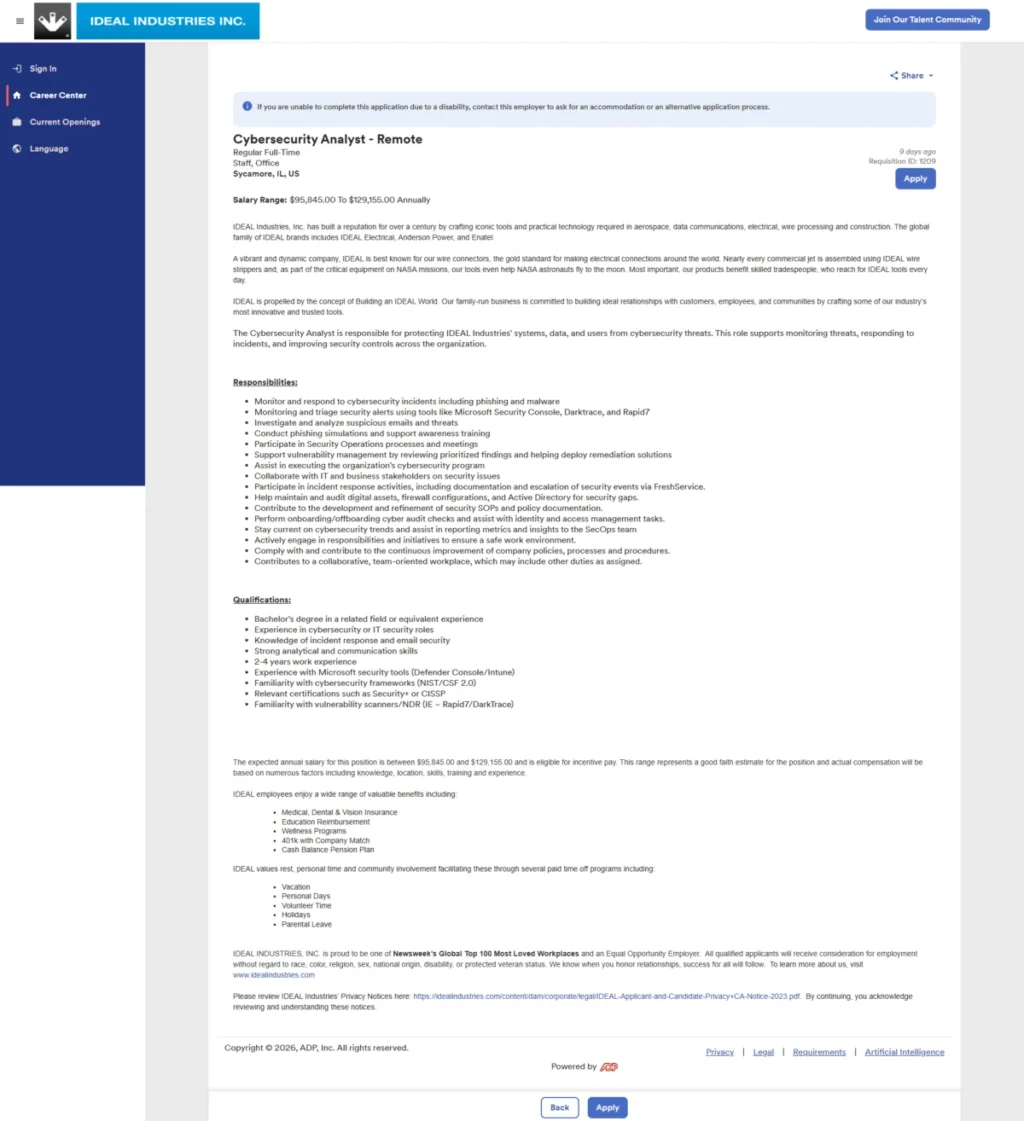
Beyond the URL, visual branding plays an equally critical role. It is common to find job search pages where the ATS provider’s logo is as, if not more, prominent than the employer’s own brand logo. In the Ideal Industries example, the ADP logo held significant visual weight, potentially confusing candidates about whose page they were on.
Candidates are seeking to build a relationship with the employer, not its software vendor. When an ATS logo competes for attention or even overshadows the company’s logo, it dilutes the employer’s brand identity and can create a sense of detachment. This subtle yet significant visual inconsistency can undermine the professional image an employer strives to project. From a marketing perspective, brand consistency across all touchpoints is paramount for building recognition and trust. Recruitment marketing experts frequently cite brand consistency as a key factor in attracting higher quality and more engaged applicants, with some studies suggesting that a strong employer brand can reduce cost-per-hire by up to 50%.
The Fix: Employers must insist on their logo being the dominant visual element on their job search pages. ATS providers generally allow for customization of branding elements. A direct request to reduce the size and prominence of the ATS logo, or even to move it to a less conspicuous "powered by" footer, is often accommodated. This ensures that the candidate’s focus remains squarely on the potential employer, reinforcing the brand throughout the application journey.
3. The Invisible Filters: Why Dropdowns Deter Google and Candidates
Interactive dropdown filters are designed to help candidates refine their job searches by location, job type, department, etc. While seemingly helpful for an active user already on the page, they present a significant invisible barrier to search engines and, by extension, to candidates who start their search on Google. When a candidate selects "Sycamore – IL" or "Regular Full-Time" from a dropdown on a page like Ideal Industries’, the results update dynamically, but the URL in the browser’s address bar typically remains unchanged.
This poses a critical problem for SEO. Google’s crawlers rely on unique, static URLs to index individual pages. If filtering a job board does not generate a unique URL, Google cannot "see" or index that specific filtered result. Consequently, if a job seeker searches for "IDEAL Industries jobs in Illinois," Google cannot direct them to a dedicated page for Illinois roles because, technically, such a page with a unique URL doesn’t exist in its index. This results in a massive loss of organic traffic from highly targeted searches. Data from Moz indicates that long-tail keywords (like "software engineer jobs in Austin") account for a significant portion of search traffic, and failing to capture these through indexable pages means missing out on highly qualified candidates.
Conversely, best-in-class career sites, like Culture Amp’s, demonstrate the power of crawlable links. Each office hub (e.g., Melbourne, New York, London) has its own distinct, indexable URL. When a candidate clicks on "See open roles" for a specific location, they are directed to a dedicated page with a unique URL, which Google can easily crawl, index, and present in search results.
The Fix: Companies need to work with their ATS or internal tech teams to generate static, hyperlinked pages for each significant location, department, or job category. This transforms dynamic filters into a robust network of indexable pages, allowing Google to surface specific job openings to candidates performing precise searches. This architectural change is crucial for maximizing organic search visibility and ensuring that every relevant job opening can be found and shared.
4. The Missing Emblem: The Unseen Power of the Favicon
The favicon—that small, iconic graphic displayed in browser tabs, bookmarks, and search results—is a subtle yet powerful branding element. It provides instant visual recognition and reinforces brand presence across multiple browser windows. For Ideal Industries, their distinctive white arrow in a gray box serves this purpose on their main website.
However, many ATS-hosted job search pages strip out the employer’s favicon, replacing it with the ATS provider’s default icon. In Ideal Industries’ case, the ADP favicon appeared on their job search page instead of their own. This seemingly minor detail has significant implications. For candidates navigating multiple tabs during their job search, the absence of the familiar brand favicon can lead to confusion, making it harder to distinguish between different company pages. It also subtly communicates a lack of attention to detail or a fragmented digital presence, detracting from the overall candidate experience. Consistency in micro-branding elements like favicons contributes to a cohesive and professional online identity.
The Fix: This is typically a straightforward request to the ATS provider or internal tech team. Replacing the default ATS favicon with the company’s branded one ensures visual consistency across all job-related pages, from the initial search to the individual job description. It’s a small technical adjustment with a considerable positive impact on brand recall and candidate navigation.
5. The Generic Trap: Job Descriptions That Fail to Convert
Ultimately, the job description (JD) is the candidate’s first in-depth "conversation" with a potential role and employer. If it’s generic, vague, or merely a copy-paste from an outdated template, it fails to engage, inform, and convert suitable candidates. While Ideal Industries’ Cybersecurity Analyst posting showed commendable improvements, such as including a salary range and specific tools (Darktrace, Rapid7), it still fell short in crucial areas.
A truly effective job description goes beyond listing responsibilities and requirements. It acts as a marketing document, selling the opportunity and the company culture. Generic JDs often lack a compelling, role-specific introduction that speaks directly to the desired candidate profile. They might present an undifferentiated list of duties without prioritizing or explaining the impact of each task. Crucially, in an era of remote work, a generic JD often fails to articulate what "remote" truly means for the role—details like geographic limitations, required travel, or expectations for team collaboration. This ambiguity can deter qualified candidates who value clarity and a genuine understanding of their future work environment. A LinkedIn study revealed that job posts with more detailed information about company culture, team structure, and work-life balance receive significantly more engagement.
The Fix: Crafting high-converting job descriptions requires a strategic approach. This includes:
- Role-Specific Intros: Develop an engaging introductory paragraph that highlights the unique appeal of the role and the specific type of candidate sought.
- Prioritized Responsibilities: Organize duties by importance and impact, clearly articulating what success looks like in the role.
- Contextualize Remote Work: For remote or hybrid roles, explicitly detail the remote work policy, including any geographical restrictions, in-person meeting requirements, and tools for virtual collaboration.
- Showcase Culture: Integrate snippets about company culture, values, and team dynamics to help candidates envision themselves in the role.
These seemingly small changes collectively transform a generic job description into a powerful recruitment tool that attracts best-fit candidates and significantly boosts conversion rates.
The Cumulative Impact: Beyond Individual Fixes
The cumulative effect of these five common mistakes extends far beyond isolated technical glitches. They collectively erode the employer’s brand, inflate recruitment costs, and diminish the quality and quantity of the applicant pipeline. A fragmented, unbranded, or inaccessible job search experience translates directly into:
- Damaged Employer Brand: Inconsistent branding, confusing navigation, and generic content project an image of disorganization or indifference, deterring top talent who prioritize a professional and engaging experience.
- Reduced Applicant Pool Quality and Quantity: Poor SEO means fewer qualified candidates discover job openings organically. A frustrating candidate experience leads to higher abandonment rates, shrinking the overall applicant pool.
- Increased Cost-Per-Hire: When organic channels fail, companies become overly reliant on paid job boards, recruitment agencies, and other expensive avenues, driving up the cost of acquiring talent.
- Lost Competitive Advantage: In industries with fierce competition for skilled workers, a superior candidate experience can be a critical differentiator. Companies failing to optimize their digital gateways fall behind those that prioritize candidate engagement.
Industry Responses and Path Forward
Recognizing these challenges, many ATS providers are actively working to offer more robust customization options, improved SEO features, and better branding controls. However, the onus remains on employers to proactively engage with their ATS partners and internal technical teams. This requires a collaborative effort between HR, marketing, and IT to ensure that recruitment technology serves both backend efficiency and front-end candidate engagement. Investing in recruitment marketing specialists who understand both HR processes and digital best practices is becoming increasingly important.
The ultimate goal is to create a seamless, branded, and highly discoverable job search experience that mirrors the quality and professionalism of the company itself. This is not merely a technical exercise but a strategic imperative that directly impacts a company’s ability to attract the talent essential for its future success. Continuous auditing and optimization of the career site are necessary to adapt to evolving candidate expectations and search engine algorithms.
In conclusion, the job search page is far more than a simple listing of vacancies; it is a critical extension of a company’s brand and a powerful engine for talent acquisition. By addressing common pitfalls related to URLs, branding, search engine visibility, and job description quality, organizations can transform their digital gateways into strategic assets that attract, engage, and convert the best talent in the market. The investment in these seemingly minor fixes yields significant returns in enhanced candidate experience, improved SEO, and ultimately, a stronger, more competitive workforce.