
In the evolving landscape of organizational development and sociology, a paradigm shift is occurring that moves away from traditional deficit-based problem-solving toward an asset-based inquiry known as positive deviance. This concept, which identifies individuals or groups who achieve significantly better results than their peers despite having access to the same resources and facing identical constraints, is increasingly being adopted by Human Resources (HR) and Learning and Development (L&D) leaders. By focusing on the "bright spots" within a system, organizations are discovering that the solutions to their most complex challenges often already exist within their own ranks, hidden in the unconventional but successful behaviors of their top performers.
The Sociological Origins and Theoretical Framework
Positive deviance (PD) finds its roots in the late 20th century, emerging from behavioral studies that sought to understand why certain members of a community thrived while others struggled under the same socioeconomic pressures. Unlike traditional sociology, which historically focused on "negative deviance"—behaviors such as crime, deviancy, or rule-breaking that disrupt social order—positive deviance examines those who break from the norm in a constructive and beneficial manner.
The theory posits that in every community or organization, there are "positive deviants" whose uncommon behaviors or strategies enable them to find better solutions to problems than their neighbors or colleagues. The fundamental premise of positive deviance theory is that the knowledge required to solve a problem is already present within the system. This stands in stark contrast to traditional "benchmarking" or "best practice" models, which typically look outward toward competitors or external consultants for answers. By shifting the gaze inward, the PD approach fosters a culture of self-reliance and organic growth.
Historical Context: The Vietnam Malnutrition Case Study
The most cited historical application of the positive deviance model occurred in 1990, led by Jerry and Monique Sternin of Save the Children in Vietnam. Tasked by the Vietnamese government to address widespread childhood malnutrition with minimal resources and a mandate to produce results within six months, the Sternins eschewed traditional aid models. Instead of bringing in outside food or expertise, they looked for "bright spots" within the local villages.
They identified very poor families whose children were remarkably healthy. Upon investigation, they discovered these "positive deviant" families were adding small shrimps, crabs, and sweet potato greens—items readily available but traditionally considered "low-class" or inappropriate for children—to their meals. They also fed their children multiple times a day rather than the standard two large meals. By identifying these internal solutions and facilitating a process where other villagers could observe and replicate these behaviors, the program achieved a 65% to 85% reduction in malnutrition in the target areas. This success provided the blueprint for the positive deviance approach now used in corporate and healthcare settings globally.
Chronology of Integration into the Corporate Sector
The transition of positive deviance from social work to the corporate boardroom followed a clear chronological path:
- Early 1990s: Success in international public health (Vietnam, Bangladesh, and Egypt) establishes the viability of the PD model.
- Early 2000s: The healthcare industry adopts PD to combat Hospital-Acquired Infections (HAIs). Hospitals in the United States used the model to identify nurses and staff who consistently maintained lower infection rates, discovering subtle but vital differences in hygiene and patient interaction.
- 2010s: The rise of Big Data allows HR and L&D departments to identify performance outliers with greater precision. The term begins to appear in management literature as a tool for "agile" and "lean" organizational strategies.
- 2020-Present: The post-pandemic shift toward remote and hybrid work environments creates a renewed need for PD, as managers seek to understand how certain teams maintain high engagement and productivity despite the challenges of digital silos.
Characteristics of the Positive Deviant
To effectively leverage this phenomenon, leaders must recognize the specific traits that define a positive deviant. Research suggests four primary characteristics:
- Exceptional Outcomes Under Common Constraints: They achieve superior results without additional budget, specialized tools, or expanded timelines. Their success is a product of "how" they work, not "what" they have.
- Unconventional Adherence: Positive deviants are not rebels in the traditional sense. They generally follow organizational policies and ethical guidelines but utilize unconventional workflows or communication styles within those boundaries.
- Low Visibility: Because their methods are often informal or intuitive, positive deviants frequently go unnoticed by traditional performance metrics that favor adherence to standard operating procedures.
- Social Connectivity: While they may work differently, positive deviants are often influential within their immediate social or professional circles, acting as informal mentors or "nodes" of knowledge.
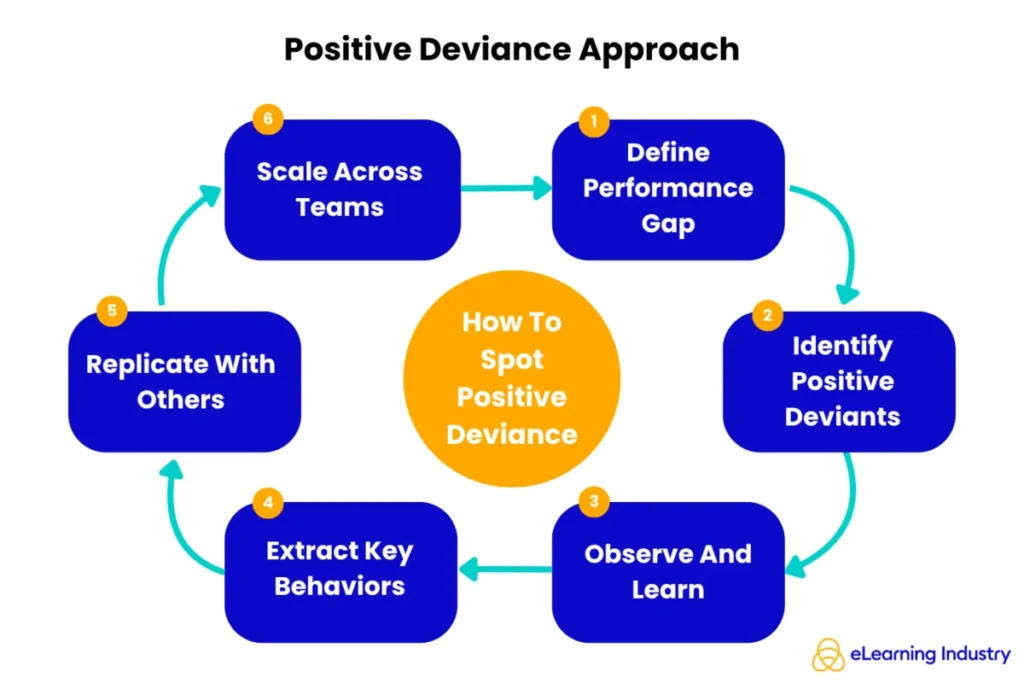
The Positive Deviance Model: A Five-Step Implementation Strategy
For L&D and HR professionals, implementing a positive deviance approach requires a structured methodology to ensure that "bright spots" are not just identified but effectively scaled.
Step 1: Define the Performance Gap
Organizations must first establish a clear baseline. This involves identifying a specific problem or a desired outcome that can be measured, such as customer retention rates, software deployment speed, or employee turnover. By defining what "normal" looks like, the organization can identify the "right-hand tail" of the bell curve—the outliers.
Step 2: Locate the Outliers (Internal Benchmarking)
Using data analytics, leaders segment the workforce to find the over-performers. This step is critical because it prioritizes internal benchmarking over external trends. As one industry analyst noted, "An external best practice is like a foreign organ; the body’s immune system—the company culture—often tries to reject it. An internal positive deviance is like a stem cell; it is already part of the organism and is much more likely to be accepted."

Step 3: Discover Uncommon Behaviors through Qualitative Research
Once the deviants are identified, the L&D team must determine the "why." This requires qualitative methods such as "workplace ethnography," where researchers observe the daily habits of high performers. In a sales context, this might reveal that a top-performing agent spends five minutes researching a client’s recent LinkedIn activity before a call—a behavior not mandated in the official sales script but vital to their success.
Step 4: Design Peer-Led Replication
Replication should never be a top-down mandate. The positive deviance approach relies on social proof. Organizations create "communities of practice" where the positive deviants share their methods with their peers. This peer-to-peer learning reduces the "not invented here" syndrome and increases the speed of adoption.
Step 5: Scale and Monitor
The final phase involves integrating these successful behaviors into broader training programs and digital workflows. However, experts warn against over-standardization. The goal is to share the principles of the success while allowing teams the flexibility to adapt those behaviors to their specific sub-cultures.
Supporting Data and Organizational Impact
Recent studies in organizational science highlight the efficacy of the PD approach. According to data from various management reviews, organizations that utilize internal positive deviance for problem-solving see a 30% higher sustainability rate in behavioral change compared to those that rely solely on external consultants.
Furthermore, in the realm of L&D, peer-led learning—a core component of the PD model—has been shown to increase knowledge retention by up to 75%, compared to only 5% to 10% for traditional lecture-based training. In healthcare, the application of PD to reduce MRSA (methicillin-resistant Staphylococcus aureus) infections resulted in a 33% to 70% decrease in infection rates across several U.S. hospital systems, demonstrating that the model can quite literally be a matter of life and death.
Statements from the Field
"The beauty of positive deviance is that it honors the expertise of the person doing the work," says an HR Director at a Fortune 500 tech firm. "Instead of telling an employee that their way is wrong because it isn’t in the manual, we are asking them to show us how they made the manual better. It’s a massive boost for morale and engagement."
L&D strategists also emphasize the cost-effectiveness of the model. "In a period of tightening budgets, positive deviance is the ultimate ‘low-cost, high-impact’ strategy," notes a senior consultant in organizational design. "You aren’t buying new software or hiring expensive gurus; you are simply amplifying the genius you are already paying for."
Broader Implications and Future Outlook
The implications of positive deviance extend beyond mere productivity. It represents a fundamental change in how leadership is perceived. In a PD-centric organization, the leader’s role shifts from "commander-in-chief" to "chief curator of excellence." Their job is to find the greatness within their teams and provide the platform for that greatness to spread.
As artificial intelligence continues to automate routine tasks, the "human element"—the ability to find creative, unconventional solutions to complex problems—will become an organization’s most valuable asset. Positive deviance provides the framework to capture and harness this human creativity.
In conclusion, positive deviance is more than a management tool; it is a testament to the resilience and ingenuity of individuals within a system. By moving from a "fix-it" mindset to a "find-it" mindset, organizations can unlock hidden potential, foster a culture of continuous improvement, and ensure that their best ideas are not just found, but shared and sustained across the entire enterprise. The future of organizational growth lies not in looking out at what others are doing, but in looking in at what we are already doing right.






