The global corporate training landscape is undergoing a fundamental transformation as the "Expectation Gap" between learning technology vendors and enterprise buyers widens. According to the comprehensive industry report, The AI Expectation Gap In Learning Tech 2026: What L&D Leaders Want From AI Platforms Vs. What Vendors Are Building, the initial wave of artificial intelligence (AI) hype has transitioned into a period of pragmatic scrutiny. While vendors have aggressively integrated generative capabilities into their platforms, organizational buyers are now prioritizing governance, measurable ROI, and practical implementation over technological novelty. This shift indicates that the success of AI in the workplace will depend less on the sophistication of the algorithms and more on the bridge of trust, knowledge, and practical application built between those who create the tools and those who deploy them.

The Evolution of AI in Corporate Education
The trajectory of AI adoption within Learning and Development (L&D) has moved through three distinct phases over the last several years. The first phase, beginning around 2023, was characterized by "unfettered experimentation," where organizations tested basic generative tools for content drafting. The second phase involved "platform integration," during which Learning Management System (LMS) and Learning Experience Platform (LXP) vendors raced to add AI features to their core offerings. As of 2026, the industry has entered a third phase: "Evidence-Based Implementation." In this current era, L&D leaders are no longer satisfied with the mere presence of AI; they are demanding proof of efficacy, data security, and seamless integration into existing workflows.
Data from the 2026 report reveals that 59% of L&D teams are actively exploring AI tools, yet a significant "readiness gap" persists. While nearly 60% are in the exploration stage, only 37% have moved into active implementation. This suggests a bottleneck where theoretical interest meets the complex reality of enterprise-scale deployment. Furthermore, 24% of organizations are providing internal AI training, highlighting a growing recognition that the workforce must be "AI-literate" before the technology can deliver on its promises.
Educational Disconnects: Where Buyers and Vendors Meet
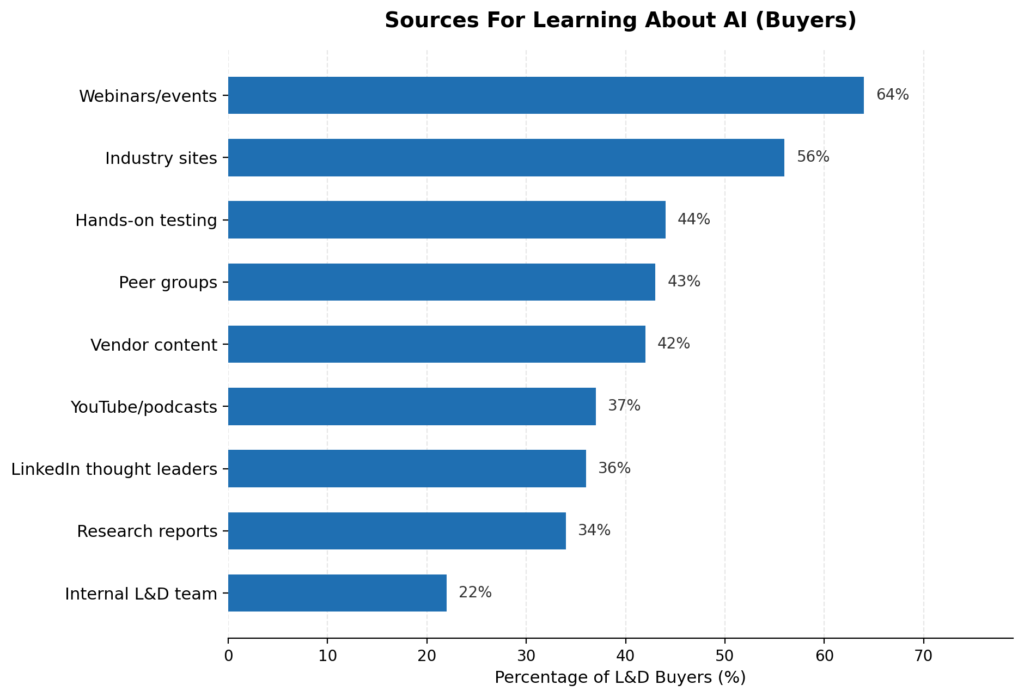
A critical finding of the report is the misalignment between how buyers seek information and how vendors distribute it. Buyers demonstrate a clear preference for interactive, experience-driven education. Approximately 64% of buyers favor webinars and live events, while 56% rely on industry websites for independent analysis. Perhaps most telling is that 44% of buyers prioritize hands-on testing and 43% look to peer groups for validation. These figures suggest that professionals trust the lived experiences of their colleagues and their own direct interactions with software more than marketing collateral.
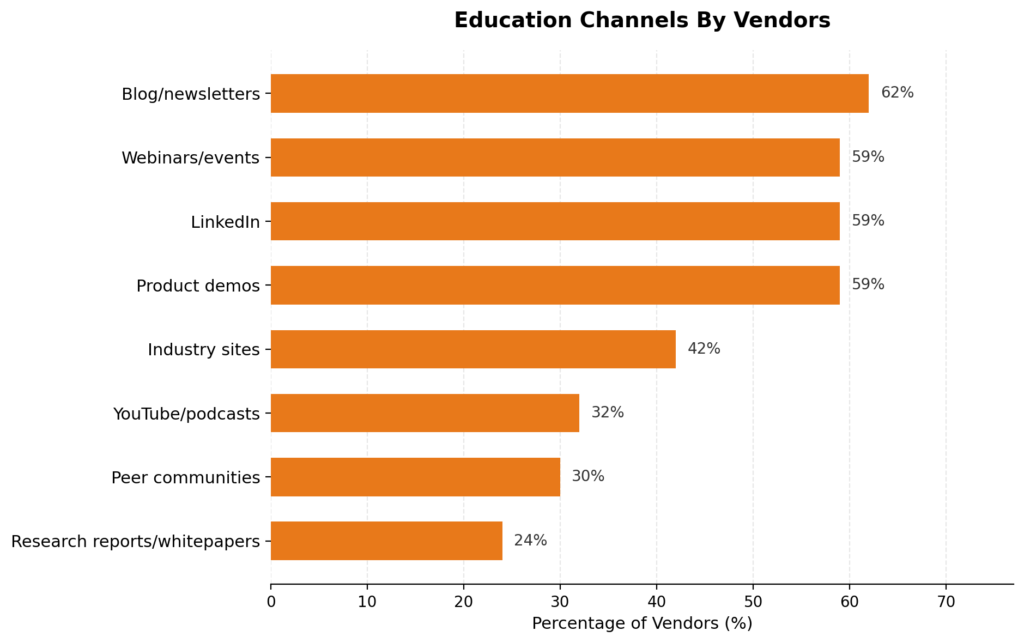
Conversely, vendors continue to lean heavily on "owned" channels. The data shows a concentration of vendor efforts in blogs, newsletters, LinkedIn updates, and structured product demonstrations. While these are efficient for broad messaging, they often fail to address the specific, nuanced concerns of buyers who are looking for social proof and independent verification. This market signal suggests that vendors who pivot toward facilitating peer-to-peer discussions and providing "sandbox" environments for hands-on experimentation will likely see higher conversion rates and stronger brand trust.
The Pragmatic Buyer: Requests and Requirements
When L&D leaders engage with vendors, their inquiries have become increasingly specific. The report identifies several recurring themes that dominate buyer-vendor conversations in 2026. The primary driver of interest remains content creation and personalization. Buyers are looking for AI that can significantly reduce the "time to market" for new training programs while simultaneously tailoring that content to individual learner needs.
However, the conversation quickly shifts from "what it can do" to "how it is governed." Security and privacy remain paramount. As global data protection regulations have matured, L&D leaders are asking pointed questions about data residency, model training sources, and the potential for algorithmic bias. Integration is another high-priority area; rather than seeking new standalone AI "islands," 2026 buyers are demanding that AI capabilities function within their existing ecosystems. They want AI that enhances their current LMS, HRIS, and communication tools (such as Slack or Microsoft Teams) rather than requiring a complete overhaul of their tech stack.
The Training Gap: A Demand for Hands-on Learning
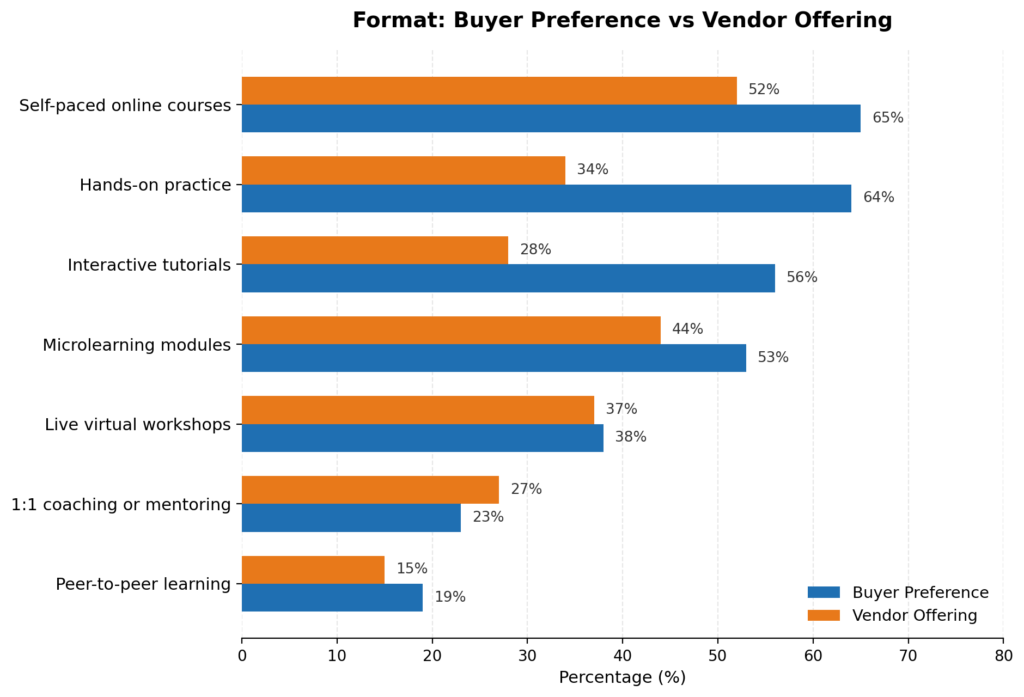
The preferred formats for AI training reveal one of the most significant disparities in the current market. Buyers overwhelmingly favor self-paced learning (65%) and hands-on practice (64%). Interactive tutorials (56%) and microlearning (53%) also rank highly. These preferences indicate a workforce that wants to learn "in the flow of work" and through direct application.
Despite this, vendor offerings are not fully aligned with these needs. While many vendors provide self-paced documentation and microlearning videos, there is a notable shortage of interactive tutorials and hands-on practice opportunities. This lack of "guided experimentation" can lead to a "usage cliff," where an organization purchases an AI-powered tool but fails to achieve high adoption rates because the users do not feel confident in their practical skills. The market signal is clear: the demand for practical AI training currently exceeds the supply, creating a major opportunity for vendors who can provide robust, interactive learning paths.
Investment Sentiment and the "Value-Added" Pricing Model
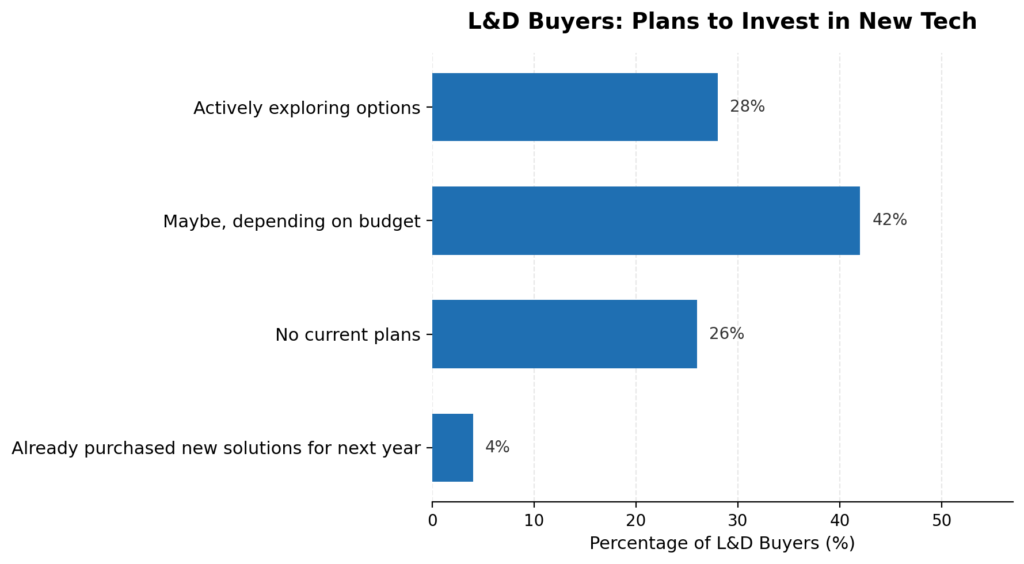
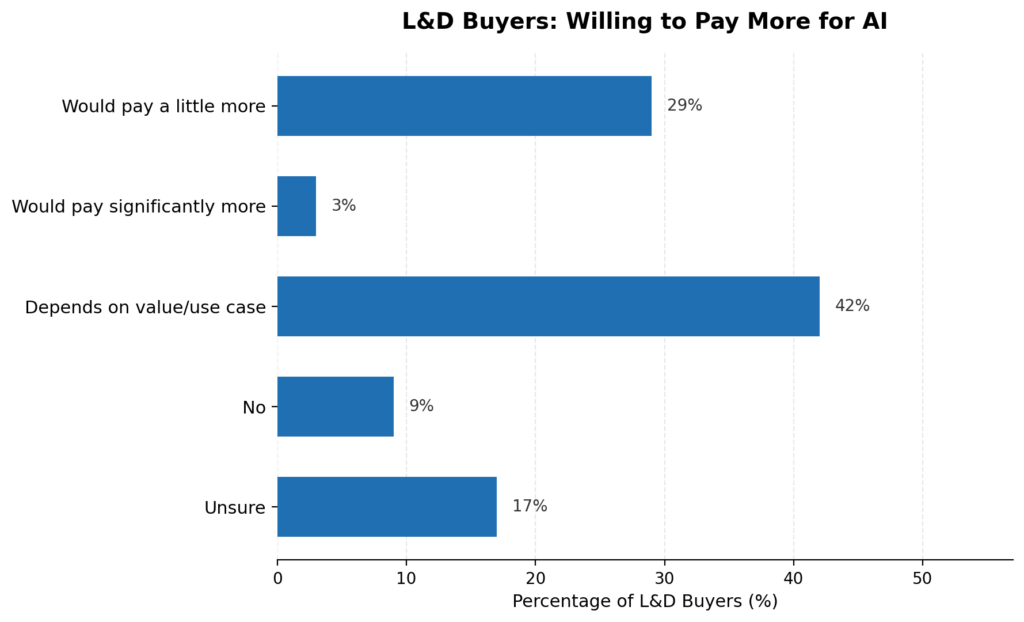
Financial commitment to AI in 2026 is characterized by "cautious optimism." While there is a strong desire to innovate, budget realities are a significant constraint. The report indicates that 42% of buyers tie their purchasing decisions directly to "available resources and demonstrated value." This is a departure from the "fear of missing out" (FOMO) buying patterns seen in previous years.
Pricing models for AI remain fragmented across the industry. Only 3% of buyers express a willingness to pay significantly more for AI capabilities as a standalone feature. Instead, 42% of respondents state that their willingness to pay is contingent on proven outcomes and specific use cases. On the vendor side, some are including AI as part of their standard subscription, while others are treating it as a premium add-on or a usage-based cost. This lack of a dominant monetization model suggests that the market is still in a discovery phase. Vendors who can quantify the ROI of their AI features—for example, by showing a 30% reduction in content development costs—are far more likely to secure budget approval than those selling "innovation" as an abstract concept.
Skills for the AI Era: Beyond Technical Proficiency
Perhaps the most profound shift identified in the 2026 report is the revaluation of human skills. While technical fluency is necessary, it is no longer sufficient. Both buyers and vendors agree that "Critical Thinking" is the most essential skill for the AI era, cited by 67% of buyers and 61% of vendors. This is followed closely by "Adaptability," reflecting the need for a workforce that can pivot as AI capabilities continue to evolve.
A notable divergence appears in the prioritization of specific technical skills. Buyers place a much higher emphasis on "Prompt Engineering" (59%) compared to vendors (41%). This suggests that those on the front lines of implementation are acutely aware of the need to effectively "communicate" with AI systems to get high-quality outputs. Furthermore, buyers are more concerned with data literacy, ethical reasoning, and emotional intelligence. These "soft skills" are increasingly viewed as the necessary guardrails for AI, ensuring that technology enhances rather than replaces human judgment.
Broader Impact and Industry Implications
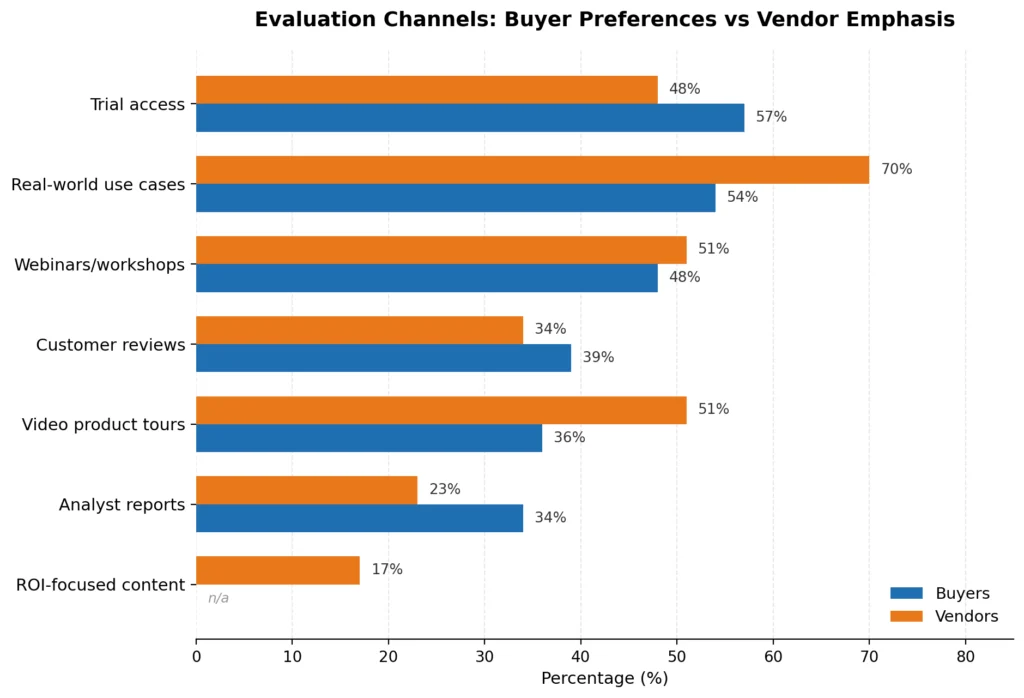
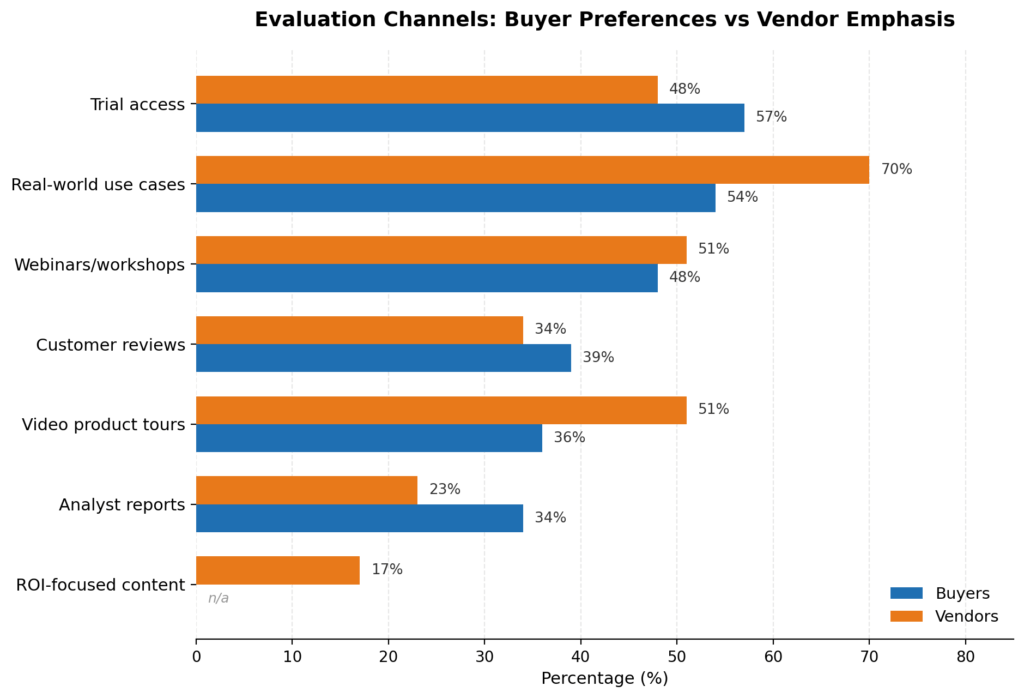
The findings of the 2026 report suggest that the L&D industry is reaching a point of maturity regarding artificial intelligence. The "Expectation Gap" is not merely a hurdle but a roadmap for the future. For vendors, the path forward involves moving away from feature-focused marketing and toward value-based validation. This includes leveraging customer reviews, analyst reports, and measurable business outcomes to build the "proof of value" that buyers now require.
For L&D leaders, the challenge lies in balancing the urgency of AI adoption with the necessity of ethical governance and human-centric design. The organizations that succeed in this era will be those that view AI as a collaborative partner rather than a total replacement for human expertise. As AI becomes more accessible, the competitive advantage will shift from those who have the technology to those who have the most skilled, adaptable, and critically-minded people using it.
In conclusion, the 2026 landscape for AI in L&D is one of transition. The focus has moved from the "wow factor" of generative AI to the "work factor"—how these tools actually perform in a high-stakes corporate environment. By closing the gap between vendor innovation and buyer expectation, the industry can finally move toward a future where AI-powered learning is not just a promise, but a proven driver of organizational performance.