
The modern talent acquisition landscape is fraught with challenges, none more acutely felt by organizations than the pervasive issue of candidate reneges. In an increasingly competitive job market, where top talent often fields multiple offers, the period between an accepted offer and a candidate’s first day represents a significant vulnerability for employers. Historically, many recruitment programs have lacked a structured process to monitor candidates during this crucial pre-start phase, often discovering a renege only after the fact. By the time a promising candidate goes silent, their decision to withdraw has frequently been solidified, leaving organizations scrambling to backfill critical roles and incurring substantial financial and operational costs. A new paradigm, however, is gaining traction: the systematic application of engagement health scorecards, which treat candidate engagement signals as leading indicators of potential attrition, allowing for timely and targeted interventions.
The Silent Threat: Unpacking the Costs of Candidate Renege
The impact of candidate reneges extends far beyond the immediate frustration of a lost hire. Industry data consistently points to significant financial repercussions. According to a study by the Society for Human Resource Management (SHRM), the average cost-per-hire can range from $4,000 to over $15,000, depending on the role and industry. When a candidate reneges, this investment—encompassing recruiter time, advertising, interview processes, and background checks—is effectively wasted. Furthermore, the need to re-initiate the hiring process for the same position incurs these costs a second time. Beyond direct expenses, there are indirect costs such as lost productivity due due to prolonged vacancies, increased workload on existing staff, and potential delays in project timelines or strategic initiatives. For highly specialized roles, the talent pool is often shallow, making a renege particularly devastating and the backfill process lengthy and arduous. Some estimates suggest that the total cost of replacing an employee, including the lost productivity, can be as high as 1.5 to 2 times their annual salary. This financial drain underscores the critical need for proactive strategies to safeguard accepted offers.
Evolution of Talent Acquisition: From Reactive to Proactive Engagement
For decades, the post-offer, pre-start phase in recruitment was largely a period of passive waiting. Once an offer was accepted, communication often tapered off, with the assumption that the candidate was fully committed. This approach, however, failed to acknowledge the dynamic nature of the job market and the psychological journey of a candidate. Even after accepting an offer, individuals may continue to receive or solicit competing offers, experience personal circumstances that alter their plans, or simply develop uncertainties about their decision. The lack of structured engagement during this vulnerable period inadvertently creates an environment where these external pressures or internal doubts can fester, ultimately leading to withdrawal.
The shift towards proactive engagement reflects a broader evolution in talent acquisition, moving from a transactional model to one focused on candidate experience and relationship management. Modern recruitment recognizes that the candidate journey does not end with an accepted offer but extends through onboarding and beyond. This perspective necessitates continuous, strategic interaction designed to reinforce the candidate’s decision, address potential concerns, and maintain a high level of excitement and commitment. The advent of sophisticated HR technology and data analytics has provided the tools necessary to implement such proactive strategies effectively, transforming what was once a blind spot into a measurable and manageable phase of the hiring process.
The Engagement Health Scorecard: A Framework for Predictive Intervention
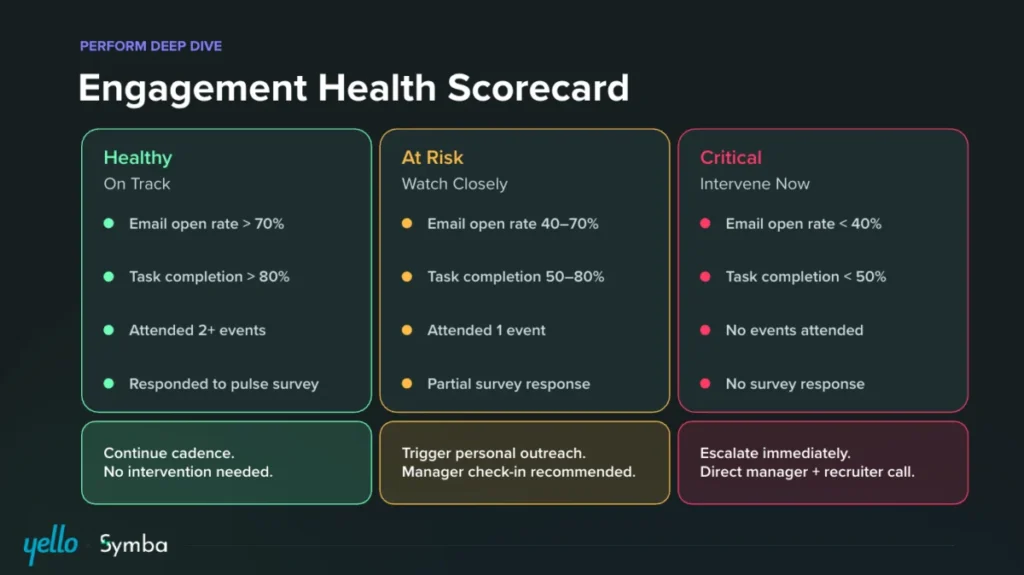
Central to this new proactive approach is the Engagement Health Scorecard, a systematic methodology designed to categorize candidates based on their observable behaviors and interactions during the critical pre-start period. This scorecard leverages various data points to generate an "engagement health" status, serving as a predictive indicator of a candidate’s likelihood to remain committed. By shifting focus from reactive problem-solving to proactive risk management, organizations can identify warning signs early and deploy targeted interventions before a candidate’s decision to renege becomes irreversible.
The scorecard typically monitors a range of behaviors, including but not limited to:
- Email Open Rates: A fundamental indicator of whether a candidate is actively consuming communications.
- Task Completion: Engagement with pre-onboarding tasks, paperwork, or requested information.
- Event Attendance: Participation in virtual or in-person company events, webinars, or meet-and-greets.
- Survey Responses: Completion and timeliness of feedback surveys.
- Activity on Internal Platforms: Engagement with internal social platforms, employee portals, or learning modules if provided.
- Responsiveness to Outreach: The speed and nature of replies to direct messages or calls.
Based on these metrics, candidates are typically grouped into distinct categories, each requiring a specific strategic response.
Deconstructing the Scorecard Tiers and Targeted Interventions
1. Healthy Candidates: Sustaining Momentum and Reinforcing Commitment
Candidates categorized as "Healthy" exhibit strong and consistent engagement. This group typically demonstrates email open rates above 70%, promptly completes required tasks, actively participates in multiple pre-start events, and provides timely responses to surveys. For these candidates, the primary objective is to maintain the positive momentum and reinforce their commitment. The recommended action is to continue the established communication cadence, ensuring a steady stream of engaging content, relevant information about their upcoming role, team, and company culture, and opportunities for continued interaction. This sustained engagement helps to solidify their decision, build excitement, and prevent external factors from swaying their commitment. It’s about nurturing the positive relationship already established and ensuring they feel valued and connected even before their first day.
2. At-Risk Candidates: The Critical Window for Personalized Outreach
The "At-Risk" category signals a noticeable decline in engagement, serving as a crucial early warning. These candidates might show email open rates between 40-70%, limited attendance at optional events, or incomplete and delayed survey responses. This declining engagement is a strong indicator that the candidate might be experiencing doubts, considering other offers, or facing personal challenges. The intervention window for this group is narrow and requires immediate, personalized outreach, ideally within 48 hours of detecting the dip in engagement.
Effective interventions for at-risk candidates include:
- Direct Message from the Program Manager: A personalized message expressing excitement for their start date and offering support or to answer any questions. This message should feel individual, not a generic mass email.
- Targeted Event Invitation: An invitation to an upcoming event that is specifically tailored to their interests or role, again emphasizing a personal touch rather than a broad distribution.
- Hiring Manager Check-in: A brief, informal call or message from their prospective hiring manager. This direct connection can significantly reassure the candidate, reinforce the team connection, and provide an opportunity to address any unspoken concerns.
- "Why Us?" Reinforcement: Sharing specific anecdotes or benefits of the company/team that might appeal to the candidate’s specific career goals or values.
These interventions are designed to quickly re-engage the candidate, identify potential issues, and demonstrate the organization’s commitment to their success and well-being. Often, a timely, personal touch can quickly turn things around.
3. Critical Candidates: Immediate Escalation and Root Cause Analysis
"Critical" candidates represent the highest level of disengagement and pose the most immediate threat of renege. Their behavior typically includes email open rates below 40%, no attendance at any pre-start events, no survey responses, and a complete lack of activity for three or more weeks. This severe disengagement necessitates immediate and high-level escalation.
Interventions for critical candidates are urgent and direct:
- Direct Call from the Hiring Manager: A personal phone call from the hiring manager is paramount. This conversation should be empathetic, aiming to understand the underlying issues rather than accuse or pressure.
- Personal Touchpoint from the Recruiter: The recruiter, who often has the longest-standing relationship with the candidate, should also reach out with a personal call, offering support and attempting to uncover the root cause.
- Real Conversation: The goal of these communications is to initiate an honest dialogue about "what’s going on." Common root causes include competing offers (often with better compensation or perceived benefits), unexpected personal circumstances (family issues, relocation problems), or simple uncertainty about the role or company culture that has not been adequately addressed.
- Problem-Solving Approach: If a competing offer is the issue, the organization might consider a counter-offer or highlight non-monetary benefits. If it’s personal circumstances, exploring flexibility or support options could be viable. If it’s uncertainty, providing additional information, connecting them with future colleagues, or scheduling another informal chat can help.
Catching these issues in time allows the organization a final opportunity to address concerns, re-engage the candidate, and potentially prevent a costly renege.
The Data Imperative: Continuous Monitoring and Strategic Insight
The fundamental difference between organizations that successfully retain candidates and those that are constantly scrambling to backfill positions lies in their approach to data. Successful teams continuously monitor engagement data, treating it as a dynamic, real-time indicator of candidate health. This continuous scrutiny allows for proactive intervention rather than reactive damage control. It moves talent acquisition beyond anecdotal evidence and gut feelings, grounding it in measurable outcomes.
Beyond preventing individual reneges, the aggregated data from an Engagement Health Scorecard offers invaluable strategic insights. Analyzing trends over time can reveal:
- Weaknesses in the Recruitment Process: Are candidates consistently becoming "At-Risk" at a specific point in the pre-start journey? This might indicate a gap in communication, insufficient pre-onboarding resources, or a problematic aspect of the candidate experience.
- Effectiveness of Engagement Strategies: Which types of communications, events, or touchpoints yield the highest engagement? This data can inform and optimize future engagement strategies.
- Competitive Landscape Insights: If a high percentage of "Critical" candidates cite competing offers, it might signal a need to re-evaluate compensation packages, benefits, or employer branding in specific markets.
- Predictive Analytics for Future Programs: Over time, the scorecard data can be used to build more sophisticated predictive models, further refining the ability to identify at-risk candidates even earlier.
Broader Implications and Strategic Advantages
The adoption of an Engagement Health Scorecard and a proactive engagement strategy offers a multitude of strategic advantages for organizations:
- Financial Savings and Enhanced ROI: By significantly reducing renege rates, organizations save substantial costs associated with repeated recruitment efforts, lost productivity, and administrative overhead. This translates directly into improved return on investment for talent acquisition functions.
- Enhanced Candidate Experience and Employer Brand: A proactive, caring approach to candidate engagement demonstrates that an organization values its future employees even before their start date. This positive experience can lead to higher satisfaction, increased loyalty, and positive word-of-mouth referrals, strengthening the employer brand in the long term.
- Operational Efficiency and Stability: Reducing the need to scramble for backfills creates a more stable and predictable hiring pipeline. This allows HR and hiring managers to focus on strategic initiatives rather than crisis management, improving overall operational efficiency.
- Improved Employee Retention: Candidates who feel genuinely engaged and supported during the pre-start phase are more likely to have a positive initial experience, contributing to higher long-term retention rates. This seamless transition from candidate to employee fosters early loyalty and integration.
- Data-Driven Decision Making: The scorecard provides tangible data that informs not just individual interventions but also broader talent strategies, allowing for continuous improvement of the entire recruitment lifecycle.
Expert Perspectives and Industry Trends
Leading HR professionals and talent acquisition experts increasingly emphasize the strategic importance of candidate experience and data analytics. "In today’s candidate-driven market, the relationship begins long before day one," states Dr. Emily Chen, a prominent talent strategist. "Organizations that invest in understanding and nurturing that relationship through structured engagement frameworks like health scorecards are seeing tangible results in offer acceptance and retention." Another industry veteran, Mark Johnson, Head of Talent at a major tech firm, adds, "The cost of inaction on candidate engagement is simply too high. We’ve moved beyond hoping candidates show up; we’re actively ensuring they do by creating a compelling, continuous journey from offer to onboarding." This sentiment reflects a growing consensus that passive recruitment is an outdated model, replaced by an imperative for dynamic, data-informed interaction.
Beyond the Scorecard: The KEEP Playbook and Continuous Improvement
The Engagement Health Scorecard is often part of a more comprehensive strategy. Resources like "The KEEP Playbook," for instance, typically include not only the full engagement health scorecard with detailed thresholds and recommended actions for each tier but also a step-by-step intervention playbook and a post-cycle review template. The intervention playbook provides practical guidance on how to conduct personalized outreach, what questions to ask, and how to address common candidate concerns. The post-cycle review template is crucial for continuous improvement, enabling organizations to analyze their performance after each hiring program, identify areas for refinement, and adapt their strategies based on real-world outcomes. This iterative process ensures that talent acquisition strategies remain agile and effective in a constantly evolving market.
In conclusion, the era of passive post-offer management is rapidly receding. Organizations that thrive in the competitive talent landscape are those that embrace proactive, data-driven candidate engagement. By implementing sophisticated tools like the Engagement Health Scorecard, companies can transform the vulnerable pre-start period into an opportunity to strengthen candidate commitment, mitigate the significant risks and costs associated with reneges, and ultimately build a more robust, stable, and satisfied workforce. The continuous monitoring of engagement signals, coupled with targeted and empathetic interventions, is no longer merely a best practice but a strategic imperative for sustained organizational success.






