The modern talent acquisition landscape is increasingly defined by its dynamism and volatility, presenting organizations with a persistent challenge: the pre-start candidate renege. This critical period, stretching from the moment an offer is accepted to the candidate’s actual start date, often represents a significant vulnerability in the hiring process. Traditionally, many recruitment programs have operated without a structured process to manage this interim phase, leaving teams to discover a renege only after it has materialized. By the time a promising candidate goes silent, having disengaged from pre-onboarding communications, they have frequently already made a definitive decision to withdraw, leaving companies scrambling to backfill critical roles.
The Silent Threat of the Pre-Start Period
The period between offer acceptance and the first day of employment is deceptively crucial. While an offer acceptance signals a commitment, it is not an ironclad guarantee. During this window, candidates are susceptible to various influences that can lead to a change of heart. These include receiving competing offers, encountering unforeseen personal circumstances, or simply experiencing "cold feet" and uncertainty about the career transition. For organizations, the traditional reactive approach – where a renege is acknowledged only after a candidate explicitly communicates their withdrawal or fails to show up – is not merely inefficient; it is economically detrimental and strategically shortsighted.
Industry reports consistently highlight the prevalence of candidate reneges. Depending on the sector, seniority, and economic climate, renege rates can range from 10% to as high as 20% for certain highly sought-after positions. In highly competitive fields such as technology, healthcare, and specialized engineering, where demand often outstrips supply, candidates frequently receive multiple offers, making the pre-start period a battleground for commitment. The absence of a proactive engagement strategy during this vulnerable phase leaves organizations exposed, transforming a presumed hiring success into an unexpected recruitment setback.
The Economic Imperative: Quantifying the Costs of Candidate Renege
The financial implications of a candidate renege extend far beyond the immediate need to restart a search. Each renege represents a significant drain on organizational resources, impacting budgets, productivity, and team morale. The costs can be broadly categorized:
- Direct Recruitment Costs: These include the expenses already incurred during the initial recruitment cycle – advertising, background checks, assessment tools, recruiter time, interview panel time, and offer letter generation. These costs are often entirely lost when a candidate reneges.
- Lost Productivity: A vacant position directly translates to lost productivity. Projects may be delayed, existing team members become overburdened, and strategic initiatives can stall. The opportunity cost of not having the right talent in place can be substantial, particularly for revenue-generating or mission-critical roles.
- Onboarding and Training Investment: While a full onboarding process might not have commenced, preliminary steps such as system access provisioning, equipment ordering, and initial training scheduling might have begun. These efforts are wasted.
- Impact on Team Morale: Frequent reneges can demoralize hiring managers and existing teams who anticipate new support or expertise. The repeated cycle of expectation and disappointment can erode confidence in the recruitment process.
- Brand and Reputation Damage: A poor pre-start experience, even if it doesn’t lead to a renege, can result in negative word-of-mouth, impacting the employer’s brand reputation and making future recruitment more challenging.
Estimates vary, but the cost of replacing a reneged hire can range from thousands to tens of thousands of dollars, depending on the role’s complexity and seniority. For executive positions, these figures can escalate dramatically. Beyond the quantifiable costs, the qualitative impact on innovation, market responsiveness, and strategic execution can be profound. This stark reality underscores the urgent need for a paradigm shift in how organizations manage their talent pipeline post-offer.
Emergence of Proactive Strategies: A Shift in Paradigm
The recognition of these significant challenges has spurred a fundamental shift in talent acquisition philosophy, moving from a purely transactional model to one that prioritizes relationship building and continuous engagement. This evolution has been significantly aided by advancements in HR technology and data analytics, enabling companies to gather and interpret engagement signals in real-time.
Historically, the focus was primarily on attracting and selecting candidates. Once an offer was extended and accepted, the process was often deemed complete until the start date. However, the rise of candidate-centric markets and the increasing sophistication of competing employers have highlighted the inadequacy of this hands-off approach. Companies began to realize that the "pre-start" phase is not a passive waiting period but an active engagement opportunity.
The development of structured, data-driven methodologies like the Engagement Health Scorecard represents the culmination of this evolving understanding. Instead of waiting for a "renege email," organizations are now adopting proactive measures designed to identify and address potential disengagement long before it escalates into a withdrawal. This shift transforms candidate management from a reactive damage control exercise into a strategic retention initiative, leveraging data as a leading indicator of commitment.
Deconstructing the Engagement Health Scorecard: A Framework for Retention
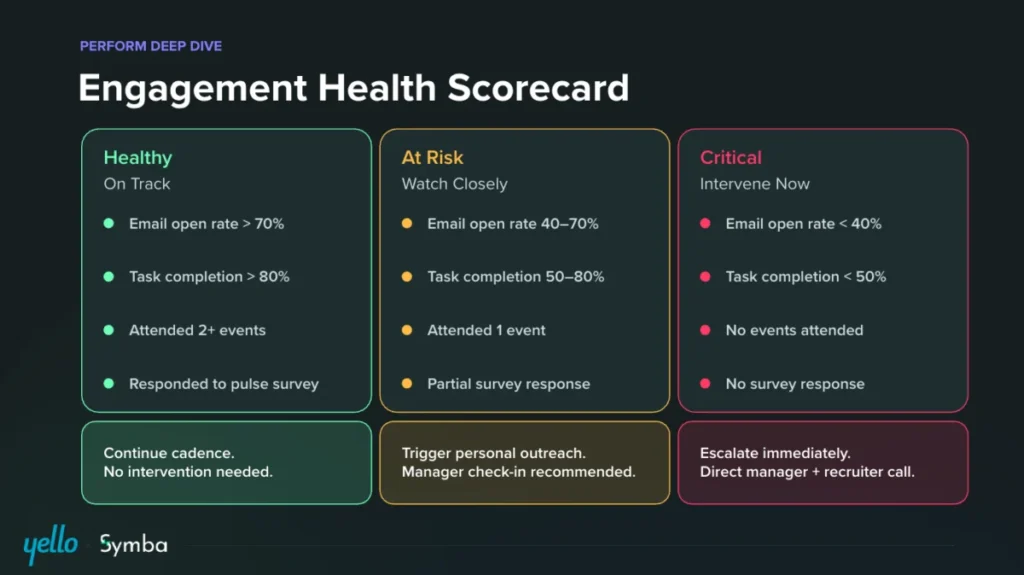
The Engagement Health Scorecard is a sophisticated, data-driven framework designed to continuously monitor and assess the commitment level of candidates during the critical pre-start period. Its core principle is to treat engagement signals as leading indicators, allowing organizations to intervene proactively rather than reactively. The scorecard categorizes candidates into three distinct groups based on their behavior and interaction with pre-onboarding communications and activities: Healthy, At-Risk, and Critical.
-
Healthy Candidates:
- Indicators: These candidates exhibit high levels of engagement. They are consistently opening emails at a rate above 70%, promptly completing assigned pre-onboarding tasks (e.g., submitting documentation, setting up profiles), actively attending multiple pre-start events (virtual meet-and-greets, informational webinars), and providing comprehensive responses to surveys. Their behavior suggests strong interest and commitment.
- Recommended Actions: For healthy candidates, the strategy is to "continue the cadence and stay the course." This involves maintaining the established communication schedule, providing relevant updates, and ensuring a smooth, consistent experience. The goal is to reinforce their positive disposition and sustain their enthusiasm until their start date. Over-engagement could potentially be counterproductive, so a balanced approach is key.
-
At-Risk Candidates:
- Indicators: These candidates show a noticeable decline in engagement. Their email open rates fall into the 40-70% range, their attendance at pre-start events is limited or inconsistent, and their survey responses might be incomplete or delayed. This declining engagement serves as an early warning sign that their commitment may be wavering or that they might be experiencing unresolved concerns.
- Recommended Actions: Candidates in the "At-Risk" category require immediate and personalized outreach, ideally within 48 hours of detecting the engagement dip. General, mass-distributed communications are insufficient at this stage. Effective interventions include:
- Personal Message from the Program Manager: A direct, empathetic message from the individual overseeing their pre-onboarding journey can signal genuine care.
- Individualized Event Invitation: Instead of a generic invite, a personalized message highlighting why a specific event would be beneficial to them can increase attendance.
- Hiring Manager Check-in: A brief, informal check-in from the future hiring manager can reinforce the candidate’s value to the team and offer an opportunity to address any nascent concerns. Often, these personal touches can quickly re-engage the candidate and alleviate uncertainties.
-
Critical Candidates:
- Indicators: Candidates in this category display almost no engagement whatsoever. Their email open rates are consistently below 40%, they have attended no pre-start events, submitted no survey responses, and shown no activity in three or more weeks. This severe lack of engagement strongly indicates a high probability of renege.
- Recommended Actions: "Critical" candidates necessitate immediate and escalated intervention. This stage requires direct, high-touch communication to understand the root cause of their disengagement. Key actions include:
- Direct Call from the Hiring Manager: A personal call from the future manager underscores the importance of the candidate to the team and organization, and often serves as the most impactful intervention.
- Personal Touchpoint from the Recruiter: The recruiter, who has built a relationship with the candidate, should also reach out directly to offer support and inquire about their status.
- Real Conversation: The objective of these interactions is not just to re-engage but to have an honest conversation about what is happening. Often, the root cause is a competing offer, a significant personal circumstance, or simple unresolved uncertainty. Catching these issues in time allows the organization to potentially address them, whether through clarifying doubts, negotiating terms, or offering support for personal challenges.
The Data-Driven Advantage: From Reactive to Predictive
The fundamental difference between organizations that successfully retain candidates and those that frequently scramble to backfill positions lies in their approach to data. The first group continuously monitors engagement data, recognizing that early signals are far more valuable than post-factum explanations. They leverage data analytics to transform candidate management from a largely intuitive, reactive process into a predictive, strategic one.
By adopting an Engagement Health Scorecard, companies move beyond the "hope and wait" strategy. They gain actionable insights into candidate sentiment and commitment, allowing for targeted, timely interventions. This data-driven approach not only reduces renege rates but also provides invaluable feedback loops for optimizing the entire recruitment and onboarding process. Specialized platforms, such as those referenced in the KEEP Playbook, provide the technological infrastructure to track these metrics, automate communications, and alert teams to changes in candidate health, making the implementation of such a scorecard practical and scalable.
Voices from the Industry: Experts Weigh In
HR analysts and talent acquisition leaders increasingly emphasize the strategic importance of proactive candidate engagement. "The candidate experience doesn’t end with an accepted offer; it truly begins there," states Dr. Evelyn Reed, a prominent organizational psychologist specializing in talent retention. "Companies that fail to nurture this relationship post-offer are essentially leaving money on the table and exposing themselves to unnecessary risk. The Engagement Health Scorecard provides a structured, data-backed methodology to mitigate that risk effectively."
Recruitment technology experts also highlight the necessity of integrated systems. "Modern recruitment platforms are no longer just about applicant tracking; they are about candidate relationship management," explains Marcus Thorne, CEO of a leading HR tech consultancy. "The ability to track engagement signals, automate personalized outreach, and provide hiring managers with clear intervention protocols is becoming a non-negotiable feature for competitive talent acquisition teams." These sentiments underscore a growing consensus that a proactive, data-informed approach to pre-start candidate management is a hallmark of sophisticated and effective talent strategies.
Broader Implications for Talent Management and Employer Branding
The adoption of an Engagement Health Scorecard extends its benefits far beyond merely reducing renege rates. It has profound implications for broader talent management strategies and an organization’s employer brand:
- Improved Candidate Experience: A well-executed engagement strategy ensures candidates feel valued and informed, even if they ultimately do not join the company. This positive experience can lead to positive word-of-mouth, enhancing the company’s reputation as an employer of choice.
- Strengthened Employer Brand: Organizations that demonstrate genuine care and commitment to their candidates from offer to start date project an image of professionalism, transparency, and employee-centricity. This strengthens their employer brand, making them more attractive to future talent.
- Enhanced Onboarding Success: Candidates who are actively engaged and supported during the pre-start phase are more likely to arrive on their first day feeling prepared, excited, and integrated. This leads to faster ramp-up times, higher initial productivity, and ultimately, greater long-term retention.
- Strategic Workforce Planning: By gaining better visibility into the health of their candidate pipeline, organizations can achieve more accurate workforce planning. They can anticipate potential shortfalls earlier and adjust recruitment strategies accordingly, reducing last-minute panic hires.
- Competitive Edge: In a fiercely competitive talent market, companies that proactively manage their pre-start candidates gain a significant competitive advantage. They not only secure more of their accepted offers but also cultivate a reputation for superior candidate care, further attracting top talent.
Implementing the Scorecard: Practical Considerations and Continuous Improvement
Successfully implementing an Engagement Health Scorecard requires more than just understanding its principles; it demands clear processes, dedicated resources, and ongoing commitment. Organizations must:
- Define Clear Thresholds and Actions: As outlined, specific percentages for email open rates and clear definitions of event attendance or task completion are crucial. Each threshold must be tied to a specific, actionable intervention.
- Assign Responsibilities: Clearly define who is responsible for monitoring the scorecard, initiating outreach for "At-Risk" candidates, and escalating "Critical" cases. This often involves collaboration between recruiters, hiring managers, and program managers.
- Integrate Technology: Leverage recruitment marketing platforms, applicant tracking systems (ATS), and customer relationship management (CRM) tools that can track engagement metrics, automate communications, and provide real-time alerts.
- Train Staff: Recruiters, hiring managers, and anyone involved in candidate engagement must be trained on the scorecard’s methodology, the importance of each intervention tier, and best practices for personalized communication.
- Conduct Post-Cycle Reviews: After each hiring cycle, conduct a thorough review of the scorecard’s effectiveness. Analyze renege rates, intervention success rates, and candidate feedback. Use these insights to refine thresholds, actions, and overall strategy. The KEEP Playbook, for instance, includes a post-cycle review template specifically designed for this purpose, enabling continuous improvement with every program.
In conclusion, the era of reactive talent acquisition is rapidly drawing to a close. The sophisticated challenges of securing and retaining top talent in today’s dynamic market necessitate a strategic, data-driven approach. The Engagement Health Scorecard represents a powerful framework for this new paradigm, transforming the vulnerable pre-start period into an active opportunity for relationship building and retention. By treating engagement signals as leading indicators and implementing timely, personalized interventions, organizations can dramatically reduce candidate reneges, safeguard their talent pipeline, and fortify their position as an employer of choice. This proactive stance is no longer a luxury but a fundamental necessity for organizational success in the modern talent landscape.