The modern talent acquisition landscape is undergoing a profound transformation, driven by an increasing global emphasis on diversity, equity, and inclusion (DEI). Central to this shift is the emergence of sophisticated software solutions designed to scan job descriptions for biased language, score them for inclusivity, and ultimately broaden applicant pools. These diversity tools, ranging from basic gender decoders to advanced AI-powered platforms, are becoming indispensable assets for organizations committed to building diverse and high-performing teams. Leading the charge in this innovative sector are established options such as Ongig’s Text Analyzer, Textio, and Gender Decoder, alongside a new wave of analytical and generative AI platforms.
The Imperative for Inclusive Hiring: A Shifting Paradigm
For decades, hiring practices inadvertently perpetuated systemic biases, often through the very language used in job advertisements. Research consistently demonstrates that seemingly innocuous words can subtly deter certain demographic groups from applying. For instance, words like "aggressive," "dominant," or "rockstar" are often perceived as masculine-coded, while terms like "supportive," "collaborative," or "nurturing" can be seen as feminine-coded. Beyond gender, biases related to race, age, disability, and socioeconomic status can also be embedded in job postings, significantly narrowing the talent funnel.
The economic and social costs of non-inclusive hiring are substantial. Studies from McKinsey & Company, Deloitte, and Harvard Business Review repeatedly highlight that diverse teams are more innovative, make better decisions, and outperform their less diverse counterparts financially. Companies in the top quartile for gender diversity on executive teams are 21% more likely to outperform on profitability, and those in the top quartile for ethnic/cultural diversity are 33% more likely. Conversely, a lack of diversity can lead to groupthink, reduced creativity, and a failure to understand broad customer bases, ultimately impacting market competitiveness and brand reputation.
The push for DEI is not merely an ethical consideration; it is a strategic business imperative. Regulatory bodies globally are also increasing scrutiny on fair hiring practices, making proactive measures to mitigate bias essential for legal compliance. This backdrop has fueled a rapid evolution in recruitment technology, with a particular focus on tools that can objectively identify and rectify bias in the earliest stages of the hiring process: the job description.
The Evolution of Bias Detection in Job Descriptions
The journey towards automated bias detection began with relatively simple tools primarily focused on gender-coded language. These early solutions, often based on academic research into word associations, provided a foundational understanding of how language subtly influences applicant behavior. Over time, as understanding of unconscious bias expanded, so too did the capabilities of these tools. They evolved to detect a wider spectrum of biases, encompassing racial, age-related, and disability biases, reflecting a more holistic approach to inclusivity.
Today, the market offers a diverse array of tools, categorized broadly into bias and language checkers, DEI analytics and culture tools, and AI-powered job description generators. Each category addresses different facets of the inclusive hiring challenge, offering solutions for identifying existing biases, measuring diversity metrics, and proactively creating inclusive content from scratch.
Bias and Language Checkers: The Frontline Defense
These tools are designed to meticulously scan job descriptions, flagging problematic language and suggesting inclusive alternatives. They act as a critical first line of defense against unintentional bias.
-
Text Analyzer by Ongig: Developed after extensive experience rewriting job descriptions for major global brands, Ongig’s Text Analyzer stands out for its comprehensive approach. Initially focusing on gender bias detection in 2017, it quickly expanded to address other forms of bias, including race, age, and disability. The software features an intuitive dashboard that provides overall and gender bias scores, allowing recruiters to track performance across teams and even benchmark against competitors. Its core strength lies in its extensive library of biased words and phrases, offering immediate, actionable suggestions for more inclusive replacements. For example, it flags terms like "Brown Bag sessions" that might inadvertently alienate certain groups. Beyond bias, Text Analyzer also optimizes for readability, suggesting simpler phrasing for complex sentences and ensuring optimal length for job descriptions. Critically, it employs AI to identify missing sections that candidates value, such as salary, benefits, company mission, and diversity statements, ensuring a complete and attractive offering.
-
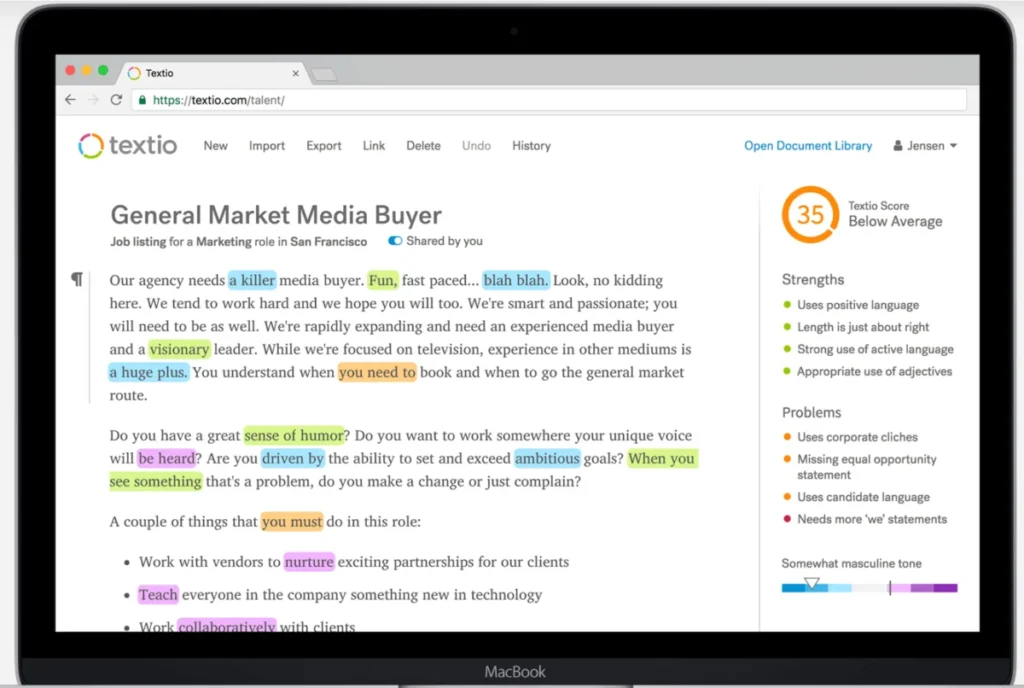
Textio: A prominent player in the augmented writing space, Textio leverages machine learning and real-world job posting outcomes to analyze job description language. It provides a "score" indicating a posting’s likely success, diversity, and neutrality. Textio’s feedback system uses color-coded words to highlight masculine or feminine tones, offering data-driven suggestions for improvement. Its predictive analytics aim to optimize job postings not just for inclusivity but also for speed of hire and quality of applicants, based on a vast dataset of successful and unsuccessful job ads.
-
Gender Decoder: Created by Kat Matfield, this free online tool represents one of the simpler yet effective solutions for gender writing analysis. Based on psychological studies identifying words that differentially attract men and women, Gender Decoder categorizes text as masculine, feminine, or neutral. While it doesn’t offer the breadth of bias detection or advanced features of commercial platforms, its accessibility and direct focus on gender coding make it a valuable resource for small businesses or individuals looking for a quick, initial assessment.
-
Clovers (formerly Talvista): This platform aims to guide hiring teams through a more efficient and inclusive process. Its integrated job description builder reviews text for word choice, positive/negative language, and includes a gender decoder feature. Clovers visually flags masculine words in red and feminine words in green, similar to other tools, providing alternative options to ensure neutrality.
-
The Polite Type: While not exclusively designed for job descriptions, The Polite Type is a free, open-source tool that exemplifies a broader movement towards inclusive language. It automatically rewrites offensive or hurtful words (e.g., racial slurs) with more inclusive alternatives (e.g., "Jewish person" instead of "kike"). Developed in partnership with Finnish youth organizations, it highlights the importance of addressing various forms of bias beyond gender, fostering a more respectful communication environment.
DEI Analytics & Culture Tools: Measuring and Fostering Inclusion
Beyond individual job descriptions, a holistic approach to DEI requires understanding and improving organizational culture and processes. These tools provide broader insights and mechanisms for fostering an inclusive environment.
-
Allie: Operating as a chatbot companion, Allie facilitates continuous DEI efforts within the workplace, often integrating with platforms like Slack. Its capabilities include deploying D&I surveys to gather employee perspectives on inclusion and company culture, ensuring diverse viewpoints are considered in decision-making. Allie also disseminates diversity-related news, keeping teams informed, and provides a feedback mechanism for employees to propose enhancements to DEI initiatives. Crucially, Allie offers diversity training sessions, equipping staff with the knowledge to navigate diverse workplace environments effectively.
-
Blendoor: This diversity analytics and hiring software company focuses on promoting fair and unbiased hiring practices. Blendoor utilizes blind recruitment techniques and sources candidates from diverse backgrounds to mitigate unconscious bias. Its unique "Blendscore" rates organizations’ diversity, equity, and inclusion performance against government data and market benchmarks, providing actionable insights for improvement. Blendoor also offers tools for tracking diversity metrics over time and an assessment tool to identify areas for making hiring processes more inclusive.
-
Diversio: Diversio offers a comprehensive suite of DEI tools aimed at driving meaningful organizational change. Its "Bias Corrector" monitors communication platforms like Slack for cultural insensitivity or unconscious bias. The "Social Media Barometer" tracks public sentiment regarding a company’s D&I record, allowing for proactive reputation management. Perhaps most impactful is its "Recommendation Engine," which uses algorithms to match specific organizational DEI challenges with evidence-based solutions, acting as a strategic advisor for inclusion efforts.
AI Job Description Generators: Proactive Inclusion at Scale
The latest frontier in inclusive hiring technology involves artificial intelligence generating job descriptions from scratch, embedding inclusivity from the outset.
-
Recruitment SMART (SniperAI): This AI-driven job description generator automatically creates optimized ads tailored to a company’s hiring goals. It focuses on role and company specifics to produce impactful and engaging promotions. Users reportedly benefit from an 80% reduction in time spent posting JDs and a 70% increase in content consistency, leading to better candidate matching and higher quality hires. Its built-in equitable hiring tool offers diversity analytics, supports anonymous hiring processes by removing identifiers like name and age, and includes a bias checker for objective candidate data scoring.
-
Manatal: An advanced recruitment automation system, Manatal simplifies the creation of inclusive JDs at scale. Its AI assistant generates descriptions based on user inputs such as company name, role, location, and target recipient. The platform offers a prompt refinement tool, enabling users to optimize JD outcomes for their specific hiring processes. With capabilities for generating numerous JDs per month, Manatal streamlines content creation while aiming for inclusivity.
-
Jasper Chat: As an advanced chatbot utilizing natural language processing (NLP), Jasper Chat allows users to generate structured job descriptions in minutes through conversational prompts. Recruiters simply input vacancy details, and the AI interprets the information to produce comprehensive JDs. Its features include scalable JD creation, ensuring brand voice consistency, and supporting rapid content generation.
-
Skima AI: Skima AI empowers hiring teams to generate high-quality job descriptions by inputting job titles, key skills, and benefits. Its expert algorithm analyzes top-performing JDs to identify "winning recipes" and creates similarly impactful descriptions. Users can easily edit, remove, or regenerate sections, ensuring the final output meets expectations. Skima AI learns from user feedback and best practices, constantly improving to ensure compliance with industry requirements, streamline candidate matching, and significantly reduce drafting time.
Implications and Future Outlook
The proliferation of these diversity tools signifies a pivotal moment in talent acquisition. By automating the detection and correction of biased language, organizations can significantly expand their applicant pools, reaching a wider array of qualified candidates who might otherwise have been deterred. This directly addresses the critical challenge of sourcing diverse talent, which is often cited as a major hurdle in DEI initiatives.
However, the implementation of these tools is not without its considerations. While technology can identify patterns and suggest improvements, human oversight remains crucial. Algorithms must be continuously trained and updated to reflect evolving societal norms and linguistic nuances. Companies must also ensure that the adoption of these tools is part of a broader, genuine commitment to DEI, rather than a superficial tick-box exercise. True inclusion requires systemic changes in company culture, interview processes, promotion pathways, and leadership accountability, with job description tools serving as an important enabler, not a sole solution.
Looking ahead, the integration of AI and machine learning will continue to make these tools more sophisticated, predictive, and personalized. Future iterations may offer real-time feedback during drafting, analyze entire career pages for inclusivity, and even predict the demographic impact of specific word choices with greater accuracy. The ultimate goal remains consistent: to create a hiring ecosystem where every individual feels seen, valued, and encouraged to contribute their unique talents, fostering workplaces that truly reflect the diversity of the global community. Organizations that embrace these technological advancements, coupled with a genuine commitment to inclusion, will be best positioned to attract top talent and thrive in the competitive future of work.