The contemporary corporate landscape is defined by its volatility, complexity, and the rapid pace of technological change. In this environment, the ability of an employee to not only perform technical tasks but also to remain acutely aware of their surroundings has transitioned from a niche requirement to a core organizational competency. Situational awareness (SA)—the capacity to perceive environmental elements, comprehend their significance, and project their future status—is now recognized as a critical factor in mitigating risk, enhancing operational efficiency, and ensuring the safety of personnel across diverse sectors. Originally developed within the high-stakes realms of military aviation and emergency response, SA training is being integrated into the professional development programs of Fortune 500 companies, healthcare systems, and educational institutions worldwide.
The Evolution and Chronology of Situational Awareness
The formal study of situational awareness began in earnest during the mid-20th century, primarily within the United States Air Force. Aviation experts recognized that pilot error was often not a result of a lack of technical skill, but rather a failure to process information correctly under pressure. By the 1980s, Dr. Mica Endsley, a former Chief Scientist of the U.S. Air Force, revolutionized the field by providing a structured theoretical framework that remains the gold standard for training today.
Throughout the 1990s and early 2000s, the application of SA expanded into "High-Reliability Organizations" (HROs), such as nuclear power plants and surgical teams, where the cost of failure is catastrophic. In the last decade, the concept has moved into the general corporate sector. This shift was accelerated by the rise of complex cybersecurity threats, the globalization of supply chains, and an increased societal focus on workplace safety and mental health. Today, SA is viewed as a foundational element of "Resilience Engineering," where organizations focus on their ability to anticipate and adapt to disruptions before they lead to failure.
The Three-Tiered Framework of Cognitive Awareness
Effective situational awareness training is structured around Dr. Endsley’s three levels of mental processing. Understanding these stages is vital for organizations looking to move beyond simple "alertness" toward a culture of proactive intelligence.
Level 1: Perception (Gathering Data)
Perception involves the monitoring and detection of cues in the environment. In a manufacturing setting, this might be the subtle change in the vibration of a lathe; in a corporate office, it could be an unusual pattern of login attempts on a secure server. Training at this level focuses on sensory acuity and the filtering of "noise" to identify relevant signals.
Level 2: Comprehension (Making Sense of Data)
Data without context is useless. Comprehension is the process by which an individual integrates Level 1 signals to understand what is happening. It requires a deep understanding of "normal" operations so that "abnormal" patterns can be interpreted correctly. For instance, a retail manager might notice a group of individuals lingering near an exit; comprehension allows them to determine if this is a benign social gathering or a potential security threat.
Level 3: Projection (Predicting Future States)
The highest level of SA is the ability to forecast what will happen next based on current observations and interpretations. This allows for proactive rather than reactive decision-making. A logistics coordinator who projects that a coming storm front will delay a shipment can reroute assets hours before the disruption occurs, saving the company significant capital.
Data-Driven Imperatives for Modern Training
The drive toward implementing SA training is supported by compelling economic and safety data. According to reports from the Occupational Safety and Health Administration (OSHA), workplace injuries cost U.S. businesses over $170 billion annually. Research indicates that approximately 70% to 80% of industrial accidents are attributable to human error, often specifically linked to a loss of situational awareness.
Furthermore, a study by the Ponemon Institute on cybersecurity found that "human error" or "system glitches" account for 52% of data breaches. Organizations that invest in situational awareness as part of their cybersecurity training see a marked reduction in successful phishing attacks and internal data leaks. In the healthcare sector, the Joint Commission has noted that communication failures and a lack of situational awareness are among the leading root causes of sentinel events—unexpected occurrences involving death or serious physical or psychological injury.
Cross-Industry Applications and Implementation
While the core principles of SA are universal, their application is highly specialized depending on the industry.
Healthcare and Clinical Excellence:
In modern hospitals, SA training is often delivered through Crew Resource Management (CRM) techniques. Clinical staff are trained to maintain a "shared mental model," ensuring that every member of a surgical or trauma team has the same understanding of the patient’s status. This reduces the cognitive load on individual doctors and empowers nurses and technicians to speak up when they perceive a deviation from the expected path of care.
Manufacturing and Industrial Safety:
In heavy industry, SA training is increasingly paired with Augmented Reality (AR) technology. Workers use AR headsets that overlay digital safety data onto their physical environment, highlighting "no-go" zones or temperature fluctuations in real-time. This tech-enabled SA helps prevent the "complacency trap" that often affects long-term employees.
Corporate and Cybersecurity:
In the white-collar world, SA is synonymous with digital vigilance. Training modules focus on recognizing the "pre-attack" indicators of social engineering. Beyond security, SA is used in leadership development to help executives read the "room" during high-stakes negotiations or to sense shifts in market sentiment before they are reflected in quarterly reports.
Public Safety and Education:
Schools have adopted SA through programs like the ALICE (Alert, Lockdown, Inform, Counter, Evacuate) protocol. This training moves away from passive "hiding" and toward active awareness, teaching staff to assess their environment and make dynamic decisions based on the location and behavior of a threat.
The Training Lifecycle: From Observation to Reflection
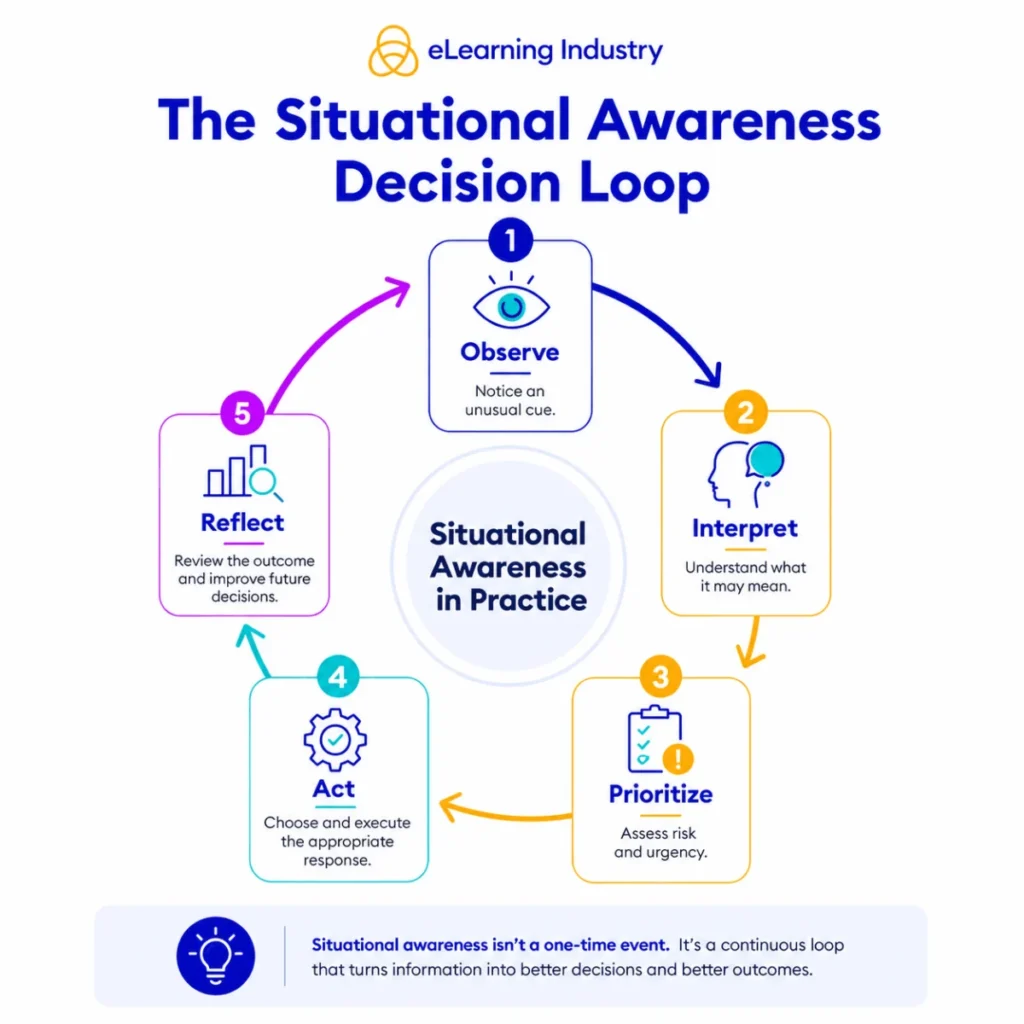
To build a truly aware workforce, organizations are moving away from one-time seminars toward a continuous learning cycle known as the OIDAR model: Observe, Interpret, Decide, Act, and Reflect.
- Observe: Employees are taught to conduct "environmental scans" at regular intervals. This involves looking for "red flags" and "green flags" (indicators of safety and stability).
- Interpret: Through case studies and simulations, employees practice connecting their observations to organizational goals and safety protocols.
- Decide: Training emphasizes "recognition-primed decision-making," where employees learn to quickly choose the most effective course of action based on previous patterns.
- Act: Hands-on drills, such as fire evacuations or simulated cyber-attacks, ensure that the transition from thought to action is seamless and calm.
- Reflect: This is perhaps the most critical stage. After-Action Reviews (AARs) allow teams to deconstruct their performance, identifying where awareness failed and where it succeeded. This creates a feedback loop that strengthens the organization’s collective intelligence.
Expert Perspectives and Organizational Responses
Industry leaders are increasingly vocal about the necessity of these programs. "Safety is not the absence of accidents; it is the presence of capacity," says one prominent safety consultant. This sentiment reflects a broader organizational response: the move from "compliance-based" safety to "competence-based" awareness.
Insurance providers are also reacting to the trend. Many commercial insurers now offer lower premiums to organizations that can demonstrate a robust, documented SA training program, recognizing that an aware workforce is a lower-risk asset. Human Resources departments are also incorporating SA into their hiring rubrics, looking for candidates who demonstrate high levels of emotional intelligence and environmental perception.
Broader Implications and Future Trends
The future of situational awareness training lies in the integration of Artificial Intelligence and the Internet of Things (IoT). As workplaces become "smarter," employees will be required to maintain SA over both physical and digital realms simultaneously. We are likely to see the rise of "Hybrid SA," where AI assistants provide real-time alerts to human workers, who then use their superior comprehension and ethical judgment to make the final decision.
However, a potential risk identified by analysts is "information overload." As the volume of data increases, the human capacity to perceive and process it can become strained. Future training will likely focus more on "attention management"—teaching employees how to direct their limited cognitive resources toward the most critical cues while ignoring distractions.
Ultimately, situational awareness training represents a fundamental shift in how we view human capital. It acknowledges that in a world of automation, the most valuable human trait is not the ability to follow a checklist, but the ability to understand, navigate, and master a changing environment. Organizations that prioritize this skill will not only be safer and more efficient but will also possess a significant competitive advantage in an increasingly unpredictable global market.