
The University of California, Berkeley, consistently ranked among the world’s premier public research institutions, has fundamentally altered the accessibility of its curriculum through the BerkeleyX initiative. Since its inception, BerkeleyX has successfully democratized high-level academic content, reaching over four million learners across 150 countries and regions. For professionals in Learning and Development (L&D), Human Resources (HR), and Instructional Design, the Berkeley course catalog serves as a sophisticated engine for professional evolution, offering a robust suite of online classes spanning business, technology, data science, and behavioral psychology. As organizations increasingly prioritize skill-based hiring and continuous upskilling, the ability to leverage university-level resources for corporate application has become a critical competency for business leaders.
The Evolution of BerkeleyX and the Global MOOC Landscape
The rise of Massive Open Online Courses (MOOCs) over the last decade has shifted the paradigm of executive education. UC Berkeley’s partnership with platforms like edX and Coursera represents a strategic effort to bridge the gap between theoretical research and practical workplace application. To date, BerkeleyX has launched more than 100 courses, designed to meet the demands of a global workforce that is navigating the complexities of digital transformation and remote collaboration.
Historically, university education was confined to degree-seeking students on physical campuses. However, the chronology of online learning at Berkeley shows a clear trajectory toward modular, self-paced education. Starting with early digital initiatives in the 2000s and accelerating with the formal launch of BerkeleyX, the institution has moved toward a "lifelong learning" model. This model is particularly beneficial for L&D professionals who must remain agile in a market where the half-life of technical skills is shrinking.
Structural Framework: Navigating Audit, Credit, and Certification
A primary concern for professionals exploring the Berkeley course catalog is the distinction between various levels of enrollment. The university offers a tiered system designed to accommodate different professional needs and budgetary constraints.
- BerkeleyX MOOCs (Audit Track): These courses allow professionals to access university-level lectures, readings, and discussion forums at no cost. This is the most popular option for self-directed learners who prioritize knowledge acquisition over formal credentials.
- Verified Certificates: For a fee, learners can transition from the audit track to a verified track. This provides a digital certificate that can be shared on professional networks like LinkedIn, serving as a verifiable record of completion.
- UC Berkeley Extension: Unlike the MOOCs, the Extension programs are generally paid and more structured. These often provide academic credit or professional continuing education units (CEUs) that are recognized by various licensing boards.
- Formal Degree Courses: These represent the traditional academic path, requiring formal admission and tuition, resulting in university credit and degree conferral.
For HR and L&D leaders, understanding these distinctions is vital for designing internal development paths. Many organizations now recognize verified certificates from BerkeleyX as a valid form of professional development, often incorporating them into tuition reimbursement programs.
Human-Centric Skills: Strengthening the Social Fabric of Organizations
As Artificial Intelligence automates technical tasks, "human skills"—often referred to as soft skills—have become the new "hard skills" of the modern economy. The Berkeley course catalog features several programs developed by the Greater Good Science Center (GGSC) at UC Berkeley, an entity renowned for its research into the psychology of well-being.
Empathy and Emotional Intelligence at Work
This course addresses a critical gap in leadership development. According to research from the World Economic Forum, emotional intelligence is among the top 10 skills required for the future of work. The Berkeley curriculum focuses on trust-building, cooperation, and conflict resolution. For L&D professionals, this provides a research-backed framework to replace outdated "sensitivity training" with evidence-based behavioral science.
The Foundations of Happiness at Work
Workplace engagement remains a persistent challenge for HR departments worldwide. This course examines the correlation between employee well-being and organizational productivity. It moves beyond the superficial "perks" of office life to explore purpose, gratitude, and social connection. Analysis of this course suggests that when L&D teams integrate these principles, they see a measurable impact on employee retention and innovation.
Mindfulness and Resilience to Stress
The modern workplace is characterized by high levels of burnout. Berkeley’s resilience training teaches professionals how to manage the physiological and psychological impacts of stress. Crucially, the course emphasizes that resilience is not merely an individual responsibility but an organizational one, urging managers to examine systemic factors that contribute to workplace fatigue.
Bridging Differences and Improving Workplace Climate
In an era of increasing social polarization, the ability to facilitate difficult conversations and maintain an inclusive environment is a core HR requirement.

The Bridging Differences course is particularly relevant for facilitators and DEI (Diversity, Equity, and Inclusion) specialists. It utilizes social psychology to teach active listening and the identification of common ground. Similarly, the Improving Workplace Climate course helps leaders distinguish between individual performance issues and systemic environmental flaws. Analysts point out that training often fails when the surrounding culture is toxic; Berkeley’s curriculum provides the tools to diagnose and repair these underlying cultural issues.
Furthermore, the course Beyond Diversity: Navigating the DEI Landscape provides a historical and structural context for bias. For L&D professionals, the value lies in translating these high-level concepts into daily leadership practices, ensuring that organizational values are reflected in actual behavior rather than just policy manuals.
The Technical Frontier: Data Literacy and Programming for Non-Technical Roles
One of the most significant trends in L&D and HR is the shift toward "People Analytics." The Berkeley course catalog offers technical training that allows non-technical professionals to speak the language of data.
Introduction to Python
While HR managers may not need to build software, understanding Python—a versatile programming language—is increasingly useful for automating data tasks and understanding AI integrations. As learning management systems (LMS) become more complex, a foundational knowledge of coding helps EdTech specialists manage APIs and data flows more effectively.
Interactive Data Science and Inferential Statistics
The ability to interpret data is what separates a reactive HR department from a strategic one. Berkeley’s courses in data science and statistics teach professionals how to move beyond descriptive data (e.g., "how many people finished the course") to predictive and inferential data (e.g., "will this training actually improve sales performance?"). By applying inferential statistics, L&D leaders can conduct controlled experiments and pilot programs with a level of rigor that satisfies executive-level scrutiny.
Strategic Application: Building a Personal Learning Path
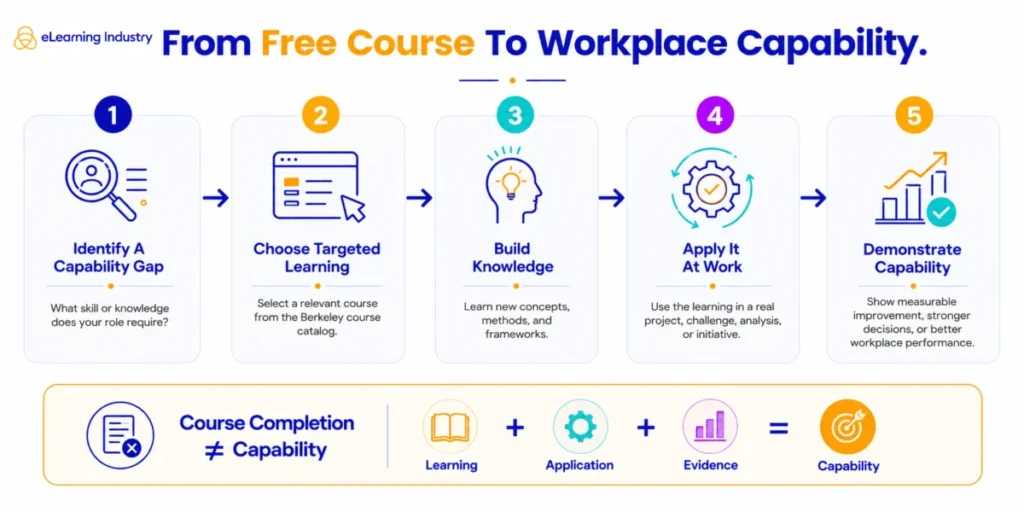
To maximize the ROI of the Berkeley course catalog, professionals are encouraged to view these offerings not as isolated events but as components of a comprehensive "Capability Path." Experts suggest a four-step approach to implementation:
- Identify the Capability Gap: Professionals should conduct a self-assessment or departmental audit to determine where skills are lacking.
- Contextualize the Learning: Enroll in a Berkeley course with a specific workplace project in mind. For example, use the "Bridging Differences" course as a foundation for a new cross-functional team initiative.
- Produce Evidence of Mastery: Rather than just obtaining a certificate, learners should produce a "capstone" project—such as a data analysis report or a new communication framework—that demonstrates the application of the knowledge.
- Stack Credentials: Combine soft skill courses with technical ones. An L&D leader who understands both "Emotional Intelligence" and "Data Science" is uniquely positioned to lead a modern, evidence-based people strategy.
Broader Impact and Industry Implications
The integration of elite university content into the corporate training ecosystem has significant implications for the future of work. As the cost of traditional MBA programs continues to rise, micro-credentials from institutions like UC Berkeley offer a cost-effective alternative for continuous professional development.
Industry analysts suggest that this "unbundling" of higher education allows for more personalized and timely skill acquisition. For an HR professional in 2026, a "verified certificate" in Workplace Climate from Berkeley may carry as much weight in a specific job function as a broader master’s degree earned a decade prior.
Furthermore, the success of BerkeleyX signals a growing partnership between academia and the private sector. By making these resources available, UC Berkeley is not only educating individual learners but also raising the standard of professional practice across entire industries. The focus on evidence-based management, rooted in rigorous research, ensures that the "professional development" of the future is grounded in science rather than corporate trends.
In conclusion, the Berkeley course catalog is a powerful tool for the modern professional. It offers a unique blend of high-level theory and practical application, covering everything from the nuances of human emotion to the complexities of data analytics. For those in L&D and HR, these courses provide the building blocks for a more resilient, inclusive, and data-driven organizational culture. As the boundaries between work and learning continue to blur, those who strategically leverage these elite resources will be best positioned to lead in the evolving global economy.






