
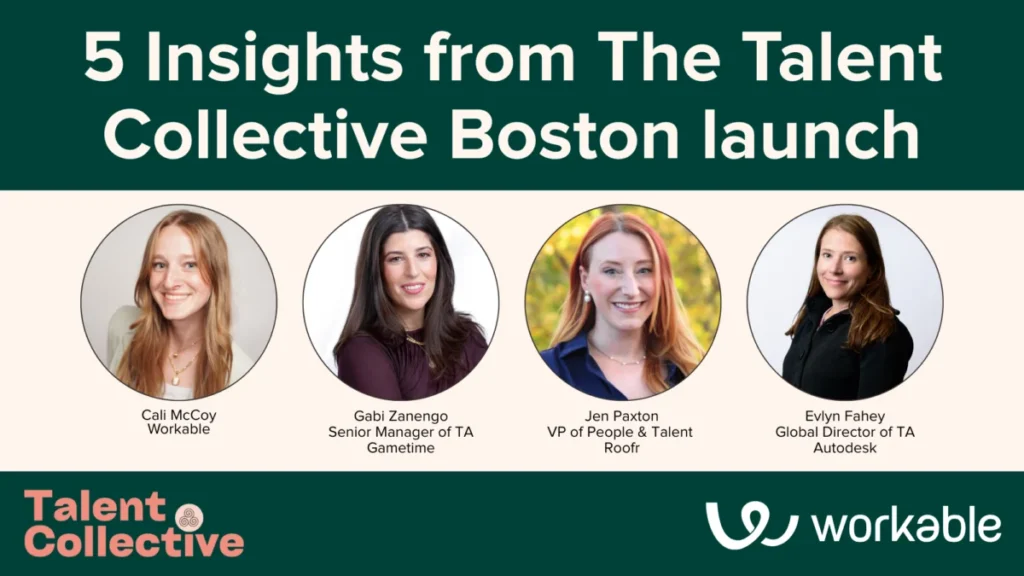
Boston’s vibrant talent acquisition community recently convened for the official launch of The Talent Collective’s Boston chapter, an event that brought together a diverse group of people leaders and HR professionals. The gathering, marked by a palpable sense of urgency and shared purpose, centered on a pivotal question reverberating across industries: How can Talent Acquisition (TA) teams innovate rapidly with emerging technologies like Artificial Intelligence without compromising the inherently human essence of the hiring process? The insightful discussion, moderated by Workable’s Cali McCoy, featured three prominent leaders from varying sectors, whose collective wisdom offered a compelling glimpse into the evolving landscape of recruitment, shaping expectations for 2026 and beyond.
The Genesis of a Critical Conversation in a Dynamic Market
The Talent Collective, a rapidly growing professional network dedicated to fostering collaboration and knowledge exchange among talent acquisition leaders, established its Boston chapter amidst a period of profound transformation in the global labor market. Boston, a renowned hub for innovation in technology, biotechnology, finance, and education, faces unique challenges and opportunities in attracting and retaining top talent. The launch event served as a crucial platform for local TA executives to address the seismic shifts impacting their strategies, from unprecedented candidate volumes to the ethical integration of AI.
Workable, a leading provider of AI-powered recruiting software, played a central role in facilitating the dialogue, underscoring its commitment to advancing the discourse around intelligent and human-centric hiring solutions. Cali McCoy, a respected voice in the talent acquisition technology space, skillfully guided the discussion, drawing out actionable insights from the panelists. While the specific identities of the panelists remained private, their collective experience spanned high-growth startups to established multinational corporations, ensuring a panoramic view of current TA challenges. This convergence of thought leadership highlights a growing recognition that strategic talent acquisition is no longer merely an operational function but a critical driver of business success, particularly as organizations navigate a volatile economic climate and an accelerating pace of technological change.
The event’s timing is particularly pertinent. Following a period of intense hiring post-pandemic, many industries have experienced a recalibration, with some sectors undergoing significant layoffs while others grapple with persistent skill shortages. This "Great Reshuffle" has created a complex environment where recruiters must simultaneously manage an influx of applicants for certain roles and an acute scarcity for highly specialized positions. This backdrop amplified the relevance of the five key trends identified during the discussion, offering a roadmap for TA leaders navigating this intricate landscape.
1. Hyper-Specialized Roles Reshaping the Recruiter Playbook
A primary theme that emerged was the dramatic shift away from high-volume, generalist hiring towards deeply niche, hybrid-skill roles. The panelists observed that organizations are no longer seeking "more of the same" but are actively hunting for unique combinations of competencies – for instance, technical prowess coupled with creative problem-solving, or AI literacy integrated with strategic business acumen. This evolution is partly driven by the rapid pace of technological advancement and the increasing complexity of business challenges, demanding individuals who can bridge traditional disciplinary divides.
This trend necessitates a significant recalibration of expectations between TA teams and hiring managers. As one panelist succinctly put it, "The days of simply replicating successful hires are over; strategic talent acquisition now demands a deep understanding of evolving business needs and the creative ability to map those to complex skill sets." The consensus was clear: while excellence remains paramount, the pursuit of a mythical "unicorn" candidate—one who perfectly embodies every desired trait—is often unrealistic and counterproductive. Instead, TA professionals are increasingly tasked with educating hiring managers on the realities of the contemporary talent pool, guiding them towards a more pragmatic and holistic view of ideal candidates, often involving a combination of existing skills and potential for growth. This involves meticulous job analysis, redefining success metrics, and sometimes, even proposing internal upskilling initiatives to cultivate required hybrid capabilities. Data from recent industry reports, such as the World Economic Forum’s Future of Jobs Report, consistently highlight the emergence of new job categories demanding interdisciplinary skills, underscoring the long-term nature of this shift.
2. Exploding Candidate Volume Overwhelming TA Teams
Paradoxically, even as roles become more specialized, the sheer volume of applicants for open positions has ballooned, with some requisitions attracting over 1,000 candidates. This surge is largely attributed to the ease of online application, coupled with economic uncertainties and workforce reductions in certain sectors, leading more individuals to actively seek new opportunities. While a large applicant pool might seem advantageous, the panelists highlighted its detrimental effects on TA operations.
The overwhelming volume leads to significant recruiter burnout, as teams struggle to sift through hundreds, if not thousands, of applications for a single role. This often results in qualified candidates being inadvertently overlooked, a phenomenon known as "missed talent," simply because human reviewers cannot process the data efficiently. Furthermore, the inability to provide timely feedback or personalized communication to a vast number of applicants severely degrades the candidate experience, damaging employer brand and potentially deterring future talent. "Another leader highlighted the paradox," it was observed, "while the talent pool appears vast, the actual suitable candidates are often buried under an avalanche of unqualified applications, making efficient, ethical AI screening not just an advantage, but a necessity." This situation accelerates the demand for AI support in initial candidate screening, not as a replacement for human judgment, but as a critical tool for efficiently identifying promising profiles, enabling TA professionals to focus their expertise on evaluation and engagement. The discussion strongly emphasized the imperative for such AI solutions to be transparent, unbiased, and ethically deployed, maintaining a human oversight layer to prevent algorithmic discrimination.
3. Candidate Fraud Emerging as a Significant Threat
Perhaps no topic resonated more deeply or elicited as many nods of agreement from the audience as the escalating threat of candidate fraud. This issue has rapidly evolved from an occasional anomaly to a pervasive challenge, undermining the integrity of the hiring process and posing substantial risks to organizations. TA teams are increasingly confronting sophisticated forms of deception, including candidate impersonation during interviews, the submission of fabricated references or credentials, and even the use of AI-generated responses in screening or assessment stages.
The sophistication of these fraudulent activities, often leveraging advancements in AI for creating convincing deepfakes or generating eloquent but inauthentic text, has made detection increasingly difficult. The financial implications of hiring unqualified or malicious individuals, alongside the reputational damage and potential security breaches, are significant. "The consensus among the panelists was clear," stated one attendee, "candidate fraud is no longer a fringe issue but a significant operational risk, demanding robust verification protocols without alienating genuine candidates." In response, leaders are adopting a range of creative and technologically advanced tactics. These include IP checks to verify applicant location, rigorous identity verification processes, and sophisticated background checks that delve beyond superficial credentials. The challenge lies in implementing these protective measures without creating an overly cumbersome or suspicious experience for legitimate candidates, thus balancing security with a positive applicant journey. The conversation underscored the need for continuous vigilance and adaptation as fraudulent methods become more advanced.
4. AI Adoption Accelerating, but Maturity Varies Widely
The integration of Artificial Intelligence into talent acquisition workflows was a central pillar of the discussion, with panelists acknowledging that every company is "somewhere different on the map" regarding AI maturity. Some organizations, particularly those with an agile tech culture, are rapidly experimenting with AI across various stages of the hiring funnel. This includes leveraging generative AI for crafting compelling job descriptions, automating personalized candidate outreach, optimizing interview scheduling, and even drafting initial offer letters. These early adopters are exploring AI’s potential to streamline administrative tasks, enhance efficiency, and improve the candidate experience through faster, more consistent communication.
Conversely, many organizations, especially larger enterprises or those in highly regulated industries, are encountering significant legal and compliance friction. Concerns around data privacy (e.g., GDPR, CCPA), algorithmic bias, and the ethical implications of AI-driven decision-making are legitimate hurdles. A standout insight offered during the panel provided a pragmatic approach to navigating these challenges: instead of asking legal departments, "Can we do this?", TA leaders should reframe the question to, "Under what conditions would this not be allowed?" This strategic shift transforms legal counsel from a potential roadblock into a partner, enabling controlled experimentation and innovation within defined boundaries, effectively managing risk while fostering progress. Data from industry analyst firms indicates a projected double-digit growth in AI adoption within HR tech over the next five years, signaling a broad-based shift. Across the board, there was a strong alignment on one foundational principle: AI should serve to eliminate administrative burdens and augment human capabilities, not to become the ultimate decision-maker in critical human processes. The human element, particularly in assessment, relationship-building, and final selection, must remain paramount.
5. Candidate Experience Moving Toward Continuous Feedback
The final key trend highlighted a significant evolution in how organizations approach candidate experience. Traditionally, feedback mechanisms often consisted of a single, end-of-process survey administered after a candidate was either hired or rejected. The panelists argued that this reactive approach frequently captured feedback when emotions were at their peak, often too late to effect meaningful change for the candidate in question or even for the broader process.
The shift is towards a model of continuous, stage-by-stage check-ins. This involves implementing quick, unobtrusive feedback loops at various points in the hiring journey – after an initial application, following an interview, or post-assessment. This proactive approach allows TA teams to surface friction points much earlier in the process. Whether it’s unclear communication, inconsistencies in interview questions, or unexpected delays, these issues can be identified and addressed in real-time, while candidates are still actively engaged. "One participant underscored the shift from reactive feedback to a proactive ‘pulse check’ model," they stated, "saying, ‘We can no longer afford to wait until a candidate is frustrated enough to withdraw or post a negative review. We need to identify friction points as they happen.’" The goal is not necessarily to achieve a 100% response rate, but rather to gather early signals that enable agile adjustments to the process, enhancing transparency and improving the overall journey for future applicants. This data-driven approach to candidate experience not only strengthens employer branding but also contributes to higher offer acceptance rates and reduced time-to-hire.
The Broader Impact: Navigating the Future of Talent Acquisition
The collective insights from The Talent Collective’s Boston launch painted a vivid picture: hiring is undergoing its most dramatic and fundamental transformation in a decade. The confluence of hyper-specialization, exploding applicant volumes, sophisticated fraud, accelerating AI adoption, and a renewed focus on candidate experience signals a new era for talent acquisition professionals.
The core message resonated clearly: Artificial Intelligence will undoubtedly revolutionize the operational efficiency and capabilities of the recruitment process, but it is the human element – empathy, discernment, and strategic guidance – that will continue to define the ultimate candidate and hiring manager experience. This paradigm shift elevates the role of the TA professional from a transactional recruiter to a strategic advisor, demanding a new set of skills encompassing data literacy, ethical AI deployment, psychological acumen, and robust communication.
For organizations looking to thrive in this complex environment, the real competitive advantage will belong to those teams capable of mastering a delicate balance. This balance involves seamlessly integrating innovation with unwavering integrity, leveraging automation for efficiency while preserving genuine empathy, and executing with both speed and substantive impact. These are precisely the qualities that were evident in the room in Boston – a community of leaders committed to shaping a future of work where technology enhances, rather than diminishes, the human connection at the heart of talent acquisition. The insights shared will undoubtedly serve as a critical guide for TA leaders as they strategically plan for the opportunities and challenges that lie ahead in 2026 and beyond.






