
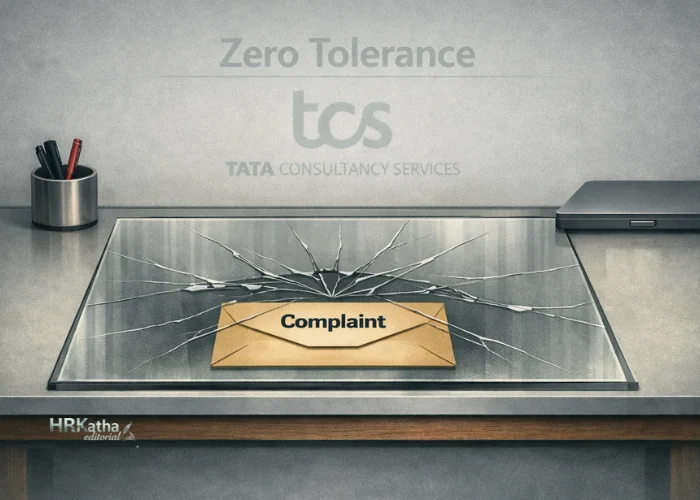
On April 12th, 2026, Tata Consultancy Services (TCS), one of India’s leading information technology giants, found itself at the centre of a burgeoning scandal, issuing a public statement addressing severe allegations of workplace harassment emanating from its Nashik facility. The company’s communication declared, “TCS has a long-standing zero-tolerance policy towards harassment and coercion of any form. As soon as we were made aware of the matter, we took swift action.” Just two days later, the gravity of the situation was further underscored when N. Chandrasekaran, Chairman of the Tata Sons conglomerate, described the allegations as “gravely concerning and anguishing,” simultaneously announcing the initiation of a comprehensive internal investigation. While these statements project an image of appropriate concern and decisive action, the context surrounding them reveals a protracted timeline of alleged inaction, raising critical questions about the efficacy of corporate grievance redressal mechanisms in India.
A Chronology of Alleged Inaction and Escalating Concerns
The public statements from TCS and Tata Sons were not a proactive disclosure but rather a response to a series of events that had been unfolding for over four years. The core of the issue involves complaints filed by eight women employees at the Nashik facility, who detailed allegations of sustained harassment, coercion, and intimidation. These incidents reportedly occurred between February 2022 and March 2026, painting a grim picture of an environment where alleged misconduct persisted over an extended period.
Police investigations, which ultimately led to the public outcry, have meticulously documented a staggering 78 emails and multiple phone calls made to the company’s Human Resources (HR) department over this four-year span. This volume of communication suggests a persistent effort by the complainants to seek internal resolution, yet, according to the emerging details, these appeals seemingly failed to trigger the "swift action" articulated in the company’s official response.
The situation escalated dramatically when internal mechanisms allegedly proved insufficient, compelling the victims to turn to law enforcement. This led to the formation of a Special Investigation Team (SIT) by Nashik police, which embarked on an intensive, evidence-gathering operation. In a move highlighting the seriousness and the perceived difficulty in obtaining internal cooperation, undercover officers were deployed at the Nashik facility for 40 days. Their efforts culminated in a series of arrests, with seven individuals taken into custody. Shockingly, among those arrested was an HR manager who was also a member of the Internal Committee (IC) responsible for addressing complaints under the Prevention of Sexual Harassment (POSH) at Workplace Act, 2013. This particular detail has sent ripples through corporate India, exposing potential systemic failures at the very heart of supposed protective mechanisms.
Scrutiny of Official Responses and the ‘Awareness Gap’
The official responses from TCS and Tata Sons, while outwardly appropriate, have come under intense scrutiny when juxtaposed with the detailed chronology of events. The phrase "as soon as we were made aware of the matter" becomes highly problematic when weighed against the documented 78 emails and numerous calls to HR spanning four years. Critics are questioning what constitutes "awareness" within a large corporate structure and whether the company’s internal reporting systems are designed to effectively escalate and address such critical complaints.
Similarly, the reiteration of a "zero-tolerance policy towards harassment and coercion of any form" appears to contradict a situation where alleged tolerance seemingly lasted until criminal charges were filed and police intervention became undeniable. The assertion of "swift action" also loses its credibility when such action was reportedly necessitated by external law enforcement pressure, following years of alleged internal inaction. As legal experts and women’s rights advocates have pointed out, a system that only activates after police intervention cannot genuinely claim to be demonstrating zero tolerance; it is, rather, demonstrating delayed accountability, often forced by circumstances beyond internal control.
The Pervasive ‘Instinct to Bury’ in Corporate India
The TCS Nashik case, while specific to one company, is increasingly being viewed as emblematic of a broader, troubling trend within corporate India concerning the handling of workplace harassment allegations. When such complaints surface, the prevailing corporate reflex often follows a predictable, yet deeply flawed, pattern: an initial assessment of reputational risk, deployment of carefully crafted crisis communication, attempts to contain the issue internally, and a hope that public attention will eventually fade.
The underlying assumption driving this approach is that harassment complaints constitute a blot on the company’s image that must be removed as quickly and quietly as possible. The primary objective often shifts from ensuring accountability and justice for the victims to managing damage control and protecting the brand’s perception. This perspective fosters an environment where complaints are frequently buried within convoluted internal processes, and complainants are sometimes subtly or overtly advised to "handle it quietly." HR departments, instead of functioning as robust mechanisms for redressal and employee safety, can inadvertently become buffers designed to absorb and diffuse complaints, preventing them from escalating or becoming public.
This flawed logic operates under the premise that openly addressing harassment will inflict more damage upon the organization’s reputation than the harassment itself. However, the reality, as demonstrated by numerous high-profile cases, is often the inverse. Transparency and decisive action, even in the face of uncomfortable truths, tend to bolster long-term trust and credibility, whereas concealment and delayed responses inevitably lead to deeper reputational crises when the truth eventually emerges.
Consequences of Suppression: What Burying Complaints Produces
When organizations prioritize reputation management over employee safety, treating harassment as a PR problem rather than a fundamental failure of safety and ethics, the consequences are far-reaching and consistently detrimental:
- Deterrence of Future Complaints: Complainants quickly learn that raising concerns carries significant personal and professional risk. If the internal system is unresponsive, appears to protect the accused, or even victim-blames, the message is clear: silence is safer. This leads to a severe underreporting of incidents, creating a widening gap between the actual prevalence of harassment and the number of formally filed cases.
- Undetected Patterns and Repeat Offenders: When each complaint is processed in isolation, or worse, suppressed, systemic patterns of abuse go undetected. A serial offender, particularly if they are senior or well-connected, can operate with impunity for years, moving between teams or departments, because no mechanism aggregates complaints or flags repeated problematic behaviour across the organization.
- Loss of Valued Employees: Often, those who raise legitimate complaints find themselves marginalized, ostracized, or simply exhausted by an unresponsive system. They are either subtly pushed out or choose to leave, opting for exit over enduring a hostile and unsupportive environment. Conversely, those accused, especially if they hold positions of power or influence, frequently remain in their roles, further signaling that the system protects the powerful rather than the vulnerable. The organization thus loses the very people it should have protected and retains those it should have removed.
- Inevitable External Intervention: When internal mechanisms fail comprehensively, complainants are left with no recourse but to turn to external bodies – the police, regulatory authorities, or the media. What could have been a contained, internal matter to be addressed with integrity then explodes into a public crisis, often resulting in legal battles, regulatory penalties, and severe reputational damage that far exceeds the initial scope of the allegations. The Nashik case, with its repeated complaints, alleged HR inaction, arrests including an HR manager, police undercover operations, and an SIT probe, perfectly illustrates this trajectory. This is not "swift action"; it is action delayed and forced by external pressure, after internal systems reportedly failed for years.
The Legal Framework: The POSH Act and its Implementation Challenges
The Prevention of Sexual Harassment at Workplace (POSH) Act, 2013, was a landmark legislation in India, designed to provide a legal framework for preventing and redressing sexual harassment at workplaces. It mandates that every organization with 10 or more employees establish an Internal Committee (IC) to investigate complaints and recommend action. The fact that an HR manager, also part of the POSH Internal Committee, was among those arrested in the Nashik case is profoundly disturbing. It suggests a potential breakdown not just in general HR practices, but in the very mechanism specifically designed to protect employees under the law.
The case highlights critical challenges in POSH implementation across India:
- Effectiveness of ICs: The incident raises questions about the independence, training, and accountability of IC members, especially when an IC member themselves is implicated in the alleged cover-up or inaction.
- Awareness and Trust: Despite the Act, many employees remain unaware of their rights or lack trust in the IC process, fearing retaliation. The sheer volume of emails to HR over four years in the TCS case suggests that while employees tried to use internal channels, those channels may have failed them.
- Oversight and Accountability: There appears to be a significant gap in oversight over how ICs function and whether their recommendations are truly acted upon. The Nashik case underscores the need for greater external accountability and transparency in POSH proceedings.
The False Choice: Reputation vs. Safety
Organizations frequently operate under the erroneous belief that they face a binary choice: either address harassment complaints openly and risk reputational damage, or manage them quietly to protect the brand. This framing is fundamentally incorrect and detrimental.
A company that responds decisively to early complaints, conducts credible and transparent investigations, and takes visible, appropriate action does not weaken its reputation. On the contrary, it demonstrates robust governance, a genuine commitment to employee well-being, and the effective functioning of its internal systems. Such an approach builds trust among employees, signals to potential hires that it is a safe workplace, and enhances its standing with stakeholders.
Conversely, a company that buries complaints, delays action, and responds only when legally compelled or publicly shamed does not protect its reputation. Instead, it confirms to the world that optics and damage control are prioritized over employee safety and ethical conduct. TCS’s response – “as soon as we were made aware, we took swift action” – when evidence strongly suggests awareness should have existed for years, regrettably falls into this latter category. It represents accountability as a performance, a public relations exercise, rather than accountability as an embedded organizational practice and cultural value.
What Genuine Accountability Truly Requires
The significant disparity between corporate statements and operational reality in cases like TCS Nashik reveals a critical missing element: genuine, proactive accountability. This goes beyond mere policy compliance and delves into the very fabric of organizational culture and process.
- Specificity and Transparency: Accountability demands specificity. Instead of vague assurances like "we acted swiftly," it requires a clear, detailed timeline: when were complaints first raised, what specific steps were taken at each stage, why did those initial steps not lead to a resolution, and why did they not trigger formal processes earlier?
- Institutional Scrutiny, Not Just Individual Blame: While individual perpetrators must be held accountable, the inquiry must extend beyond them. If an individual tasked with addressing complaints (like an HR manager on the POSH IC) is themselves implicated in alleged inaction or complicity, the question expands to how the system allowed for such a critical failure in oversight and what systemic checks and balances were missing.
- Concrete Process Redesign: Accountability necessitates tangible change. Which specific processes broke down? How will they be fundamentally redesigned to prevent recurrence? What new mechanisms will be implemented to ensure that complaints, formal or informal, are not just raised but are effectively captured, investigated, and acted upon?
- Acknowledgement of Harm: Beyond expressing concern about "allegations," genuine accountability requires acknowledging the profound harm endured by individuals who may have suffered years of distress while the internal system allegedly failed to respond. This includes offering support, restitution, and a clear path to justice for the victims.
Too often, what emerges instead is a predictable, hollow script: express concern, announce an investigation, reiterate zero tolerance, and then implicitly, move on. The real gap is not between policy and practice in a general sense; it is specifically between complaints raised by suffering individuals and the effective, timely action taken upon those complaints.
Lessons for Organizations of All Sizes
TCS, with its global workforce exceeding 600,000 employees, might lead some to attribute this failure to sheer scale and complexity. However, such an interpretation would be a grave misreading of the situation. The Nashik facility, where these allegations originated, reportedly employed around 170 people. This is a size where patterns of behaviour should be readily visible, complaints more easily surface, and HR should be more accessible and responsive. Scale, therefore, was not the problem; the fundamental response mechanism was.
This case offers crucial lessons, particularly for smaller organizations that often mistakenly assume their proximity creates inherent accountability, that informal systems are sufficient, or that harassment is solely a "large company" problem. All three assumptions are flawed. What truly matters is not the existence of a policy, but the robustness and trustworthiness of the process.
For all organizations, regardless of size, building credible and effective grievance redressal mechanisms requires:
- Clarity and Independence: Complaint intake must be clearly separated from those who are being complained about. This can be achieved through independent external channels, ombudsmen, or strictly independent internal oversight structures.
- Documentation and Tracking: Every complaint, whether formally filed or informally raised, must be meticulously documented, formally acknowledged, and systematically tracked through to a verifiable resolution. What is not recorded can be easily denied or forgotten.
- Visible Consequences: The consequences for misconduct must be visible, consistent, and proportionate to signal unequivocally that the system functions and that inappropriate behaviour will not be tolerated. In smaller environments, where information travels quickly, silence around action can rapidly erode trust.
- Proactive Culture Building: Ultimately, the test is simple: would an employee facing harassment tomorrow genuinely trust the system enough to use it, confident that they would be heard, protected, and that justice would be served? If the answer is uncertain, the problem is not merely a policy gap; it is a fundamental failing of organizational culture.
Redefining ‘Zero Tolerance’: From Policy to Practice
The instinct to bury complaints, while seemingly protective of the organization’s immediate image, is ultimately a destructive strategy. It shields the illusion of a safe workplace while allowing genuine harm to continue unchecked. When this illusion inevitably collapses, often under external pressure or legal mandates, the resulting damage – to reputation, employee morale, and financial stability – is far greater than it would have been had the issues been addressed transparently and decisively from the outset.
True "zero tolerance" is not merely defined by the language in a corporate policy document. It is demonstrably defined by the speed, integrity, and effectiveness of an organization’s response time when allegations surface. A system that activates only after police intervention, or after years of alleged internal complaints, is not demonstrating zero tolerance. It is demonstrating a severe failure of accountability, a system that prioritizes institutional self-preservation over the well-being and safety of its employees. In such critical instances, delay is not neutral; it is, unequivocally, the failure itself. The TCS Nashik case serves as a stark, urgent reminder for all of corporate India that genuine commitment to employee safety demands more than just well-worded policies; it requires unwavering integrity in action.








