
The modern corporate landscape is currently witnessing a fundamental shift in how institutional knowledge is generated, shared, and preserved. As artificial intelligence moves from a speculative tool to a core component of business operations, the traditional role of the Chief Learning Officer (CLO) is being forced to evolve. In a typical contemporary scenario, a team is tasked with rolling out an AI copilot across multiple business units, complete with enablement curricula and interactive dashboards to track manager certification. On paper, these initiatives often appear successful; however, internal audits frequently reveal a stark divide in actual application. While a small percentage of early adopters integrate the tool to sharpen their workflows, a significant majority often treat the rollout as a mandatory bureaucratic hurdle to be outwaited, leaving the technology unclicked and its potential untapped.
The core failure in these scenarios is rarely the technology itself, but rather a breakdown in what experts call "knowledge circulation." When adopters find success, they often fail to share their breakthroughs, and when laggards struggle, they remain silent to avoid appearing obsolete. This culture of silence creates a bottleneck that prevents learning from keeping pace with the rapid evolution of AI tools. To address this, organizations must move away from the "cascade" model of top-down instruction and toward a human-centered circulatory system where information flows multidirectionally.
The Global Surge in AI Investment and the Readiness Gap
The urgency for this transition is underscored by massive capital shifts. According to recent data from Boston Consulting Group (BCG), organizations are on track to nearly double their AI investments as a percentage of total revenue. Furthermore, 72 percent of CEOs have moved from passive oversight to personally directing AI strategy. This shift indicates that AI capability is no longer a peripheral IT concern but a primary pillar of competitive survival.
However, the speed of investment is outstripping the speed of human adaptation. Deloitte’s Global Human Capital Trends report indicates that seven out of 10 business leaders identify organizational nimbleness as their top strategic priority through 2029. Despite this, 59 percent of organizations continue to employ a purely tech-focused approach to AI implementation. The financial consequences of this oversight are significant: companies that ignore human-centered design in their AI rollouts are 1.6 times more likely to fall short of their expected returns on investment compared to those that prioritize the human element.
A critical missing link in this chain is middle management. Udemy’s 2026 Global Learning and Skills Trends Report highlights a staggering disconnect: while 88 percent of employees believe effective leadership is the deciding factor in AI success, only 48 percent believe their direct managers are actually "AI-ready." This creates a psychological safety vacuum where neither the manager nor the employee feels comfortable admitting a lack of proficiency, leading to a stagnation of skills.
Chronology of an AI Learning Rollout: The 18-Month Failure Loop
To understand why traditional learning models fail, it is necessary to examine the typical chronology of a modern AI implementation:
- Month 1-3: The Strategic Launch. Leadership announces the AI integration. Dashboards are created, and a "cascade" of training materials is pushed from the top down.
- Month 4-6: The Compliance Peak. Completion rates for mandatory training hit 90 percent. Managers are "certified," but actual tool usage remains superficial.
- Month 7-12: The Divergence. A small group of "rogue" innovators develops workarounds and high-efficiency prompts in isolation. Meanwhile, the majority of the workforce reverts to old habits, feeling overwhelmed by the tool’s complexity.
- Month 13-18: The Obsolescence Gap. The AI tool undergoes a major version update. Because there was no feedback loop to capture what the frontline learned during the first year, the organization must start the training cycle from scratch, having gained no institutional intelligence.
This cycle demonstrates the limitations of "single-loop learning"—a concept where errors are corrected without questioning the underlying assumptions. In contrast, "double-loop learning" encourages employees to question the tool’s logic and its fit within their specific workflow. Without a system that allows these questions to circulate back to leadership, the organization remains in a state of perpetual "catch-up."
From Top-Down Cascades to Multidirectional Circulation
The traditional architecture of corporate learning assumes that knowledge is a commodity designed at the top and pushed downward. This unidirectional flow is inherently slow and ignores the reality that those closest to the work often understand the tool’s practical applications better than the designers do.
Adaptive leadership requires a systems mindset that prioritizes "relatedness." In this model, the frontline is not the final destination for information; it is a primary source. For circulation to work, two conditions must be met: employees must believe that their feedback will lead to actual change, and they must feel that admitting confusion will not be used against them.

Industry analysts suggest that "psychological safety" is not just a human resources buzzword but a technical requirement for AI adoption. When employees fear that AI might make them dispensable, they are less likely to share the very insights that would make the AI—and themselves—more effective. Humanizing the rollout means leaders must model "not-knowing." When a senior executive admits to fumbling a prompt or struggling with an output, it creates a sanctioned space for others to do the same.
The Role of Agentic AI as a Listening Partner
Ironically, the same technology that creates the need for new learning models can also provide the solution. "Agentic AI"—AI systems capable of autonomous reasoning and pattern recognition—can be utilized as a listening partner within the organization’s circulatory system.
Forward-thinking companies are beginning to use AI to detect "positive deviance"—instances where specific teams are using the tool in unique, unauthorized, but highly effective ways. Instead of using this data for surveillance or reprimand, AI can flag these patterns for L&D teams to investigate and share across the company.
However, experts warn that this must be an "opt-in" mechanism. The moment a sensing tool feels like surveillance, the candor required for learning disappears. AI can extend the reach of an inquiry mindset, but it cannot substitute for the foundational trust between a leader and their team.
Judgment as the New Core Curriculum
As AI becomes more proficient at drafting financial models, writing code, and generating communications plans, the "how-to" of technical tasks is becoming a commodity. This shift is moving corporate learning out of the classroom and into the "moment of need."
The new curriculum for the AI era is not technical procedure, but "judgment." Employees must be trained on:
- Verification: When to trust an AI output and when to interrogate it.
- Bias Detection: Identifying when a confident AI answer encodes hidden prejudices.
- Reflexivity: The ability to sit with ambiguity when the tool provides conflicting information.
These "power skills"—formerly dismissed as "soft skills"—are now the load-bearing pillars of technical competence. The ability to apply human intuition to machine-generated data is becoming the most valuable asset in the modern workforce.
Practical Implementation: The Next Two Quarters
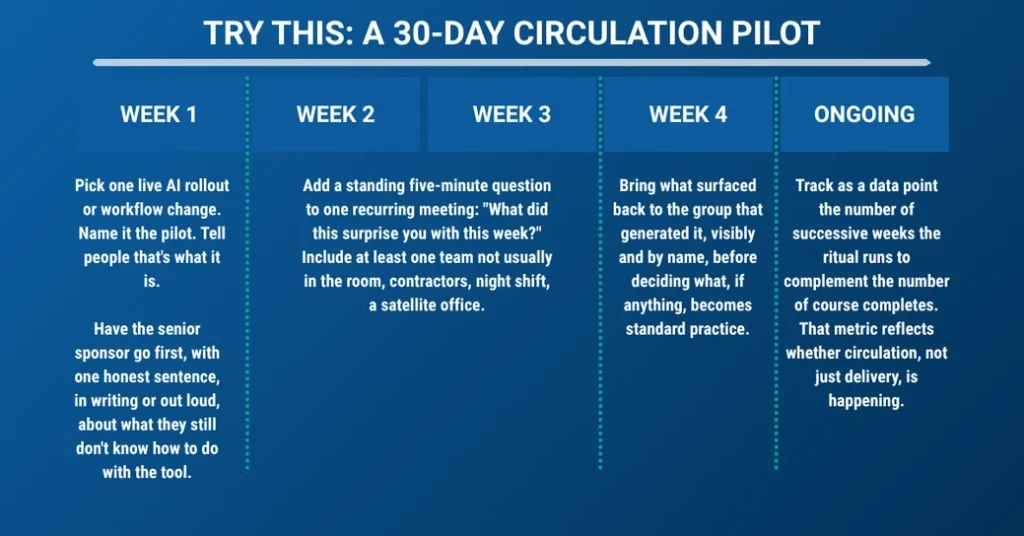
For organizations looking to move from a cascade to a circulatory model, the transition does not require a massive platform migration, but rather a change in ritual. Experts recommend a three-step approach for the next six months:
- Establish Rapid-Cycle Inquiry: Integrate a standing five-minute inquiry slot into weekly team meetings. The question should not be "Are you using the tool?" but "How did the tool surprise or fail you this week?"
- Widen the Sensing Mechanism: Ensure that contract staff, night-shift teams, and frontline workers—those often excluded from high-level strategy—are included in feedback loops. Their distance from power often gives them a clearer view of the tool’s practical flaws.
- Trait-Mapping Over Org Charts: Instead of assigning AI tasks based on job titles, organizations should map specific human strengths—such as future-focus or interpersonal sensitivity—to project needs. This allows teams to reconfigure dynamically around the work rather than the hierarchy.
Conclusion: The CLO as Learning Architect
The role of the Chief Learning Officer is undergoing an existential transformation. The CLO is no longer a curriculum owner but a "learning architect" responsible for building the infrastructure of trust. In an era of constant technological volatility, the ultimate competitive advantage is not the technology an organization buys, but the speed at which it can circulate what its people are learning.
The organizations that thrive in the coming years will be those that treat learning circulation as core infrastructure. By fostering an environment where people feel safe to share both their triumphs and their fumbles, leaders can ensure that their multi-million dollar AI investments produce more than just impressive dashboards—they produce a resilient, intelligent, and truly adaptive workforce. The portal for organizational learning is open; the challenge now is to ensure that everyone feels safe enough to walk through it.






