The global professional development market, encompassing training, certification, and upskilling, represents a colossal industry valued at over $400 billion. A significant portion of this market, nearly one-third, is dedicated to non-company-specific skills and technologies. For decades, this demand has been met by a robust ecosystem of training providers, including online course libraries, video platforms, simulations, expert assessments, and a myriad of professional certifications, testing, and accreditation services. This sector has historically been resilient to economic downturns, as continuous learning and career advancement remain paramount for both individuals and organizations. Companies often tout their commitment to employee growth as a key differentiator, fostering environments where professionals can build new skills and maintain a competitive edge.
However, the landscape of online learning is undergoing a seismic transformation, driven by rapid technological advancements, particularly in artificial intelligence. Prominent players that once dominated the market, such as Udacity (now part of Accenture), Coursera, Udemy (recently acquired by Coursera), LinkedIn Learning, SkillSoft, and Pluralsight, alongside educational platforms like Masterclass, TEDx, and BigThink, are facing new challenges. Recent market shifts, exemplified by the plunging stock prices of publicly traded companies following consolidation within the sector, underscore this dynamic change. This recalibration is not a reflection of diminished managerial acumen but rather a fundamental alteration in how learning is consumed and delivered, largely influenced by the pervasive impact of AI.
The Evolution from Content Publishing to Personalized Growth
The core of the professional development market remains strong, fueled by an innate human drive for career progression. Regardless of industry or role—be it in IT, sales, marketing, finance, human resources, or support—the demand for acquiring new skills is perennial. This demand can be broadly categorized into five distinct levels of professional growth:
Level 1: Foundational Learning for Newcomers
This tier caters to individuals entering a new profession, role, or career path. The primary need is for foundational training and often certification to grasp the basic principles, terminology, and fundamental concepts of a field. While organizations like SHRM and HCI offer certifications, their perceived value can fluctuate. In fields like HR, for instance, the market has seen a diminishing return on certain certifications, as employers increasingly seek demonstrable skills over credentialing alone. At this stage, learners require an overview of tools, core ideas, and the essential language of their chosen profession.
Level 2: Expanding Expertise for the Experienced
Professionals with two to three years of experience often possess a solid grasp of the basics but seek to deepen their understanding and broaden their applicability. This level requires more advanced content, including case studies, real-world use-case scenarios, and exercises designed to challenge and expand their thinking. For example, a recruiter looking to transition into a senior role would need training in advanced sourcing techniques, sophisticated skills assessment, candidate marketing strategies, and the integration of AI into recruitment processes.
Level 3: Broadening Horizons for Specialists
At this stage, professionals have achieved deep expertise in a specific niche but lack breadth across different areas or industries. A tech recruiter, for instance, might want to develop skills in executive search or sales recruitment. Similarly, an individual focused on building product organizations might need to learn about hiring and assessing candidates across diverse functions. Professionals at this level often seek to move beyond their specialized domain to gain multi-industry or multi-technology experience. This often involves exposure to new case studies, project-based learning, and mentorship from more senior or multi-disciplinary experts. This transition can also mark a move into leadership roles, such as moving from "Senior Recruiter" to "Head of Recruiting," which necessitates leadership development and opens doors to a new spectrum of learning opportunities.

Level 4: World-Class Professionals Seeking Further Advancement
This level encompasses seasoned professionals with decades of experience who aim to stay at the forefront of their fields. They are keen to identify emerging technologies, advanced methodologies, and often seek to globalize or diversify their industry experience. For senior leaders, such as those in HR, a limitation might be their deep knowledge within a single industry. Shifting industries can provide invaluable exposure to novel approaches, thereby enhancing wisdom, perspective, confidence, and overall value creation. These individuals may ascend to senior executive positions, transition from large corporations to startups, or venture into entirely new technological or scientific domains. The inherent curiosity that drives deep expertise in one area often fuels a desire for knowledge in adjacent fields, leading to a pursuit of "T-shaped" skills—deep expertise in one area coupled with broad knowledge across others.
Level 5: The Architects of Knowledge
At the pinnacle are tenured, highly accomplished experts—the "10X engineers" or C-suite gurus—who have a proven track record of impact and influence. Their pursuit of further growth often involves teaching, mentoring, coaching, or writing. Their engagement with professional communities is not for fame but for collaboration with peers and access to cutting-edge research and global case studies. They seek to share their knowledge and learn from others at a similar caliber.
The Challenge for Traditional Training Providers
The professional development market has historically attempted to address these diverse needs through packaged solutions. However, many providers offer generic training without adequately mapping it to the specific developmental stage of an individual. An "advanced" course, for example, might introduce new topics, but if the learner is already at Level 3 or 4, its efficacy diminishes. The challenge lies in aligning pre-packaged training modules with the dynamic and individualized career aspirations of professionals.
Artificial Intelligence: The Game Changer
Artificial intelligence is emerging as the transformative force capable of solving this critical challenge. The ability of AI to process vast amounts of information and tailor learning experiences to individual needs is revolutionizing the sector. As highlighted in research like "The Revolution in Corporate Learning," AI is uniquely positioned to meet these evolving demands. Platforms like Galileo are specifically designed to deliver personalized learning journeys for HR professionals and leaders.
The widespread adoption of AI tools like ChatGPT, with hundreds of millions of weekly users, underscores this shift. Analysis indicates that a significant portion of these interactions—upwards of 40%—involve users seeking to learn, find information, develop skills, or solve problems. This demonstrates a powerful, organic adoption of AI as a learning agent, surpassing the reach of traditional Learning and Development (L&D) platforms in a remarkably short period.
This phenomenon is driven by two primary factors:
- Intuitive Inquiry-Based Learning: AI facilitates a natural, curiosity-driven approach to learning, mirroring how children acquire knowledge. The ease with which users can ask questions, explore topics, and receive immediate feedback fosters engagement and accelerates understanding.
- Holistic Information Interconnection: Advanced AI models, such as those underpinning Galileo, utilize embeddings to create interconnected webs of information. This allows for a non-linear learning path, enabling users to delve deeper into specific areas, request clarifications, or skip sections as needed, significantly enhancing both the speed and quality of learning.
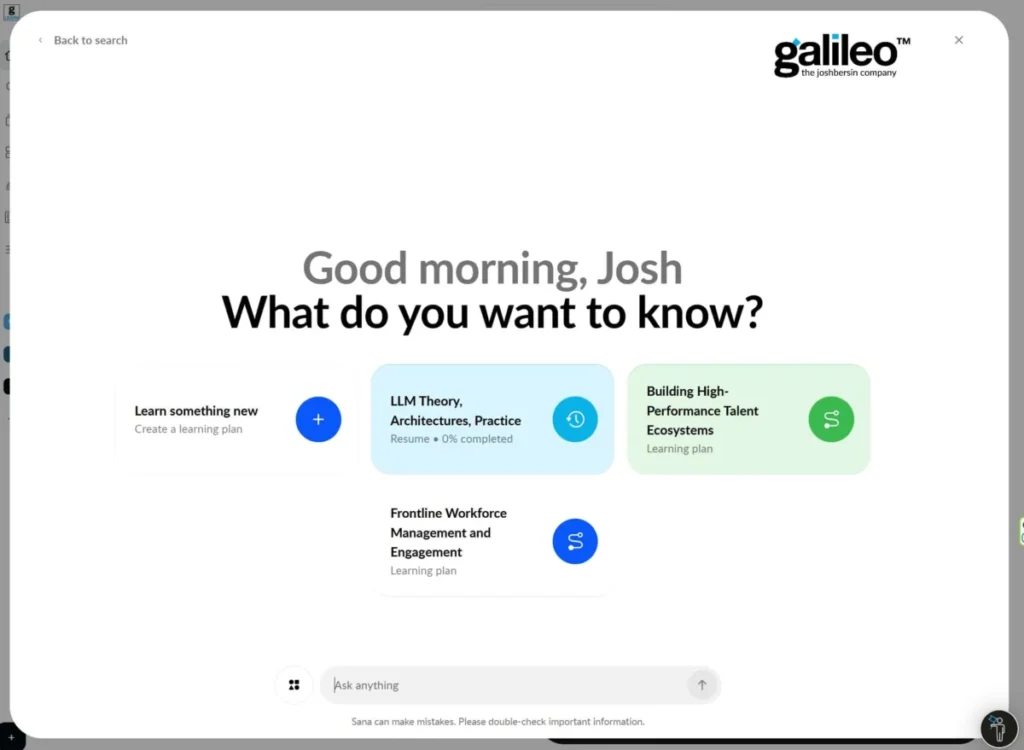
Platforms like Galileo exemplify this paradigm shift by offering dynamic content, including examples, scenarios, challenges, and simulations, on demand. Users can opt for structured courses or engage with an AI "Supertutor" that provides personalized information and experiences based on their role, past interactions, and other contextual data. The seamless integration of these capabilities offers a "breathtaking" learning experience.

Market Disruption: From Publishing to Dynamic Delivery
This fundamental shift from static "publishing courses" to dynamic content delivery is fundamentally altering the professional development market. The industry, traditionally segmented into learning platforms (LMS, LXP), content (course libraries, executive education), content development tools, certifications, and consulting services, is now being compelled to adopt AI-native infrastructure. This is not a minor adjustment but a discontinuous, rapid evolution.
The "old model" of online learning, prevalent since the late 1990s, operated on a publishing paradigm. Subject matter experts were engaged to create courses, interactive modules, simulations, and assessments, which were then "published" onto learning management systems or custom platforms for user access. This model, while revolutionary at its inception, disrupted traditional classroom training and continues to serve certain high-touch, high-cost executive education programs. However, the vast majority of professional development is now migrating towards AI-driven solutions.
The "AI-First" or "AI-Native" model leverages AI for content collection, generation, translation, and delivery. Platforms like Galileo integrate extensive research and case studies with a company’s proprietary content, creating a bespoke learning environment. Users can engage with formal courses, request simulations, participate in role-playing exercises, or simply query the AI for immediate answers. This interactive, on-demand approach transforms learning from a passive consumption of pre-authored material to an active, personalized dialogue.
The user experience is profoundly enhanced through AI’s ability to remember past interactions and adapt to individual needs. Furthermore, the cost and complexity associated with traditional instructional design, translation, and video production are significantly automated. AI-native systems can generate new learning experiences daily as new content is added and can seamlessly blend external expert knowledge with an organization’s internal processes, technical specifications, and cultural nuances.
Features such as career pathways, learning paths, skills taxonomies, and assessments, once labor-intensive to create, are now machine-generated. This repositioning shifts the vendor’s value proposition from simply selling content and platforms to delivering an optimized, personalized, and highly valuable user experience. The integration of generative AI tools like Sora, capable of creating impressive educational content, further illustrates this trend. YouTube’s automated chapter creation for videos, even before integrating advanced AI like Gemini, signals a broader movement towards making any spoken content educational and accessible.
AI’s capabilities are expected to deepen further, with platforms capable of discerning a user’s reading level, learning preferences, and technical interests. By analyzing user interactions, meeting transcripts, and other data, AI-powered learning platforms can develop a comprehensive understanding of an individual’s professional context, communication style, and thought processes, enabling even more tailored learning interventions.
Opportunities for Innovation and Market Reconfiguration
The online learning industry, which had arguably entered a period of stagnation, is now experiencing a renaissance driven by AI. The potential for innovation is vast, leading to a reshaping of the market into several key areas:
- AI-Native Learning Platforms: Development of platforms that are built from the ground up to leverage AI for personalized content delivery, adaptive learning paths, and intelligent tutoring.
- Generative Content Creation Tools: AI-powered tools that can rapidly generate diverse learning materials, including text, video, audio, simulations, and assessments, significantly reducing production time and cost.
- Personalized Skill Mapping and Career Guidance: AI systems that can accurately assess an individual’s current skill set, identify gaps, and recommend personalized learning pathways aligned with career aspirations and organizational needs.
- AI-Powered Assessment and Credentialing: Innovations in AI-driven assessment methodologies that offer more dynamic, nuanced, and real-time evaluation of skills and competencies, potentially leading to new forms of digital credentialing.
- Intelligent Learning Agents and Assistants: The rise of AI agents that act as personalized learning companions, proactively offering relevant resources, answering queries, and guiding users through their development journeys.
- Data Analytics and Learning Insights: Advanced AI analytics that provide deep insights into learning effectiveness, user engagement, and skill development trends, enabling continuous improvement of learning strategies.
Implications for Professionals, HR, and L&D Buyers
The pervasive influence of AI necessitates a strategic reevaluation for all stakeholders in the professional development ecosystem. Training providers, certification bodies, and educational institutions must adapt to this new reality. While established course libraries and subscriptions may persist, the emergence of personalized, AI-centric solutions will likely lead to consolidation and acquisitions within the legacy vendor space.
The increasing ubiquity of AI agents on personal devices and corporate networks will fundamentally change how employees access information and support. As employees begin to leverage these agents for queries related to benefits, HR policies, and career progression—asking questions like "What is my path to promotion?"—organizations will have an unprecedented opportunity to integrate learning seamlessly into these interactions. This could manifest in scenarios where an hourly worker looking to increase their income is informed by their AI agent about skill upgrades that would qualify them for higher-paying shifts.
For HR and L&D departments, this presents a chance to reimagine their strategies. Many traditional L&D functions, including translation services, skills architecture management, LMS publishing, metadata management, and the creation of job aids and career pathing documents, are ripe for automation. Companies that have proactively re-engineered their L&D programs using AI have reported significant cost reductions—upwards of 40%—while simultaneously delivering more personalized and effective employee experiences.
For vendors and consultants, the message is clear: embrace the AI revolution. Boldly explore new market entrants, forge partnerships, and invest in the AI platforms necessary to remain competitive. This transformative period offers a profound opportunity to redefine how individuals are developed and supported, with demand for innovative solutions expected to surge.
As major research on L&D maturity models and in-depth case studies are released in early 2026, the industry will gain further clarity on navigating this new landscape. For those eager to experience the potential of AI-fueled professional development immediately, platforms like Galileo offer a hands-on exploration of its capabilities. The future of learning is here, and it is undeniably AI-driven.