

The advent of artificial intelligence heralds a period of unprecedented change, poised to redefine industries, societal structures, and the very nature of work, according to leading figures at Indeed FutureWorks 2026. Marc Benioff, Chairman, CEO, and Co-founder of Salesforce, emphatically stated that this AI shift "will be one of the greatest transformations of our society and our businesses ever." His remarks, delivered on September 3, 2026, during a pivotal panel discussion in Phoenix, Arizona, underscored a prevailing sentiment of both immense opportunity and palpable uncertainty as organizations globally grapple with the implications of widespread AI integration.
The conference, Indeed FutureWorks 2026, served as a critical forum for industry leaders, HR professionals, and policymakers to dissect the complex interplay between emerging technologies and the evolving human workforce. Held against a backdrop of accelerating AI development and adoption, the event sought to provide clarity and strategic direction amidst what many describe as a new technological frontier. Benioff’s declaration resonated deeply with attendees, acknowledging that while the promise of AI is vast, the journey into this "new world" carries an element of the unknown, likening it to "getting in the Waymo for the first time" – a poignant reference given Phoenix is one of many U.S. cities where Waymo operates its autonomous robotaxi service. This metaphor encapsulates the collective experience of venturing into uncharted territory, where the destination is compelling but the path is still being forged.
The Unprecedented Scale of AI Transformation
The notion of AI as one of history’s most significant transformations is not hyperbole. Unlike previous industrial revolutions that primarily augmented physical labor or automated repetitive manual tasks, AI, particularly generative AI, is beginning to augment cognitive functions, challenging long-held assumptions about human intellect and creativity. Economic forecasts leading up to 2026 consistently projected multi-trillion-dollar impacts from AI, with some reports suggesting that AI could add over $15 trillion to the global economy by 2030. This growth is anticipated to stem from a combination of increased productivity, new product and service innovation, and the creation of entirely new industries.
Historically, major technological shifts—from the agricultural revolution to the industrial age and the internet era—have reshaped human civilization. However, AI’s unique capacity for learning, adaptation, and autonomous decision-making presents a different paradigm. Its pervasive nature means it can infiltrate every sector, from healthcare and finance to education and creative arts, making its impact far more widespread and fundamental than previous technological waves. The speed of AI’s advancement, particularly since the breakthroughs in large language models around 2022-2023, has further intensified the sense of urgency and the need for proactive adaptation. Governments, businesses, and educational institutions are all scrambling to understand, regulate, and harness this power responsibly.
Indeed FutureWorks 2026: A Nexus for Workforce Evolution
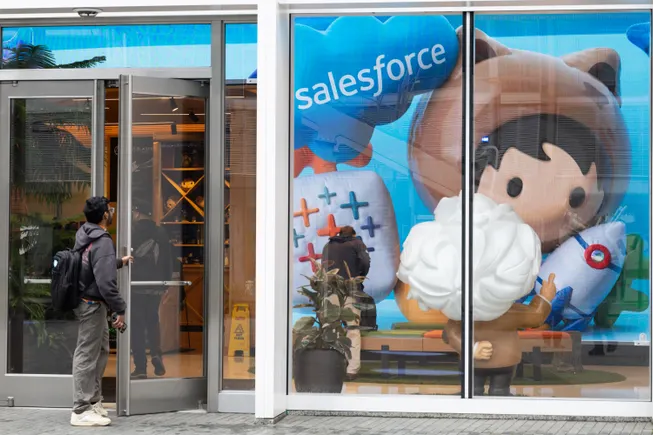
Indeed FutureWorks has established itself as a premier conference for exploring the future of work, attracting a diverse array of global thought leaders. The 2026 iteration, held in Phoenix, was particularly significant due to the heightened discourse surrounding AI’s role in the labor market. The panel featuring Benioff and Hisayuki “Deko” Idekoba, President and CEO of Indeed and Recruit Holdings, was a cornerstone event, bringing together two titans from the technology and recruitment sectors. Their combined insights offered a dual perspective: Benioff from the vantage point of a leading enterprise software provider integrating AI into core business functions, and Idekoba from the global pulse of employment trends and workforce dynamics.
The choice of Phoenix as a venue was also symbolic, given its emergence as a tech hub and its embrace of autonomous vehicle technology, further grounding the abstract discussions of AI in tangible, real-world applications. The atmosphere at the conference was a mix of cautious optimism and strategic contemplation, as attendees sought practical guidance on how to navigate the complex landscape of AI-driven change. Discussions extended beyond technological capabilities to encompass ethical considerations, workforce development, and the imperative for inclusive growth in an AI-powered economy.
Reframing Human Potential: The Balance Between AI and Humanity
While Benioff highlighted the transformative power of AI, Idekoba offered a crucial counterpoint, cautioning against an overestimation of AI’s capabilities and an underestimation of human potential. "I think we’re overestimating the ability of AI, and we’re underestimating the ability of the human being," Idekoba asserted. This statement served as a vital reminder that despite AI’s rapid advancements, there remains an irreplaceable core to human intelligence, creativity, and emotional capacity. He elaborated that while humans excel at complex problem-solving, nuanced communication, and innovative thinking, they often dislike "repetitive tasks every day." This is where AI truly shines, acting as a powerful tool to offload mundane, high-volume, and data-intensive operations.
Idekoba’s vision is not one of human replacement but of human augmentation. He advocated for the strategic deployment of "a lot of AI tools to automate many repetitive tasks to maximize the ability of a human being." This perspective aligns with broader trends indicating that the most successful implementations of AI will involve symbiotic relationships between humans and machines, rather than outright substitution. Studies from organizations like the World Economic Forum consistently predict that while some jobs may be automated, many more will be enhanced or created through AI, requiring a fundamental shift in skills and job design. The focus, therefore, shifts from what AI can do to what humans should do when empowered by AI.
The "Agentic Transformation": Humans and AI Working in Concert
Marc Benioff elaborated on Salesforce’s strategic approach to this synergy, coining the term "dramatic agentic transformation." This concept describes a future where humans and AI agents work seamlessly together, each leveraging their unique strengths. Benioff provided concrete examples from Salesforce’s own operations:

- Engineers augmented by coding agents: These AI tools assist engineers by generating code snippets, identifying errors, and automating routine coding tasks, allowing human developers to focus on architectural design, complex problem-solving, and innovation. This significantly boosts productivity and reduces time-to-market for software solutions.
- Salespeople aided by qualification agents: AI-powered agents can analyze vast amounts of data to identify potential clients, understand their needs, and even pre-qualify leads, presenting salespeople with highly curated prospects. This frees up sales teams to concentrate on relationship building, negotiation, and closing deals.
- Customer service representatives receiving escalated requests: In this model, AI agents handle initial customer inquiries, resolve common issues, and provide instant support. Only complex, emotionally charged, or unique problems are then escalated to human representatives, who can dedicate their expertise to resolving intricate issues, enhancing customer satisfaction, and building loyalty.
Benioff acknowledged that while the vision of a fully "agentic enterprise" promises significant efficiency and effectiveness gains, "most companies are not quite yet an agentic enterprise." However, he emphasized that "we are all on this journey together," highlighting the collaborative and evolutionary nature of this transition across the global business landscape. This journey involves not just technological adoption but also significant organizational redesign, cultural shifts, and continuous learning.
The Evolving Workforce: New Roles and Skill Demands
The integration of AI agents into workflows has profound implications for the job market. Idekoba stressed that AI agents can effectively fill gaps created by a shrinking workforce, particularly in aging economies, and help companies address persistent skills shortages. This necessitates a proactive approach from HR leaders, who must "redesign their workforce to work with AI to maximize the potential of the human being." This redesign involves identifying tasks that can be automated, redefining job descriptions, and investing heavily in reskilling and upskilling initiatives.
Crucially, this transformation is not solely about automation; it is also a powerful engine for job creation. Idekoba pointed to the emergence of entirely new roles that are direct byproducts of the AI revolution:
- AI Ethics Managers: Professionals responsible for developing and enforcing ethical guidelines for AI systems, ensuring fairness, transparency, and accountability. This role has gained prominence as concerns around algorithmic bias, privacy, and responsible AI deployment have grown.
- AI Conversation Designers: Specialists who craft the dialogue, personality, and user experience for conversational AI agents (chatbots, virtual assistants), ensuring natural, effective, and empathetic interactions.
- AI Prompt Designers: Experts in formulating precise and effective prompts for generative AI models to achieve desired outputs, a skill rapidly becoming crucial in fields ranging from content creation to data analysis.
These new professions highlight a broader trend: as AI takes over routine and analytical tasks, human roles are shifting towards areas requiring creativity, critical thinking, emotional intelligence, and interdisciplinary collaboration. The emphasis is on uniquely human attributes that AI currently cannot replicate.
Broader Impact and Implications: Beyond the Enterprise
The implications of AI extend far beyond individual enterprises, touching upon national economies, educational systems, and societal well-being. Economists and policymakers are increasingly focused on how to manage this transition to ensure broad-based prosperity and minimize social disruption.

- Economic Growth and Productivity: AI is expected to be a major driver of productivity growth, allowing businesses to operate more efficiently, innovate faster, and scale operations previously constrained by human limitations. This could lead to higher GDPs and improved living standards, provided the benefits are distributed equitably.
- Education and Training: Educational institutions face an urgent need to adapt curricula to prepare future generations for an AI-powered world. This involves not only teaching AI literacy and technical skills but also fostering critical thinking, adaptability, and creativity. Lifelong learning programs will become paramount for reskilling existing workforces.
- Ethical Governance and Regulation: The rapid pace of AI development has outstripped regulatory frameworks. Discussions around data privacy, algorithmic bias, accountability for AI decisions, and the potential for misuse of AI are ongoing at national and international levels. Establishing robust ethical guidelines and legal frameworks is crucial to building public trust and ensuring responsible AI deployment.
- Social Equity and Inclusion: There is a risk that the benefits of AI could exacerbate existing inequalities if access to training, technology, and new job opportunities is not equitable. Efforts to ensure inclusive AI development and deployment are vital to prevent a widening digital divide.
Addressing the "Scary Unknown": Navigating the Transition
Benioff’s candid admission that the AI shift is "a little bit scary because it’s unknown" reflects a widespread anxiety. This apprehension stems from several factors: fear of job displacement, concerns about the ethical implications of powerful AI systems, and the sheer speed and unpredictability of technological change. However, experts at Indeed FutureWorks 2026 and other forums consistently advocate for proactive measures to mitigate these fears.
Transparency in AI development, public-private partnerships for workforce development, and robust societal dialogues about the future of work are seen as essential. Leaders are urged to communicate clearly about the strategic benefits of AI while also acknowledging and addressing legitimate concerns. The "Waymo" analogy suggests a journey that requires trust in the technology and the systems around it, even as one experiences it for the first time. Building this trust requires demonstrating AI’s benefits in practical, human-centric ways and establishing safeguards against potential harms.
The Imperative for HR Leaders
For HR leaders, the AI transformation is not a distant future but a present reality. Their role is shifting from administrative tasks to strategic workforce planning, talent development, and cultural stewardship. Key responsibilities include:
- Workforce Redesign: Collaborating with business units to identify tasks suitable for AI automation, redefine roles, and create new AI-centric positions.
- Skill Development: Implementing comprehensive training programs to upskill and reskill employees for human-AI collaboration, focusing on "human-centric" skills such as critical thinking, creativity, emotional intelligence, and complex problem-solving.
- Change Management: Leading organizational change initiatives to foster a culture of adaptability, continuous learning, and acceptance of AI tools.
- Ethical AI Deployment: Working with IT and legal departments to ensure that AI tools are used ethically, fairly, and transparently, adhering to internal policies and external regulations.
- Talent Acquisition: Adapting recruitment strategies to attract talent with both traditional and emerging AI-related skills, including those for new roles like AI ethics managers and prompt designers.
Looking Ahead: The Path to an Agentic Future
As Benioff concluded, "We’re really in a new, exciting world, an agentic world." This sentiment encapsulates the duality of the AI era: a period of profound excitement for innovation and progress, coupled with the inherent challenges of navigating uncharted waters. The insights from Indeed FutureWorks 2026 highlight a collective recognition that the future of work is not one where humans are replaced by machines, but one where humans are empowered by intelligent agents to achieve unprecedented levels of productivity, creativity, and fulfillment. The journey towards this "agentic enterprise" demands foresight, collaboration, continuous learning, and a steadfast commitment to maximizing human potential in an increasingly intelligent world. The successful integration of AI will ultimately depend on how effectively societies and businesses can adapt, innovate, and ensure that technology serves humanity’s best interests.






