A well-structured performance review template is far more than a mere bureaucratic form; it is a critical tool for fostering clarity, building trust, and driving genuine employee development. When an organization implements a robust performance review framework, managers and employees achieve greater alignment on expectations, focus on impactful behaviors and results, and engage in fair, productive dialogue. This consistency and dedicated space for candid feedback cultivate transparency, ultimately leading to enhanced employee development and organizational engagement.
Key Takeaways:
- A strong performance review template is essential for aligning expectations, focusing on meaningful outcomes, and fostering productive conversations between managers and employees.
- Constructive feedback is the cornerstone of effective performance reviews, directly impacting employee growth and retention.
- Regular feedback, as indicated by research, significantly boosts employee engagement and reduces turnover.
- Performance review templates standardize the evaluation process, reducing bias, ensuring compliance, and generating valuable performance data for organizational analysis.
- A comprehensive template includes clear performance criteria, opportunities for both strengths and areas for improvement, a balanced rating system, ample space for comments, and a forward-looking focus on goals and development plans.
- Various template types cater to different organizational needs, from monthly check-ins to annual evaluations and specialized development plans.
The Indispensable Role of Constructive Feedback
At the heart of any effective performance review lies the power of constructive feedback. This critical component acts as a catalyst for employee advancement and accelerated growth. It empowers managers to guide their teams, fostering development and enabling continuous improvement. Exceptional feedback is characterized by its specificity, timeliness, and actionability, offering clear guidance on both achievements and areas requiring attention.
Research from Quantum Workplace underscores the profound impact of frequent feedback. Employees who receive more regular feedback are twice as engaged, three times less likely to seek employment elsewhere, and 1.4 times more inclined to remain with their current organization. This data clearly illustrates that helpful feedback is not merely a soft skill but a strategic imperative for engagement and retention. To further assist in crafting impactful feedback, organizations can leverage resources such as comprehensive lists of performance review examples, comments, and phrases to inspire more effective dialogue.
Defining the Performance Review Template
A performance review template serves as a structured document designed to guide the conversation around employee evaluations. Its primary function is to ensure consistency among managers, clearly outline performance expectations, facilitate fair assessment based on defined criteria, and meticulously document progress. A well-designed template ensures employees fully understand how their performance is being evaluated, recognize their strengths, and identify specific avenues for growth.

The adoption of a performance review template, employee review template, or employee review form streamlines the entire process, making it more focused, organized, and manageable for both managers and employees. For HR departments, this standardization is paramount. Templates help mitigate bias, create uniformity in performance discussions across the company, strengthen compliance documentation, and generate clean, comparable performance data. This data is invaluable for identifying organizational trends, providing targeted support to managers, and systematically improving the overall performance management strategy.
The Strategic Advantages of Utilizing Performance Review Templates
The implementation of performance review templates significantly enhances a manager’s ability to conduct effective performance reviews and deliver feedback that genuinely contributes to employee development. A structured employee review template or employee review form guarantees that these conversations remain focused, equitable, and consistent.
These templates empower managers to provide constructive feedback, effectively highlighting both an employee’s strengths and areas where improvement is needed, in a manner that motivates rather than discourages. For HR professionals, this consistency is non-negotiable. It ensures that every employee receives clear, actionable guidance, supports equitable evaluations, and simplifies the tracking and analysis of performance data across the entire organization.
Essential Components of an Effective Performance Review Template
Best practice dictates that a performance review form should incorporate clear and specific performance criteria. It should provide concrete examples of both employee accomplishments and areas identified for development, striking a balance in its assessment. While a rating system can be included, it should not be the sole focus of the evaluation. Ample space for comments and feedback from both the reviewer and the employee is crucial. Furthermore, the template should possess a forward-looking orientation, designed to foster employee growth through the establishment of clear goals and development plans.
Key Components of an Effective Performance Review Template:
An effective performance review process hinges on several core components, each contributing to dialogues that are meaningful, transparent, and fair. A well-designed performance appraisal template offers a consistent framework across the organization and crucially, reduces the administrative burden on managers, enabling them to initiate effective conversations with greater ease.

- Clear Performance Criteria: Defining what success looks like for each role, aligned with organizational objectives.
- Specific Examples: Requiring concrete instances of achievements and areas for development, moving beyond general statements.
- Balanced Assessment: Acknowledging both strengths and opportunities for growth in a constructive manner.
- Employee Self-Reflection: Providing a dedicated section for employees to assess their own performance, goals, and development needs.
- Manager Feedback: A structured section for managers to provide their assessment, guidance, and support.
- Goal Setting: Establishing clear, measurable, achievable, relevant, and time-bound (SMART) goals for the next review period.
- Development Planning: Outlining specific actions, training, or resources to support employee growth and career progression.
- Future Focus: Emphasizing forward-looking objectives and strategies rather than solely dwelling on past performance.
- Open Dialogue Space: Ample room for qualitative comments, reflections, and discussion points from both parties.
What to Avoid in an Employee Performance Review Template:
Certain pitfalls can undermine the effectiveness of performance reviews. Thoughtful template design can help mitigate some of these common issues:
- Vague or Subjective Language: Avoid terms that are open to broad interpretation and can lead to bias.
- Over-reliance on Ratings: While ratings can provide a quantitative measure, they should not overshadow the qualitative feedback and discussion.
- Lack of Specificity: Generic comments without supporting examples are unhelpful and can feel dismissive.
- Focus Solely on Deficiencies: A review should acknowledge successes and contributions, not just areas for improvement.
- Infrequent Reviews: Sporadic feedback leaves employees guessing about their performance and development.
- One-Sided Conversations: Templates should encourage a two-way dialogue, not a monologue from the manager.
- Unclear Expectations: Employees need to understand what is expected of them to meet performance standards.
- Irrelevant Criteria: Performance metrics should directly relate to the employee’s role and responsibilities.
Employee review templates inject consistency, clarity, and structure into performance conversations. They equip managers and employees with guided questions, facilitate goal alignment, and encourage thoughtful reflection. By integrating various employee review templates throughout the performance cycle, organizations can establish a consistent rhythm of meaningful, growth-oriented dialogues.
A Spectrum of Performance Review Templates for Diverse Needs
Organizations often benefit from a range of performance review templates tailored to different stages of the employee lifecycle and various organizational needs. These templates can transform performance management from a perfunctory exercise into a strategic driver of talent development and employee engagement.
1. The GOOD Performance Review Template
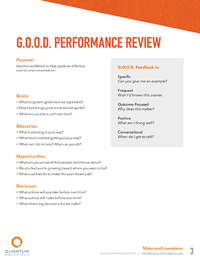
Developed and utilized internally by Quantum Workplace, the GOOD template is designed for monthly manager-employee check-ins. It stands for Goals, Obstacles, Opportunities, and Decisions. This framework encourages a broader perspective, prompting reflection on the bigger picture.
-
Goals: Reviewing progress on current objectives and setting new ones.
-
Obstacles: Identifying challenges that are hindering progress and brainstorming solutions.
-
Opportunities: Exploring new possibilities for growth, learning, or contribution.
-
Decisions: Agreeing on actionable steps and commitments for the period ahead.
-
Pros: Fosters consistent conversation, encourages reflection, and supports future planning.
-
Cons: Does not inherently include metrics for direct comparison between employees, which aligns with a philosophy that discourages such comparisons.
2. Quarterly Check-In Template
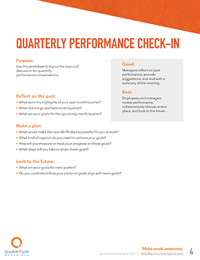
For organizations where monthly reviews are not feasible, quarterly check-ins offer a valuable alternative. This template facilitates collaborative performance reviews, discussion of action plans, and future-oriented planning.
-
Reflect on the Past: Reviewing achievements, challenges, and key learnings from the previous quarter.
-
Make a Plan: Developing specific action steps to address identified areas for improvement or capitalize on opportunities.
-
Look to the Future: Setting objectives and aligning on priorities for the upcoming quarter.
-
Pros: Allows for more immediate action on feedback and performance adjustments.
-
Cons: May sometimes lack focus on long-term organizational and employee goals if not carefully managed.
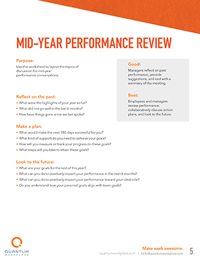
3. Mid-Year Performance Review Template
The mid-year review is a crucial juncture for assessing progress toward annual goals and making necessary adjustments. This template focuses on key highlights, challenges, and future planning.
-
Reflect on the Past: Evaluating performance against goals set at the beginning of the year.
-
Make a Plan: Identifying strategies to overcome obstacles and leverage opportunities for the remainder of the year.
-
Look to the Future: Setting revised goals and development priorities for the second half of the year.
-
Pros: Enables recalibration of efforts and expectations before the year concludes.
-
Cons: If used as the primary review mechanism, it leaves a significant gap between feedback opportunities.
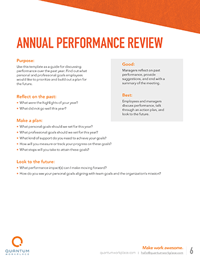
4. Annual Performance Review Template
The annual review serves as a comprehensive summary of an employee’s performance over the entire year. It’s also an ideal time to discuss future career aspirations and priorities.
-
Reflect on the Past: A holistic review of accomplishments, contributions, and challenges faced throughout the year.
-
Make a Plan: Developing strategies for continued growth and addressing any outstanding performance areas.
-
Look to the Future: Setting ambitious goals and identifying development paths for the upcoming performance cycle.
-
Pros: Provides a broad overview of an employee’s performance trajectory.
-
Cons: Condensing an entire year’s performance into a single conversation can be challenging.
5. One-Page Performance Review Template
For a streamlined approach, a one-page template offers a concise overview. These are often quick and straightforward, typically featuring a defined rating scale.
- Pros: Efficient and easy to complete.
- Cons: May offer limited space for detailed qualitative feedback and can discourage in-depth, two-way discussion.
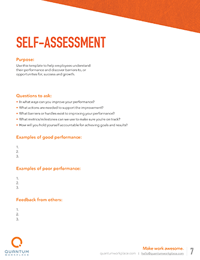
6. Self-Assessment Template
This template empowers employees to reflect on their own performance, identify personal barriers and opportunities, and actively participate in shaping their career path. It provides managers with valuable insights for coaching.
-
Questions to Ask: Prompts that encourage introspection on strengths, achievements, and areas for development.
-
Share Examples of Good Performance: Requiring specific instances of success.
-
Share Examples Where Improvement is Needed: Encouraging honest self-appraisal.
-
Pros: Cultivates reflective habits and encourages employee ownership of performance.
-
Cons: Does not incorporate feedback from peers or managers.
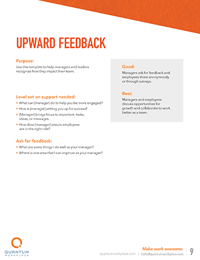
7. Upward Feedback Template
Crucial for leadership development, upward feedback allows employees to provide input on their manager’s effectiveness. This feedback, shared with the manager’s superior, can lead to targeted development for leaders.
-
Level Set on Support Needed: Employees identify what they require from their manager to succeed.
-
Ask for Feedback: Employees provide constructive input on their manager’s leadership style, communication, and support.
-
Pros: Opens avenues for two-way dialogue regarding managerial effectiveness.
-
Cons: Employees may experience apprehension about providing candid feedback due to potential repercussions.
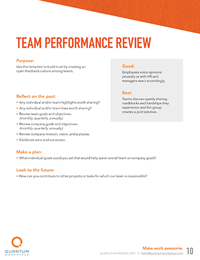
8. Team Performance Review Template
High-performing teams are foundational to organizational success. This template fosters an open feedback culture within teams, enabling open discussion of roadblocks and collaborative solution development.
-
Reflect on the Past: Evaluating team achievements and challenges.
-
Review Team Goals and Objectives: Assessing progress against collective targets.
-
Make a Plan: Developing strategies for enhanced team collaboration and performance.
-
Look to the Future: Setting team aspirations and aligning on future endeavors.
-
Pros: Provides insight into overall team performance beyond individual contributions.
-
Cons: Extreme scores from a few individuals can potentially skew aggregate results.
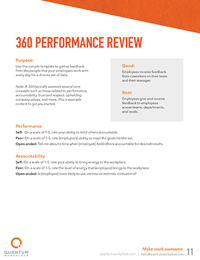
9. 360 Performance Review Template
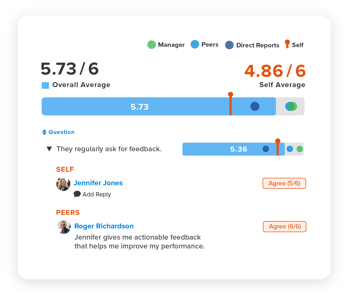
A 360 review gathers feedback from an employee’s peers, subordinates, and managers, providing a comprehensive view of their performance and impact. This multi-rater approach can reveal strengths and challenges not always apparent to a single manager.
-
Performance Self: Employees rate their own performance in key areas.
-
Accountability Self: Employees assess their ability to take ownership and drive results.
-
Example Questions: Structured prompts for assessing specific competencies and behaviors from multiple perspectives.
-
Pros: Offers a holistic perspective on an employee’s actions and interactions.
-
Cons: Can be challenging for some individuals to provide consistently accurate judgments across a broad spectrum of feedback providers.
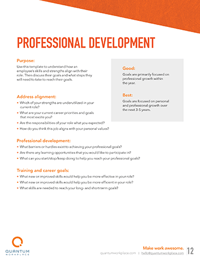
10. Professional Development Template
Focusing on career growth, this template aligns employee strengths, skills, and goals with their current role and future aspirations. It encourages discussions about long-term career trajectories over the next 3-5 years.
-
Address Alignment: Evaluating how current skills match job requirements and future roles.
-
Discuss Development: Identifying areas for skill enhancement and career advancement.
-
Talk Through Training and Goals: Outlining specific learning opportunities and career milestones.
-
Pros: Ensures aligned expectations and facilitates proactive career planning.
-
Cons: May sometimes be too general if not accompanied by specific, actionable development plans.
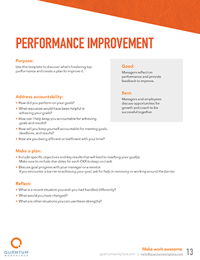
11. Performance Improvement Template
When an employee is not meeting expectations, a performance improvement plan (PIP) is often necessary. This template helps identify performance hindrances and create a structured plan for improvement.
-
Address Accountability: Clearly defining performance expectations and consequences.
-
Make a Plan: Outlining specific actions, support, and timelines for improvement.
-
Reflect: Regularly reviewing progress and making adjustments as needed.
-
Pros: Provides a structured approach to addressing declining performance and offers employees a fair chance to improve.
-
Cons: Requires commitment and active participation from both the employee and the manager.
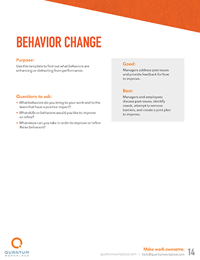
12. Behavior Change Template
Employee behaviors significantly influence individual and team success. This template aids in understanding and addressing behaviors that either support or hinder performance.
-
Questions to Ask: Prompts designed to uncover the root causes of specific behaviors and explore desired changes.
-
Pros: Facilitates collaborative identification of issues, needs, and barriers.
-
Cons: The effectiveness of the conversation heavily relies on the employee’s willingness to engage and self-reflect.
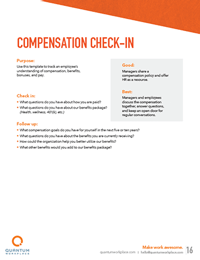
13. Compensation Check-In
Open and transparent conversations about compensation are vital. This template facilitates discussions about salary, benefits, bonuses, and pay raises, ensuring employees and managers are aligned.
-
Check-in: Discussing current compensation, market rates, and employee contributions.
-
Follow-up: Outlining next steps, potential adjustments, and future review cycles.
-
Pros: Promotes pay transparency and can help manage employee expectations.
-
Cons: Not all employee compensation expectations can always be met, requiring careful communication.
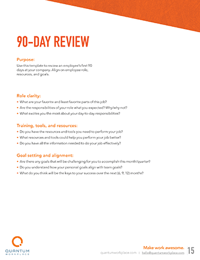
14. 90-Day Review Template
Essential for new hires, this template provides early feedback on their integration into the organization. It helps set short-term goals, establish a shared vision, and clarify role expectations and resource availability.
-
Role Clarity: Ensuring the new hire understands their responsibilities and objectives.
-
Training, Tools, and Resources: Assessing if the employee has what they need to succeed.
-
Goal Setting and Alignment: Establishing initial performance benchmarks and aligning with team objectives.
-
Pros: Offers crucial clarity and early performance feedback for new employees.
-
Cons: Primarily suited for assessing initial integration rather than long-term performance.
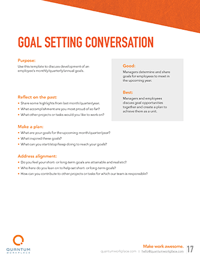
15. Goal Setting Conversation Template

Setting clear, measurable goals is fundamental to performance management. This template guides the development of monthly, quarterly, or annual goals that are aligned with organizational objectives.
-
Reflect on the Past: Reviewing previous goals and their outcomes.
-
Make a Plan: Defining new, SMART goals for the upcoming period.
-
Address Alignment: Ensuring individual goals contribute to broader team and company objectives.
-
Pros: Facilitates the creation of aligned and measurable performance targets.
-
Cons: Requires ongoing discussion and reinforcement throughout the performance cycle to remain effective.

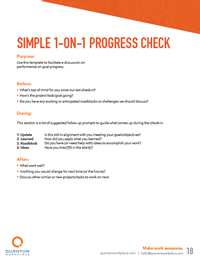
16. Simple 1-on-1 Progress Check
Beyond formal reviews, regular weekly check-ins are essential for real-time progress monitoring and obstacle resolution. This template streamlines these brief, frequent conversations.
- Pros: Promotes agile communication and rapid problem-solving.
- Cons: Requires managers to dedicate consistent, focused time for each employee.
Elevating Performance Reviews from Administrative Tasks to Strategic Initiatives
Performance reviews, when approached strategically, become powerful tools for aligning teams with organizational goals, driving employee and business success, and fostering a positive culture. By emphasizing the value of feedback, these reviews transform into catalysts for development and career advancement.
Simple performance review templates empower HR and managers by:
- Ensuring Consistency and Fairness: Standardizing the evaluation process across the organization.
- Reducing Bias: Minimizing subjective interpretations and promoting objective assessment.
- Improving Managerial Effectiveness: Providing a framework for more structured and productive conversations.
- Enhancing Employee Engagement: Fostering transparency and a sense of value.
- Facilitating Data Collection: Generating reliable data for organizational analysis and talent management.
- Supporting Compliance: Documenting performance discussions for legal and HR purposes.
Streamlining Performance Reviews with Quantum Workplace
Performance conversations need not be arduous. Quantum Workplace’s suite of tools helps keep managers and employees synchronized through engaging performance reviews. Our performance review software provides teams with reliable context, enabling more objective and impactful discussions.
The platform offers several key benefits:
- Customization: Tailor review modules to fit organizational culture and specific team needs, allowing for flexible measurement.
- Habit Building: Integrate the performance process into managers’ existing workflows, encouraging consistent coaching and formal conversation cycles.
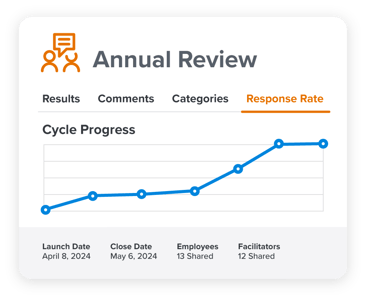
- Tracking and Accountability: Monitor review response rates and performance ratings in real-time to ensure progress.
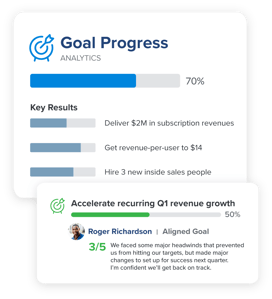
- Goal Integration: Seamlessly embed performance goals directly into evaluations, fostering objective, growth-oriented conversations.
- Multi-Rater Feedback: Incorporate feedback from various sources to gain comprehensive insights for development.
- Data Visualization: Utilize talent dashboards to visualize performance data across teams, enabling informed talent management decisions.
Performance Review Template FAQs
What are the most important sections in an employee review template?
The most effective performance review templates incorporate clear, structured sections to guide meaningful conversations. Key components typically include:
- Employee Information: Basic details about the employee and reviewer.
- Review Period: Clearly defined timeframe for the evaluation.
- Key Responsibilities/Goals: A summary of the employee’s primary duties and objectives.
- Performance Assessment: Evaluation of performance against set criteria, with specific examples.
- Strengths and Areas for Development: A balanced assessment of the employee’s contributions and growth opportunities.
- Employee Comments: Space for the employee to provide their perspective.
- Goals for Next Period: Setting clear, actionable objectives for the future.
- Development Plan: Outlining steps for professional growth.
- Signatures: Formal acknowledgment from both employee and manager.
These sections ensure consistency, fairness, and alignment across teams, while providing HR with crucial visibility into performance trends.
How to write a good performance review template?
To craft an effective performance review template, HR leaders should design a framework that promotes clarity, alignment, and action. Begin by defining what constitutes excellent performance within your organization, then develop prompts that encourage reflection and forward-looking planning. An effective employee review form should:
- Be Goal-Oriented: Link performance to specific, measurable objectives.
- Focus on Behaviors and Results: Evaluate both how work is done and the outcomes achieved.
- Include Specific Prompts: Guide reviewers to provide concrete examples.
- Allow for Qualitative Feedback: Provide ample space for narrative comments.
- Encourage Two-Way Dialogue: Include sections for employee input and self-assessment.
- Be Future-Focused: Emphasize development and future goals.
- Be Simple and Understandable: Avoid overly complex jargon or structures.
The best templates balance structure with flexibility, supporting both strategic evaluation and human-centered conversations.
What is an example of a good performance review?
A good performance review effectively highlights achievements, assesses progress toward goals, and establishes clear expectations for the future. Quantum Workplace’s GOOD Performance Review Template, for instance, utilizes four pillars—Goals, Obstacles, Opportunities, and Decisions—to foster a holistic, two-way conversation.
A strong example would include:
- Specific examples of accomplishments: Quantifiable achievements and contributions.
- Clear feedback on goal achievement: Progress against defined objectives.
- Constructive suggestions for improvement: Actionable advice for development.
- A collaborative discussion on future goals: Setting clear objectives for the next period.
- An employee’s voice: Space for self-assessment and feedback.
This approach strengthens trust, enhances clarity, and supports both employee engagement and overall organizational performance.
What are the 5 words for a performance review?
To ensure employee review forms foster productive conversations and actionable growth, remembering key frameworks is essential. Quantum Workplace’s widely recognized G.O.O.D. model provides a guiding framework for performance conversations and check-ins. The acronym stands for:
- Goals
- Obstacles
- Opportunities
- Decisions
These five concepts (including the implicit need for "Dialogue" or "Discussion" around these points) help structure meaningful reviews and check-ins, ensuring a comprehensive approach.
How can HR create effective performance review templates?
HR teams can design effective performance review templates by prioritizing fairness, clarity, and strategic alignment. Key steps include:
- Define Organizational Values and Competencies: Ensure the template reflects the core principles and desired behaviors of the company.
- Involve Stakeholders: Gather input from managers and employees to ensure the template is practical and relevant.
- Focus on Future Development: Design prompts that encourage goal setting and career pathing.
- Simplify and Streamline: Avoid overly complex or lengthy forms that can lead to administrative burden.
- Provide Clear Guidance: Offer training and resources to managers on how to effectively use the templates.
- Regularly Review and Update: Periodically assess the template’s effectiveness and make necessary adjustments based on feedback and evolving organizational needs.
An effective employee review form should simplify performance conversations, not complicate them.
By implementing well-designed performance review templates and leveraging appropriate technology, organizations can transform their performance management processes, fostering a culture of continuous improvement, engagement, and sustained success.