As companies across the global economic spectrum accelerate their integration of artificial intelligence into core operations, the demand for tech talent is witnessing a significant and transformative surge, originating from an increasingly varied array of organizations beyond traditional technology firms. This pivotal shift marks a profound evolution in the job market, as employers move decisively from experimental AI projects to large-scale, practical implementation, thereby creating a robust ecosystem of new roles and skill requirements. The landscape, once dominated by the tech giants, is now seeing a diversification of demand, with sectors ranging from manufacturing to administrative support services and retail actively seeking professionals capable of harnessing AI’s power.
The AI Imperative: From Experimentation to Enterprise Integration
The current surge in AI-related job openings is a direct consequence of a fundamental strategic pivot within corporations worldwide. For years, artificial intelligence was largely viewed as a futuristic concept or a tool for specialized research and development teams. However, the mid-2020s have heralded an era where AI is no longer a peripheral experiment but a central pillar of business strategy. According to industry analyses, companies are now "increasingly incorporating AI into business operations, creating demand for workers who can apply AI tools, manage AI-enabled workflows, and support AI-driven initiatives." This transition signifies a maturation of AI technologies and a growing recognition of their tangible benefits in enhancing efficiency, fostering innovation, and driving competitive advantage.
The shift is comprehensive, impacting every facet of business, from customer service automation and predictive analytics to supply chain optimization and advanced manufacturing processes. As AI models become more sophisticated and accessible, organizations are finding practical applications that directly translate into a need for specialized human capital. This includes not only data scientists and machine learning engineers but also a broader category of professionals who can bridge the gap between AI capabilities and business objectives, such as AI project managers, AI ethicists, and specialists in AI integration and deployment.
A Shifting Landscape: Tech Demand Beyond Traditional Tech
One of the most striking revelations of recent market analyses is the profound diversification of industries now actively recruiting for technology roles. Historically, the tech job market was largely concentrated within software companies, IT services, and telecommunications. However, the pervasive nature of AI has shattered these traditional boundaries. The analysis from CompTIA, released in September 2026, highlighted this trend, noting that a substantial portion of available technology jobs originated from outside traditional tech sectors. This includes robust hiring activity in manufacturing, administrative support services, and retail, signaling a fundamental restructuring of what constitutes a "tech job" and who employs tech professionals.
This phenomenon is further underscored by a July report from Indeed’s Hiring Lab, which meticulously tracked job postings containing the term "artificial intelligence" in their titles. The report revealed a staggering trend: the number of such job postings more than tripled in the U.S. since 2022. More significantly, the study found that "AI-touched job titles" had increased across every tracked market, with the U.S. leading the non-tech category at 63%. This means that over half of all job titles incorporating AI were found in industries traditionally not classified as "tech." Many of these roles were not entirely new creations but rather existing positions that had been updated and augmented to include AI responsibilities, reflecting a pervasive integration rather than mere addition of new roles. For instance, a "Marketing Manager" might now be an "AI-Driven Marketing Manager," requiring expertise in leveraging AI for targeted campaigns and customer analytics.
Quantifying the Demand: Key Data Points and Trends
The robust demand for technology talent, particularly in AI-related fields, remains undeniably strong, often defying narratives around broader tech industry layoffs. CompTIA’s findings from August 2026 paint a clear picture: nearly 600,000 active technology occupation postings were identified across the U.S. workforce. Of these, a significant 42% represented newly posted positions, indicating fresh demand, while the remaining percentage belonged to open roles that had remained unfilled from previous months, underscoring persistent talent shortages in specific areas.
Beyond the sheer volume, CompTIA’s analysis provides insight into the specific areas of growth. The report noted that "growth in tech support, infrastructure, project management and cybersecurity roles suggests employers remain focused on strengthening core technology functions while expanding emerging capabilities." This indicates a dual strategy by companies: fortifying their foundational IT systems to ensure stability and security, while simultaneously investing in advanced capabilities driven by AI.
Further substantiating these trends, a report from the tech career site Dice for Q1 2026 revealed a dramatic 173% year-over-year jump in job postings for roles explicitly mentioning "AI" in their titles. This explosive growth stands in stark contrast to a 22% dip in software development jobs during the same period, suggesting a reallocation of focus and resources within the tech hiring landscape. While traditional software development remains crucial, the specialized skills required for AI implementation are now commanding a premium. The Dice report also highlighted an uneven distribution of this growth across sectors, with tech listings in finance and banking seeing a remarkable 47% year-over-year increase, significantly outpacing the 23% year-over-year increase in overall tech job postings. This points to specific industries like finance being early adopters and heavy investors in AI solutions for competitive advantage, risk management, and customer service enhancement.
The Paradox of Layoffs and Robust Hiring
The current employment landscape presents a complex paradox: while headlines frequently announce rounds of layoffs, particularly from large, established technology companies, the overall demand for tech talent, especially in AI, remains remarkably resilient. This apparent contradiction can be understood by examining the nature of these layoffs versus the areas of hiring growth. Many prominent tech firms engaged in workforce reductions in the mid-2020s, often citing overhiring during the pandemic boom, economic uncertainties, or strategic re-prioritizations. These layoffs frequently affected roles in areas that were heavily scaled up during periods of rapid expansion, or those deemed less critical in a new, leaner operational model.
Conversely, the surge in AI-related hiring is driven by a forward-looking imperative. Companies are not merely replacing old roles but creating entirely new categories of jobs or profoundly reconfiguring existing ones to integrate AI. The skills required for these new roles—such as machine learning engineering, prompt engineering, AI ethics, and data governance—are often distinct from those targeted in layoffs. This implies a significant skill mismatch rather than an overall decline in the need for skilled professionals. Organizations are shedding talent in areas they perceive as less strategically vital while aggressively recruiting in emerging, high-growth domains, primarily centered around AI. This ongoing rebalancing act underscores a dynamic and rapidly evolving job market where adaptability and continuous learning are paramount.
Industry-Specific Transformations
The widespread adoption of AI is not merely creating new job titles; it is fundamentally transforming entire industries.

-
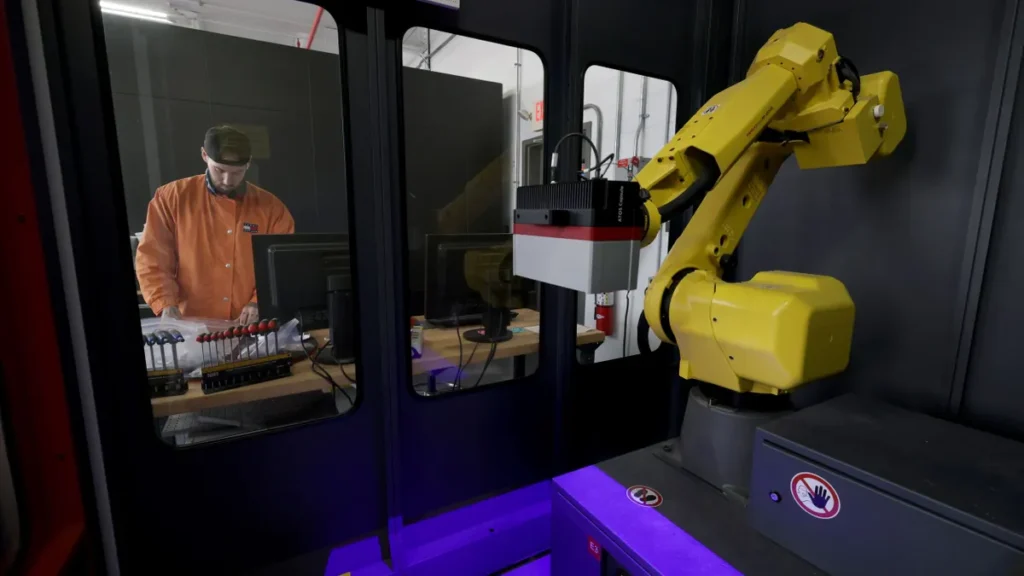
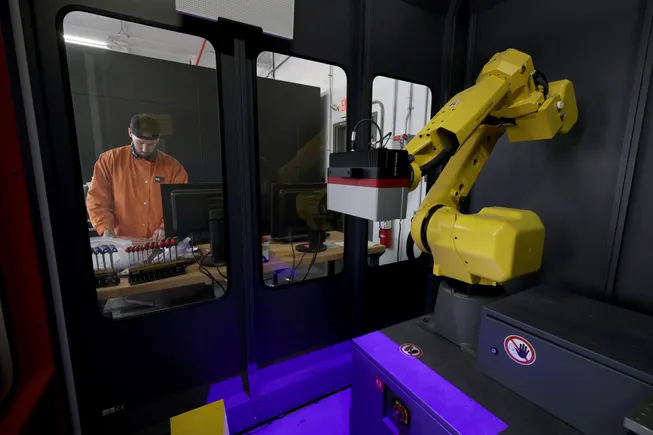
Manufacturing: In the manufacturing sector, AI is revolutionizing production lines through predictive maintenance, which uses machine learning to anticipate equipment failures, thereby minimizing downtime and optimizing operational efficiency. AI-powered robotics are enhancing precision and speed in assembly, while computer vision systems are performing quality control inspections with unparalleled accuracy. This necessitates roles like AI-driven production engineers, industrial data scientists, and robotics technicians with AI expertise. The image of an employee working in a 3-D scan lab at GE Appliances on August 8, 2025, in Louisville, Ky., perfectly encapsulates this trend, showing how even established industrial giants are embracing advanced technologies.
-
Finance & Banking: The financial industry is leveraging AI for sophisticated fraud detection algorithms that can identify anomalies in transactions in real-time, significantly reducing financial crime. Algorithmic trading, powered by AI, executes complex trades at speeds and scales impossible for humans. AI-driven chatbots and virtual assistants are redefining customer service, while machine learning models are enhancing risk assessment, credit scoring, and personalized financial advice. This has spurred demand for AI-savvy quantitative analysts, cybersecurity specialists, and AI compliance officers.
-
Retail: Retailers are employing AI for hyper-personalization, using consumer data to recommend products and experiences tailored to individual preferences, both online and in physical stores. AI optimizes inventory management, predicting demand fluctuations and ensuring optimal stock levels. In supply chain management, AI-driven analytics enhance route optimization, warehouse efficiency, and last-mile delivery. Roles such as AI merchandising strategists, customer experience AI specialists, and supply chain AI analysts are becoming increasingly critical.
-
Healthcare: While not explicitly mentioned in the original article, the healthcare sector is a prime example of AI’s transformative potential. AI is accelerating drug discovery, improving diagnostic accuracy through image analysis (e.g., radiology, pathology), and personalizing treatment plans based on patient data. This generates demand for medical AI researchers, clinical informaticists with AI expertise, and AI-driven bioinformatics specialists.
Addressing the Talent Gap: Reskilling and Upskilling Imperatives
The rapid pace of AI adoption and the concurrent shift in skill requirements have created a significant talent gap. Companies are struggling to find qualified professionals who possess both deep technical AI expertise and the necessary business acumen to apply these technologies effectively. This challenge has placed an unprecedented onus on human resources and learning and development departments.
To bridge this gap, organizations are increasingly investing in comprehensive reskilling and upskilling programs. These initiatives aim to retrain existing employees for new AI-driven roles or to equip them with the necessary skills to integrate AI into their current responsibilities. Partnerships with educational institutions, online learning platforms, and specialized training providers are becoming common strategies. HR executives, while not directly quoted in the provided text, are likely emphasizing the criticality of continuous learning and adaptability. For instance, an HR leader might infer that "the shelf-life of skills is shrinking, and companies must cultivate a culture of lifelong learning to remain competitive in the AI era." Furthermore, recruitment strategies are evolving to look beyond traditional qualifications, placing greater emphasis on potential, problem-solving abilities, and a willingness to learn new technologies.

The Future Workforce: Adapting to AI-Driven Evolution
The long-term implications of AI on the future workforce are profound and multifaceted. As AI automates routine and repetitive tasks, the nature of work is shifting towards activities that require uniquely human attributes: creativity, critical thinking, complex problem-solving, emotional intelligence, and ethical reasoning. The growing importance of ethical considerations in AI development and deployment, for instance, is giving rise to roles focused on ensuring fairness, transparency, and accountability in AI systems.
AI is not merely a job destroyer; it is a powerful augmentative tool that can enhance human capabilities, freeing individuals from mundane tasks to focus on higher-value activities. This paradigm shift necessitates a re-evaluation of educational curricula, from K-12 to higher education and vocational training. Educational systems must adapt to prepare future generations for a world where collaborating with AI is a fundamental skill. Policies supporting workforce transition, including unemployment benefits linked to retraining programs and incentives for companies to invest in employee development, will also become crucial. The ultimate vision is a symbiotic relationship between humans and AI, where technology empowers individuals to achieve greater productivity and innovation, driving economic growth and societal progress.
In conclusion, the artificial intelligence revolution is not just a technological advancement; it is a profound economic and social phenomenon that is fundamentally reshaping the global job market. The surge in AI-related job postings across an expanding array of industries, coupled with the strategic pivot from AI experimentation to full-scale implementation, signals a new era for workforce development. While challenges such as talent gaps and the need for continuous upskilling persist, the opportunities for innovation, efficiency, and economic growth presented by AI are immense, demanding strategic adaptation from individuals, businesses, and educational institutions alike.