The rapid integration of generative artificial intelligence into the professional and academic spheres has created a polarizing divide in institutional policy. While academic institutions have largely pivoted toward a model of "abstinence"—characterized by AI detection software and revised integrity policies—corporate America has moved toward aggressive "adoption," focusing on deployment targets and fluency training. However, emerging neurological research suggests that both extremes fail to address the fundamental question of human agency. A new framework, known as the Bot Check Method, is emerging as a critical third path, focusing on a governed, sequenced practice that prioritizes human cognition before technological assistance. This method addresses the growing phenomenon of "cognitive debt," a term coined by researchers to describe the neurological cost of outsourcing thought to machines.
The Neuroscience of Cognitive Debt
The impetus for a redesigned approach to AI integration stems from recent findings at the MIT Media Lab. In a comprehensive study titled “Your Brain on ChatGPT: Accumulation of Cognitive Debt when Using an AI Assistant for Essay Writing Task,” researchers led by Nataliya Kosmyna explored the real-time neurological impacts of large language model (LLM) usage. The study utilized EEG caps to monitor the brain activity of 54 university students as they performed writing tasks under three distinct conditions: using ChatGPT, using a standard search engine, and using no digital tools.
The data revealed a stark contrast in neural engagement. Participants who worked without AI tools exhibited the strongest and most distributed neural networks, particularly in regions associated with active thinking, memory, and executive function. In contrast, those using ChatGPT showed significantly weakened brain connectivity. Most concerning was the "underengagement" observed in a subsequent session where students who had previously relied on AI were asked to work independently. Their neural pathways remained depressed, suggesting that the habit of deferring to AI creates a lingering neurological deficit.
This "cognitive debt" is not merely a metaphor for laziness; it is a measurable reduction in cognitive ownership. The study found that LLM users had lower self-reported ownership of their work and struggled to accurately quote or explain their own writing. This suggests that when AI provides the framework for a task before a human has engaged with the problem, the cognitive events required to build genuine understanding—triggering, exploration, and integration—are short-circuited.
The Failure of Institutional Extremes
The current landscape of AI policy is defined by two flawed approaches. In academia, the "abstinence error" mirrors historical failures in public health education. By prohibiting AI, institutions do not stop the behavior; they merely drive it underground. This "shadow AI" usage occurs without pedagogical scaffolding, ensuring that when students do use the tool, they do so as a replacement for thinking rather than a supplement to it.

In the corporate sector, the rush toward adoption creates a different set of risks. Organizations that prioritize speed over sequence often overlook the erosion of human capability. Furthermore, strict prohibitions in corporate settings lead to significant security vulnerabilities. When employees are denied sanctioned AI tools, they frequently turn to personal devices and consumer-grade accounts to process sensitive company data, including client files, internal strategies, and financial projections. This creates a "governance vacuum" where data flows outside the organization’s security perimeter, often without the knowledge of IT or HR departments.
The common thread in both failures is a lack of focus on the developmental outcome of the user. Neither the "keep it out" nor the "get it in" approach asks what kind of thinker the individual is becoming through their interaction with the technology.
Chronology of the AI Integration Crisis
The current tension is the result of a compressed timeline of technological evolution and institutional reaction:
- November 2022: The public release of ChatGPT triggers immediate panic in academic circles, leading to widespread bans and the rise of AI detection startups.
- Early 2023: Corporate leaders begin mandating "AI fluency" as a core competency, often without clear guidelines on how to maintain intellectual property or human oversight.
- Mid-2023: Researchers begin to note "AI fatigue" and a decline in the quality of independent work among heavy AI users.
- Late 2023 – Early 2024: Studies like the MIT Media Lab EEG research provide the first empirical evidence of the neurological costs of AI over-reliance.
- Present: The emergence of frameworks like the Bot Check Method and the SHINE framework signals a shift toward "agentic AI" and human-centric design.
The Bot Check Method: A Four-Phase Sequence
To counteract cognitive debt, the Bot Check Method proposes a deliberate sequence designed to protect human agency. This method is rooted in the Community of Inquiry (CoI) framework, which identifies four cognitive events necessary for learning: triggering, exploration, integration, and resolution.
Phase 1: Think Human
Before any external consultation, individuals must work through a problem in isolation. This creates "cognitive stake." By forcing the brain to form its own frame of reference, the individual activates the neural pathways associated with ownership and memory. This phase serves as the "triggering event" that anchors the learning process.
Phase 2: Think Human Together
Participants move into peer-to-peer dialogue. This social layer allows for the exploration of ideas and the challenging of reasoning without the "authority" of an AI output. Research into social presence suggests that cognitive depth is often reached through emotional and personal connection to a group, a process that AI cannot replicate.
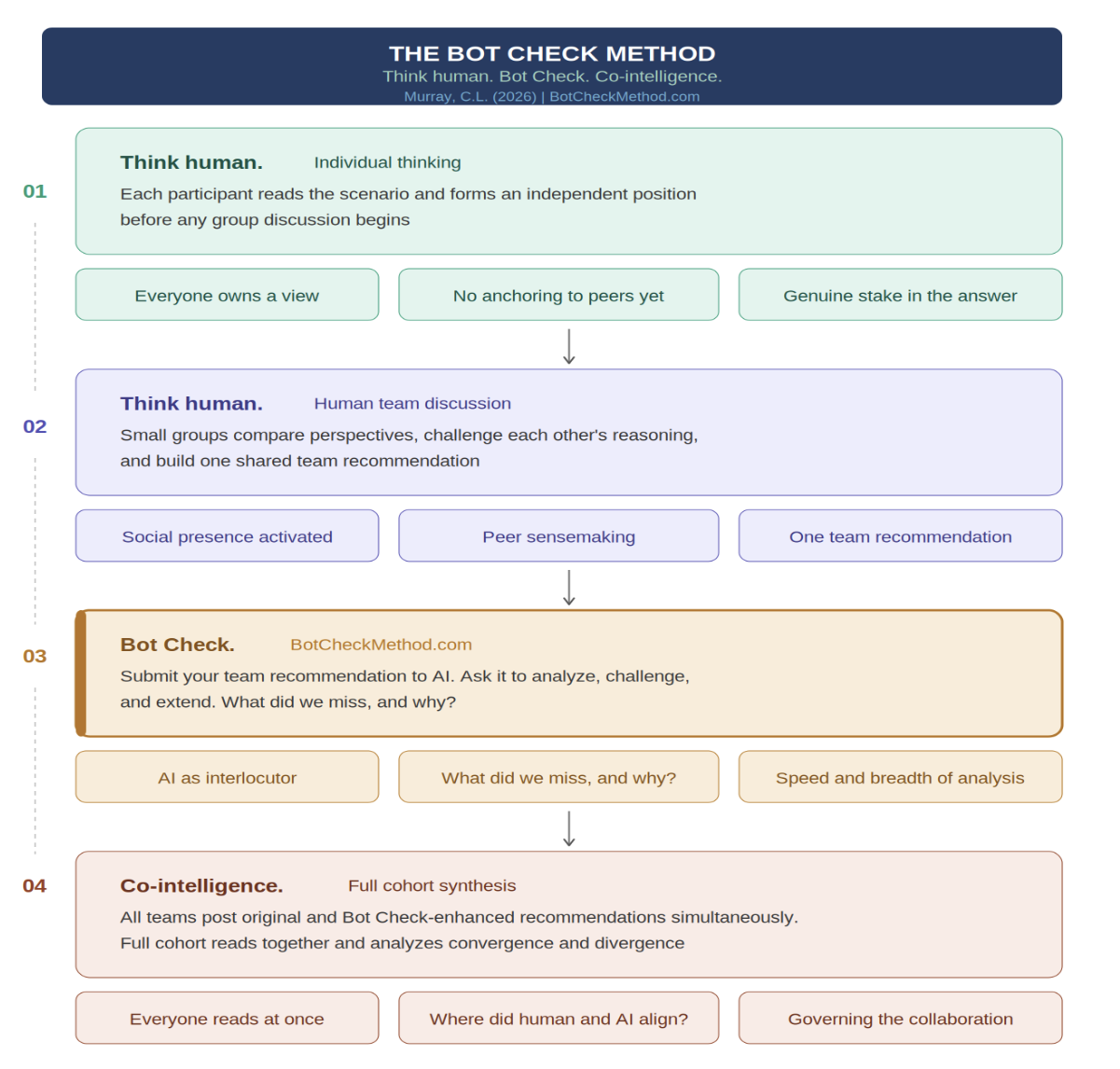
Phase 3: Bot Check
Only after a human team has developed a defensible recommendation is AI introduced. In this phase, the AI acts as an interlocutor rather than an author. The team submits their work to the bot and asks it to analyze, challenge, and identify gaps. This turns the AI into a tool for sharpening human scrutiny. A sophisticated application involves asking the AI to help write the most rigorous prompt possible to "stress test" the human recommendation.
Phase 4: Co-intelligence
The final phase involves a shared synthesis. All teams compare their original human-led versions with the AI-enhanced versions. This reveals patterns of convergence and divergence, providing data on where the AI adds value and where it may be hallucinating or oversimplifying. The result is a product that carries genuine human intellectual ownership while benefiting from machine-assisted refinement.
Scaling Through the SHINE Framework
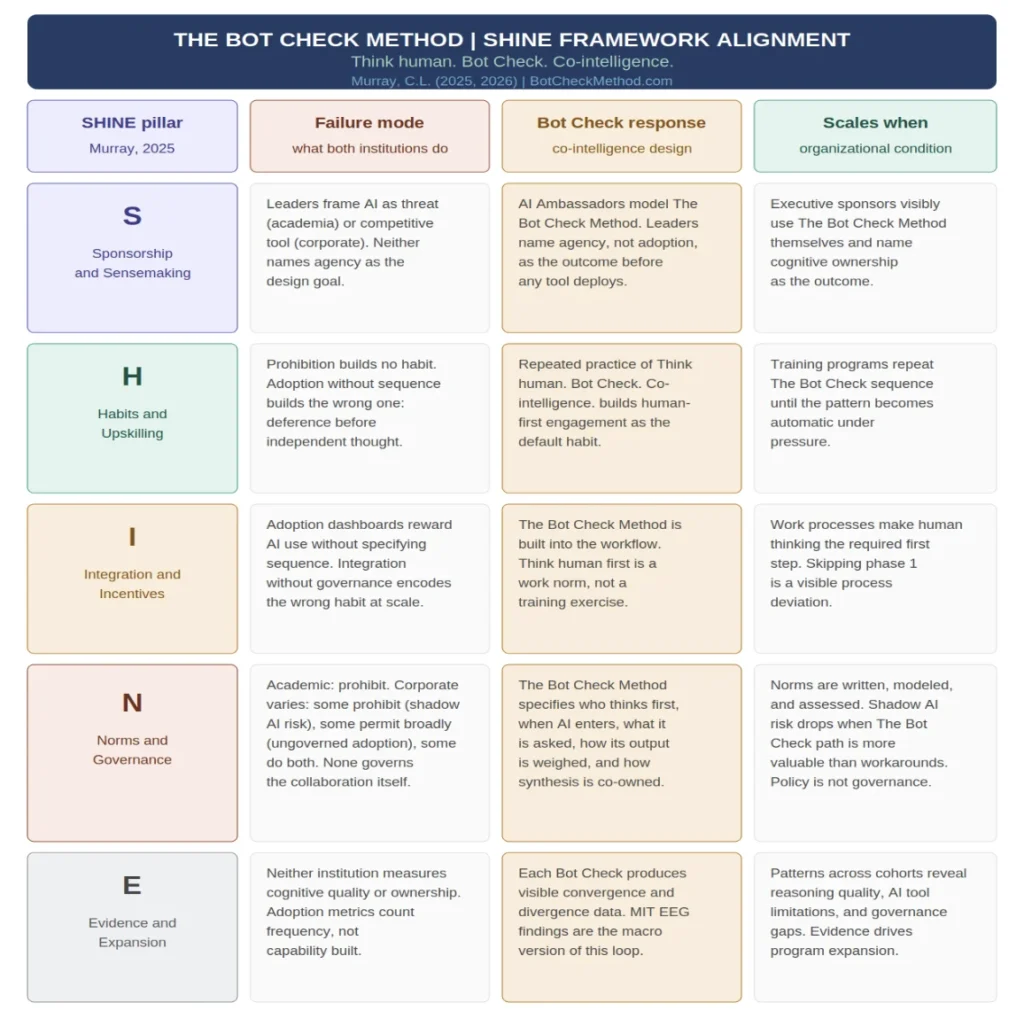
For organizations to move beyond session-level exercises and into institutional capability, the Bot Check Method must be supported by a robust governance architecture. The SHINE framework provides this structure through five key pillars:
- Sponsorship and Sensemaking: AI Ambassadors must model the "Think Human" sequence. Leadership must demonstrate that purposeful AI use is valued over mere usage frequency.
- Habits and Upskilling: Training should focus on the behavioral pattern of human-first engagement. The goal is not "tool proficiency" but the habit of maintaining agency throughout the technological encounter.
- Integration and Incentives: Workflow norms must be redesigned to reward individual reflection. If the incentive structure only rewards the final output, the temptation to skip to the AI phase will remain high.
- Norms and Governance: Governance must evolve from "usage policies" to "collaboration designs." This involves creating clear rules for how and when AI is introduced into the decision-making pipeline.
- Evidence and Expansion: Organizations must build internal evidence loops to monitor the quality of human-AI collaboration. This data allows for the continuous refinement of governance policies.
Analysis of Implications and Future Outlook
The shift from "abstinence" to "agency" represents a fundamental change in how we view the role of technology in human development. If the findings of the MIT study hold true across larger populations, the long-term risk of unchecked AI adoption is a workforce that is technically proficient but cognitively dependent. This has profound implications for leadership development, where the ability to think critically under pressure is a non-negotiable requirement.
Industry experts suggest that the next phase of enterprise transformation will not be defined by who has the best AI tools, but by who has the best "human operating system" to manage those tools. Institutions like the Columbia University School of Professional Studies Pedagogical Lab are already training faculty to leverage these sequenced designs, recognizing that the human cognitive architecture is universal across both the classroom and the boardroom.
The adoption of the Bot Check Method and similar frameworks suggests that the future of work is not a choice between human and machine, but a disciplined integration of both. By requiring a "Think Human" first step, organizations can ensure that they are building capability rather than accumulating debt. As AI continues to evolve toward more agentic forms, the need for a named, teachable, and repeatable method of human-AI collaboration will only become more urgent. The decision to prioritize human agency is not a technological one; it is a design choice that will determine the intellectual health of future generations.