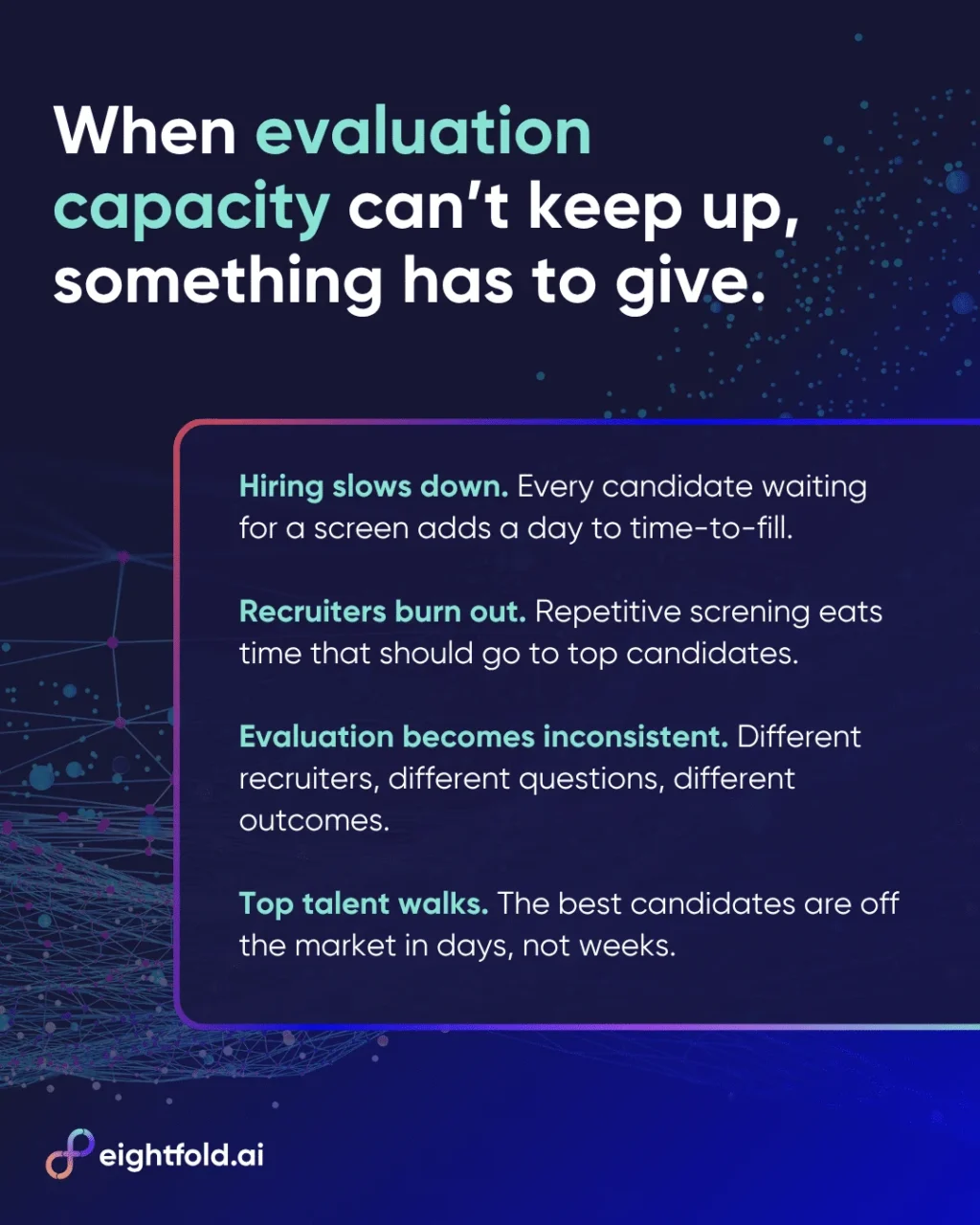
The landscape of talent acquisition has undergone a dramatic transformation over the past decade. Innovations like applicant tracking systems (ATS), sophisticated recruitment marketing platforms, automated scheduling tools, and self-service career sites have fundamentally reshaped how organizations attract, engage, and manage prospective employees. Consequently, many stages of the hiring funnel now operate with unprecedented speed compared to just five years ago. However, paradoxically, the overall time-to-fill metric, a critical indicator of hiring efficiency, continues to lengthen for many companies. This persistent challenge points to a critical bottleneck that has shifted to the midpoint of the hiring funnel: the stage where candidates must be meticulously evaluated by human recruiters.
This is precisely the problem that Eightfold AI Interviewer is engineered to address. This innovative solution introduces an AI-led structured interview layer designed to empower recruiting teams to assess candidates earlier in the process, with greater consistency, and at a scale that was previously unattainable without augmenting headcount. In stark contrast to the rapidly evolving segments of the hiring process, the practice of initial candidate screening has remained remarkably stagnant for the better part of two decades. The traditional model involves a recruiter making phone calls, posing a standardized set of questions, meticulously taking notes, and repeating this process dozens of times for each open requisition. This methodology was functional when applicant volumes were manageable. However, in today’s hyper-competitive and high-volume hiring environment, it is demonstrably insufficient.
The Unraveling of Recruitment Math: Escalating Applicant Volumes and Stagnant Capacity
The surge in applicant volumes across nearly every industry is a multifaceted phenomenon. It is fueled by the proliferation of simplified "easy apply" functionalities on job boards and company career pages, more expansive sourcing strategies that cast a wider net, and, increasingly, the use of AI tools by candidates themselves to apply to a larger number of roles in a significantly shorter timeframe. Concurrently, the capacity of human recruiters, both in terms of numbers and efficiency, has either remained flat or, in some instances, has contracted. This widening chasm between the influx of applications and the available human resources to process them creates a critical operational challenge.
For a substantial number of organizations, the fundamental issue is not a deficiency in technology adoption. Rather, the challenge lies in maximizing the return on existing technology investments by systematically identifying and eliminating manual, time-consuming tasks that continue to impede the speed and efficiency of the hiring process. The prevailing expectation placed upon recruiting teams is to screen an ever-increasing number of candidates, expedite the hiring timeline, and simultaneously enhance the candidate experience, all without the luxury of additional personnel. This confluence of demands necessitates a fundamental re-evaluation of existing workflows.
When faced with this escalating pressure, organizations typically find that several aspects of their recruitment process are compromised. These often include:
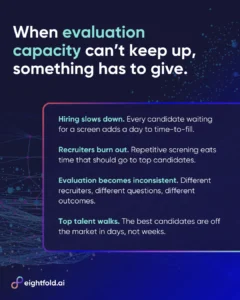
- Compromised Quality of Evaluation: To maintain speed, the depth and rigor of candidate evaluations are often sacrificed, leading to less informed hiring decisions.
- Extended Time-to-Offer: Despite efforts to speed up initial screening, the overall time it takes to extend an offer can still lengthen due to inefficiencies in subsequent stages.
- Diminished Candidate Experience: A rushed or inconsistent screening process can leave candidates feeling undervalued, negatively impacting the employer brand.
- Increased Risk of Mis-hires: A less thorough evaluation increases the likelihood of hiring candidates who are not a good fit, leading to potential performance issues or early attrition.
The False Tradeoff: Speed vs. Thoroughness in Candidate Assessment
In response to these pressures, many talent leaders find themselves compelled to accept what appears to be an unavoidable tradeoff: either prioritize speed and conduct a lighter evaluation, or opt for a thorough evaluation at the cost of a protracted hiring cycle. This often translates to screening fewer candidates per requisition or shortening the duration of initial conversations. Furthermore, there is a tendency to place undue reliance on the information presented in resumes, which, while important, is often insufficient on its own for making a high-stakes hiring decision.
However, this perceived tradeoff is, in itself, the core of the problem. Resumes and simple keyword matching have historically been inadequate inputs for making high-quality hiring decisions. When this thin screening is compounded by higher applicant volumes, the inherent risks are amplified. This can lead to the overlooking of exceptionally talented candidates, a lack of consistency in the evaluation process, and a higher incidence of "misses" – candidates who are hired but later prove to be a poor fit, surfacing as attrition issues down the line.
For organizations that have strategically invested in technology as the bedrock of their talent acquisition strategy, this situation presents a significant opportunity for further optimization. Once the operational aspects of recruiting are streamlined, the logical next frontier for improvement lies in enhancing the quality, consistency, and scalability of candidate evaluation. The conflict between speed and thoroughness is an artificial constraint that arises solely when candidate evaluation is entirely dependent on synchronous human-led conversations. This is an operational model limitation, not an immutable law of recruitment.

The Dawn of Scalable Evaluation: Redefining Where and How Assessment Occurs
Organizations that are successfully dismantling this bottleneck are not simply hiring more recruiters or replacing their existing systems. Instead, they are strategically extending their recruitment capabilities by fundamentally restructuring where and how candidate evaluation takes place. This approach continues to leverage new platforms as the definitive system of record for candidate data.
This advanced methodology complements existing recruiting workflows by providing more consistent and objective candidate insights. Crucially, it liberates recruiters to dedicate more of their valuable time to high-value interactions, such as engaging with promising candidates, collaborating with hiring managers, and strategic talent planning, while significantly reducing the time spent on repetitive, lower-value screening tasks.
The evolution of scalable evaluation often involves:
- Leveraging Asynchronous AI-Powered Screening: Utilizing AI tools to conduct initial, structured assessments that can be completed by candidates at their convenience. This allows for a more standardized evaluation of core competencies and role-specific skills.
- Data-Driven Insights for Recruiters: AI can analyze candidate responses and provide recruiters with synthesized insights, highlighting key strengths, potential areas of concern, and alignment with job requirements, enabling more informed decision-making.
- Focusing Human Effort on High-Impact Stages: By automating initial screening, recruiters can dedicate their expertise to later-stage interviews, behavioral assessments, and critical relationship building, ensuring that human interaction is reserved for the most impactful touchpoints.
- Standardizing Evaluation Criteria: AI-driven tools ensure that all candidates are evaluated against the same objective criteria, mitigating unconscious bias and promoting greater fairness and equity in the hiring process.
Eightfold AI Interviewer: An Extension, Not a Replacement, for Recruiting Teams
A pervasive misconception surrounding AI-enabled candidate evaluation is that it necessitates a complete overhaul of existing recruiting processes. In reality, solutions like the Eightfold AI Interviewer are meticulously designed to integrate seamlessly with an organization’s existing Applicant Tracking System (ATS), acting as a powerful augmentation rather than a replacement. The ATS continues to serve as the authoritative system of record, while the AI-enabled screening layer introduces a structured, objective evaluation component that enables recruiters to gather richer, more nuanced candidate insights much earlier in the hiring journey.
The implementation of such solutions is typically straightforward. Organizations can build upon their established workflows, processes, and prior technology investments. This allows teams to commence with a single role or a specific hiring process, enabling them to standardize screening questions and rapidly cultivate a more consistent and equitable candidate experience without causing disruption to recruiters, hiring managers, or existing ATS workflows.
The ultimate outcome is a strengthened, more robust recruiting process, not a fundamentally different one. Recruiters experience a significant reduction in time spent on repetitive screening conversations, candidates navigate through the hiring funnel with greater alacrity, and hiring teams are equipped with more consistent and reliable information to support superior decision-making. This strategic integration of AI empowers human recruiters to focus on what they do best – building relationships, assessing cultural fit, and making final, informed hiring decisions – while the AI handles the heavy lifting of initial, scalable evaluation.
The Broader Implications: A Paradigm Shift in Talent Strategy
The advancements in AI-driven candidate evaluation, exemplified by tools like Eightfold AI Interviewer, signify a crucial paradigm shift in how organizations approach talent acquisition. This evolution moves beyond simply digitizing existing processes to fundamentally reimagining them. The ability to conduct consistent, scalable, and objective initial candidate assessments unlocks several significant benefits:
- Enhanced Candidate Experience: By speeding up initial screening and providing more consistent feedback, organizations can reduce candidate frustration and improve their perception of the employer brand. According to a recent study by LinkedIn, 72% of candidates report that their candidate experience has a significant impact on their decision to accept a job offer.
- Reduced Time-to-Hire: Automating early-stage evaluations directly contributes to a shorter overall hiring cycle, allowing companies to secure top talent before competitors. Data from the Society for Human Resource Management (SHRM) indicates that the average time-to-fill for a position is currently around 36 days, a metric that AI can help to significantly reduce.
- Improved Quality of Hire: By enabling more thorough and consistent evaluation from the outset, AI tools can help identify candidates who are not only skilled but also a strong cultural and long-term fit, leading to lower attrition rates and higher employee productivity. Research from the Brandon Hall Group suggests that a better quality of hire can lead to a 20% increase in job performance.
- Mitigation of Unconscious Bias: Structured, AI-driven evaluations based on objective criteria can help to level the playing field, reducing the impact of unconscious biases that can inadvertently influence human decision-making. This is particularly critical in today’s diverse workforce.
- Increased Recruiter Efficiency and Job Satisfaction: By offloading repetitive tasks, recruiters can focus on more strategic and engaging aspects of their roles, leading to increased job satisfaction and a more efficient allocation of human capital.
The current talent acquisition landscape is characterized by a delicate balance between the need for speed and the imperative for quality. As applicant volumes continue to rise and the competition for skilled professionals intensifies, the traditional methods of candidate evaluation are proving increasingly inadequate. The emergence of AI-powered solutions like Eightfold AI Interviewer represents not just a technological advancement, but a strategic imperative for organizations seeking to build and maintain high-performing teams in the modern era. By addressing the bottleneck in candidate evaluation, these innovations are poised to redefine the future of talent acquisition, enabling companies to attract, assess, and onboard the best talent more effectively and efficiently than ever before. The era of the AI-augmented recruiter has arrived, promising a more streamlined, equitable, and successful hiring future.