
In sectors where the stakes are inherently high, the traditional hiring process has often presented a difficult dichotomy: the need for speed versus the absolute requirement for rigor. For defense contractors requiring cleared analysts, fire departments operating below minimum staffing, or police departments struggling to fill patrol shifts due to lengthy academy graduations, hiring delays are more than just an administrative headache. They translate into critical vacancies, place immense pressure on existing personnel, and in the most severe cases, can directly jeopardize community safety and national security. This inherent tension between accelerating the hiring timeline and maintaining stringent vetting standards has historically been viewed as an unavoidable trade-off. Organizations within military, defense, and public safety have often prioritized thoroughness over swiftness, recognizing that the repercussions of a flawed hire far outweigh the inconvenience of a prolonged recruitment process. However, this long-standing paradigm is undergoing a significant transformation, driven by the advent of artificial intelligence-powered interviewing solutions. These technologies are now enabling defense-adjacent employers and public safety agencies to dramatically expedite the initial stages of candidate evaluation without compromising the essential structure, consistency, and detailed documentation that these critical roles demand. The perceived opposition between speed and high standards is dissolving, revealing a path where both can be achieved through a single, integrated tool.
The Shared Crucible: Understanding Sector-Specific Hiring Challenges
While military and defense civilian roles may differ significantly from public safety positions on the surface, they are locked in a common struggle when it comes to talent acquisition. Both domains necessitate an exceptionally high caliber of candidate. A civilian analyst supporting a sensitive defense program and a paramedic responding to a critical emergency at 3 a.m. are roles where there is virtually no room for on-the-job learning. The required skills, judgment, and situational awareness must be present from the outset.
Compounding this challenge is a pervasive talent deficit. Defense and security employers find themselves in fierce competition with the private sector for individuals possessing security clearances and specialized skills. Simultaneously, public safety agencies are grappling with what is now widely acknowledged as a recruiting crisis. Applicant pools are shrinking, and the competition for qualified individuals is intensifying. In this environment, every day a candidate remains in the hiring pipeline represents a lost opportunity, as they may accept an offer from a more agile competitor.
Furthermore, both sectors are subject to intense scrutiny regarding their hiring processes. Inconsistent interview practices, undocumented decision-making, and variability among evaluators are not merely poor HR practices; they constitute significant liabilities. Whether facing an audit, a union grievance, or a public records request, hiring processes must be demonstrably defensible retrospectively, not just efficient in the immediate moment. This shared landscape is precisely where AI interviewing emerges as a powerful solution, engineered to compress timelines without sacrificing the essential rigor required.

The Defense Sector: Balancing Mission Agility with Unwavering Compliance
Defense-adjacent civilian roles, encompassing positions such as analysts, program support staff, logistics specialists, and roles requiring security clearances, occupy a particularly demanding niche. The imperative to fill these positions rapidly is critical for maintaining program continuity and ensuring mission readiness. Concurrently, the hiring process must withstand rigorous scrutiny to maintain compliance and prevent potential security breaches.
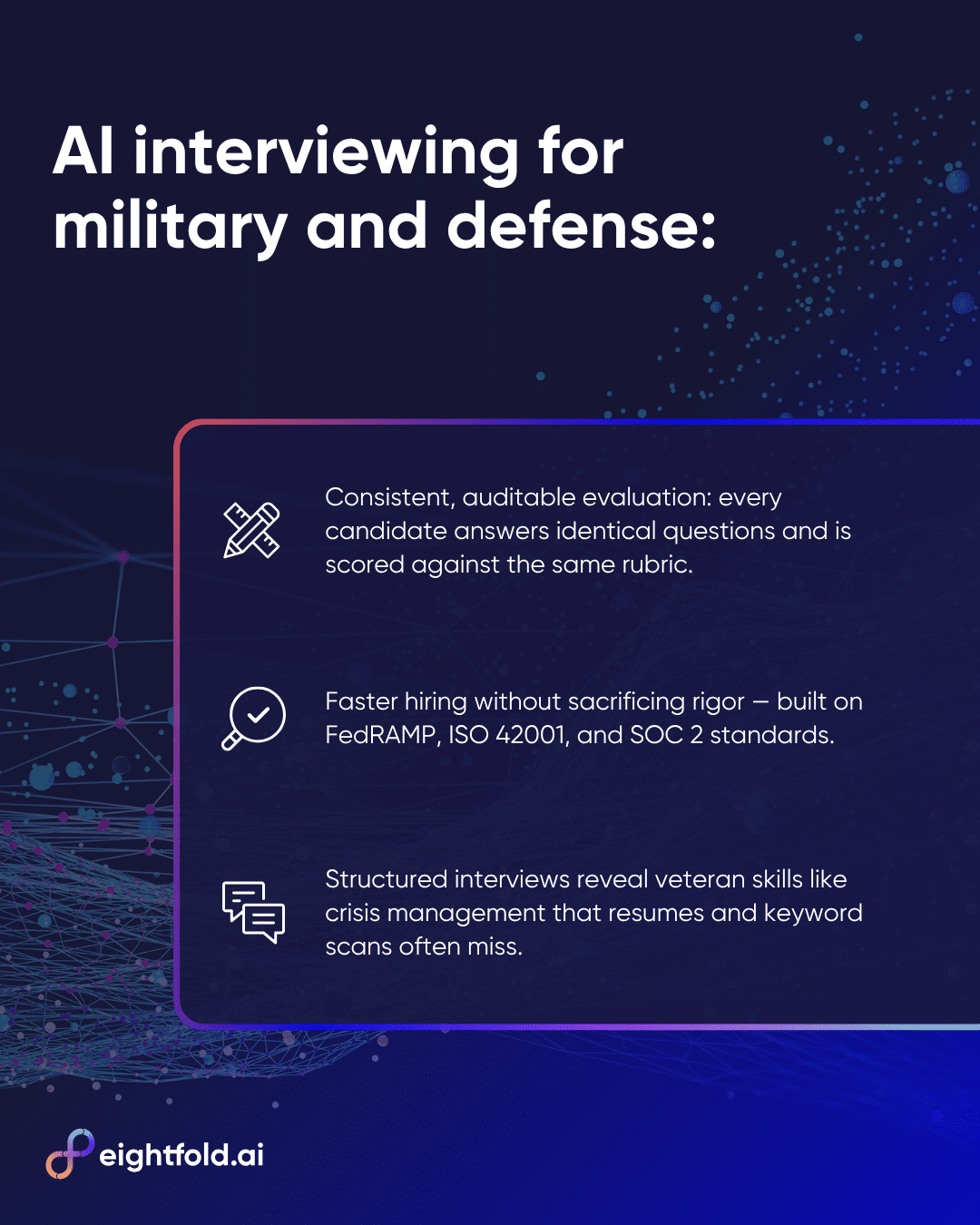
Inconsistency in candidate evaluation can quickly become a serious finding during audits, raising questions about fairness and due diligence. AI interviewing fundamentally reshapes this challenge by introducing an unprecedented level of standardization. Every candidate is presented with the same set of structured, role-relevant questions and is assessed against a uniform scoring rubric. This eliminates the variability that can arise from different recruiters conducting interviews and ensures that there are no documentation gaps concerning why one candidate advanced while another did not.
Moreover, AI interviewing facilitates immediate candidate engagement. Instead of waiting for a recruiter’s availability, candidates can complete their initial interviews shortly after applying. This drastically reduces the time lag, with hiring teams receiving structured summaries and scores within hours, rather than weeks.
Organizations like Constellis, a global leader in defense and security services, have successfully navigated these complexities. Facing the need to fill a high volume of security roles while adhering to strict industry compliance and audit trail requirements, Constellis leveraged Eightfold AI’s Interviewer. This solution enabled them to maintain the necessary rigor while accelerating their recruitment process. Eightfold’s platform is built on infrastructure that meets stringent government standards, including FedRAMP Moderate and ISO 42001, in addition to SOC 2 certification. This compliance is paramount for organizations accountable for the secure handling of candidate data and the integrity of hiring decisions. The U.S. Department of Defense itself trusts Eightfold’s Talent Intelligence Platform, underscoring its suitability for high-stakes environments. This is not a generalized tool adapted for defense; it is a platform conceived with the demands of such scrutiny from its inception.
An additional, significant benefit of AI interviewing in this sector is its capacity to identify and articulate the transferable skills of transitioning service members and veterans. Critical competencies such as crisis management, structured decision-making under pressure, and effective team leadership are often obscured on resumes that primarily list military job titles. A structured interview designed to elicit these skills, rather than a superficial keyword scan, can transform veterans into highly visible and competitive candidates, preventing them from being overlooked.

Public Safety: Addressing a Growing Crisis with Urgency and Precision
Public safety agencies, including police, fire departments, and emergency medical services (EMS), are confronting a hiring crisis that has been escalating for years. Many departments operate with insufficient staffing levels to meet community needs. The demanding nature of the work, both physically and emotionally, significantly narrows the pool of individuals willing and able to serve. Each week a position remains vacant exacerbates the strain on existing teams.
In this context, speed is not merely a desirable attribute but a critical competitive necessity. Public safety agencies are increasingly vying for talent in a labor market also sought by private sector employers. A candidate who must endure weeks of waiting for a first-round interview is highly likely to accept an offer from another employer that provides a more streamlined process.
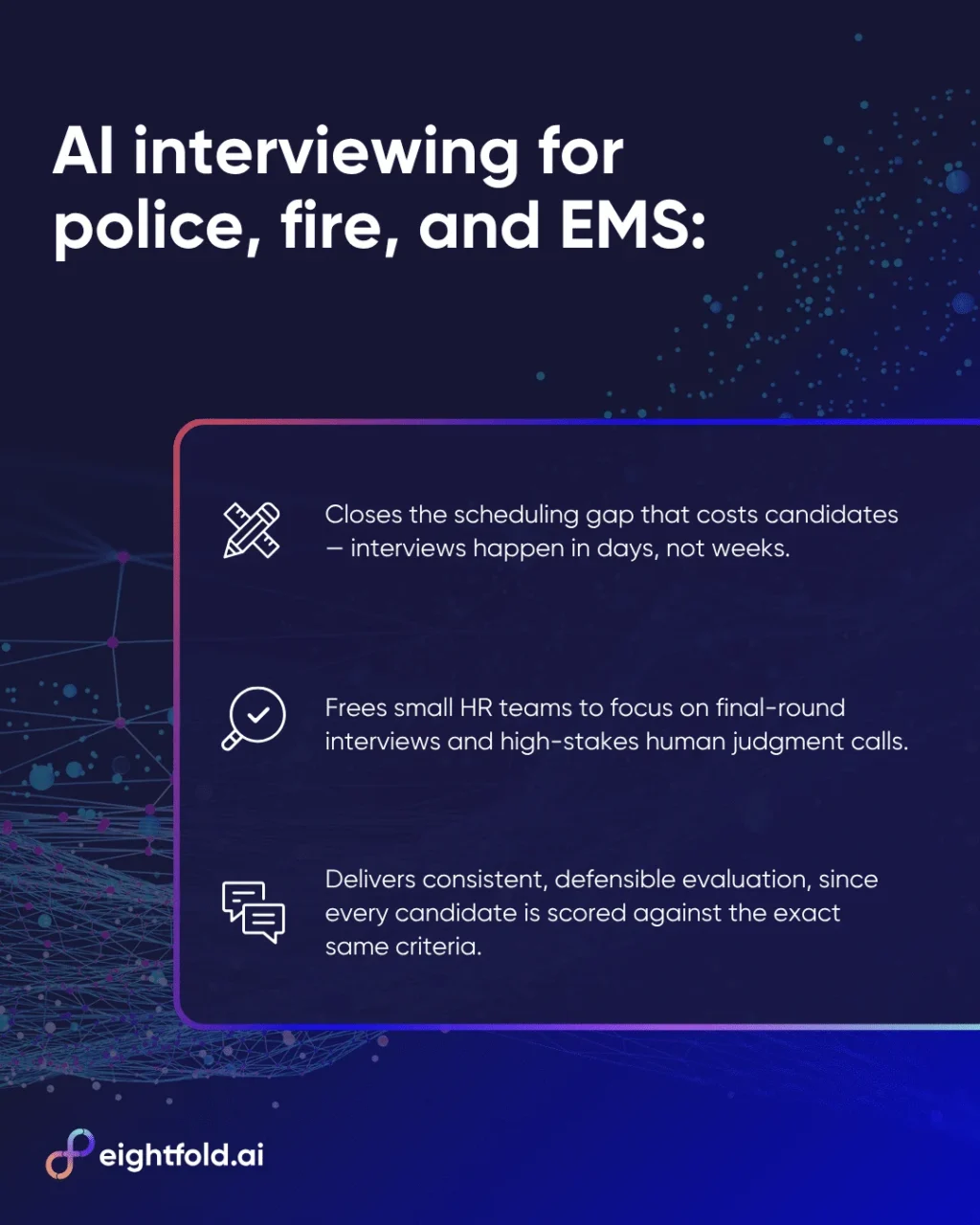
AI interviewing directly addresses this bottleneck by removing scheduling delays from early-stage screening. Candidates can complete a structured interview within days of applying, allowing hiring teams to identify qualified individuals and advance them through the process almost immediately. This agility is crucial for capturing top talent before it is lost.
The importance of consistency in evaluation cannot be overstated. In roles where the consequences of a poor hiring decision can impact public trust and physical safety, every candidate must be assessed against the same objective criteria. AI interviewing provides this standardization, ensuring that evaluations are not dependent on the subjective emphasis of individual interviewers on any given day. This structured, standardized screening process provides public safety agencies with a defensible foundation for their hiring decisions. It also liberates their often-limited HR and recruiting teams to focus their valuable time on higher-order tasks, such as final-round interviews and the nuanced human judgment calls that are essential and should not be automated.
The Evolving Landscape: A New Era of Hiring Efficiency
For decades, organizations within the military, defense, and public safety sectors have operated under a significant constraint: the inability to compromise between speed and accuracy. This often necessitated accepting slow, labor-intensive manual processes as the unavoidable cost of ensuring rigorous vetting. However, this long-standing trade-off is rapidly becoming obsolete.
AI interviewing offers these critical sectors a revolutionary means to screen candidates more rapidly, with greater consistency, and with enhanced transparency than manual methods could ever achieve. The perceived conflict between speed and maintaining high standards is no longer an insurmountable barrier. Organizations that embrace this technological advancement will be positioned to fill essential roles swiftly, gaining a distinct advantage over their more deliberative counterparts who remain tethered to outdated recruitment methodologies. The ability to identify and onboard qualified personnel efficiently is directly linked to operational effectiveness, mission success, and the safety and security of the communities they serve.
For agencies and organizations considering the integration of AI interviewing into their hiring frameworks, a demonstration can provide invaluable insight. Scheduling a demo with a provider like Eightfold AI can illustrate how their solutions are specifically designed to address the unique demands of mission-critical, high-compliance hiring processes. This technological evolution represents not just an improvement in efficiency, but a fundamental shift in how critical talent can be secured in high-stakes environments.







