
A classroom without a teacher is more than just an open requisition; it represents a student potentially falling behind. A hospital ward short two nurses is not merely a staffing gap; it signifies patients enduring longer wait times for essential care. For the human resources leaders and recruiters tasked with staffing our nation’s educational institutions and public health organizations, the challenge of filling these critical roles is immense and directly impacts the communities they serve. This article explores the unique hiring hurdles faced by both sectors and investigates how innovative solutions, such as AI interviewing, are emerging as vital tools to bridge these gaps effectively and ethically.
The Shared Strains on Public Service Hiring
At first glance, a K-12 school district and a sprawling public hospital system might seem worlds apart operationally. However, a closer examination of their hiring calendars, the pressures they face, and the talent pools they draw from reveals a striking convergence of challenges. Both sectors are characterized by predictable, intense hiring waves. Educational institutions, from elementary schools to universities, must staff up meticulously before the commencement of each academic year, often facing a secondary surge mid-year due to turnover. Similarly, health systems and public health departments experience pronounced hiring demands tied to seasonal illnesses like the flu, the cyclical nature of budget allocations, and unpredictable public health emergencies that demand immediate staffing responses.
In both these vital public sectors, the hiring window is notoriously narrow, and the volume of applicants can be overwhelming. This combination elevates screening – not just sourcing – to the primary bottleneck in the recruitment process. Furthermore, these organizations frequently find themselves in direct competition with private-sector employers. These private entities often possess greater agility, faster procurement processes, and the ability to offer more competitive compensation packages, giving them a significant speed advantage in the talent market. Public-serving organizations, bound by more complex procurement timelines, union negotiations, and stringent budget cycles, often find themselves at a disadvantage, struggling to match the pace of their private counterparts.
The consequences of these hiring inefficiencies are not confined to internal HR metrics. In education, a delayed hire can mean a classroom operating with a substitute for an extended period, impacting a generation of students. In healthcare, prolonged vacancies can lead to overburdened staff, compromised patient care, and longer wait times for critical medical services. The human cost of these delays is borne directly by the students and patients who rely on these essential services. This shared reality underscores the importance of examining hiring solutions that can serve both sectors effectively.

Public Education: Navigating the Seasonal Hiring Gauntlet
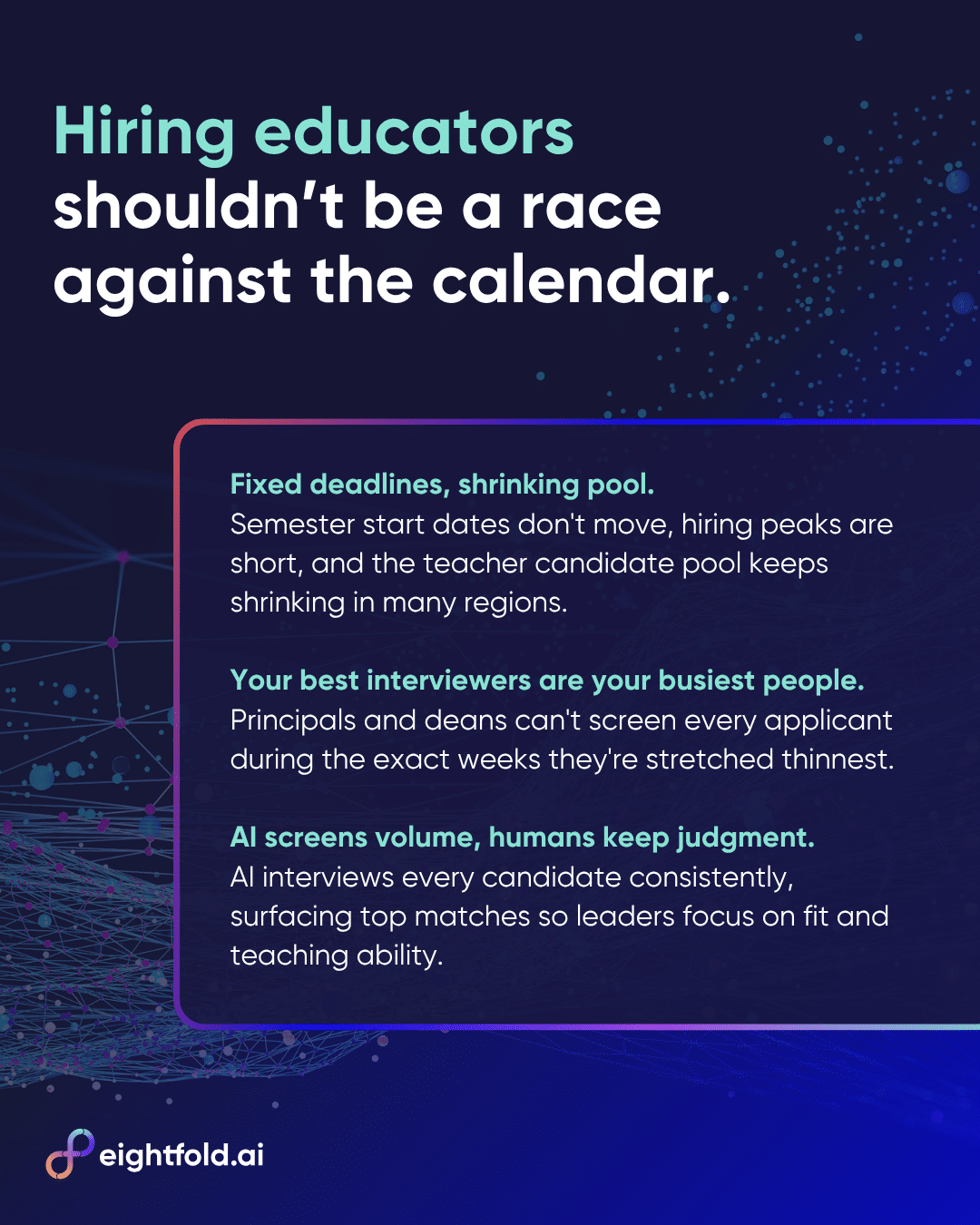
The hiring cycle in public education, encompassing both K-12 and higher education, is dictated by a demanding seasonal clock. Districts and universities must have their classrooms and departments fully staffed before the academic term begins, with little to no flexibility in these crucial deadlines. Adding to this pressure, the individuals most responsible for conducting interviews – principals, department chairs, and deans – are often already stretched to their limits during the peak hiring weeks. Expecting them to meticulously screen every applicant while managing their existing administrative and educational duties is neither realistic nor fair to them or the candidates.
Compounding these challenges, the applicant pool for many teaching and instructional roles has been contracting in numerous regions. This scarcity means that the qualified candidates who do emerge must be moved through the hiring process with remarkable speed, lest they accept employment elsewhere.
This is precisely where Artificial Intelligence (AI) interviewing emerges as a transformative tool. It is not intended to replace the nuanced human judgment essential in education hiring – the ability to assess a candidate’s rapport with students or their cultural fit within a school’s community. Instead, AI interviewing tackles the sheer volume that precedes this critical human evaluation. It can efficiently screen a large cohort of applicants during the most intense hiring periods, posing standardized, role-specific questions to each candidate. The system then identifies and presents the strongest matches, allowing human recruiters and hiring managers to focus their efforts on the subsequent interview rounds where teaching aptitude and cultural alignment are thoroughly assessed.
This capability significantly alleviates the burden on principals and department heads during their busiest times. It also ensures that candidates receive timely feedback, avoiding the frustrating experience of waiting in silence while their applications navigate a potentially slow-moving internal process. An AI Interviewer can be precisely configured to evaluate candidates based on essential qualifications, certifications, and specific criteria relevant to each role. This might include a valid teaching license, a specialized subject-matter expertise, or experience working with particular student demographics. By performing this targeted screening, the initial stage of hiring becomes a substantive assessment rather than a rudimentary keyword search.
Furthermore, data from organizations implementing AI interviewing highlights the remarkable scale it can unlock. A single posting can attract hundreds of applicants. AI Interviewer can efficiently process these candidates, providing concise summaries for each, enabling hiring teams to enter initial interviews with a clear understanding of each applicant’s qualifications, rather than facing an overwhelming backlog of resumes. This streamlined approach is particularly beneficial in districts facing teacher shortages, as evidenced by recent reports indicating over 80% of districts experiencing difficulties filling open positions.
Public Health and Healthcare Systems: Accelerating Care Delivery
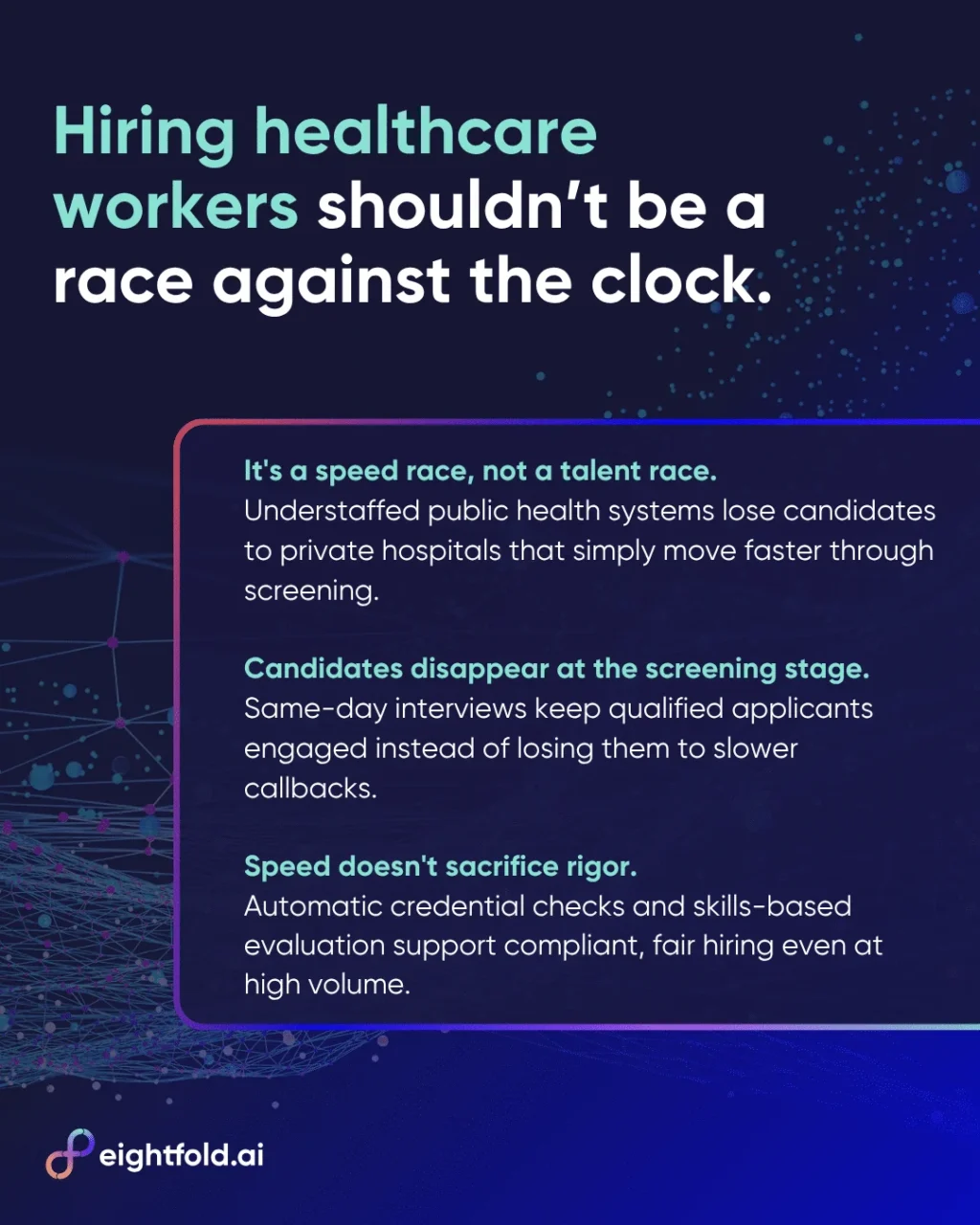
Public hospitals and health departments often operate from a more challenging starting point than many private healthcare systems. They frequently contend with chronic understaffing, constrained budgets, and the imperative to fill clinical and support roles with utmost urgency. Every vacant shift directly translates into a reduction in patient capacity and potentially compromised care. Moreover, these public entities often lose qualified candidates to private hospitals and health systems that can navigate their hiring pipelines more swiftly, sometimes extending job offers before the public-sector hiring process has even completed its initial screening phase.
The screening stage is frequently the point at which these vital organizations lose promising candidates. A qualified individual applies, then waits days for a response, often while juggling multiple other job offers. By the time a recruiter reaches out, the candidate may have already accepted a position elsewhere, representing a loss for both the applicant and the healthcare system.
An AI interviewer effectively eliminates this critical delay by engaging candidates immediately upon application. In practice, this can mean a candidate completing an interview on the very same day they apply. This rapid engagement keeps candidates invested in the process during the crucial window when they are most likely to be exploring other opportunities.
For roles where specific credentials are non-negotiable – such as a nursing license, a specialized medical certification, or the successful completion of background checks – AI Interviewer platforms can be configured to verify these qualifications directly within the interview process. This ensures that no critical requirement is overlooked at a stage where a missed credential could lead to significant delays or complications much later in the hiring pipeline.
This capability is particularly significant in highly regulated healthcare environments. AI Interviewer is designed to evaluate candidates solely based on their spoken responses, meticulously avoiding considerations of facial expressions, tone of voice, or emotional cues. This approach is specifically engineered to promote fairness and ensure compliance with evolving regulations, such as New York City’s Local Law 144, Illinois’ Biometric Information Privacy Act, and Maryland’s HB 1202. This objective evaluation methodology, coupled with integrated fraud detection safeguards, empowers public health employers to document a consistent and defensible hiring process, mitigating legal and ethical risks.
The scale of improvement offered by AI interviewing is especially relevant to public health, where a substantial portion of hiring is high-volume and shift-based. Early adopters of AI Interviewer have reported dramatic accelerations in their hiring cycles, shrinking them from an average of six weeks down to less than a week. The time required to move a candidate from application to their first interview has been compressed by as much as 90%. In chronically understaffed public health systems, such improvements translate directly into more shifts being covered, rather than leaving critical positions vacant. For instance, during the COVID-19 pandemic, healthcare systems faced unprecedented staffing pressures, and technologies that could expedite the hiring of essential personnel became invaluable.
Closing the Gap Without Compromising Standards
In both education and public health, a delayed hire carries profound implications that extend far beyond internal operational metrics. It can manifest as a classroom that remains under the care of a substitute for an extended period, impacting student learning. It can mean a hospital unit operating short-staffed through the most critical weeks of a flu season, straining existing personnel and potentially affecting patient outcomes. The individuals most impacted by these hiring delays are not within the HR departments but are the students and patients who depend on the uninterrupted delivery of these vital public services.
AI interviewing offers a solution that does not force HR leaders in education and public health to choose between speed and quality. It effectively offloads the high-volume, time-consuming initial screening process – a phase that previously consumed weeks and diverted the attention of the organization’s busiest professionals – to a sophisticated technological layer. This layer can operate around the clock, evaluate every applicant against the same standardized criteria, and deliver a curated list of genuinely qualified candidates. This replaces the overwhelming task of sifting through an unsorted stack of applications with a focused pool of promising individuals.
The ultimate decision-making power remains firmly in the hands of human professionals. However, they are empowered to make these critical decisions faster, armed with more comprehensive and reliable information, and crucially, without losing promising candidates to the more agile private sector.
As educational institutions prepare for the upcoming academic year and healthcare systems brace for seasonal surges in demand, exploring the capabilities of AI interviewing for their specific open roles becomes a strategic imperative. Organizations that implement these technologies can not only streamline their recruitment processes but also ensure that the essential services they provide to students and patients are delivered with the highest possible standards of care and educational support. The ability to rapidly identify and onboard qualified personnel is no longer a mere operational advantage; it is a fundamental requirement for fulfilling the public trust.







