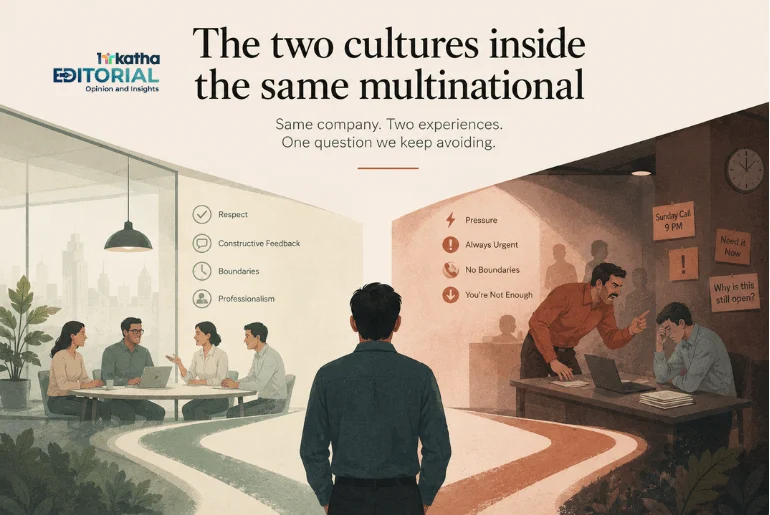
The stark reality of contrasting workplace experiences within India’s global technology and consulting sector is laid bare by an unsettling narrative: an individual, a seasoned mid-level professional with nearly eight years at one of the world’s largest technology and consulting firms based in India, underwent an internal realignment that revealed two drastically different corporate cultures operating under the same organizational banner. For most of their tenure, this professional worked directly with global teams, experiencing a work environment characterized by respect, valued time, constructive feedback, and a clear delineation of professional boundaries. Meetings, though sometimes at inconvenient hours due to time zone differences, were calm, professional, and dignified. There was no pretense of personal friendship, but a fundamental quality of mutual respect that, remarkably, felt exceptional rather than standard.
A Tale of Two Teams: A First-Hand Account
The shift, however, was not gradual. An internal realignment within the same company, placing the individual under Indian colleagues and Indian bosses, precipitated an immediate and profound transformation of their daily work life. The professional found themselves in an environment marred by screaming, shouting, unscheduled Sunday calls, and an incessant labeling of every task as "urgent," irrespective of its actual priority. More insidiously, a persistent effort was made to undermine their professional confidence, despite nearly a decade of experience. The message, delivered from various directions, was consistently one of inadequacy: "you don’t know enough, you haven’t done enough, you are not enough." The same organization, the same designation, yet a profoundly different and distressing experience of what it meant to go to work. This anecdote, far from being an isolated incident, reflects a broader, systemic challenge within Indian corporate environments, where a "cultural operating system" profoundly shapes employee experiences, often to their detriment.
Beneath the Surface: Unpacking the Cultural Operating System
The underlying technology, client base, and fundamental work processes remained largely unchanged. What shifted dramatically was the invisible "cultural operating system" dictating interactions, expectations, and management styles. This phenomenon is not merely anecdotal; it is a critical signal from India’s burgeoning workforce. Gallup’s State of the Global Workplace report, for instance, starkly revealed that a staggering 86 percent of Indian employees surveyed described themselves as "struggling" at work. This figure, far from a statistical anomaly, underscores a deep-seated issue that warrants rigorous examination. The pertinent question is not if Indian workplaces can be challenging—that is widely acknowledged—but why these patterns persist, and whether those perpetuating them have ever paused to reflect on their origins and impact. This inquiry delves into historical context, socio-cultural influences, and the unintended consequences of systemic pressures.
The Echoes of Scarcity: A Generational Legacy
A significant factor contributing to current management practices in India stems from the historical context of professional scarcity. The generation currently occupying middle and senior management roles grew up in an era characterized by intense competition for limited opportunities. Post-liberalization in the early 1990s, while opening new avenues, also meant that proving oneself professionally was not merely an aspiration but a fundamental requirement for survival in a highly competitive job market. This period fostered a workforce that was exceptionally capable and driven, often navigating complex challenges with ingenuity and perseverance.
However, this anxiety-driven environment also forged a management culture that, in many instances, never fully shed the pressures under which it was formed. The individual who once fought tooth and nail to prove their worth often evolves into a manager who, consciously or unconsciously, expects the same level of relentless self-validation from their subordinates. The initial scarcity may no longer exist in the same acute form, but the psychological template, ingrained during formative years, continues to dictate managerial behavior. This dynamic creates a self-reinforcing cycle: employees began staying late and responding to emails on weekends not necessarily because it was explicitly demanded, but because it provided visible differentiation and a perceived advantage in a competitive landscape. Over time, this evolved into an unspoken expectation, subtly marking those who prioritize work-life balance as "insufficiently serious." Breaking this cycle carries inherent individual career risk, thus perpetuating the status quo and making systemic change incredibly difficult. The outcome is a workplace where the demonstration of competence is an endless pursuit, urgency is often performed for visibility rather than necessity, and making a colleague feel inadequate can, perversely, provide a fleeting sense of superiority.
Hierarchy’s Enduring Grip: Social Structures in the Workplace
Indian social structures have historically placed immense value on seniority and age, principles deeply ingrained in family, community, and educational systems. This traditional emphasis on hierarchy has seamlessly permeated corporate life, translating directly into management behavior. In many Indian workplaces, a boss’s authority extends beyond mere organizational designation; it carries a personal weight, making disagreement feel less like a professional divergence and more like a profound act of disrespect or insubordination. This cultural freight means that challenging a superior is not simply a professional act but often feels like a violation of a more fundamental societal norm.
This hierarchical mindset can manifest in behaviors that range from demanding to overtly theatrical. Anecdotes abound, such as a manager at the Indian center of a large technology firm who reportedly took pride in patrolling the office canteen during work hours, sending employees back to their desks if their tea or coffee cups were empty—a behavior they boasted about in team meetings as evidence of "good management." Such examples are not isolated flights of imagination; extensive discussions on platforms like Reddit’s Bangalore community, where hundreds of professionals share their experiences, reveal remarkably similar patterns: managers priding themselves on restrictive cultures, and teams working late driven by the need for visibility rather than actual work demands. This consistency across different companies and industries points to a deeply entrenched cultural issue.
The newer generations, particularly Gen Z and younger millennials, are increasingly rejecting this traditional framing. They exhibit a greater willingness to challenge and call out behaviors that their parents’ generation silently absorbed. However, many of the current managers were shaped in a different era, trained within authority structures that heavily rewarded compliance, deference, and unquestioning obedience. While some managers have consciously chosen to adopt more modern, collaborative approaches, many others continue to reproduce the established template without critical examination. This generational gap in expectations and management philosophies is a significant source of friction in contemporary Indian workplaces.
Colonial Vestiges: Administrative DNA and Power Dynamics
While it would be an oversimplification to attribute all contemporary workplace issues solely to colonial history, it would be equally dishonest to ignore its enduring legacy. The administrative structures inherited from British rule were fundamentally built on principles of compliance, control, and absolute authority, rather than collaboration or empowerment. The hierarchy existed to be obeyed, not engaged with or questioned. Post-independence, India built its own institutions, but the "management DNA" within many of them carried forward these colonial-era patterns. The deference to rank, the instinct to protect positional authority rather than distribute it, and a top-down approach to decision-making did not magically disappear with political independence; they migrated into various facets of corporate life.
Most of India’s younger workforce has moved beyond this colonial mindset, influenced by global exposure and modern educational paradigms. However, the traces remain most visible among those who were trained by individuals themselves trained by a generation that never questioned the original template. This means that, even three generations removed, the imprints of colonial administrative practices continue to subtly shape power dynamics and management styles in certain segments of Indian corporate culture, contributing to a workplace environment where questioning authority is still fraught with cultural implications.
The Global Paradox: Double Standards in Management
It would be erroneous to conclude that global teams are inherently superior. They often demonstrate higher levels of professionalism, a genuine respect for boundaries, and a structured feedback culture that prioritizes development. However, the most revealing data point in this conversation isn’t about Western companies per se, but about Indian ones. Indian multinational corporations (MNCs) operating overseas routinely offer their foreign employees flexible hours, remote work options, and generous leave policies. Yet, the very same Indian colleagues working on identical projects from Bengaluru or Hyderabad are often expected to work late, take calls well into the evening, and frequently earn a fraction of the salary.
This disparity reveals a crucial insight: the problem is not merely that Western companies treat their Indian branches differently. Instead, it highlights that Indian companies themselves often treat their own Indian employees differently from their overseas staff. The variable is not the company’s global origin, but rather the location and the pervasive management culture that location has engendered. The same manager who might adopt a collaborative and measured approach with colleagues in London can become authoritarian and demanding with a team in Bengaluru. This suggests that the issue is not a lack of capability in leadership, but rather a "permission" structure—a tacit acceptance of certain demanding behaviors within the Indian context that would be unacceptable elsewhere. This striking contrast underscores how deeply cultural norms influence employee experiences, even within a single organization capable of fostering radically different work environments based on geographical and cultural context.
The Glass Ceiling: Leadership Aspirations vs. Systemic Barriers
Despite India’s reputation as a global hub for execution, delivering complex work reliably and at scale, the narrative shifts significantly when it comes to leadership roles. While the world celebrates Indian-origin CEOs leading some of the most consequential global companies—Sundar Pichai, Satya Nadella, Indra Nooyi—these are exceptional individuals in exceptional circumstances. Their success, while inspiring, does not serve as evidence that the system works equitably for the average Indian professional in a regional office in Bengaluru or Pune. The "plural of anecdote is not data." For every Indian-origin Fortune 500 CEO, there are thousands of equally capable Indian professionals who have watched a less experienced counterpart in the US or Europe receive the managerial promotion they were passed over for, often quietly and without a transparent explanation that could be directly challenged.
The glass ceiling for Indian talent within global organizations is rarely constructed from overt prejudice. Instead, it is often built from subtle, unexamined assumptions: that "leadership presence" embodies a specific kind of cultural fluency, that "executive gravitas" has a particular sound or style, and that "the right person for the room" is the one senior leadership in New York or London can most easily envision being there. These deeply ingrained assumptions, rarely questioned or even explicitly named, are what make them so durable and insidious, creating systemic barriers to advancement despite proven competence and dedication.
The Cost of Resilience: Sustaining a Dysfunctional System
Indian corporate culture has undoubtedly produced an extraordinary cadre of professionals—individuals adept at navigating immense complexity, absorbing intense pressure, and delivering under constraints that would overwhelm less resilient people. This resilience is a genuine strength, a testament to the adaptability and fortitude of the Indian workforce. However, a critical problem arises when resilience becomes the only acceptable response to a broken system. In such scenarios, resilience ceases to be a virtue and transforms into a mechanism that inadvertently allows the dysfunctional system to perpetuate itself.
If employees consistently absorb shouting, unscheduled Sunday calls, public humiliation, and constant undermining because they are resilient enough to survive it, the workplace environment faces no imperative to change. The problematic behaviors continue unchecked because the people experiencing them continue to function, deliver results, and remain within the system. In this context, resilience becomes the system’s most effective defense against reform, stifling any organic pressure for improvement.
The individual whose story catalyzed this discussion remains with their organization, continuing to perform well and navigate the challenging new environment. Yet, something fundamental has changed. Their clear articulation of the difference between the two cultures—what it felt like to be respected versus managed through fear—stems from a direct comparison of outcomes. One culture expected performance and accountability while meticulously preserving dignity; the other relied on pressure, urgency, and rigid hierarchy to achieve compliance. Both delivered work. Crucially, however, only one genuinely fostered growth and made people better at their jobs, enhancing their skills and professional confidence.
This distinction is paramount. While Indian workplaces have become exceptionally good at cultivating resilient employees, the fundamental question remains: is resilience the ultimate outcome we should be celebrating? We have demonstrably mastered the art of making people tougher, capable of enduring immense stress. But the question that continues to be avoided is whether the cultures we have meticulously built are truly helping people evolve into better, more innovative, and more fulfilled professionals, or merely teaching them to endure more, often at significant personal cost. The true measure of a progressive workplace culture lies not in its employees’ capacity for suffering, but in its ability to inspire, empower, and enable their fullest potential.