
The landscape of corporate learning and development (L&D) is undergoing a profound transformation, moving beyond traditional education and credentialing to embrace a new, dynamic approach. A recent comprehensive study, "The Definitive Guide to Corporate Learning," published by Josh Bersin, introduces the concept of "Dynamic Enablement," redefining the role of L&D teams as facilitators of immediate, context-aware support for employees directly within their workflow. This evolution, accelerated by advancements in artificial intelligence, signals a significant market shift as numerous vendors are rapidly pivoting to address this burgeoning need.
The core of Dynamic Enablement lies in providing employees with precisely the information, guidance, or expertise they require, precisely when they need it. This is a departure from the more generalized "learning in the flow of work" concept, expanding to encompass a broader spectrum of support. An employee might need a quick answer to a specific question, a deeper dive into a complex topic, assistance in connecting with a subject matter expert, or even the acquisition of a new skill. This enablement is facilitated not only through formal L&D resources but also through the collective knowledge of peers, managers, and designated experts within the organization.
The Rise of Dynamic Enablement: A Market Response to Evolving Needs
The introduction of Bersin’s findings has reportedly spurred a rapid response from the corporate learning technology market. Within weeks of the study’s release, a noticeable "lurch" or accelerated movement among vendors towards solutions supporting Dynamic Enablement has been observed. This surge is attributed to a clear and significant market demand, made more attainable than ever by the widespread integration of artificial intelligence.
"The concept of ‘learning in the flow of work’ has been a growing trend for years, but AI has truly unlocked the potential for ‘dynamic enablement’," stated a source familiar with Bersin’s research methodology. "It’s no longer just about accessing courses; it’s about receiving targeted support that directly addresses an immediate need or knowledge gap, right when it arises."

Understanding the Mechanics of Enablement
Delivering an effective enablement experience requires a nuanced understanding of various employee needs and contexts. When an employee encounters a challenge or seeks to enhance their performance, several paradigms for support come into play. These can range from formal, structured training programs designed for skill acquisition to informal, just-in-time interventions that provide immediate answers or guidance. The most effective strategies, according to the research, integrate a combination of these approaches.
The challenge for L&D and HR departments lies in tailoring enablement platforms to specific use cases. The support required by an Uber driver, for instance, differs vastly from that needed by a middle manager, a software engineer, a sales representative, or a manufacturing worker. Each role has unique demands, workflows, and learning preferences. Consequently, a one-size-fits-all approach is insufficient; instead, organizations must deploy flexible enablement platforms capable of adapting to diverse operational environments.
The current market is characterized by a frenetic pace of innovation. Vendors are racing to develop and refine solutions that meet these dynamic enablement needs. This rapid evolution, while promising for organizations seeking to enhance employee performance, also necessitates a cautious approach. Buyers are advised to thoroughly evaluate emerging solutions before committing to a single platform, as the technology is still in its nascent stages of widespread adoption.
Key Players and Emerging Solutions in Dynamic Enablement
The corporate learning and enablement technology sector is witnessing a wave of innovation, with several companies positioning themselves at the forefront of this paradigm shift. These solutions leverage AI and other advanced technologies to deliver personalized, context-aware support to employees.
Arist: Mobile-First Enablement and Autonomous Learning
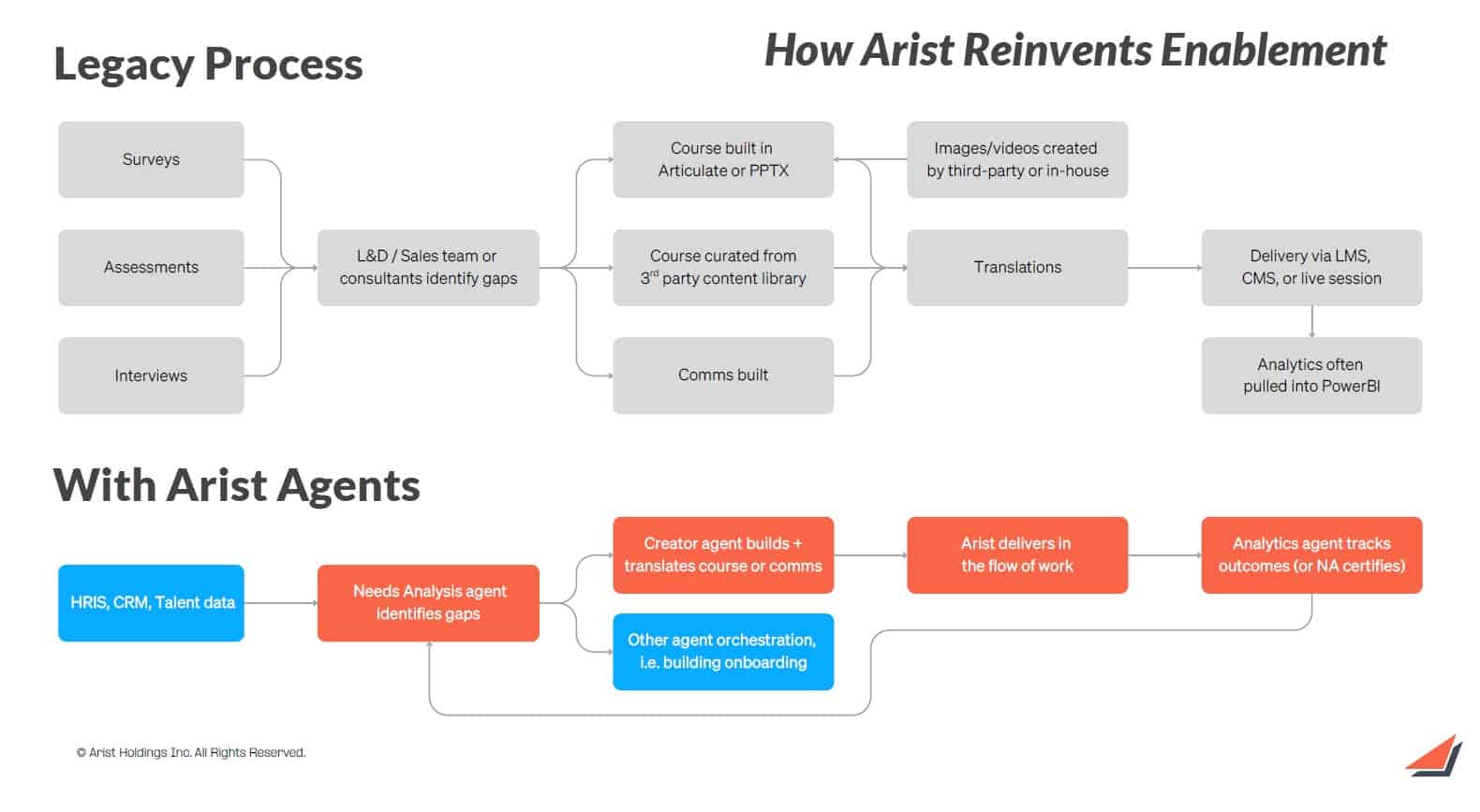
Arist, a company that partners with Bersin on various HR training and enablement initiatives, has emerged as a significant player. Initially focused on mobile-first enablement, Arist excels at dynamically generating content and chunking complex training materials for easy consumption on mobile devices. Their offerings now extend to an "AI Performance Consultant," which can autonomously identify operational challenges by interviewing staff and subsequently develop targeted content to address these issues. This capability represents a significant stride towards "autonomous corporate learning," where AI agents proactively identify and resolve performance gaps, akin to self-driving vehicles in the automotive industry. Arist’s rapid evolution into the end-to-end enablement market, offering solutions for pharmaceutical sales, regulatory compliance, and technology training, underscores its innovative approach.

Sana (Galileo Learn): AI-Native Powerhouse and End-to-End Learning
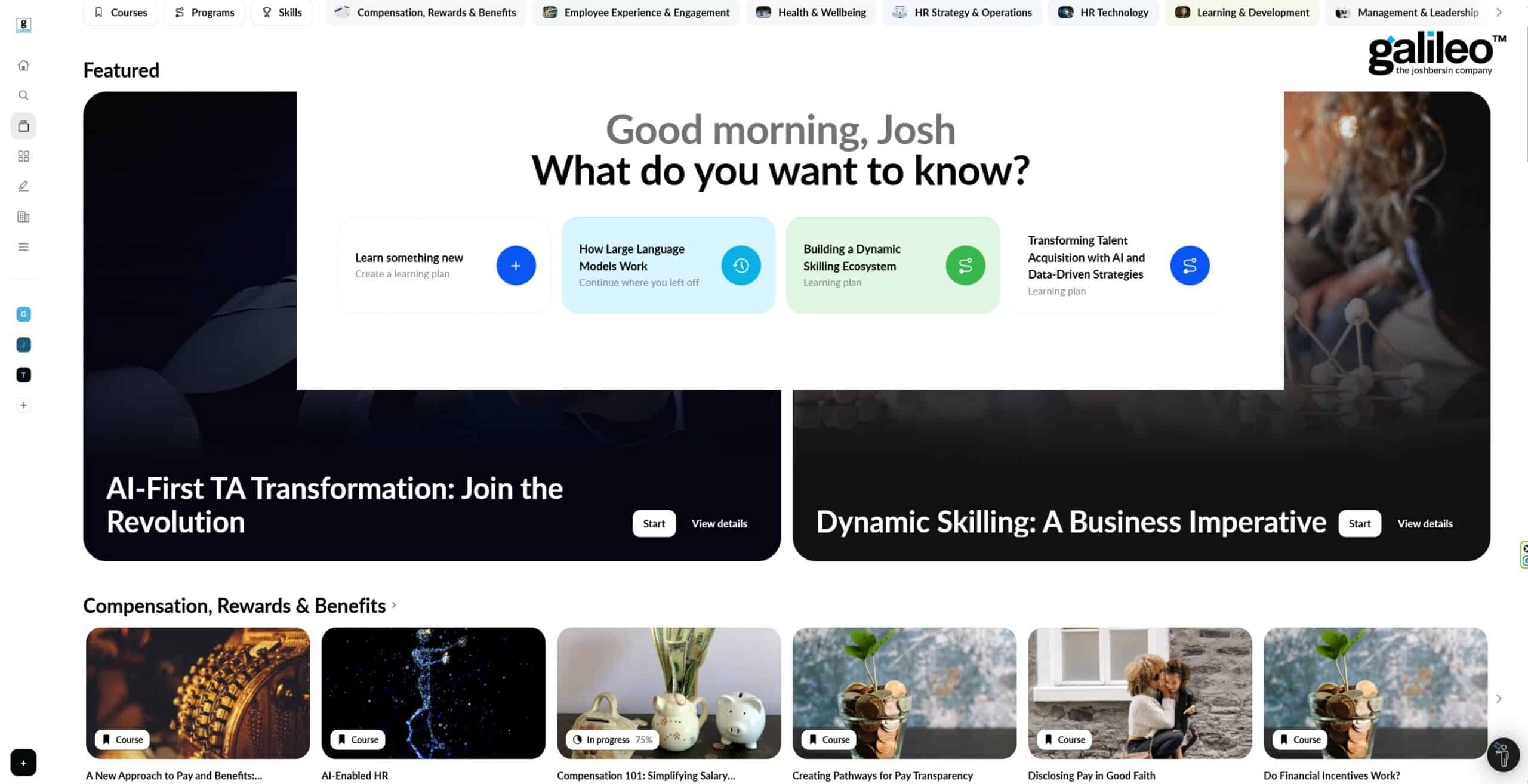
Sana, now a Workday company, is recognized as one of the most advanced AI-native platforms available. Founded by Joel Hellermark in 2016 with a vision to revolutionize learning, Sana integrated AI from its inception, utilizing OpenAI technologies long before the public launch of ChatGPT. The platform has since expanded into corporate training, offering an end-to-end learning ecosystem accessible through Galileo. Sana’s core AI capabilities power the Sana Agent, a dynamic platform for learning, knowledge, and AI agent development. The impending launch of Sana Enterprise will enable direct integration with Workday data and transactions, solidifying its position as a leading dynamic enablement platform.
Seismic: Dominating Sales Enablement with AI Integration
Seismic is a recognized leader in the substantial sales enablement market, a sector valued between $4 to $6 billion and experiencing robust double-digit growth. Companies in this space provide sales teams with essential resources such as pricing guides, product launch materials, videos, and other tools. Seismic’s offerings address the critical need for sales professionals to stay abreast of product updates, contract details, pricing strategies, competitive intelligence, and effective selling techniques. While Seismic leads, numerous other vendors like Allego, Mindtickle, Highspot, and Showpad operate within this competitive landscape. The integration of AI into these platforms is a key differentiator, enhancing content personalization and delivery.
Docebo: Next-Generation LMS with AI-Driven Skills Intelligence
Docebo, a publicly traded Learning Management System (LMS) provider, has proactively embraced AI in its learning and enablement solutions. The company has introduced AI tutors, AI-native authoring tools, and templated AI assessments, all designed to augment its offerings for revenue-generating training and corporate L&D. The recent acquisition of 365 Talents has significantly enhanced Docebo’s capabilities by adding a comprehensive AI-driven skills intelligence system. This allows for the identification of skills within content, the development of a corporate-wide skills taxonomy, and the deployment of learning initiatives aligned with identified skill needs. Prominent European organizations like SNCF and Airbus utilize Docebo’s platform, highlighting its effectiveness in complex corporate environments. This functionality directly addresses the need for employees to understand skill gaps and identify learning pathways, such as "I need to learn more about XYZ, what do I need to know?"
LinkedIn Learning: AI Coaching for Enhanced Skill Development
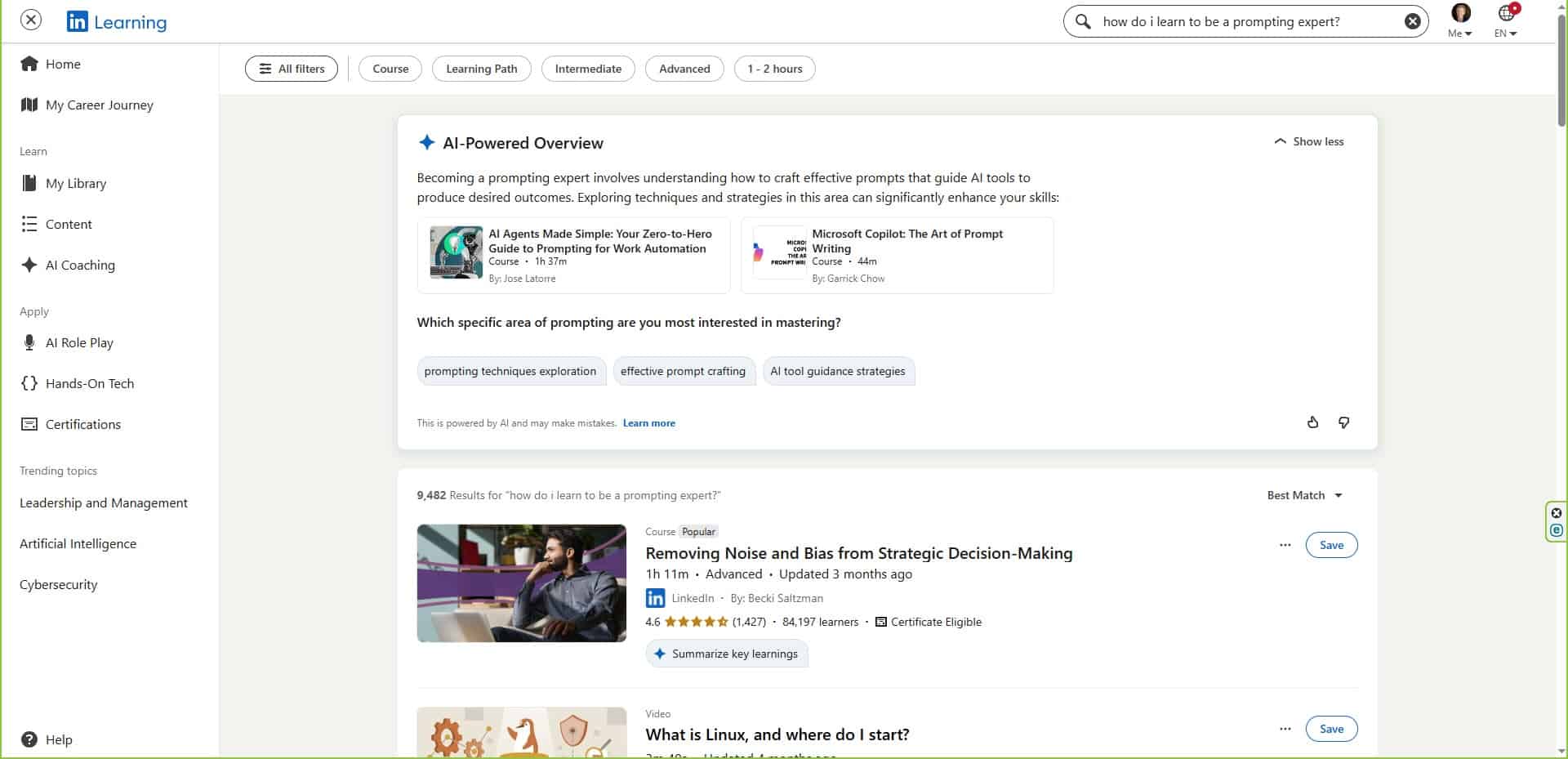
LinkedIn Learning has established itself as a trusted provider of corporate learning content. The recent launch of its LinkedIn Learning AI Coaching system introduces a "coach" to assist users in their learning journeys. This feature allows users to find relevant content and engage in AI-powered role-playing scenarios designed to build confidence through practice and interaction. While offering a "heavy-touch" enablement experience, this capability serves a critical role for leaders, new managers, sales professionals, and individuals entering new domains. LinkedIn Learning is gradually integrating into the dynamic enablement space, offering a more standardized yet valuable approach to personalized learning support.
Uplimit: Performance Support Through Practice and Feedback
Uplimit positions itself as the essential performance support AI that has been missing from many L&D technology stacks. The platform is built on the principle that effective learning occurs through active doing and practice, rather than passive content consumption, debunking the myth of fixed learning styles. Uplimit focuses on technical and sales training, areas where skill development is inherently practice-based. The platform guides learners through real-world projects and AI-powered role-plays, providing scalable, personalized feedback. Learners develop skills by engaging in practical tasks, receiving iterative coaching, and refining their performance. For instance, a desire to improve customer discovery conversations can lead to AI-powered role-play scenarios with real-time coaching. Uplimit also enables instructors and experts to evaluate exercises and support a large number of learners through its AI capabilities, making it ideal for cohort-based programs that require scalable coaching and just-in-time support without proportional headcount increases. Fast-growing companies like Databricks are already leveraging Uplimit.
Degreed: AI-Native Content Generation within LXP Framework
Degreed, a pioneer in the Learning Experience Platform (LXP) space, has long advocated for performance enablement. The company has now integrated extensive AI-native content generation capabilities into its platform. Its next-generation Maestro Studio empowers L&D and sales enablement teams to create custom AI-based experiences, including coaches and simulations, without the need for constant course updates. For existing Degreed users, Maestro acts as a contextual coach and tutor, analyzing learner skill profiles, past learning history, and pathway progress to deliver targeted suggestions and feedback within the learning pathway. The platform is also enhancing its offerings with adaptive assessments and coaching, providing employees with real-time guidance.
Perceptyx: Integrating Employee Insights with AI Coaching
Perceptyx, a leader in employee engagement surveys, has acquired Lyceum, a company specializing in AI tutors built from existing content. This integration aims to equip employees and leaders with dynamic enablement tools to address workplace issues. For example, if an engagement survey reveals a manager is micromanaging, the data can directly inform coaching needs. The manager could then query the AI agent for improvement strategies, which would draw upon the company’s leadership content to provide personalized coaching. This acquisition signals a broader trend where traditional employee experience and survey platforms are evolving into front doors for enablement.
Disprz: AI-Native Learning for Business Outcomes
Disprz offers an AI-native learning platform designed for a comprehensive range of organizational needs, including onboarding, performance enablement, upskilling, reskilling, mobility, and compliance training. The platform emphasizes an "impact-first" approach, ensuring that all learning initiatives are directly tied to measurable business outcomes rather than merely completion rates. Disprz distinguishes itself by integrating dynamic content development with advanced analytics and automated performance coaching. The company has a strong presence in India, Southeast Asia, and the Middle East and is currently expanding into North America and Europe.
Cornerstone: Skills-Based Talent Development and AI Integration
Cornerstone provides a suite of skills-based learning and talent products aimed at fostering workforce agility and sustaining performance amidst evolving work designs and roles. The platform enhances learning, development, and performance management through personalized, multidimensional experiences aligned with business and individual objectives. The upcoming rollout of Cornerstone Galaxy, its new skills-based talent and learning system, is anticipated to introduce further AI-native learning capabilities. For years, Cornerstone has offered microlearning content, dynamic content development, job aids, and a broad network of partners that facilitate learning within the flow of work. A significant announcement regarding AI-driven content generation is expected from Cornerstone soon.
360 Learning: Collaborative Learning and Democratized Content Creation
360Learning champions a collaborative learning model based on the premise that "everyone is a teacher." The platform empowers subject matter experts, including sales professionals, IT specialists, and other domain experts, to create courses and share knowledge without requiring extensive instructional design expertise. Initially, L&D leaders may express skepticism about subject matter experts creating content, but the experience often demonstrates that the quality surpasses expectations, leading to increased organizational agility and improved performance. The market for knowledge sharing through democratized content authoring is expanding, with platforms like Syllog offering rapid content authoring and personalized training programs for specific industries such as manufacturing, engineering, banking, insurance, and technology.
The Evolving Frontline Enablement Market
Beyond general corporate enablement, a specialized market focused on frontline workers is gaining prominence. These solutions are designed to address the unique training and support needs of employees in operational roles.
Axonify: Brain Science and AI for Frontline Training
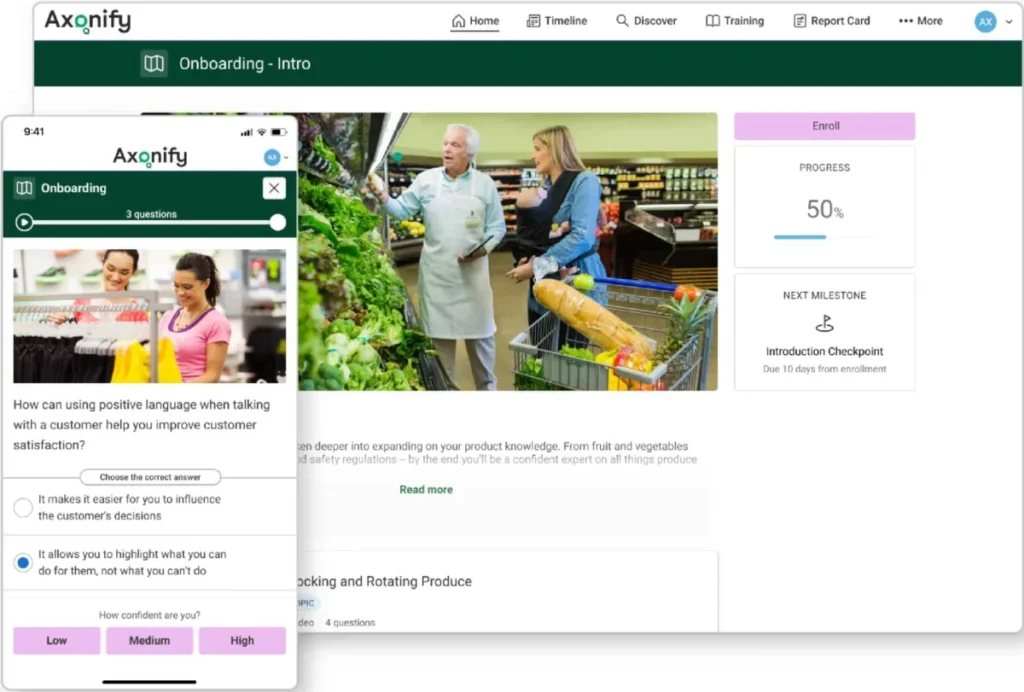
Axonify, a pioneer in frontline enablement, utilizes principles of brain science and AI to deliver training that adapts to individual roles and existing knowledge. The platform reinforces critical behaviors through spaced repetition, ensuring long-term retention and application. Its AI-driven approach personalizes the learning experience, making it highly effective for a workforce often engaged in hands-on tasks.
Kahuna: Operational Training and Skills Validation
Kahuna specializes in operational training and in-depth skills validation, with a strong track record in industries such as oil and gas, energy, manufacturing, and distribution. The company has become a Workday Gold Innovation Partner, highlighting its ability to enable workers in recertifying and upskilling their competencies. This focus on practical skills validation is crucial for industries where safety and proficiency are paramount.
Unique Enablement Providers
In addition to broad market solutions, niche AI-powered enablement platforms are emerging with highly specific functionalities.
IMMERSE: AI-Powered Language Fluency and Performance
IMMERSE offers an AI-powered performance platform focused on language fluency. It addresses the ambiguity often associated with "limited working proficiency" by leveraging AI and live enablement experiences to enhance communication confidence across languages. This goes beyond traditional language learning by focusing on practical application and real-time performance improvement.
Feedly: Translating Market Signals into Learning Moments
Feedly, integrated into AI-enabled L&D tech stacks, helps organizations translate external market signals into continuous, role-relevant learning moments. This approach ensures employees remain current with industry trends and can make informed, real-time decisions. Chalhoub Group, a luxury retail experience creator in the Middle East, utilizes Feedly to maintain a stream of curated insights for its employees.
Glean: AI-Powered Search for Real-Time Content Discovery
Glean, an AI-powered search engine, now facilitates real-time content discovery and access through platforms like Microsoft Teams and Slack. Glean can function as a comprehensive enablement platform by providing instant access to relevant information and resources, positioning itself as a key component of the modern "work platform."
The Future of Enablement: Convergence and Personalization
The proliferation of "dynamic enablement" solutions across various HR technology categories signifies a broader trend: the convergence of traditional market segments. The distinct categories of LMS, LXP, microlearning platforms, and employee experience platforms (EXP) are increasingly overlapping and integrating AI-driven capabilities.
"The market is no longer defined by rigid categories," noted an industry analyst. "We’re seeing a blurring of lines as platforms aim to provide a holistic enablement experience. Whether it’s through Microsoft Viva integrating with Copilot or other HR suites adopting AI, the expectation is for seamless, intelligent support."
Dynamic Enablement synthesizes expert and validated internal content with external resources and expertly crafted experiences tailored to specific employee roles. In the emerging landscape of enterprise AI, where organizations are becoming "builders" rather than just "buyers," a careful examination and experimentation with these evolving solutions are paramount. The future of corporate learning lies in providing agile, context-aware, and personalized support that empowers employees to perform at their best, precisely when and where they need it. The ongoing advancements in AI are not merely augmenting existing learning systems; they are fundamentally reshaping the very definition and delivery of corporate enablement.







