
In today’s hyper-dynamic business landscape, disruption has become the persistent hum of the workplace. This relentless pace, amplified by rapid technological advancements like artificial intelligence (AI), is not only altering how we work but also draining the vital energy leaders need to foster growth within themselves, their teams, and their organizations. While AI promises transformative efficiencies, the article "Psychological Capital: The Fuel to Navigate Disruption" underscores a crucial truth: human leaders remain the indispensable architects of organizational success. Even as they navigate a minefield of compounding obstacles, these leaders possess a profound, often overlooked, internal resource—psychological capital, or PsyCap—that acts as a silent engine, enabling organizations to not just survive but thrive.
PsyCap is defined as an individual’s positive psychological state, encompassing four core elements: hope, efficacy, resilience, and optimism. These components are not merely desirable traits; they are foundational to a leader’s capacity to persevere, adapt, and inspire. Research consistently demonstrates a strong correlation between high PsyCap and enhanced organizational outcomes. Studies indicate that employees with elevated PsyCap exhibit greater commitment, superior performance, improved well-being, and a reduced likelihood of burnout. For leaders, this translates into more authentic leadership behaviors, characterized by self-awareness, relational transparency, and a robust moral compass, all of which cultivate trust and drive team performance.
The concept of psychological capital has been a subject of academic inquiry for decades. Pioneering work in the field has established PsyCap as a significant predictor of key organizational success metrics, including performance, employee engagement, and retention. It encapsulates the uniquely human strengths that empower leaders to not only weather turbulent times but also to steer their organizations toward future prosperity. Crucially, PsyCap is not a static attribute but a dynamic, developable resource. Through targeted interventions, professional development, and supportive organizational cultures, leaders can actively cultivate and sustain their psychological capital. This makes it a powerful indicator of the return on investment derived from leadership development initiatives.
The critical role of PsyCap in leadership effectiveness is further illuminated by research conducted by organizations specializing in leadership development. Findings from programs like the flagship Leadership Development Program (LDP) reveal that PsyCap is not merely a positive byproduct of development; it is, in fact, a key determinant of why development initiatives succeed. Leaders who demonstrated increased levels of hope and optimism post-program subsequently reported higher rates of goal attainment and enhanced team engagement. This suggests that enhancing a leader’s psychological capital should be a central objective of any effective leadership development strategy.
The Mechanics of PsyCap Growth Through Leadership Development
The impact of structured leadership development on psychological capital is demonstrable. When leaders are provided with dedicated time for introspection, receive constructive feedback, and are encouraged to experiment with new approaches, they gain more than just new skills. They acquire the internal fortitude—the "inner fuel"—necessary to apply these skills effectively, especially during challenging periods. This process directly contributes to the growth of their PsyCap.
Empirical data from numerous leadership programs consistently supports this notion. For instance, a review of custom programs designed for education leaders revealed a significant surge in PsyCap over the course of the development experience. In a typical cohort, the percentage of leaders reporting "high PsyCap" more than doubled, escalating from 36% prior to the program to 79% upon its completion. This substantial increase highlights the transformative potential of well-designed leadership development.

Delving deeper into the developmental journey, research indicates that the growth of PsyCap is not always a linear ascent. Data collected during intensive leadership programs often shows an initial dip in PsyCap, frequently occurring around the time leaders receive challenging feedback, such as from 360-degree assessments. This temporary decline is attributed to the heightened self-awareness and potential discomfort that arises from confronting areas for improvement. However, this dip is often a precursor to significant growth. As leaders process this feedback, acquire new strategies, and apply them, their PsyCap rebounds and surpasses its initial levels. This phase underscores the importance of support and guidance during periods of intense self-reflection. The ability to navigate this temporary wobble in confidence or optimism is a testament to developing resilience, a core component of PsyCap.
The Indispensable Role of Coaching in Cultivating PsyCap
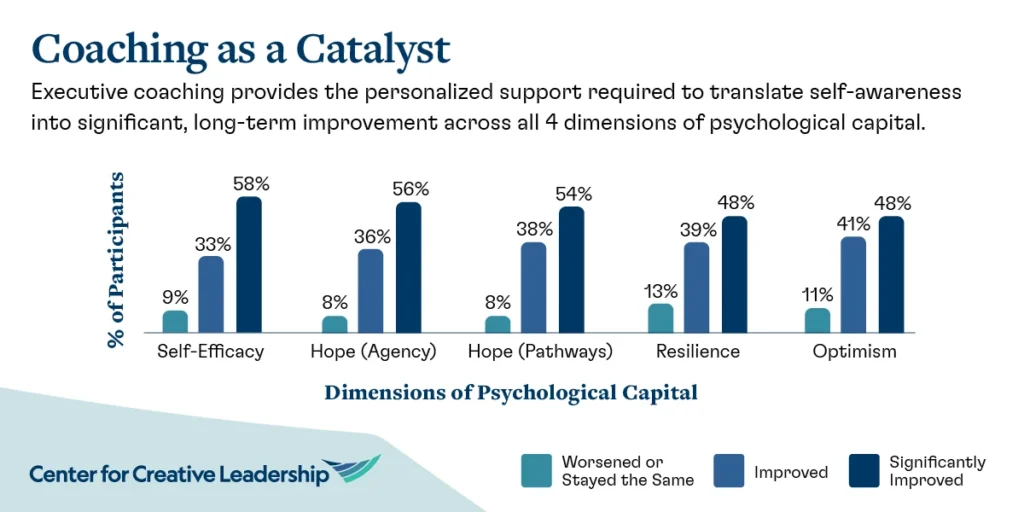
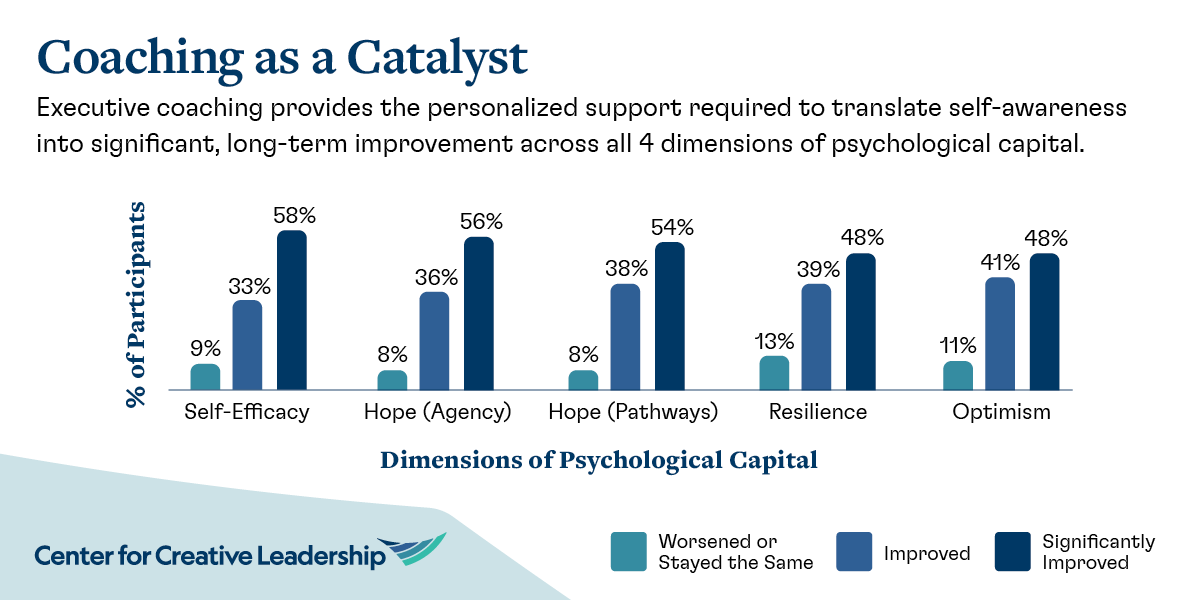
Coaching emerges as a particularly potent catalyst for bolstering leader PsyCap. It offers a personalized and sustained avenue for leaders to confront challenges, refine their strategies, and engage in goal-achieving behaviors that directly enhance their psychological capital. Evaluations of executive coaching services have consistently shown positive improvements in PsyCap, even among highly experienced leaders. This aligns with the fundamental purpose of coaching: to move beyond skill acquisition and foster the self-awareness and internal work necessary for sustained leadership effectiveness, while simultaneously replenishing the energy of leaders who practice these demanding behaviors daily.
An infographic detailing the role of coaching as a PsyCap catalyst visually represents this dynamic. It illustrates how personalized guidance helps leaders translate insights into actionable strategies, thereby reinforcing their sense of efficacy and optimism. This targeted support is crucial for leaders operating in environments where sustained high performance is expected.
The Efficacy of Bite-Sized Interventions in Boosting PsyCap
The cultivation of psychological capital is not solely dependent on lengthy, immersive programs. Encouraging data suggests that shorter, more targeted interventions, such as online leadership training modules, can also effectively strengthen PsyCap, particularly when the learning is directly linked to real-world work challenges.
A pilot study of a self-paced online course designed to build leader PsyCap yielded promising results. Participants reported a statistically significant increase in their psychological capital, with an average increase of nearly one point on a 1-to-5 scale (0.74). Notably, 86% of leaders who completed the online course indicated experiencing overall improvement. The strength of this format lies in its ability to anchor learning within a leader’s specific professional context, enabling personalized reflection and practice that directly addresses their most pressing leadership challenges. This "bite-sized" approach democratizes access to PsyCap development, making it more adaptable to busy schedules and diverse learning preferences.
Neurodiverse Leaders and the Nuances of PsyCap
Recent research is shedding light on the experiences of neurodiverse leaders regarding psychological capital. A growing body of evidence highlights the significant benefits that neurodiverse leadership teams bring to organizations. However, comparative studies indicate that leaders who identify as neurodivergent—including those with conditions like ADHD or autism—tend to report lower overall levels of PsyCap when contrasted with their neurotypical counterparts.
This finding is not an indictment of leadership potential but rather an acknowledgment that individuals possess diverse strengths and unique needs concerning their psychological resources. For organizations, this underscores the imperative to foster inclusive environments that provide the necessary psychological conditions for all leaders, regardless of their neurotype, to sustain their impact and thrive. Visualizations of this data, such as infographics comparing PsyCap levels, serve to raise awareness and encourage more tailored support strategies.
The Broader Impact: PsyCap as the Engine for Organizational Resilience
In an era defined by perpetual uncertainty, leadership development must transcend the mere acquisition of technical skills. It must actively cultivate the psychological fuel that empowers leaders to remain effective amidst ambiguity, pressure, and rapid change. Psychological capital serves as this essential fuel, and its growth is demonstrably linked to effective leadership development.
Across various modalities—immersive programs, individual coaching, and digital learning—PsyCap is enhanced when leaders engage with a carefully calibrated blend of increased self-awareness, meaningful challenges, and supportive environments that facilitate the translation of insight into decisive action. While this growth journey may involve temporary setbacks, such as the initial dip following challenging feedback, the right support systems can transform these moments into pivotal turning points. Leaders emerge with renewed agency, enhanced clarity, and a bolstered confidence to adopt innovative approaches.
The impact of PsyCap extends beyond the individual leader; it is a powerful driver of organizational culture. High-performing organizations actively foster cultures that nurture PsyCap. This involves normalizing constructive feedback, celebrating incremental progress, and providing robust support for recovery as much as for high performance. When these conditions are met, the positive energy generated by high PsyCap can cascade from leaders to their teams and permeate the entire organization. This creates a virtuous cycle where hope, self-efficacy, resilience, and realistic optimism gain momentum, fostering a more adaptive and thriving workplace.
However, it is crucial to recognize that developing psychological capital is not a panacea for systemic issues. It is not intended to enable individuals to endure unhealthy workloads or toxic work environments. Instead, it complements and amplifies the benefits of a healthy organizational ecosystem. Leader resilience and optimism reach their zenith when underpinned by systemic support, robust psychological safety, and thoughtful boundaries. The ultimate objective is not to create leaders who can passively endure adversity, but to cultivate the inner resources that enable them to confront harsh realities, devise pragmatic solutions, and inspire a collective vision for a better future for all.
Charting the Path Forward: Investing in Leader PsyCap
The imperative to build and sustain psychological capital in leadership is clear. Organizations that recognize this imperative are actively seeking pathways to empower their leaders. Programs like the Leadership Development Program (LDP) and executive coaching services are specifically designed to cultivate the psychological capital and inner resources that leaders require to perform optimally, especially during periods of intense pressure and uncertainty. By investing in these development initiatives, organizations can equip their leaders with the essential "fuel" needed to navigate disruption, drive innovation, and foster enduring success. The future of leadership is intrinsically linked to the strength of its psychological foundations.








