In an era defined by unprecedented access to information and rapid technological advancement, leaders are faced with a paradox: while the ability to generate answers has never been greater, the challenge of discerning which answers truly warrant action, understanding their cascading impacts, and establishing clear accountability has become significantly more complex. This deluge of data, amplified by artificial intelligence, does not automatically translate into enhanced knowledge or effective leadership. Instead, it underscores a critical need for a deeper, more nuanced form of leadership: wisdom.
The modern organizational landscape is characterized by pervasive ambiguity, conflicting priorities, and the imperative to lead across increasingly porous boundaries. In such an environment, expertise alone is no longer a sufficient compass. Leaders are compelled to navigate this intricate terrain simultaneously, demanding a leadership capability that transcends mere knowledge or aspiration. This capability, leadership wisdom, is not an innate trait reserved for a select few but a learnable and essential skill that, when absent, leads leaders to default to the seductive, yet ultimately fragile, substitutes of speed or an illusion of certainty. The development of leadership wisdom, therefore, becomes a pivotal factor in strengthening individual leaders and enhancing the resilience and effectiveness of teams and entire organizations when confronted with uncertainty and urgency.
The foundational understanding of leadership wisdom, as emerging from extensive research and practice, posits that it is an integral component of the leadership function, not an abstract ideal. It is a capability that can be cultivated, understood, and actively applied, beginning with its most tangible manifestations: sound judgment and effective decision-making.
The Interplay of Decision-Making, Judgment, and Wisdom
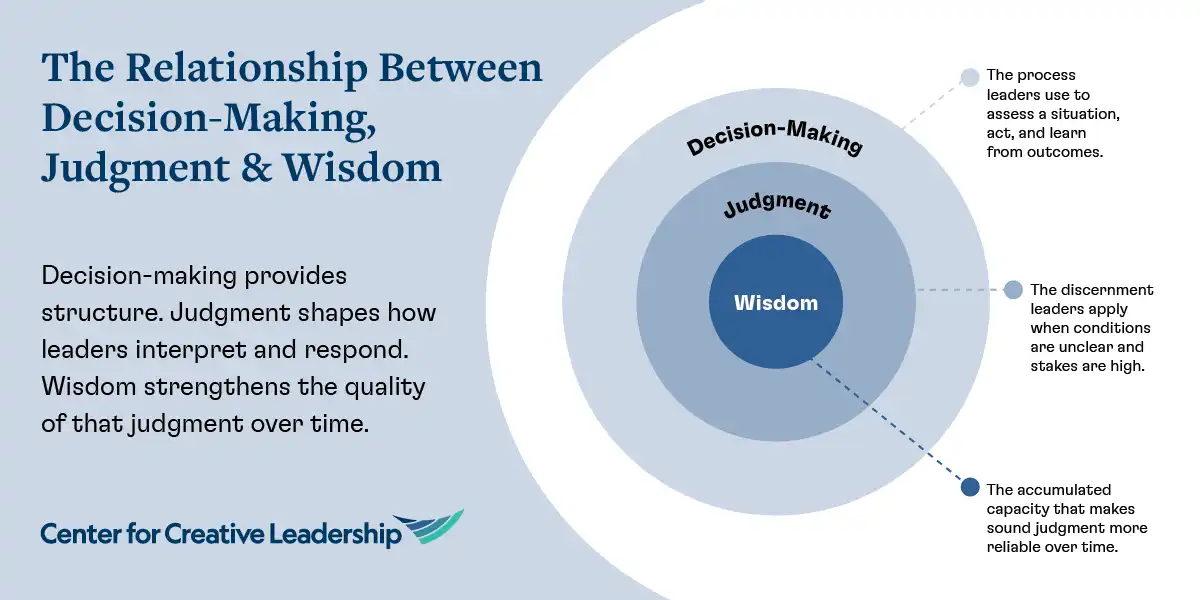
At the core of effective leadership lies a sophisticated interplay between decision-making, judgment, and wisdom, each playing a distinct yet interconnected role in navigating complexity.
Decision-making represents the structured process through which leaders systematically analyze a challenge and arrive at a conclusion. It is the framework within which options are considered and a path forward is chosen.
Judgment, on the other hand, is the discerning faculty leaders employ during this process. It is particularly crucial when conditions are opaque, information is incomplete, or the stakes are exceptionally high. Judgment involves the ability to assess situations with nuance, weigh competing factors, and anticipate potential consequences beyond the immediate.
Wisdom serves as the bedrock upon which sound judgment is built and sustained over time. It is the accumulated insight, experience, and reflective capacity that refines judgment, making it more reliable, robust, and contextually appropriate. Wisdom imbues judgment with a deeper understanding of human nature, organizational dynamics, and long-term implications.
The advent of artificial intelligence has begun to significantly reshape the decision-making process, offering unparalleled analytical power and the capacity to surface a vast array of potential solutions and insights. However, AI’s capabilities are inherently limited when it comes to the core tenets of leadership judgment and wisdom. AI cannot, by its nature, engage in the reflective practice of reviewing past decisions to extract lessons learned, nor can it empathize with the human impact of a decision on individuals or stakeholders. It lacks the capacity for the collective sensemaking that transforms raw data into meaningful understanding, a process vital for infusing information with deeper significance and context.

While AI can amplify analysis and present a multitude of possibilities, it is leadership wisdom that dictates how these possibilities are interpreted, prioritized, and applied within a specific context. In an environment where AI can generate an abundance of answers, leadership wisdom emerges as the indispensable, yet increasingly scarce, resource for identifying which answers are truly relevant and actionable. Wise leaders and their teams possess the inherent capability and capacity to dissect complex challenges, draw upon the wealth of knowledge and insights gleaned from their experiences, and engage in collaborative sensemaking. This allows them to forge sound judgments that not only pave pathways for progress but also contribute to the greater good.
The Accelerating Urgency for Leadership Wisdom
A confluence of powerful forces is intensifying the imperative for leadership wisdom. The transformative impact of AI on decision-making processes is undeniable. Simultaneously, the very nature of the decisions leaders must make is becoming inherently more challenging. These decisions are characterized by an increasing number of interacting variables, less straightforward trade-offs, higher stakes, and diminishing timelines for consideration. Leaders are thus under immense pressure to act with speed in circumstances where acting swiftly and acting wisely are often at odds.
This complexity is further compounded by the evolving demographics of the modern workforce. With multiple generations coexisting in organizations, each brings a unique relationship to experience, technology, and risk, thereby multiplying the leadership challenge. While individual leaders may possess the capacity for sound judgment, achieving consistent, organization-wide application of this judgment, extending beyond a select few at the top, remains a formidable undertaking.
A salient example of this challenge is evident in succession planning. Research consistently highlights wisdom transfer as a critical, yet frequently overlooked, factor in ensuring successful leadership transitions. The departure of an experienced leader can result in the loss of invaluable wisdom, a cost that often far exceeds the mere vacancy of their formal role. This underscores the organizational imperative to systematically capture and disseminate the tacit knowledge and nuanced understanding that constitute leadership wisdom.
The Multifaceted Dimensions of Leadership Wisdom
Leadership wisdom is not a reserve for the most senior individuals, nor is it an immutable trait one either possesses or lacks. Extensive research and practical experience with global organizations reveal several key characteristics that define leadership wisdom:
- Holistic Perspective: Wise leaders understand that challenges are rarely isolated incidents. They possess the ability to see the broader context, connecting seemingly disparate issues and recognizing the interconnectedness of various organizational systems and external factors. This allows them to anticipate unintended consequences and develop solutions that are more sustainable and effective.
- Deep Self-Awareness and Emotional Intelligence: A cornerstone of wisdom is a profound understanding of one’s own biases, strengths, and limitations. This self-awareness, coupled with robust emotional intelligence, enables leaders to manage their reactions, empathize with others, and foster trust. They can differentiate between personal preferences and objective needs, leading to more balanced and considerate decision-making.
- Ethical Foundation and Moral Compass: Wisdom is intrinsically linked to a strong ethical framework. Wise leaders are guided by a deep-seated sense of integrity and fairness. They consider the moral implications of their decisions, striving to do what is right, not just what is expedient or profitable. This ethical grounding builds credibility and fosters a culture of trust and accountability.
- Resilience and Adaptability: The ability to learn from adversity and adapt to changing circumstances is a hallmark of wisdom. Wise leaders view setbacks not as failures, but as opportunities for growth and refinement. They can maintain composure under pressure, pivot when necessary, and inspire others to persevere through challenging times.
- Long-Term Orientation and Foresight: Unlike a focus on short-term gains, wisdom embraces a long-term perspective. Wise leaders consider the enduring impact of their decisions on future generations, the environment, and societal well-being. They possess the foresight to anticipate future trends and proactively shape outcomes rather than merely reacting to them.
- Humility and Continuous Learning: True wisdom is often accompanied by a degree of humility. Wise leaders recognize that they do not have all the answers and are open to learning from diverse perspectives. They actively seek out feedback, engage in reflective practices, and demonstrate a commitment to continuous personal and professional growth.
Cultivating Wisdom in Leadership
Similar to other complex human qualities such as creativity, leadership wisdom is more effectively nurtured than directly taught. The development process involves creating an environment conducive to its formation, providing support for both individual and collective wisdom as it emerges, and offering consistent guidance.
At its core, developing leadership wisdom is facilitated by a three-pronged approach:
- Experience: This is the raw material from which wisdom is forged. However, experience alone is insufficient. It must be a rich, diverse, and challenging set of encounters that push leaders beyond their comfort zones. This includes opportunities to lead in unfamiliar contexts, manage complex projects, and navigate difficult stakeholder relationships.
- Reflection: This is the crucial process of making meaning from experience. It involves actively contemplating past actions, decisions, and their outcomes. Techniques such as journaling, debriefing sessions, and structured self-assessment are vital for translating raw experience into actionable insights. Without reflection, experience remains inert data.
- Perspective-Taking: This dimension involves actively seeking out and considering diverse viewpoints. It requires leaders to step outside their own frame of reference, understand the motivations and concerns of others, and integrate these perspectives into their own thinking. This can involve engaging with individuals from different departments, cultures, or levels of the organization, as well as seeking external counsel.
These three dimensions are not isolated but mutually reinforcing. Leaders who consistently engage in rich experiences, dedicate time to thoughtful reflection, and actively seek out varied perspectives are far more likely to develop robust and reliable wisdom. This integrated approach allows for the translation of accumulated experience into discerning judgment, ultimately enhancing their effectiveness in navigating complex leadership challenges.
The Tangible Impact of Leadership Wisdom
The presence of leadership wisdom yields profound and lasting benefits, extending from the individual leader to the broader societal context.
For individuals, wisdom acts as a compounding force. It leads to richer insights, stronger judgment, and a clearer sense of purpose, accumulating with each decision made and lesson learned. This personal growth fosters greater confidence, resilience, and a more profound understanding of their own leadership journey.
For teams, the cultivation of shared wisdom translates into collective judgment that surpasses the capabilities of any single individual. This enhanced collective intelligence enables teams to navigate complex challenges with greater agility and effectiveness. This is particularly critical for global and cross-functional teams, where the synergistic leveraging of diverse perspectives is essential for achieving optimal, long-term outcomes.
For organizations, the scaling of wisdom fosters environments characterized by psychological safety, open dialogue, and continuous renewal. These are the bedrock conditions that sustain high performance and adaptability. Wise organizations elevate collective wisdom to the level of institutional wisdom, leveraging it to navigate crises and periods of disruption with unwavering confidence and demonstrable competence. This institutional wisdom becomes a critical competitive advantage, allowing organizations to not only survive but thrive in volatile environments.
For the greater good, while wisdom may not be a panacea for all the persistent challenges that leaders confront, it undeniably equips societies to address these issues with the maturity, foresight, and momentum required for genuine and sustainable progress. It enables leaders to make decisions that consider the well-being of future generations and the health of the planet, fostering a more responsible and equitable future.
The future landscape will not be shaped by leaders who merely possess more information, act with unthinking speed, or project an unshakeable, yet often unfounded, certainty. Instead, success will be found in leaders who possess the capacity to discern what truly matters, to make sense of complexity collaboratively with others, and to exercise sound, ethical judgment when the stakes are at their highest.
Embracing the Path Forward
The imperative to cultivate leadership wisdom has never been more pronounced. As organizations grapple with the dual forces of technological advancement and escalating complexity, the ability to discern, reflect, and judge with wisdom will be the defining characteristic of effective leadership. Embracing this evolution is not merely an option; it is a necessity for navigating the challenges and seizing the opportunities of the future.
To delve deeper into the evolving landscape of decision-making and the role of AI, consider exploring resources that examine the intersection of these critical areas. For those seeking to stay abreast of emerging research on AI, leadership wisdom, and the future of organizational effectiveness, subscribing to relevant newsletters offers a direct channel to cutting-edge insights and analysis. The journey toward greater wisdom is continuous, and the rewards—for individuals, teams, organizations, and society—are immeasurable.