
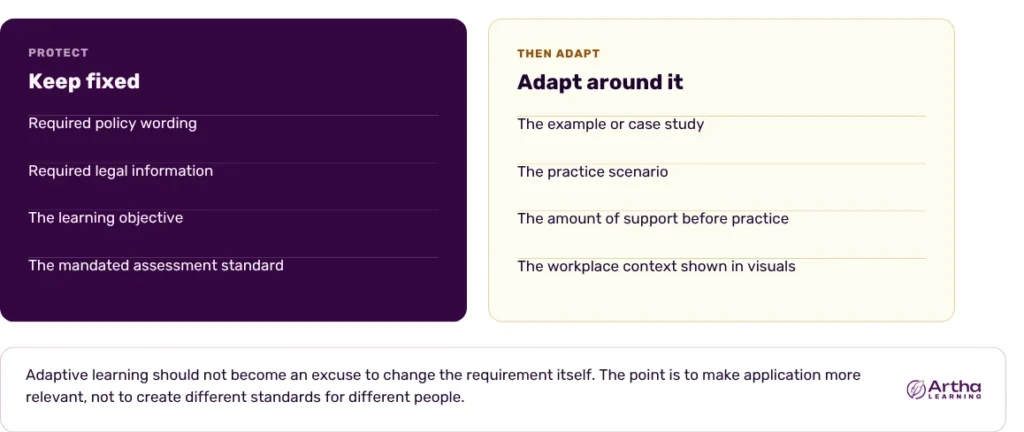
The landscape of corporate education is undergoing a fundamental shift as organizations move away from the traditional, "one-size-fits-all" model of compliance training toward more sophisticated, adaptive frameworks. This transition is driven by the recognition that while a consistent learning outcome is non-negotiable in highly regulated industries, an identical learning experience for every employee is often counterproductive. By maintaining a "common spine" of core policies and legal requirements while varying the context, scenarios, and practice activities based on a learner’s role, region, or experience level, organizations can significantly improve the efficacy of their risk management strategies. The most practical approach to modern compliance is no longer about building a different course for every individual, but rather identifying precisely where uniformity hinders the application of critical principles.
The Paradigm Shift: From Documentation to Behavioral Change
For decades, the primary objective of corporate compliance training was legal defensibility. Organizations prioritized the ability to prove that every employee had clicked through the same screens and passed the same assessment. This "sameness" was viewed as a safeguard; if a legal issue arose, the company could demonstrate a standardized effort to educate its workforce. However, learning science and industry data suggest that this approach often fails to produce the desired behavioral outcomes. According to recent industry reports from the Association for Talent Development (ATD), learner engagement in compliance topics is historically lower than in elective professional development, largely due to a lack of perceived relevance.
The assumption that everyone must take the identical course to learn the same principle is increasingly viewed as a design flaw rather than a requirement. While the learning outcome—such as understanding a Code of Conduct—must remain consistent across the board, the route to achieving that understanding can, and should, vary. This distinction allows for a more nuanced instructional design that respects the learner’s time and cognitive load.
The Strategic Architecture of the Common Spine
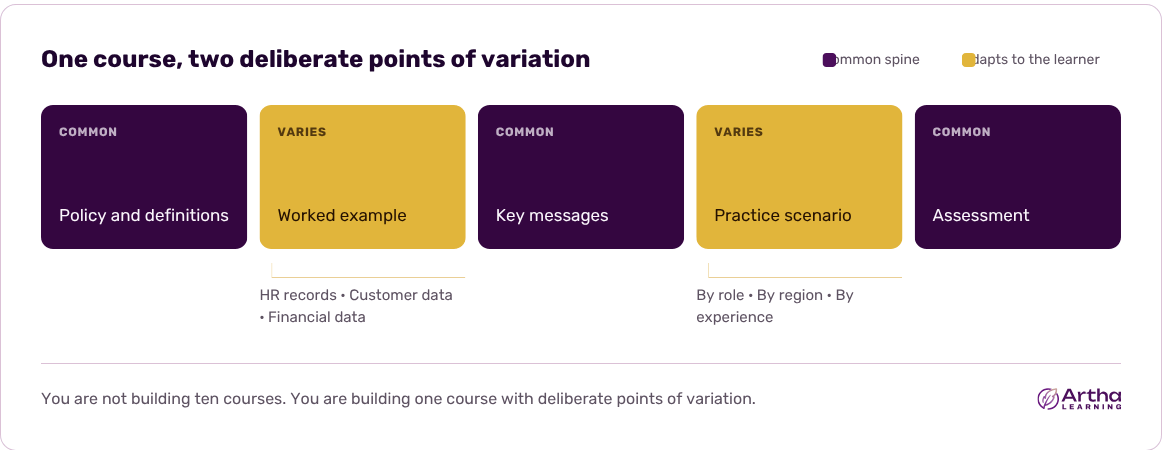
The most effective adaptive learning programs utilize a "common spine" architecture. This model ensures that the foundational elements of the training remain standardized across the entire enterprise. These elements typically include the core policy text, the legal or regulatory definitions, the organization’s official stance on specific issues, and the consequences of non-compliance. These are the non-negotiables that provide the legal and ethical framework for the company.
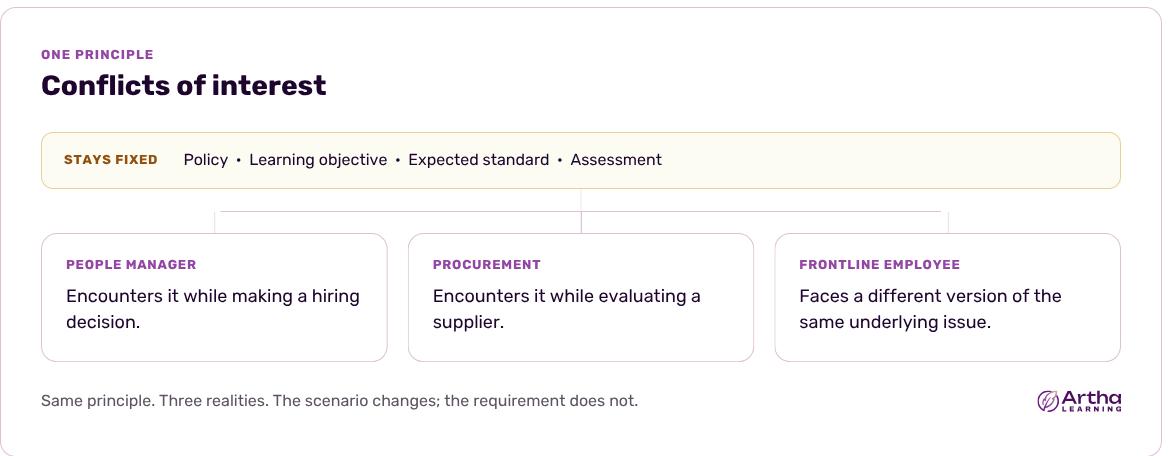
Once this spine is established, designers can introduce "points of variation." These are specific segments of the training—such as case studies, branching scenarios, or practice exercises—that are tailored to the specific reality of the employee. For instance, a policy regarding "Conflicts of Interest" is a universal requirement. However, the manifestation of that conflict differs by department:
- Procurement Officers: May face scenarios involving vendor gifts or supplier relationships.
- Hiring Managers: May encounter conflicts during the recruitment of family members or former colleagues.
- Frontline Staff: Might deal with the appropriate use of company assets or secondary employment.
By adapting the scenario to the role, the organization eliminates the "translation friction" that occurs when a learner is forced to imagine how a generic or irrelevant example applies to their specific daily tasks.
Data and Industry Context: The Cost of Irrelevance
The move toward adaptive training is supported by data regarding workforce productivity and risk. A study by the Brandon Hall Group found that personalized learning paths can reduce the time spent in training by up to 40% while maintaining or improving knowledge retention. In a global organization with 50,000 employees, reducing a mandatory one-hour course by just 15 minutes through relevant adaptation can save over 12,000 hours of collective productivity.
Furthermore, the "one-size-fits-all" approach can create a "check-the-box" culture. When employees are presented with scenarios that do not reflect their work environment, they are more likely to disengage, viewing the training as a hurdle to be cleared rather than a tool for decision-making. In high-stakes environments—such as financial services dealing with Anti-Money Laundering (AML) or healthcare dealing with patient privacy (HIPAA)—the failure to recognize a violation in a real-world context can lead to multi-million dollar fines and reputational damage.
A Chronology of Compliance Training Evolution
The evolution of compliance training can be mapped across four distinct stages:
- The Seminar Era (Pre-2000s): Training was primarily conducted in person via workshops or lectures. While this allowed for some instructor-led adaptation, it was impossible to scale and difficult to document consistently.
- The Static E-Learning Era (2000s – 2015): The rise of the Learning Management System (LMS) led to the "page-turner" model. Every employee received the exact same digital file. This solved the documentation problem but introduced the "sameness" trap.
- The Algorithmic Era (2015 – 2022): Highly complex platforms attempted to use AI to generate unique paths for every learner. While innovative, these systems were often too expensive and difficult for internal L&D teams to manage, leading to "over-engineering."
- The Selective Adaptation Era (Present): The current best practice focuses on "purposeful variation." It utilizes simple, data-driven triggers—such as a learner’s department or a self-selected region—to deliver contextually relevant content within a standardized framework.
Implementation Strategies: Simple vs. Sophisticated Adaptation
Adaptation does not necessarily require complex algorithms or expensive software. Some of the most effective adaptive experiences are built on simple logic.
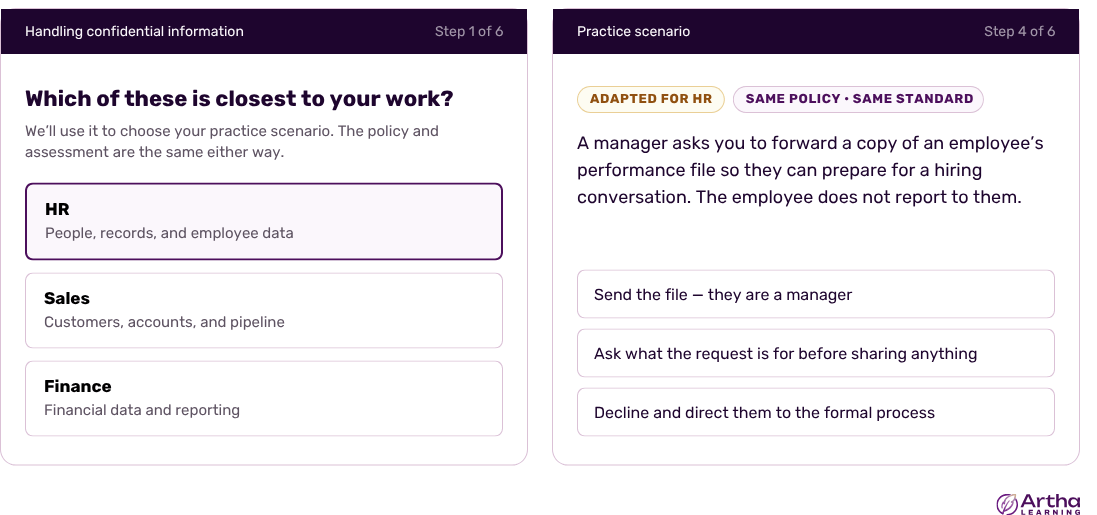
Self-Selection and Branching
At the beginning of a module, a learner may be asked: "What is your primary area of responsibility?" Their answer determines which track of scenarios they follow. This empowers the learner and ensures immediate relevance without the need for complex data integration.
Experience-Based Fast-Tracking
Experienced employees or managers can be given a "pre-assessment" or a high-level "challenge scenario." If they demonstrate mastery of the core principle, they can move directly to advanced applications, while newer employees receive the foundational support and definitions they need. This respects the expertise of the veteran workforce and prevents the "boredom-induced disengagement" that often plagues annual compliance recertifications.
Regional and Language Localization
For global organizations, adaptation is often a matter of regional law and cultural context. Anti-bribery training in Scandinavia may look very different from the same training in Southeast Asia, even if the underlying corporate policy is identical. Localizing the visuals, the currency, and the social nuances of the scenarios makes the principle recognizable and actionable.
Regulatory Responses and Legal Considerations
A common concern among legal and compliance officers is whether "different" training paths could be perceived as "unequal" training in a court of law. However, recent trends in regulatory oversight suggest that authorities are more interested in the effectiveness of a compliance program than its uniformity.
The U.S. Department of Justice (DOJ) guidelines on the "Evaluation of Corporate Compliance Programs" emphasize that training should be "tailored to the audience" and "measured for effectiveness." Regulators are increasingly critical of "paper programs" that look good on a spreadsheet but fail to influence behavior. By providing role-relevant training, organizations can argue that they have taken a more rigorous approach to risk mitigation by ensuring employees truly understand how to apply policies in their specific high-risk areas.
Broader Implications for Organizational Culture
The shift toward adaptive compliance training has implications beyond mere efficiency. It signals a shift in organizational culture—from one of policing to one of partnership. When an organization takes the time to ensure that training is relevant to an employee’s role, it demonstrates a respect for the employee’s professional reality.
Moreover, this approach allows organizations to identify specific "hot spots" of risk. If data shows that the sales team is struggling with a specific scenario regarding gift-giving, the compliance team can provide targeted interventions or updated guidance for that specific group, rather than forcing the entire company to undergo remedial training.
Conclusion: Protecting the Goal, Not the Format
The ultimate goal of any compliance program is to help employees make better decisions when they encounter real-world challenges. Consistency should serve to protect the organization’s ethical and legal standards, not to flatten the learner’s experience into a generic, unhelpful routine.
By standardizing the "what" (the principles and outcomes) while adapting the "how" (the context and practice), organizations can create a more resilient and informed workforce. In the modern corporate environment, the most successful training programs are those that recognize a simple truth: the course does not have to be the same for everyone to teach everyone the same thing. Relevance is not an enemy of consistency; it is the vehicle through which consistency is achieved.






