The landscape of corporate education has undergone a radical transformation, shifting from a focus on simple course completion to a high-resolution view of the entire learner journey. Today, learning leaders possess an unprecedented level of insight into employee behavior, facilitated by sophisticated Learning Management Systems (LMS), Learning Experience Platforms (LXP), and increasingly, generative artificial intelligence. These platforms provide granular data on what employees search for, where they struggle, how many attempts they make on assessments, and which paths they abandon. While this visibility offers the potential for hyper-personalized development, it also introduces a critical ethical dilemma: the point at which data collected to support growth becomes data used to penalize or judge professional potential.
As organizations move toward "skills-based" models, the integration of learning data into broader human resources ecosystems has accelerated. Information that was once siloed within a training department is now frequently synced with talent marketplaces, workforce analytics, and performance management systems. This convergence has fundamentally changed the responsibility of learning leaders, who must now navigate the complex intersection of data privacy, algorithmic bias, and the preservation of psychological safety in the workplace.
The Convergence of Learning and Talent Ecosystems
Historically, corporate learning was a closed loop. An employee took a compliance course or a leadership seminar, and the only data point that moved into their permanent HR file was a "complete" or "incomplete" status. In the current era of digital transformation, those walls have effectively crumbled. Modern learning systems are designed to be "interoperable," connecting seamlessly with Human Capital Management (HCM) software and internal talent marketplaces.
This connectivity is driven by the corporate demand for agility. According to recent industry reports, nearly 90% of organizations are currently experiencing or expecting a skills gap within the next five years. To address this, companies are using AI to "infer" skills from learning data. If an employee watches three videos on Python and passes a quiz, the system may automatically update their talent profile to include "Beginner Python." While this can facilitate internal mobility, it also means that the "messy" parts of learning—the failures, the confusion, and the exploratory searches—are no longer private.
The risk lies in the lack of transparency. Often, data gathered in a supportive context—such as a diagnostic test meant to identify training needs—migrates into a performance context without the employee’s explicit understanding. This "context collapse" can lead to situations where a manager views a low diagnostic score from six months ago as evidence of a current lack of competency, ignoring the fact that the assessment was designed to be a starting point, not a final evaluation.
Preserving the Right to be Unfinished
A central tenet of effective adult learning is the freedom to experiment and fail without immediate consequence. However, the omnipresence of AI monitoring threatens to eliminate this "safe space." When every interaction with an AI tutor or every failed practice quiz is recorded and potentially analyzed, employees may become hesitant to admit ignorance or explore new fields.
Consider the common behaviors of a learner: an employee might start a leadership course but drop it when they realize the content isn’t relevant to their current goals. Another might take a technical assessment three times before achieving a passing score. In a traditional learning environment, these are seen as non-events or signs of persistence. However, an AI-driven system might interpret an abandoned course as a lack of "follow-through" or multiple assessment attempts as a lack of "cognitive agility."
The distinction between evidence and inference is where the ethical challenge becomes most acute. The evidence is that the employee took three attempts; the inference is that the employee is a slow learner. If that inference leaves the learning environment and follows the employee into a promotion review, the tool has shifted from a support mechanism to a surveillance mechanism.
A Chronology of Corporate Learning Technology
To understand the current tension, it is helpful to view the evolution of learning data through the following phases:
- The Compliance Era (1990s–2000s): The focus was on the Learning Management System (LMS). Data was binary (pass/fail) and primarily used for legal and regulatory record-keeping.
- The Experience Era (2010s): The rise of the Learning Experience Platform (LXP) introduced social learning and content curation. Data collection expanded to include "likes," "shares," and "time spent," aiming to improve engagement.
- The Skills Era (2020–Present): The integration of AI and Talent Marketplaces. Learning data is now used to build dynamic "skills taxonomies." The focus has shifted from what people did to what people can do and might do next.
This progression shows a clear trend toward higher data density and higher stakes. As we move further into the Skills Era, the "permanent record" of an employee is no longer just a résumé and a few performance reviews; it is a massive, AI-generated map of their digital behavior.

Implementing a Five-Stage Governance Framework
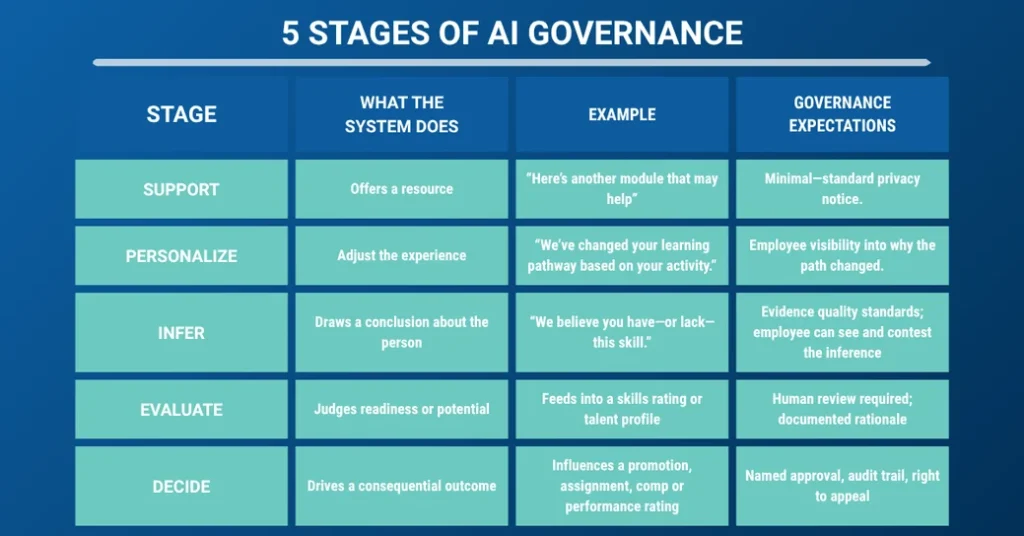
To manage the risks associated with AI inferences, learning leaders are beginning to adopt governance frameworks that scale based on the consequence of the data use. Not all learning data requires the same level of scrutiny. A useful model for organizations involves categorizing AI interactions into five distinct stages:
- Support: The AI provides recommendations or resources directly to the learner. (Low risk; minimal governance needed).
- Assist: AI tutors or chatbots help learners work through problems. (Low-to-medium risk; privacy of transcripts is key).
- Inform: Data is used to update a skills profile that the employee can see and edit. (Medium risk; requires transparency).
- Evaluate: AI-generated scores or insights are used by managers to assess performance or readiness for a task. (High risk; requires human oversight).
- Decide: Data directly influences high-stakes outcomes like hiring, firing, or promotions. (Highest risk; requires rigorous auditing and human-in-the-loop validation).
As a general rule, any data use that crosses into the "Evaluate" or "Decide" categories should not rely on system-generated scores alone. There must be a named human approver and a clear record of the evidence considered, allowing the employee the opportunity to contest or correct the data.
The Role of Vendor Accountability
A significant portion of the data drift occurs not because of intentional corporate policy, but because of default software settings. Many AI-enabled learning vendors sync diagnostic scores and behavioral data to talent profiles by default. This "opt-out" rather than "opt-in" approach often bypasses the traditional rigors of HR policy.
Learning leaders are now being urged to scrutinize vendor contracts more closely. Key questions include:
- Does the platform data sync to HR systems by default?
- Can data syncing be toggled at the individual element level (e.g., sync certifications but not practice scores)?
- What is the data retention policy for "exploratory" behaviors like searches or AI tutor transcripts?
If a vendor cannot provide granular control over how learning data is shared, they may be creating a long-term liability for the organization, particularly in jurisdictions with strict data privacy laws like the EU’s General Data Protection Regulation (GDPR).
Implications for Psychological Safety and Trust
The long-term success of AI in the workplace depends entirely on employee trust. If workers suspect that their uncertainty is being weaponized against them, they will adapt their behavior to "game" the system. They will ask safer questions, avoid challenging subjects, and only engage with the platform when they are certain of success.
This "chilling effect" undermines the very purpose of corporate learning. An organization that tracks everything may end up knowing nothing about the true skills gaps of its workforce, as employees hide their struggles to protect their professional standing.
Industry analysts suggest that the "final test" for any new AI learning capability should be a transparency test: Would leadership be comfortable explaining the data collection and inference process directly to an employee in plain English? If the explanation feels like it requires a legal disclaimer, the system likely infringes on the necessary "room to be unfinished" that humans require to grow.
Conclusion: The Learning Leader as Data Steward
The role of the Chief Learning Officer (CLO) is evolving from a content curator to a data steward and ethical gatekeeper. While AI offers a powerful toolkit for identifying talent and personalizing growth, it also requires a new set of guardrails.
The goal is not to stop the flow of data or to abandon AI, but to ensure that technology serves the learner rather than just the institution. By distinguishing between "learning data" and "evaluation data," and by giving employees control over their digital profiles, organizations can harness the power of AI without sacrificing the honesty and vulnerability that genuine learning requires. In the age of AI, preserving the space for employees to be "unfinished" may be the most important contribution a learning leader can make to their organization’s long-term health and innovation.