The landscape of corporate learning and development (L&D) is undergoing a fundamental transformation as instructional designers (IDs) move beyond basic experimentation with generative artificial intelligence toward sophisticated, integrated workflows. While the majority of industry professionals have adopted Large Language Models (LLMs) to some degree, a significant performance gap has emerged. This gap is not defined by the limitations of the AI models themselves, but rather by the sophistication of the prompts used to guide them. Industry experts are increasingly advocating for a shift in perspective: treating AI not as a simple search engine, but as a "junior designer" that requires a comprehensive brief, clear objectives, and rigorous oversight to produce course-ready content.
The Shift from Search Box to Strategic Briefing
In the early stages of AI adoption within the educational sector, many professionals utilized tools like ChatGPT or Claude as glorified search engines, inputting brief, one-sentence queries and receiving generic, often unusable, results. This approach frequently led to "hallucinations" or bland content that necessitated extensive rewriting by Subject Matter Experts (SMEs). However, as the field matures, prompt engineering has emerged as a core competency for instructional designers, standing alongside traditional skills such as needs analysis and assessment writing.
The transition toward professional-grade AI output requires a move away from "magic phrases" and toward a structured, reusable scaffold. By providing the model with the same level of context one would provide a new human hire—including learner demographics, behavioral objectives, raw source material, and specific output constraints—designers can transform AI into a high-functioning drafting partner. This methodology ensures that the generated content is not only linguistically fluent but also pedagogically sound and aligned with organizational goals.
A Chronology of AI Integration in L&D
The integration of AI into instructional design has followed a rapid timeline over the past several years:
- Phase I: Automated Transcription and Translation (2018–2021): Early AI use was largely limited to mechanical tasks such as generating captions for video content or performing literal translations of text.
- Phase II: The Generative Explosion (Late 2022–2023): The release of GPT-3.5 and GPT-4 democratized access to high-level text generation. Designers began using AI for brainstorming and initial drafting, though quality remained inconsistent.
- Phase III: Strategic Prompt Engineering (2024–Present): The current era is defined by "Chain-of-Thought" prompting and the use of structured frameworks. Designers are now building internal prompt libraries and using AI for complex tasks like storyboarding, scenario-based assessment, and cultural localization.
As of mid-2024, industry surveys suggest that while over 70% of L&D professionals use AI weekly, fewer than 25% have established standardized "prompt scaffolds" across their teams. This lack of standardization remains the primary hurdle to scaling AI-assisted content production.
The Five-Part Prompt Scaffold: A Methodology for Consistency
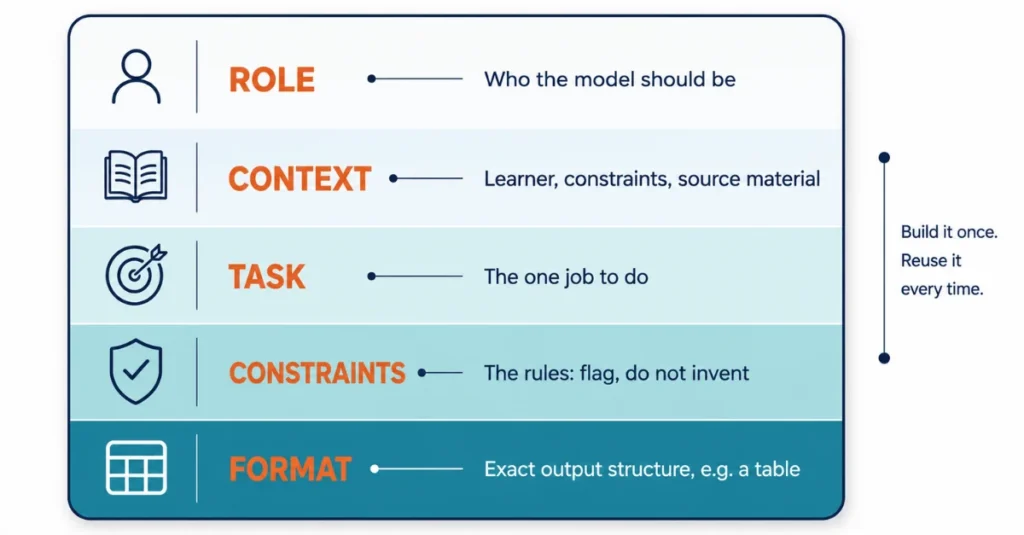
To bridge the quality gap, leading instructional designers are adopting a five-part reusable scaffold for all AI interactions. This framework acts as a quality control mechanism, ensuring that the AI understands the nuances of the instructional task.
- Role Specification: Explicitly defining the AI’s persona (e.g., "Act as a Senior Instructional Designer specializing in technical compliance").
- Task Definition: A clear, verb-driven description of the work to be performed (e.g., "Draft a three-scene storyboard").
- Contextual Background: Information regarding the target audience, their prior knowledge, and the learning environment.
- Source Material Integration: Providing the specific raw data, policy documents, or SME notes that must ground the content.
- Constraint and Format Parameters: Defining the "shape" of the output, such as word counts, reading levels, or specific table columns.
By utilizing this scaffold, designers can move from a "fresh sentence" approach to a repeatable process, significantly reducing the time spent on administrative drafting while increasing the defensibility of the final product.
Deep Dive: Four Patterns for High-Impact Design
The application of this scaffold is best observed through four specific "patterns" that address the most time-consuming aspects of the instructional design lifecycle.
1. Storyboarding from Dense SME Content
Turning a 50-page policy manual into a 15-minute eLearning module is traditionally a mechanical and slow process. AI can accelerate this by mapping every screen directly to a learning objective. A successful storyboard prompt requires the model to produce a multi-column table including on-screen text, visual directions, and narration scripts. Crucially, professional designers include a "Gap Identification" rule: the AI is instructed to flag any areas where the source material is insufficient to meet the learning objective, rather than inventing information. This turns a potential hallucination into a focused task list for the next SME review.
2. Advanced Assessment Design
Standard AI output for quizzes tends to focus on low-level recall (e.g., "What does the acronym stand for?"). To move up Bloom’s Taxonomy to "Apply" or "Analyze" levels, designers must specify the cognitive level and demand realistic distractors. A sophisticated prompt requires the AI to provide a rationale for each incorrect answer. If the model cannot explain why a wrong answer might be tempting to a novice, the question is discarded as "weak." This approach ensures that assessments are measuring actual competency rather than test-taking skills.

3. Precision Rewriting and Tone Adjustment
Rewriting content for different reading levels (e.g., simplifying technical jargon for a general audience) carries the risk of losing technical accuracy. To mitigate this, designers are using "Constraint-Based Rewriting." This involves instructing the AI to simplify the language while "locking" specific mandatory terminology. By requiring the AI to provide a list of every term it simplified, the designer can perform a targeted audit of the changes, ensuring compliance and precision are maintained without having to re-read every line of the output.
4. Localization vs. Translation
For global organizations, the distinction between translation (changing words) and localization (adapting meaning) is critical. AI-assisted localization prompts now include instructions to identify cultural references, regional regulatory figures, or idioms that do not translate well. The output is structured to include a "Human Review Required" column, where the AI flags segments that may be culturally sensitive or legally specific to a certain region. This allows native-speaking reviewers to focus their attention on high-risk areas rather than performing a line-by-line proofread of standard content.
Data Security and Quality Guardrails
The rise of AI in instructional design has brought significant concerns regarding data privacy and intellectual property. Major players in the insurance, finance, and healthcare sectors have implemented strict policies against the use of consumer-grade AI tools for proprietary content.
Enterprise Security: Experts warn that "protecting your data" is no longer optional. Organizations are increasingly shifting toward enterprise versions of AI tools (such as ChatGPT Enterprise or Microsoft Copilot) that offer data silos and guarantees that input data will not be used to train future iterations of the model.
Verification and Truth: From a journalistic and professional standpoint, the industry consensus is clear: the AI is never the "source of truth." Every factual claim, citation, or regulation generated by a model must be verified against an authoritative source. LLMs are optimized for fluency, not accuracy; they are capable of generating perfectly formatted but entirely fictitious reference lists.
The Alignment Pass: A final quality guardrail involves a "self-check" prompt. After a draft is produced, designers run a secondary prompt asking the AI to critique its own work against criteria such as inclusivity, accessibility (WCAG) standards, and alignment with the initial objectives. This "flag-but-don’t-fix" instruction keeps the designer in the editorial driver’s seat.
Broader Impact: The Designer as Editor-in-Chief
The long-term implication of these developments is a shift in the value proposition of the instructional designer. As AI handles the "mechanical" side of writing—formatting, initial drafting, and basic translation—the designer’s role becomes increasingly editorial and strategic.
"The skill is becoming editorial, not technical," notes one industry analysis. The most successful designers in the coming decade will be those who can write the best creative briefs and who have the deepest understanding of the learner’s needs. The ability to decide what "good" looks like, and the discipline to hold the AI output to that standard, is becoming the most valuable part of the role.
As organizations continue to demand faster turnaround times for training in response to rapid technological changes, the use of AI as a drafting partner is no longer a luxury but a necessity. By adopting structured scaffolds and rigorous guardrails, instructional designers can ensure that they are not just producing content faster, but producing better, more effective learning experiences that are grounded in data and human expertise.
The transition is best summarized as a move from "individual experimentation" to "repeatable capability." By building shared prompt libraries and standardized workflows, L&D teams can ensure that the quality of their digital learning products remains high, regardless of which individual designer—or which AI model—is involved in the drafting process.