
In the current economic climate, Learning and Development (L&D) departments are under unprecedented pressure to transition from being perceived as "cost centers" to "value drivers." For decades, the success of a training program was measured by completion rates—the number of employees who clicked through a slideshow or attended a seminar. However, as organizations face rapid technological shifts and widening skills gaps, the focus has shifted from mere participation to verified proficiency. The post-test has emerged as the definitive instrument for this verification, providing the empirical evidence required to prove that learning has actually occurred and that the investment in training is yielding a tangible return.
The Strategic Framework of the Post-Test
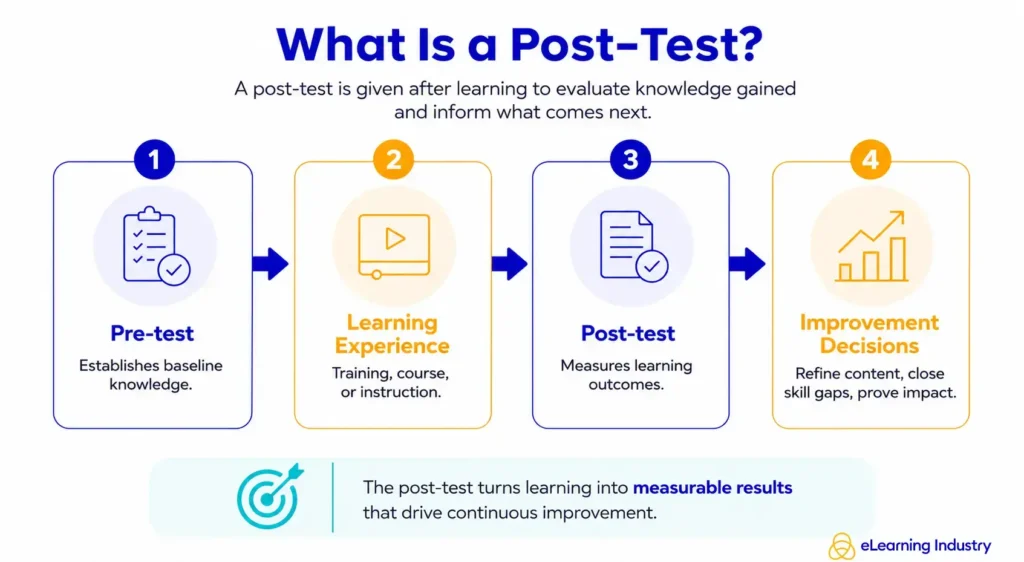
A post-test is a formal assessment administered following a period of instruction to evaluate a learner’s mastery of specific knowledge, skills, or competencies. While its definition is straightforward, its application within a corporate environment is multifaceted. It serves as the bridge between the theoretical delivery of content and the practical application of that content in the workplace.
The primary objective of a post-test is to validate that the learning objectives of a program have been met. In a corporate setting, this validation is critical for several reasons. First, it ensures that employees are equipped to perform their duties safely and effectively. Second, it provides a layer of legal and regulatory protection, particularly in highly scrutinized industries such as healthcare, finance, and manufacturing. Third, it allows instructional designers to audit their own work; if a high percentage of learners fail a post-test, it suggests that the training material itself—rather than the learners—may be the source of the failure.
From the perspective of the Kirkpatrick Model—the industry standard for evaluating training—the post-test resides primarily at Level 2: Learning. This level measures the degree to which participants acquired the intended knowledge, skills, and attitudes based on their participation in the training. By moving beyond Level 1 (Reaction, or how much the learners liked the training), the post-test provides the first layer of hard data regarding the program’s efficacy.
The Baseline: Understanding the Role of the Pre-Test
To understand the full impact of a post-test, one must first look at its precursor: the pre-test. A pre-test is an assessment given before any instruction occurs. Its purpose is to establish a baseline of existing knowledge. Without this baseline, it is impossible to determine how much a learner actually gained from the training versus what they already knew.
In modern L&D strategies, pre-tests are increasingly used to facilitate "adaptive learning." By identifying what a learner already knows, organizations can allow experienced employees to bypass redundant modules, focusing their time only on the areas where they have documented gaps. This personalization not only respects the learner’s time but also significantly reduces the "opportunity cost" of training—the time employees spend away from their core job functions.
When a pre-test is paired with a post-test, the resulting data point is known as the "learning gain" or the "delta." This metric is the most accurate representation of instructional impact. For example, if an employee scores 40% on a pre-test and 85% on a post-test, the 45% increase represents the direct value added by the training intervention.
Comparative Analysis: Pre-Test vs. Post-Test
The distinction between these two assessments is fundamental to a data-driven learning strategy. The following table highlights the core differences:
| Feature | Pre-Test | Post-Test |
|---|---|---|
| Timing | Administered before instruction begins. | Administered after instruction is completed. |
| Primary Goal | Establishes a baseline and identifies gaps. | Measures outcomes and validates mastery. |
| Data Use | Personalizes the learning path. | Evaluates the success of the program. |
| Focus | Prior knowledge and misconceptions. | Knowledge acquisition and application. |
| Benefit | Saves time by avoiding redundant content. | Provides proof of ROI and compliance. |
By utilizing both, L&D leaders can answer two critical questions: "Where did they start?" and "How far did they go?" This dual-metric approach is essential for any organization looking to move toward a mature, evidence-based culture of learning.
A Chronology of the Assessment Lifecycle
The implementation of an effective assessment strategy follows a logical progression within the development of any training program. This chronology ensures that data collection is intentional and aligned with business goals.

- Objective Definition: Before any test is written, L&D teams must define what "success" looks like. This involves identifying the specific Key Performance Indicators (KPIs) the training is meant to influence.
- Pre-Assessment Administration: Learners take a baseline test. The data is analyzed to determine if the planned training is too basic, too advanced, or perfectly aligned with the group’s needs.
- Instructional Delivery: The training is conducted, whether through e-learning, instructor-led sessions, or blended formats.
- Post-Assessment Administration: Immediately following the training, the post-test is given to measure immediate recall and comprehension.
- Data Triangulation: The scores from the pre-test and post-test are compared. This data is often integrated with Learning Management System (LMS) analytics to see how time-spent-on-task correlates with final scores.
- Long-term Retention Check (Delayed Post-Test): In some advanced models, a follow-up test is given 30 to 90 days later to measure the "forgetting curve" and determine if "booster" training is required.
The Economic Impact and ROI of Testing
Data from various industry reports suggests that organizations that utilize rigorous assessment strategies see a significant improvement in training efficiency. According to the Association for Talent Development (ATD), companies in the United States spend an average of over $1,200 per employee annually on training. Without post-tests, there is no way to verify if that $1,200 is a sound investment or a sunk cost.
Christopher Pappas, CEO and founder of eLearning Industry, emphasizes the necessity of this data for executive buy-in. "Organizations don’t gain a competitive advantage by delivering more training, but by proving that learning changes performance," Pappas noted. "Post-tests provide the evidence leaders need to invest with confidence."
The ROI of post-testing is most visible in three areas:
- Reduced Training Time: Pre-tests allow for "test-out" options, saving thousands of man-hours across a large enterprise.
- Mitigated Risk: In compliance scenarios, a failed post-test prevents an uncertified employee from performing a high-risk task, potentially saving the company millions in legal fees or fines.
- Targeted Improvement: Post-test data reveals which specific parts of a course are failing. If 80% of learners miss a question on "data encryption," the company knows exactly where to focus its remedial efforts.
Industry-Specific Applications
The utility of the post-test varies depending on the regulatory and operational needs of the sector.
Healthcare and Pharmaceuticals:
In these industries, the post-test is a matter of safety. Compliance with HIPAA (Health Insurance Portability and Accountability Act) or clinical trial protocols requires 100% mastery. Post-tests here often include complex scenarios where a single wrong choice results in a "fail," reflecting the high stakes of the real-world environment.
Financial Services:
Anti-money laundering (AML) and "Know Your Customer" (KYC) regulations demand that employees recognize subtle patterns of fraud. Post-tests in this sector often use simulation-based questions to ensure that the theoretical knowledge of the law translates into the ability to spot suspicious activity.
Onboarding and Corporate Culture:
For new hires, the post-test serves as a "readiness check." It confirms that the individual understands the company’s mission, its internal tools, and its security protocols before they are given access to sensitive systems.
Best Practices in Post-Test Design
Creating an effective post-test is a scientific process. Poorly designed tests—those that are too easy or focus on trivia—provide a false sense of security. To ensure validity, designers should follow these principles:
- Alignment with Bloom’s Taxonomy: Questions should not just test "remembering" (rote memorization) but also "applying," "analyzing," and "evaluating."
- Scenario-Based Questioning: Instead of asking for a definition, ask the learner to solve a problem. For example, "An employee reports a safety hazard; what is the first step you take according to company policy?"
- Distractor Plausibility: In multiple-choice questions, the incorrect options (distractors) should be plausible. This ensures that the learner actually knows the correct answer rather than just being able to spot the "least wrong" option.
- Psychometric Analysis: L&D teams should periodically review question performance. If a question is consistently answered correctly by both high-performers and low-performers, it has low "discriminatory value" and should be rewritten.
Conclusion: The Future of Assessment
As artificial intelligence (AI) becomes integrated into Learning Management Systems, the post-test is evolving into a dynamic, "living" assessment. AI can now generate unique questions for every learner, preventing cheating and ensuring that the test remains challenging over time. Furthermore, predictive analytics can now use post-test scores to forecast which employees are most likely to excel in leadership roles or which ones are at risk of leaving the company due to a lack of skill confidence.
The post-test is no longer just a hurdle at the end of a course; it is a critical business intelligence tool. By providing a clear, objective measure of knowledge gain, it allows organizations to build a more competent, compliant, and competitive workforce. In an era where "skills are the new currency," the post-test is the mechanism that verifies the value of that currency. For L&D leaders, the message is clear: if you aren’t testing, you aren’t truly training; you are merely hoping for the best. In a professional newsroom or a corporate boardroom, hope is never a substitute for data.






