The modern corporate landscape is currently witnessing a significant shift in the role of the Chief Learning Officer (CLO), as organizations move beyond the initial excitement of artificial intelligence toward the complex reality of long-term implementation. In a typical scenario facing today’s L&D leaders, a team is tasked with rolling out an AI-powered "copilot" across multiple business units. The project plan is comprehensive: build an enablement curriculum, certify every manager, and track completion rates on a sophisticated interactive dashboard. On paper, the initiative appears to be a resounding success. However, eighteen months into the rollout, a stark divide often emerges. While a small percentage of teams have successfully integrated the tool—fundamentally altering how they draft, review, and execute work—the majority of the workforce remains stagnant. For these employees, the AI tool remains open but unclicked, viewed as just another corporate mandate to be ignored until the next trend arrives.
This disparity highlights a critical flaw in modern organizational design. The most valuable insights—the "how-to" breakthroughs discovered by early adopters and the specific roadblocks faced by those struggling—rarely move across the organization. This silence is often rooted in a lack of psychological safety. Employees fear that admitting confusion will be seen as a sign of falling behind, while those who find innovative workarounds worry about being labeled as "going rogue." By the time a formal refresher course is scheduled, the technology has already evolved, leaving the organization’s collective knowledge perpetually out of date. The fundamental issue is not one of adoption, but of circulation. Without a system for knowledge to move fluidly through an organization, learning cannot keep pace with the rapid rate of technological change.
The Economic Imperative and the AI Investment Surge
The urgency for a new approach to learning is driven by a massive increase in financial commitment toward AI. According to recent data from the Boston Consulting Group (BCG), organizations are moving to roughly double their AI investment as a share of revenue. This shift is being driven from the very top, with 72 percent of CEOs now personally directing AI strategy rather than delegating it solely to IT or HR departments. This high-level attention means that capability requirements are shifting at the pace of executive decision-making, far outstripping the traditional three-to-six-month curriculum development cycles used by many L&D teams.
Deloitte’s Global Human Capital Trends report reinforces this need for agility, finding that seven in 10 business leaders identify speed and organizational nimbleness as their top competitive strategy through the end of the decade. Despite this, a significant gap remains between strategy and execution. Approximately 59 percent of organizations still take a purely technology-focused approach to AI rollout, treating it as a software installation rather than a cultural transformation. The data suggests this is a costly mistake: organizations that focus solely on the technical aspects are 1.6 times more likely to fall short of their expected returns compared to those that infuse the technology with human-centered design.
From Cascade to Circulation: A New Architecture for Learning
For decades, the standard model for corporate training has been the "cascade." In this architecture, knowledge is designed at the top of the hierarchy and pushed downward in a unidirectional flow. Feedback, if collected at all, usually arrives too late to influence the process, often appearing in post-rollout surveys that are rarely acted upon. This is what theorists call "single-loop learning"—a system that corrects errors without examining the underlying assumptions that produced them.
Adaptive leaders are now advocating for a move toward "circulation," or "double-loop learning" at scale. In a circulatory model, the frontline worker is not the final destination for information; they are a primary source of it. This systems-oriented mindset prioritizes multi-directional loops where information flows up, down, and across the organization. For this to work, employees must believe two things: that their feedback will actually result in change, and that admitting to a struggle will not be used against them in performance reviews.
The Managerial Readiness Gap and the Crisis of Trust
A significant bottleneck in this new circulatory system is the role of middle management. Udemy’s 2026 Global Learning and Skills Trends Report reveals a troubling disconnect at the employee level. While 88 percent of workers believe that effective leadership is critical to the success of AI initiatives, only 48 percent believe their own managers are actually "AI-ready."
Managers are often the least psychologically safe link in the corporate chain. They are expected to be experts and guides for their teams, yet they frequently receive the same level of training as their subordinates. This creates a culture of "performative competence," where managers feel they cannot admit to their own fumbles with AI prompts or their lack of understanding regarding the tool’s outputs. When managers are unable to model vulnerability and "not-knowing," their teams follow suit, and the circulation of knowledge grinds to a halt.
Implementing Human-Centered Design and Rapid-Cycle Inquiry
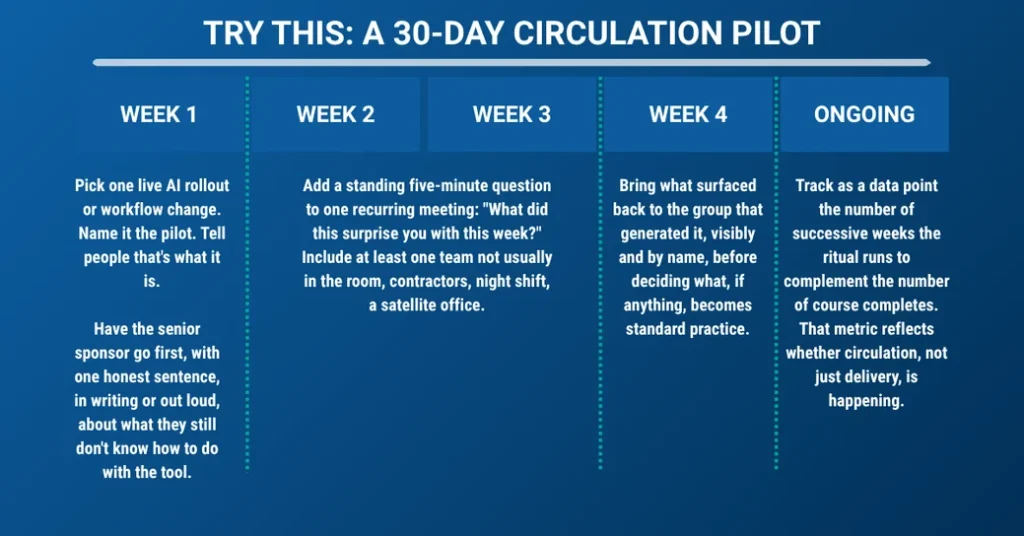
To bridge this gap, organizations must design for trust and judgment alongside technical functionality. This requires a "humanizing mindset" that attends to people and purpose, not just process. One effective method for fostering this environment is "rapid-cycle inquiry." These are short, structured bursts of authentic listening—such as flash focus groups or brief workflow walk-throughs—that feed directly into active decision-making.

One global organization recently implemented a ritual in its leadership meetings, asking a single recurring question: "What are we assuming about this tool that we haven’t tested?" By having a senior leader answer this question first, admitting to their own uncertainties, the organization created the safety necessary for a regional team to come forward with a custom workaround they had built. Within two quarters, this "rogue" solution was vetted and integrated into the official workflow, saving the company thousands of hours in manual data entry. This is adaptive intelligence in action: the collective capacity to sense a signal, question assumptions, and act in the moment.
The Equity Challenge in Knowledge Circulation
A circulatory model that is not built with equity in mind risks reinforcing existing power imbalances. Often, those most likely to have their AI experimentation noticed and rewarded are those who are already visible and credentialed within the organization. Conversely, frontline workers, night-shift employees, or contract staff—who are often closest to the actual work—may find their insights structurally unsupported.
If there is no channel to harness the knowledge of these groups, their innovations fade away. Applying a humanizing mindset means building learning systems that extend beyond traditional power structures. It requires creating channels where people at all levels can share knowledge without fear of dismissal. This inclusivity is not just a matter of social responsibility; it is a business necessity. When knowledge from the "edges" of the organization is allowed to circulate, the entire system becomes more resilient and innovative.
AI as a Listening Partner and the Shift to Judgment
Ironically, the same technology that is disrupting work can also be used to facilitate learning. "Agentic AI" can now be used as a listening partner, recognizing patterns and detecting where teams are deviating from—or improving upon—standard practices. Some pioneering organizations use AI as an early-warning system to flag unique use cases developed by unconnected teams.
However, this only works if the AI is introduced as a high-trust mechanism. If employees feel the AI is being used for surveillance to identify who is "behind," the candor required for learning will vanish. The tool must be named publicly and opted into, with the human remaining the ultimate decision-maker.
Furthermore, as AI increasingly handles the "how-to" of tasks—such as drafting financial models or coding—the focus of L&D must shift. BCG argues that AI is moving corporate learning out of the classroom and into the moment of need. In this environment, "judgment" becomes the primary curriculum. Employees no longer need to be taught the procedure; they need to be taught when to trust the AI’s output, how to interrogate its logic, and how to identify the biases encoded in its training data.
Redesigning Teams for Fluid Potential
The final stage of this transformation involves a total rethink of "potential." Traditionally, potential was measured by what an individual could be trained to do within a fixed job description. In the AI era, potential is measured by how quickly a team can recombine human and machine capabilities to meet the demands of a specific project.
Using trait- and skill-mapping, organizations are beginning to design teams based on specific strengths—such as future focus, execution, or interpersonal sensitivity—rather than rigid org charts. These teams are treated as reconfigurable units that assemble around work and then disperse. This level of agility is only possible when the organization has moved from a "cascade" of information to a "circulation" of knowledge, where every team member feels safe to contribute their unique insights.
Conclusion: The Path Forward for the Next Two Quarters
The transition from a traditional training model to a circulatory one does not require a massive platform migration, but it does require deliberate design choices. In the coming months, CLOs should identify a single near-term initiative and build a standing listening mechanism into its pre-launch phase. By having senior leaders model vulnerability and by widening the reach of sensing mechanisms to include the entire workforce, organizations can begin to build the habits of adaptive intelligence.
In a period defined by volatility, the organizations that succeed will be those that view learning circulation as core infrastructure. The role of the CLO is evolving from a curriculum owner to a learning architect. In the end, the ultimate competitive advantage in the age of AI is not the technology itself, but the human-centered network of trust that allows knowledge to move faster than the pace of change.