For nearly three decades, the world of work has been a constant flux of evolving themes. From the seismic shifts of digital transformation and the growing emphasis on employee wellbeing, to the complexities of hybrid work, the critical imperatives of diversity and inclusion, and the ongoing pursuit of women’s rights, organizations and their workforces have been in perpetual adaptation. Now, artificial intelligence (AI) has emerged as the dominant narrative, prompting a fundamental re-evaluation of employment structures and career trajectories. Yet, beneath the surface of these successive trends lies a more profound and enduring transformation: the "Great Decoupling" of workers from their employers, a phenomenon amplified by technological advancements and shifting economic philosophies.
This decoupling is not a new development, but rather a decades-long trend that has been steadily gaining momentum. While the current discourse often frames the integration of AI as a move towards a more "human" workplace, evidence suggests a different reality. Companies are increasingly characterized by rapid and often abrupt workforce adjustments, with mass layoffs becoming commonplace, sometimes communicated with little more than an email and minimal notice. Simultaneously, the emphasis on critical social and economic issues like diversity, equity, and inclusion (DEI) and pay equity appears to be diminishing in certain sectors, particularly as highly specialized roles, such as AI engineers, command astronomical salaries exceeding $500,000 annually. This stark disparity contributes to an underlying anxiety among employees, who now face the prospect of AI-driven productivity gains translating into job displacement.
The erosion of trust between employees and employers has been a persistent undercurrent throughout this period. Numerous studies, including those from Pew Research Center and Edelman, have documented a steady decline in this crucial relationship over the past 30 years. A 2024 PwC report revealed that only 67% of employees generally trust their employers, a figure that plummets to less than half for frontline workers, who constitute a significant majority of the workforce. Trust in leadership has fallen even more dramatically. In 2019, approximately 25% of workers expressed confidence in their company’s leadership; by today, this figure has dwindled to around 19% and continues to decline. While the COVID-19 pandemic saw a temporary surge in employee trust as organizations rallied to support their workforces, this sentiment has rapidly eroded as corporate leaders increasingly signal potential layoffs driven by AI advancements.
The Accelerating Trend of Decoupling
The most significant underlying trend, however, is the accelerating "decoupling" of workers from their employers. This manifests in several key areas: the proliferation of side-hustles, with over 65% of workers now engaged in multiple income streams, and a dramatic increase in layoff rates and job-switching frequency. Research indicates that the average U.S. worker can expect to experience 2.5 layoffs over their career, a figure that has more than doubled in the last three decades.
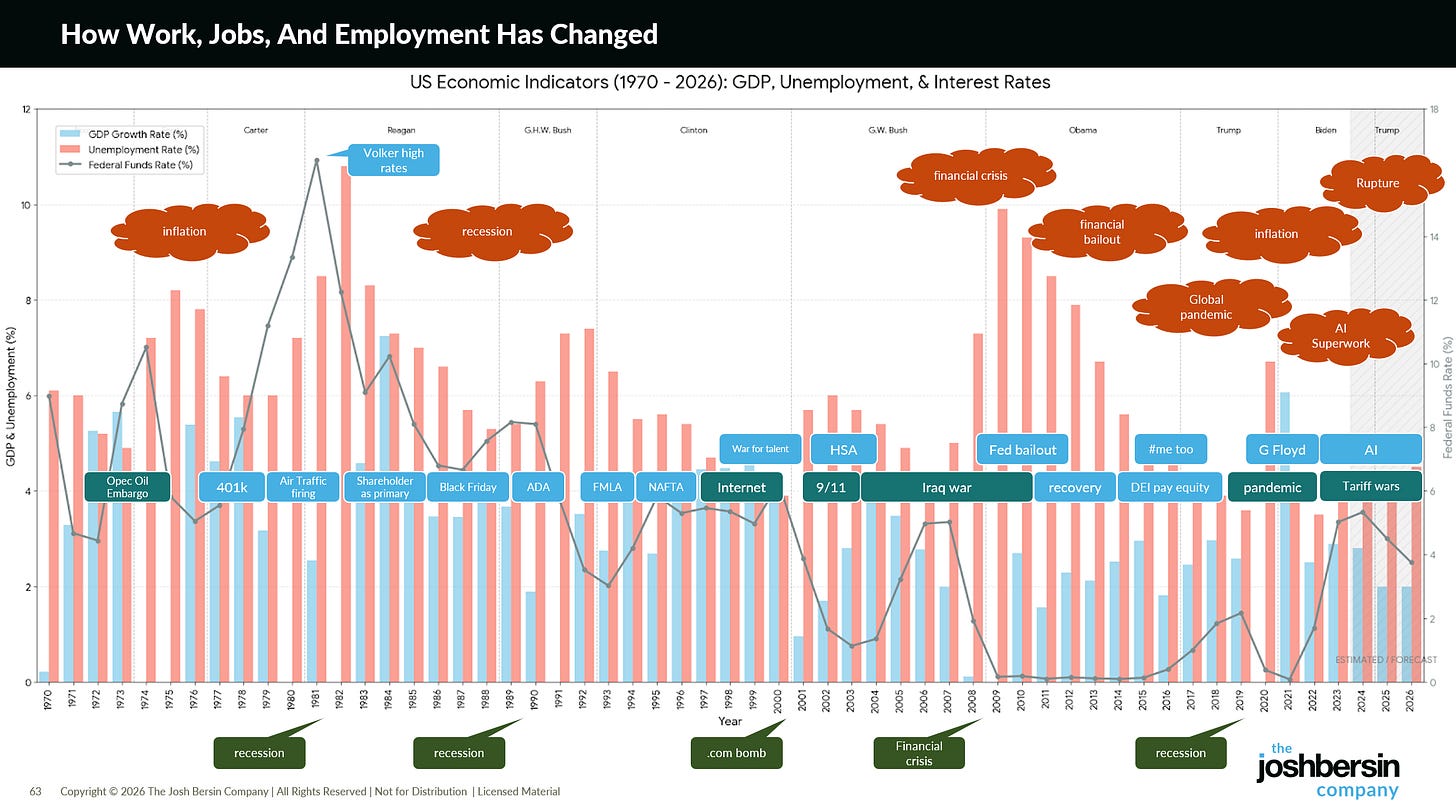
This trend is visually represented in data illustrating the historical trajectory of the U.S. economy. Charts depicting GDP growth, interest rates, presidential administrations, recessions, and significant regulatory events reveal a consistent shift away from traditional labor protections. The decline of labor unions, collective bargaining, and legislative support for workers, evident in the historical data, has paved the way for what former President George W. Bush termed an "ownership economy." In this model, the responsibility for retirement planning has largely shifted to individuals through 401(k)s, while benefits like family leave and health savings accounts place a greater burden on employees. Globalization, through initiatives like NAFTA, has also contributed to the outsourcing of previously stable, long-term jobs.

The stability of corporations themselves has also diminished. In the 1970s and 1980s, companies typically remained on the S&P 500 for an average of 12-13 years. Today, this average has shrunk to approximately 4-5 years, a consequence of rapid technological advancements and intense global competition. While some view this dynamism as a positive indicator of economic evolution, it fundamentally alters the nature of work and career development.
The current widespread concern surrounding AI, which the author views as a potentially positive force for workers, is intensifying the focus on "self-career management." The prevailing narrative suggests that individuals can thrive by embracing entrepreneurialism, developing digital skills, and leveraging platforms to build online presences. However, this overlooks the precarious financial reality for a significant portion of the workforce. In the U.S., over half of the working population lacks more than three weeks of savings, rendering them highly vulnerable to economic shocks. This precariousness is further exacerbated by factors like high gas prices and persistent inflation, contributing to a 60-year low in U.S. Economic Sentiment as measured by the University of Michigan.
The once-liberating appeal of the gig economy, epitomized by services like Uber and DoorDash, has largely transformed into a survival tactic. As these platforms consolidate their market dominance, they exert downward pressure on labor costs, leaving many workers feeling expendable and replaceable by automation. This sentiment is pervasive, even among HR executives, who report feeling like "labor" on the verge of obsolescence.
The Inevitable March of Decoupling
This decoupling was not a sudden event but a gradual, almost inevitable process that began to gain traction in the late 1970s and 1980s. While not necessarily driven by socialist ideologies, the trend has been significantly accelerated and institutionalized by the advent of the internet and AI. Companies now possess unprecedented capabilities to hire contractors globally and implement sophisticated monitoring systems to track individual performance and productivity.
While highly skilled tradespeople, such as nurses, machinists, plumbers, and electricians, may remain in high demand, professionals in fields like accounting and administration are increasingly facing concerns about automation and job security. The narrative often presented is that these individuals should simply adapt by creating their own independent ventures, a prospect that remains challenging for those without substantial financial reserves.
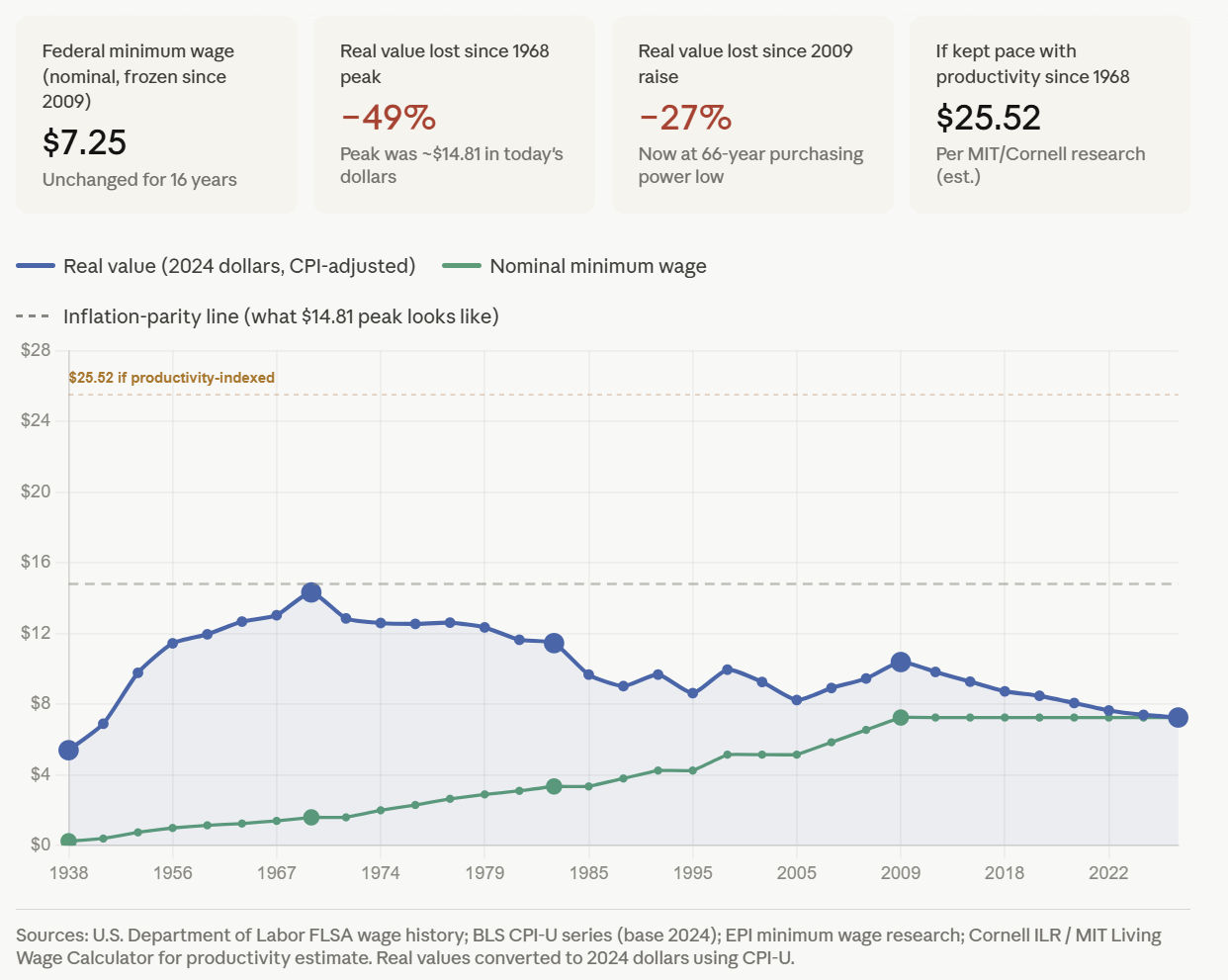
The stagnation of U.S. minimum wage further underscores the widening gap. As of 2026, the federal minimum wage will have remained at $7.25 for nearly 17 years, marking the longest period in U.S. history without an increase. This has resulted in a nearly 49% loss in purchasing power, illustrating a broader governmental stance that places the onus of economic security primarily on the individual rather than systemic support.
The Impact on Worker Earnings
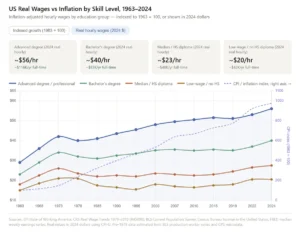
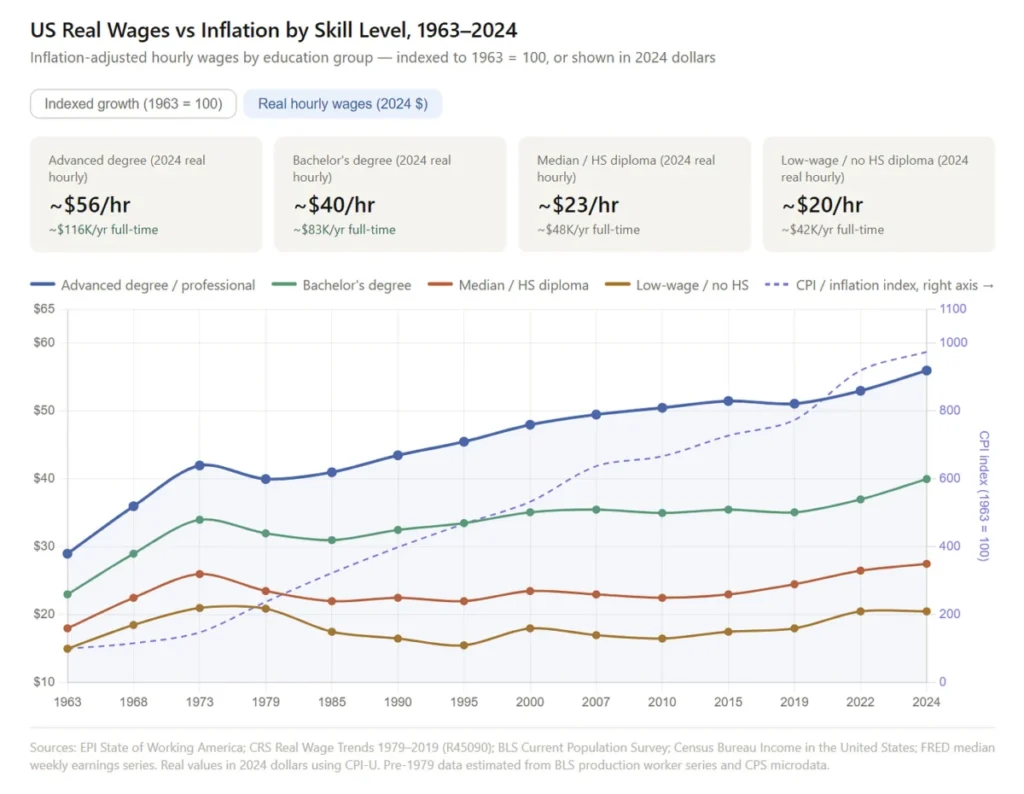
The consequences of this decoupling are starkly reflected in worker earnings relative to inflation. Historical data from the 1960s and 1970s shows wages consistently outpacing inflation. However, following the inflationary shock of the 1970s, wages began to lag. Low-wage workers and high school graduates experienced the most significant decline in their standard of living starting in the early 1980s. College graduates began to see their earnings plateau in the late 1990s, and even those with advanced degrees have witnessed a decline in their real earnings since the pandemic year of 2020. The notion that a college degree guarantees financial security has become increasingly untenable, with the return on investment for higher education plateauing for nearly two decades.
Addressing the Great Decoupling
The core issue at the heart of the Great Decoupling is not solely the wage-inflation disparity, but the fundamental shift in how employers perceive and treat their workforce. A diminished sense of obligation towards the long-term financial well-being of employees has become prevalent. In response, employees are exhibiting increased job mobility, changing employers at rates significantly higher than in previous decades. This mutual disengagement signifies a departure from the traditional employer-employee social contract.
This shift is also reflected in the financial markets. Layoffs are often met with positive stock market reactions, a phenomenon not observed in past decades. Financial analysts increasingly view labor as a "cost" to be minimized rather than an "investment" to be nurtured. The rationale often cited is that tangible assets like data centers have a defined lifespan and amortization period, whereas human capital is perceived as an ongoing operational expense. This accounting perspective, rooted in historical agricultural economies, remains a significant impediment to fostering a more sustainable approach to talent management.
Pathways to a More Equitable Future
Addressing the complex challenges of the Great Decoupling requires a multi-faceted approach that moves beyond simplistic solutions. While advocating for massive income redistribution is not a viable path, a commitment to supporting individuals through reskilling, upskilling, and continuous education is paramount. The U.S. education system has faced significant challenges over the past six decades, with alarming statistics revealing that a substantial portion of U.S. adults (approximately 45-55%) do not possess a 12th-grade reading proficiency. This deficit is particularly concerning in an era where AI is increasingly integrated into the workplace, demanding advanced cognitive abilities such as synthesis, inference, and evaluation.
The development of "power skills"—critical thinking, communication, and adaptability—is becoming more crucial than ever. While learning to operate AI tools is important, it is not a substitute for fundamental literacy and analytical capabilities. Employers have a vital role to play in fostering this development, perhaps by incentivizing broad educational programs beyond immediate job-specific training. A greater focus from governmental bodies on promoting these essential skills, rather than solely on technological infrastructure, would significantly benefit the nation’s human capital.
Furthermore, a fundamental re-evaluation of workforce and talent management strategies is urgently needed. Many organizations operate under the assumption that talent is always readily available, leading to a cycle of layoffs and rehiring that erodes organizational culture, dissipates institutional knowledge, and fosters long-term distrust. This approach, driven by short-term financial gains, often overlooks the long-term consequences for employee morale and organizational resilience. A more strategic approach would involve slowing down hiring processes, being more discerning in candidate selection, and designing business models that prioritize sustainable growth and development over constant headcount churn.
The Choice Between Short-Term Gains and Long-Term Value
The Great Decoupling, a trend spanning nearly six decades, may appear to be an immutable aspect of the modern economy. For many investors and CEOs, it is viewed as an organic and inevitable progression. However, this perspective overlooks the agency that companies possess. Organizations that adopt a high-growth, venture-backed startup mentality, characterized by rapid hiring and a focus on short-term gains, are more likely to perpetuate this decoupling trend. The rationale of "size matters" in the tech sector, for instance, often justifies aggressive hiring and subsequent layoffs once initial objectives are met.
Conversely, enduring companies across various sectors, including technology giants like Nvidia, Microsoft, and Apple, hospitality leaders such as Wynn and Marriott, and energy corporations like Chevron and Exxon, demonstrate a commitment to long-term human capital responsibility. While they too face pressures to adapt and grow, they prioritize retention, minimize layoffs, and avoid excessive hiring.
As AI presents unprecedented opportunities for reinvention, businesses have a critical choice: to continue down the path of decoupling or to invest in their existing workforce. Empowering current employees to drive innovation and adaptation is the true leadership challenge of our time. The most valuable asset in any business remains its people, and sustained investment in their long-term development, retention, and growth ultimately yields the greatest returns. In an era of rapid decisions and market-driven reactions, a long-term perspective that prioritizes the well-being and growth of employees is not only ethically sound but also strategically prudent for leaders and job seekers alike.