The fundamental human need to earn a living is increasingly clashing with deeply held ethical principles for a growing segment of the workforce. As the Artificial Intelligence (AI) revolution accelerates, driven by massive data centers, a new and unsettling moral quandary is emerging: the conflict between financial necessity and the ethical implications of working for companies that directly support this burgeoning AI infrastructure. This dilemma carries potentially dramatic career consequences, forcing individuals to question whether their labor is contributing to progress or perpetuating environmental degradation and societal concerns.
The AI boom, while promising innovation and efficiency, is built upon a foundation of immense energy consumption and resource utilization, the environmental toll of which is becoming increasingly difficult to ignore. Data centers, the physical backbone of AI and cloud computing, are voracious consumers of electricity. Many of these facilities rely on power grids that are still heavily dependent on fossil fuels, including natural gas plants and diesel backup generators. The operation of these power sources releases significant amounts of nitrogen oxides and fine particulate matter, pollutants directly linked to a host of public health issues such as asthma, heart disease, and respiratory illnesses. In some instances, large data centers operate continuous on-site gas turbines, exacerbating local air quality concerns and contributing to a measurable increase in ambient temperatures. Reports indicate that these facilities can raise local temperatures by as much as 28 degrees Fahrenheit, creating localized heat island effects. Furthermore, the burgeoning demand for data center electricity is projected to drive up utility bills significantly, with some states anticipating increases of over 50% by 2030.
Beyond air pollution and energy consumption, data centers present a critical challenge to global water resources. The intense heat generated by these facilities necessitates extensive cooling systems, which often rely on vast quantities of fresh water. With less than 0.5% of Earth’s water being readily accessible fresh water, the consumption by the world’s approximately 11,000 data centers is becoming a major environmental concern, particularly in drought-prone regions. Some large data centers can consume up to 5 million gallons of water per day, a figure that becomes alarming when multiplied across thousands of facilities and amplified by the accelerating demand for AI processing power.

The ethical objections to working in this sector extend beyond environmental impact to the very nature of AI itself. For many, particularly younger workers, the proliferation of AI raises profound ethical questions about its impact on creativity, labor, and human interaction. While AI tools are becoming ubiquitous, with roughly half of U.S. adults using them weekly, a significant portion of the population perceives AI as doing more harm than good. This sentiment is increasingly translating into a rejection of the infrastructure that powers AI, with many finding the environmental devastation associated with data centers to be an unacceptable price to pay for technological advancement.
This growing unease is manifesting as active resistance within workplaces. A recent survey revealed that nearly 30% of knowledge workers admit to undermining or avoiding their company’s AI tools, a figure that rises sharply among Gen Z employees. This resistance can range from passive non-compliance to deliberate manipulation of AI outputs or the unauthorized use of public AI tools with sensitive company data. For a subset of these workers, the opposition extends beyond the immediate use of AI tools to a broader questioning of the industries and infrastructure that are enabling the AI revolution.
The Case of Peter Tallcouch: A Shift in Corporate Mission and Personal Ethics
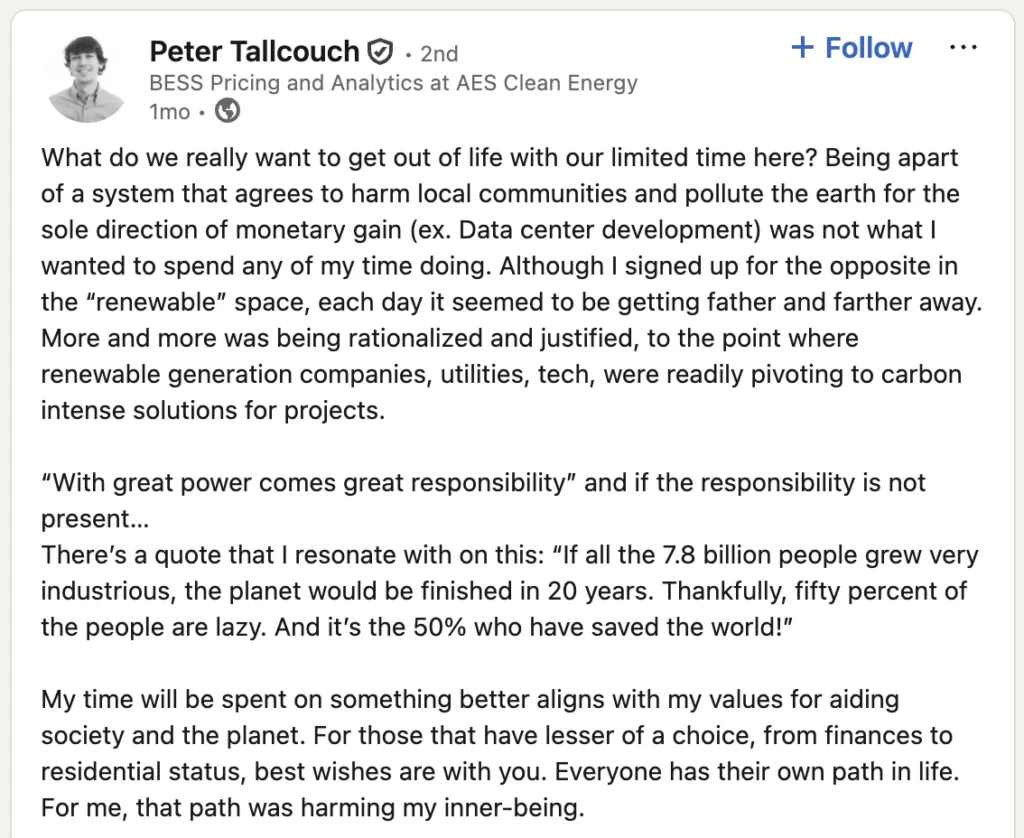
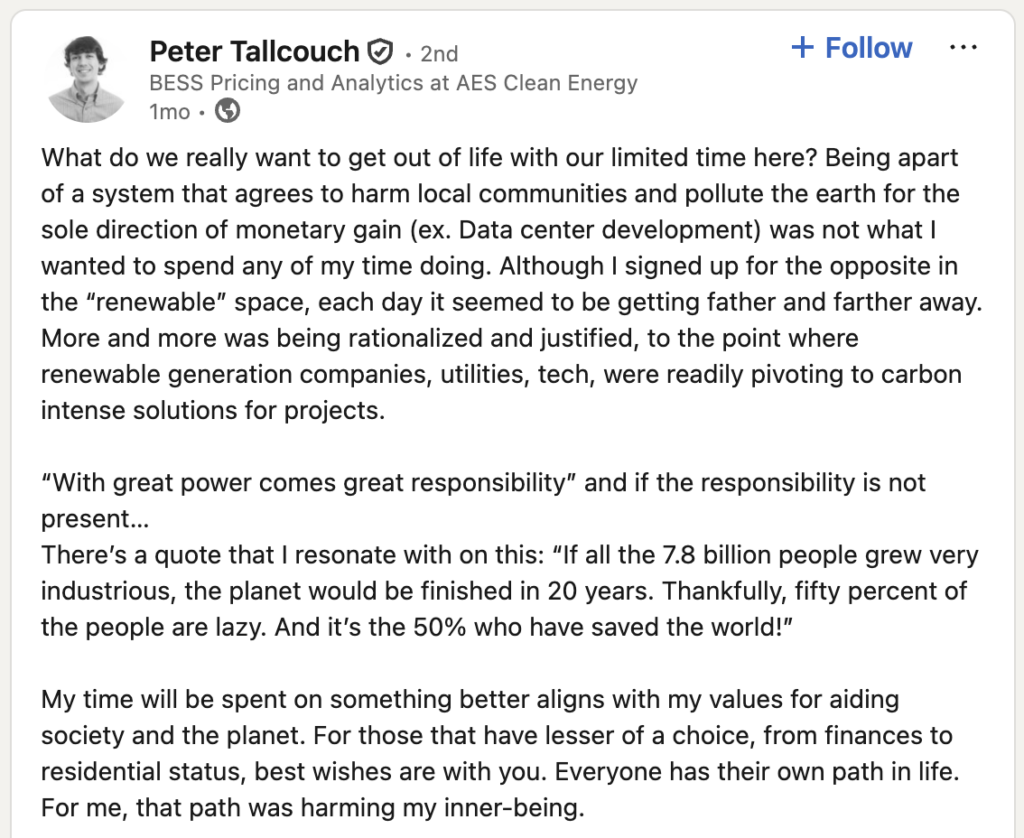
One compelling example of this ethical conflict is the experience of Peter Tallcouch, a former employee of a Fortune 500 clean energy company based in New York. Tallcouch was initially drawn to the company by its stated commitment to "creating greener, smarter, and innovative energy solutions." This mission aligned perfectly with his personal ethics, providing him with a sense of purpose and the belief that he was contributing to a positive societal impact.
However, the company’s strategic pivot to powering AI data centers marked a profound shift that conflicted with Tallcouch’s values. "This is not what Peter signed up for," he stated in a recent interview with Allwork.Space. The lucrative six-figure salary, once a significant draw, became insufficient compensation for the internal and ethical turmoil the new corporate direction engendered. Tallcouch described his departure as a form of "quiet quitting," where his disengagement stemmed from a deep-seated ethical dissonance.

Tallcouch articulated a broader critique of the prevailing economic system, stating, "The bigger problem kind of just boils down to capitalism and a growth mindset, and a company always having to grow and always having to put their shareholders first – it’s just always going to lead to this problem." He observed that nearly every major financial incentive within the current system rewards data center expansion, from utilities that profit from grid growth to independent power producers developing new energy capacity and tech companies fueling AI demand. He also highlighted the role of regulators and policymakers, suggesting that a unified support for expansion from government, energy companies, and investors creates a powerful inertia that makes it difficult for companies to deviate from this trajectory. "It’s not just my company that changed up, it’s the entire system incentivized by it," he explained.
Shareholder Value vs. Worker Conscience: A Fundamental Conflict
Tallcouch’s realization centers on the inherent prioritization of shareholder value within many corporate structures. He contends that the primary objective of businesses, particularly publicly traded ones, is not necessarily to create beneficial products or improve employee well-being, but rather to maximize returns for their investors. Shareholders, as the financial backers of a company, wield significant influence, and corporate leadership is often expected, pressured, and compensated through stock options to prioritize their interests and continued growth.
In the United States, corporate law traditionally emphasizes shareholder interests. Directors are generally bound by fiduciary duties to act in the best interests of the corporation and its shareholders. This can manifest through voting rights, board elections, shareholder proposals, and activist campaigns, all of which grant investors considerable leverage over company strategy and leadership. While the specifics vary by state, the overarching principle remains that shareholder value is a paramount consideration.
In the United Kingdom, the Companies Act 2006, specifically Section 172, outlines a broader duty for directors. While it requires directors to act in good faith to promote the success of the company for its members (shareholders), it also mandates consideration of a wider range of factors. These include the long-term consequences of decisions, the interests of employees, relationships with customers and suppliers, the company’s impact on the community and the environment, maintaining strong business ethics, and treating all shareholders fairly. If a company has broader stated purposes beyond shareholder benefit, directors must also factor those into their decision-making.

The AI Economy’s Ethical Friction Points
The escalating tension between shareholder expectations and contemporary social and environmental concerns is becoming increasingly evident within the AI economy. As companies aggressively pursue AI infrastructure development to satisfy investor demands for growth, not all employees find these priorities to be in alignment with their personal values or their vision for the future.
Peter Tallcouch expressed this sentiment forcefully: "If you think they’re going to jeopardize their profits significantly for creating a better earth, you’re gravely mistaken. I felt like I had an internal obligation to do something that was right; I don’t need the $100,000+ – I would rather not be harming people to make money."
He further elaborated on how the increasing electricity demand from AI infrastructure could translate into amplified profits across the clean energy sector. The prevailing narrative within his company framed the expansion of data centers as an inevitable outcome, with renewable energy simply being positioned as a means to power them, thereby preventing a reliance on fossil fuels. "I was like – I’m not falling for this," Tallcouch recounted. "If we’re supporting data centers, then we can’t reduce carbon emissions. Data centers being online causes a lot of electricity to be used, and it enables oil, coal, and gas plants to stay online. My company even filed paperwork to un-retire a coal plant." This illustrates a concerning scenario where clean energy initiatives are being co-opted to facilitate, rather than replace, fossil fuel dependence.
AI Expansion’s Impact on Climate Commitments
The growing demand for energy to power AI is not only impacting individual ethical choices but also complicating the climate commitments of major technology corporations. Google, for instance, has faced scrutiny over its AI expansion’s effect on its climate goals. In 2021, the company pledged to achieve net-zero emissions by 2030. However, by July 2024, Google reported a nearly 50% increase in greenhouse gas emissions since 2019, largely attributed to the energy demands of AI-driven data centers. The company has since acknowledged its inability to maintain its prior "carbon neutral" status, shifting its messaging towards aspirational goals while simultaneously investing in nuclear power and, controversially, gas plants to meet energy needs.

Microsoft is also reportedly reconsidering its 2030 renewable energy goal as its AI buildout tests its current sustainability strategies. This trend suggests a systemic challenge for even the most forward-thinking companies in balancing rapid technological advancement with established environmental targets.
Tallcouch criticized this apparent backtracking, stating, "You’ll see these companies kind of backtracking, based on justifications like ‘the grid can’t run without oil,’ and it’s like…do you not see the wildfires that are happening? Do you not see the droughts? Do you not see how much water is being used to keep these oil and gas plants online? How they contribute to actually needing to use even more electricity?" His perspective highlights the perceived disconnect between corporate justifications and the visible realities of climate change.
The original promise of clean energy was to displace fossil fuels. However, the surge in electricity demand from AI data centers is straining current energy supplies to such an extent that coal, oil, and natural gas plants are being kept operational to meet the escalating demand. This creates a feedback loop where insufficient supply leads to increased energy costs, with businesses benefiting from data center expansion often being the primary proponents of continued high energy usage.
The Evolving Landscape of Worker Consciousness
Peter Tallcouch may represent the vanguard of a growing movement of workers who are choosing to disassociate from companies heavily invested in the expansion of AI and data center operations. While it remains to be seen whether this will coalesce into a widespread workplace trend, the skepticism surrounding AI’s environmental impact, its labor implications, and its exponential growth is becoming increasingly difficult to disregard.
Looking ahead, this ethical awakening could lead to a greater gravitation of workers towards careers perceived as more tangible, community-focused, or human-centered. Professions such as skilled trades, healthcare, education, hospitality, and construction, which are less directly intertwined with AI infrastructure and automation, might see increased interest.
Underlying this evolving worker consciousness is a growing discomfort with the foundational principles of the modern economy and a heightened awareness of who bears the brunt of its costs. AI and data centers are now deeply embedded in critical sectors, from energy planning to corporate strategy, even as their environmental footprint intensifies. For many workers, this creates a subtle yet significant internal conflict between the necessity of earning a livelihood and the desire to align their work with their values and contribute to a future they deem positive and sustainable. The ultimate trajectory of this trend is yet to be fully determined, but its influence is already shaping career decisions and the justifications individuals are willing to make in their professional lives.