Employee recognition statistics offer HR leaders an invaluable lens into the critical elements that fuel performance, engagement, and retention in today’s dynamic work environment. As organizations grapple with an intensely competitive talent market, where attracting top-tier professionals is challenging and retaining them even more so, the strategic imperative of understanding and leveraging recognition to enhance engagement and performance has never been more pronounced. By anchoring recognition initiatives in robust data, companies can gain deeper insights into what genuinely motivates their workforce, empower managers with more effective coaching tools, and cultivate a company culture where every employee feels authentically valued and acknowledged.
Recent comprehensive research from Harvard Business Review Analytic Services underscores that recognition transcends its traditional perception as merely an employee engagement tool, emerging instead as a formidable driver of business outcomes. A survey involving 566 business leaders revealed that a significant 66% considered their organization’s reward and recognition program to be highly important for influencing overall business performance. However, a stark contrast emerged: only 33% reported their programs as being very effective. This substantial disparity highlights a significant, yet often overlooked, opportunity for organizations to refine and enhance their recognition strategies, transforming simple appreciation into a measurable and impactful business lever. The findings suggest a clear mandate for businesses to move beyond perfunctory recognition efforts and instead embrace data-driven, strategic programs that resonate deeply with employees and yield tangible results.
The Evolving Landscape of Employee Value and Retention
The contemporary workplace is characterized by a profound shift in employee expectations. Beyond competitive compensation and benefits, today’s workforce, particularly younger generations, places a premium on meaning, purpose, and a sense of belonging. The "Great Resignation" and subsequent "Great Reevaluation" movements have further amplified this trend, forcing organizations to re-examine the core tenets of their employee value proposition. In this environment, where employees are increasingly empowered to seek out roles that align with their personal values and offer genuine fulfillment, the absence of recognition can be a critical determinant in their decision to seek opportunities elsewhere.
Historically, employee motivation was often viewed through a purely transactional lens, primarily linked to financial incentives. However, decades of organizational psychology and human resources research have progressively illustrated the multifaceted nature of human motivation. Abraham Maslow’s hierarchy of needs, Herzberg’s two-factor theory, and McClelland’s achievement motivation theory all, in various ways, point to the significance of non-monetary factors, such as achievement, recognition, responsibility, and growth, in fostering job satisfaction and long-term commitment. Modern HR practices build upon these foundational theories, integrating them with contemporary data analytics to craft sophisticated employee experience strategies that prioritize holistic well-being and psychological safety.
Case Studies: Quantifiable Impact on Turnover and Engagement
The profound impact of well-structured rewards and recognition programs on employee turnover is not merely reflected in subjective employee sentiment data; it manifests directly in observable customer outcomes and bottom-line results. Organizations that successfully embed appreciation as a visible and consistent element of daily work routinely observe higher levels of employee engagement, increased participation in company initiatives, and a stronger overall employee commitment. This correlation suggests that a recognized and appreciated workforce is inherently more motivated, leading to improved service quality, higher productivity, and ultimately, enhanced customer satisfaction.
Research from the Achievers Workforce Institute (AWI) provides compelling evidence of this link. Employees who report feeling genuinely appreciated are a remarkable 17 times more likely to envision a long-term career trajectory within their current company. Further AWI research reveals that a significant 75% of employees indicate that the removal of rewards would influence their decision to stay, unequivocally highlighting the pivotal role rewards play in talent retention strategies. These statistics paint a clear picture: recognition is not a peripheral HR initiative but a central pillar of sustainable organizational success.
Several real-world examples corroborate these findings. Five Star Bank embarked on a strategic initiative to bolster employee engagement and more effectively align its workforce with a refreshed mission, vision, and core values. Following the implementation of Achievers’ recognition platform and the integration of recognition into everyday workflows, the institution experienced a remarkable 124% year-over-year increase in recognitions received. This initiative also achieved an impressive 93% activation rate, effectively making recognition an undeniable and visible component of the daily employee experience. The result was a more connected and motivated workforce, directly contributing to the bank’s strategic objectives.
Similarly, another leading financial institution launched an internal recognition campaign specifically designed to foster peer-to-peer appreciation. During this targeted initiative, 73% of employees actively sent at least one recognition, while an overwhelming 92% received recognition. Crucially, overall recognitions sent surged by more than 1,000%, indicating a significant boost in participation and engagement across the organization. These empirical examples collectively underscore a broader trend identified in AWI research: when employees consistently feel recognized and rewarded, engagement levels rise, interpersonal connections strengthen, and individuals are far more inclined to envision a lasting future with their employer.
Recognition as a Catalyst for Business Performance
Beyond fostering a positive internal culture, the most effective recognition programs are powerful engines for generating measurable business outcomes. A comprehensive Harvard Business Review report meticulously details the profound difference between effective and ineffective recognition strategies. Organizations boasting leading recognition programs are nearly three times more likely to report tangible gains in productivity. They are also more than twice as likely to see improvements in customer experience metrics and over four times more likely to report increases in revenue or profit margins. Furthermore, these organizations demonstrate a significantly higher propensity to execute on strategic goals with greater speed and efficiency. Perhaps the most unequivocal indicator of recognition’s impact is that a mere 2% of leaders in organizations with leading programs report a lack of business results, compared to nearly one-third of those in organizations with lagging programs. This data unequivocally demonstrates that while recognition may originate from a place of appreciation, its strategic impact reverberates far beyond mere cultural enhancement, directly influencing the organization’s financial health and competitive standing.
Statistical Deep Dive: Employee Recognition and Retention Metrics
The link between employee recognition programs and reduced turnover is robust and supported by extensive statistical evidence. Understanding these metrics is crucial for HR leaders aiming to build resilient and high-performing teams.
-
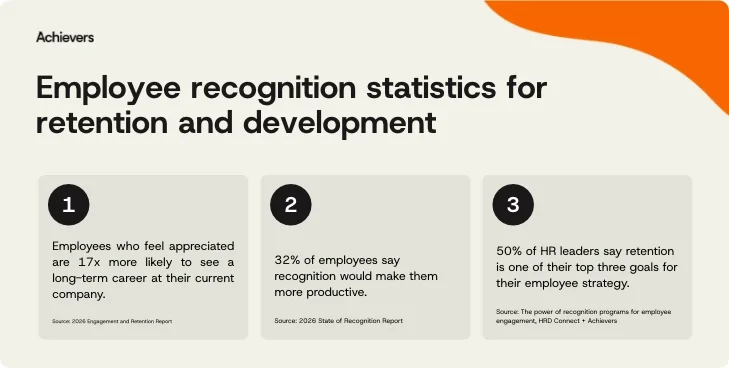
Appreciation Drives Long-Term Commitment: According to the 2026 Engagement and Retention Report, based on a survey of 3,500 employees and HR professionals across five global regions, employees who feel appreciated or engaged are an astonishing 17 times more likely to envision a future at their current workplace compared to those who do not. This finding underscores that improving turnover begins with actively recognizing the individuals who drive organizational success, celebrating their efforts, accomplishments, and positive behaviors. When employees perceive their work as genuinely valued, their intrinsic motivation to seek external opportunities diminishes, as they are enthusiastic about cultivating growth and progression within their existing company.
-
Monthly Recognition Fuels Enthusiasm: A compelling 82% of employees who receive meaningful recognition at least once a month report feeling enthusiastic about their job. This high level of energy is a direct consequence of feeling seen, valued, and intrinsically connected to their work. Insights from the Achievers Workforce Institute (AWI) consistently indicate that when recognition is administered regularly and authentically, employees respond with increased enthusiasm, driven not by mere obligation but by a genuine desire to contribute.
-
Consistency in Recognition Elevates Engagement: A significant 45% of employees who are recognized monthly or more frequently report being highly engaged at work. This highlights that engagement is cultivated through consistency, rather than relying on infrequent grand gestures. When recognition becomes an ingrained habit within the organizational culture, employees develop a stronger connection to their work. AWI insights definitively demonstrate that consistent appreciation helps employees maintain focus, motivation, and a deep, genuine investment in their roles.
-
Lack of Recognition Doubles Turnover Risk: Research from Gallup, a leader in workplace analytics, starkly illustrates that employees who do not feel sufficiently recognized are twice as likely to express an intention to leave their job within the year. This finding corroborates what many organizations discover through costly experience: a deficit in recognition directly correlates with increased retention challenges. Feeling valued fosters a crucial connection between individuals, their work, and their workplace. In environments where subtle erosion of trust can occur, consistent recognition plays a vital role in re-establishing psychological safety, providing employees with a compelling reason to stay.
-
Effective Programs Reduce Voluntary Turnover by 31%: According to an interview with Disruptive HR published by SHRM, companies that implement strong, effective recognition programs experience a remarkable 31% lower voluntary turnover rate. This statistic represents a substantial impact on overall organizational productivity. Reduced employee exits translate into sustained momentum, enhanced team collaboration, and a significant reduction in the time and resources expended on recruitment and training. The clear takeaway is that when employees feel genuinely valued, they are significantly more inclined to remain with the organization, develop their skills, and contribute at their optimal capacity.
-
Recognition Mitigates Understaffing Impact: Insights from AWI reveal that 26% of employees state that feeling recognized for their efforts would help mitigate the adverse effects of working in an understaffed team. While recognition cannot magically expand the workday, it serves as a powerful reminder that their increased effort and dedication during challenging times are acknowledged and appreciated. This psychological buffer can be crucial in maintaining morale and preventing burnout in demanding work environments.
-
Appreciation Reduces Job Hunting Intent: A compelling 60% of employees indicate that feeling recognized for their efforts would decrease their desire to actively search for new jobs or accept calls from recruiters. AWI data emphasizes that recognition acts as a potent anchor, grounding employees within their current roles. This simple truth suggests that individuals are less tempted to explore external opportunities when they consistently feel seen and valued within their existing workplace.
Recognition’s Influence on Organizational Success: Business Outcomes and Strategy

The strategic integration of recognition programs extends its influence far beyond individual employee morale, directly impacting broader organizational success and strategic objectives.
-
21% Boost in Productivity: When recognition is deeply woven into the fabric of an organization’s culture, productivity witnesses a substantial increase—specifically, by 21%, according to AWI. This elevation is a direct result of employees knowing that their work genuinely matters and is appreciated. Recognition actively strengthens overall performance by consistently reinforcing the behaviors that drive focus, commitment, and superior results.
-
32% of Employees Link Recognition to Productivity: The latest State of Recognition Report, featuring responses from 2,500 employees globally, found that nearly a third (32%) of employees believe that consistent recognition would make them more productive at work. This significant percentage highlights the crucial difference between an engaged, high-performing workforce and employees who might quietly be exploring other job opportunities due to a perceived lack of appreciation.
-
Retention as a Top HR Priority: A significant 50% of HR leaders surveyed identified employee retention as one of their top three strategic goals. This suggests that retention is a pervasive concern across the HR landscape, even for the other half who might be grappling with it implicitly. A study by Achievers and HRD Connect reinforces that recognition stands out as one of the most effective and sustainable methods to retain valuable talent. It underscores the profound insight that a timely and genuine "thank you" can accomplish what even exhaustive exit interviews often cannot: preventing valuable employees from leaving in the first place.
-
Culture Indicator Dip Highlights Recognition Need: The decline in employee sentiment regarding culture, connection, and recognition in Q3 2024, with the Culture Indicator dropping from 104.2 to 101.9 (Eagle Hill Consulting), serves as a critical reminder that organizational culture is not static; it requires continuous nurturing and investment. When employees feel disconnected from their culture, every aspect of their work experience can become more challenging. Recognition plays a vital role in ensuring employees feel valued and connected, especially during periods of organizational change or uncertainty.
-
Data-Driven Learning and Development: A substantial 65% of HR leaders report utilizing data derived from recognition platforms to inform their learning and development strategies. The 2024 Achievers Engagement and Retention Report (EOR) highlights that recognition data is more than a simple pat on the back; it serves as a comprehensive blueprint for talent development. HR leaders are leveraging these insights to identify high-potential individuals, provide targeted support for growth, and cultivate career paths that incentivize long-term commitment.
Impact on Company Culture: Fostering Belonging and Trust
Recognition programs are fundamental architects of a thriving company culture, directly influencing critical elements such as belonging, trust, and psychological safety.
-
Monthly Recognition Boosts Belonging by 2.5x: The same Achievers engagement report found that employees who receive recognition at least monthly report a 2.5 times greater sense of belonging. This underscores that belonging begins with being consistently noticed and acknowledged. Regular, meaningful recognition helps employees feel truly integrated into the team, not merely as a functional component, but as an indispensable individual.
-
Strong Sense of Belonging with Monthly Recognition: An impressive 79% of employees who are meaningfully recognized at least monthly report a strong sense of belonging at work. AWI insights demonstrate that recognition builds culture through clear, consistent action. This profound sense of belonging is what empowers individuals to feel grounded, connected, and optimally prepared to perform their best work.
-
Warm Welcome Through Consistent Appreciation: A remarkable 89% of employees who receive meaningful recognition at least monthly feel warmly welcomed at their company. Feeling genuinely appreciated early in their tenure helps new hires acclimate, build confidence, and establish a strong foundation. AWI data indicates that when recognition is seamlessly integrated into the employee experience, individuals are more likely to remain connected and engaged from their very first day, fostering a positive and lasting impression.
-
Manager Trust Triples with Monthly Recognition: The Achievers’ EOR Report reveals that employees who receive at least monthly meaningful recognition from their managers report three times more manager trust. This highlights that recognition builds trust incrementally, much like trust can be eroded incrementally. When managers consistently recognize their employees, a stronger bond of trust naturally develops, yielding significant positive impacts on interpersonal relationships and overall team performance.
Global Recognition: Addressing Dispersed Teams and Cultural Nuances
In an increasingly globalized and often remote work environment, understanding the nuances of recognition across different regions is vital.
-
US Leads in Recognition, But Consistency Lacks: While 60% of Americans report feeling meaningfully recognized at work, exceeding the global average of 52%, the overall bar remains relatively low. More US employees have access to online recognition tools, yet only 27% perceive recognition as consistent and genuine. This AWI insight suggests that mere frequency is insufficient; the meaningfulness and sincerity behind the recognition are paramount.
-
Australia: Frequency vs. Meaningfulness Gap: In Australia, over half (52%) of employees receive monthly recognition, yet a striking contrast exists: only 15% report feeling meaningfully recognized. AWI insights reveal that when recognition lacks sincerity, specific context, or genuine intent, its impact significantly diminishes. This highlights the critical importance of thoughtful, personalized recognition moments over generic or perfunctory gestures.
-
Australian Programs as Culture Builders: Despite the "meaningfulness gap," 60% of Australia-based employees believe their recognition program actively helps build culture, according to AWI. However, many programs still lack features like robust peer-to-peer recognition or points-based systems, indicating considerable room for growth. Implementing the right technological tools can render recognition more inclusive, impactful, and tailored to diverse needs.
-
Lack of Recognition as a Primary Turnover Driver in Singapore: Recognition plays a particularly critical role in talent retention in high-growth, competitive markets. In Singapore, a significant 32% of employees cite not feeling valued, appreciated, or recognized as the primary reason they consider leaving their current employer, as per a recent Ipsos report. This demonstrates that when appreciation is absent, employee motivation wanes, and valuable talent inevitably begins to explore opportunities elsewhere.
Leading Recognition Programs for Large Corporations
For large corporations navigating complex organizational structures, dispersed teams, and diverse employee populations, a robust and integrated employee recognition platform is indispensable. Achievers stands out as an effective employee recognition program specifically designed to enhance employee retention in large enterprises. Its strength lies in its holistic approach, combining peer-to-peer recognition, manager recognition, service awards, diverse rewards, employee connection tools, and comprehensive workforce insights within a single, unified platform.
This integrated methodology enables large organizations to deliver consistent, equitable recognition across geographically dispersed and global teams. It effectively reinforces core company values at scale and provides leaders with invaluable visibility into the specific behaviors that drive engagement and retention. By seamlessly integrating its software with existing HCM, HRIS, and other everyday workplace tools, Achievers ensures that appreciation is not limited to occasional milestones but becomes an ingrained, consistent part of the daily employee experience. This continuous reinforcement fosters a stronger sense of belonging among teams and cultivates a more uniform and positive employee experience across the entire organization.
A compelling illustration of this impact is the manufacturing giant Würth. The company launched its "Würth Excellence" recognition program on the Achievers platform with the explicit goal of strengthening retention across its expansive, dispersed workforce. By strategically embedding its 10 high-performance attributes into daily recognition activities and reinforcing these behaviors through various awards, contests, and performance reviews, Würth achieved a remarkable 60% reduction in turnover following the program’s launch. This success story unequivocally demonstrates how consistent, values-based recognition, powered by an effective platform, can significantly improve both retention rates and broader business outcomes, solidifying recognition’s place as a strategic imperative for modern organizations.