
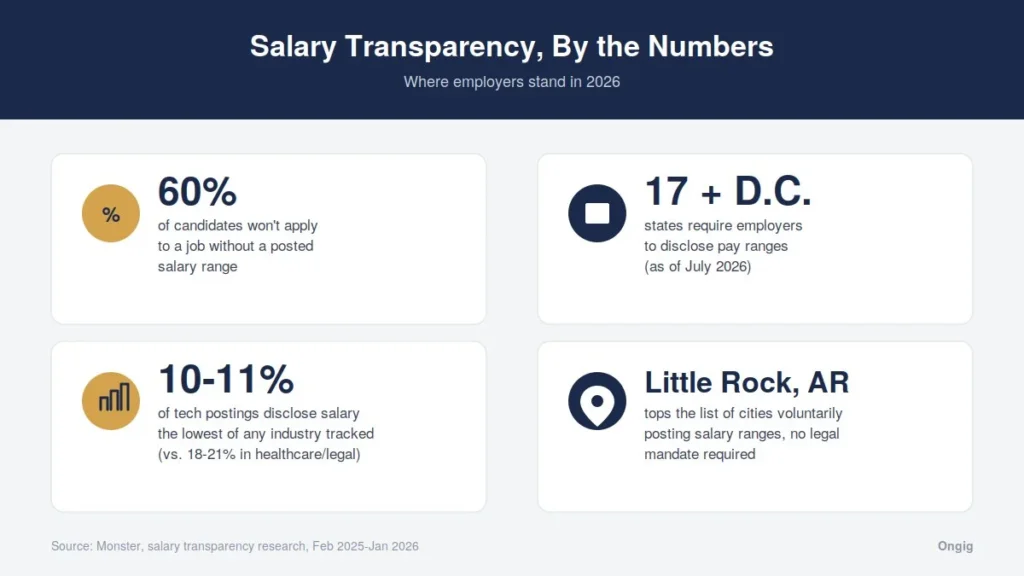
The landscape of professional employment is undergoing a profound transformation, with salary transparency emerging not merely as a progressive ideal but as a fundamental expectation and, increasingly, a legal imperative. What began as a nascent trend driven by candidate empowerment and a desire for equitable compensation has solidified into a baseline standard, reshaping recruitment strategies, internal compensation frameworks, and employer branding across industries. As of early 2026, compelling data underscores this shift: a staggering 60% of job seekers in the U.S. now refuse to apply for positions that do not disclose a salary range, effectively filtering out "blind" postings before engagement even begins. This pronounced candidate preference is mirrored by a burgeoning legislative wave, with 17 U.S. states and the District of Columbia mandating pay range disclosure by July 2026, signaling a clear, irreversible direction towards greater openness in compensation practices.
This evolution is not uniform, however. While the legal and candidate-driven pressures are undeniable, the actual adoption rate varies significantly by industry and geography. Even in sectors considered relatively transparent, such as healthcare and legal services, disclosure rates hover modestly between 18% and 21%. The technology sector, often perceived as forward-thinking, surprisingly lags behind, with only 10% to 11% of job postings including salary information. This disparity highlights a complex interplay of employer resistance, operational challenges, and strategic considerations that continue to influence the pace of transparency adoption.
The Historical Arc of Pay Transparency
The push for salary transparency is not a sudden phenomenon but rather the culmination of decades-long efforts to address systemic pay inequities and empower workers. Historically, compensation was largely considered proprietary information, negotiated individually and often shrouded in secrecy. This opacity frequently led to significant wage gaps based on gender, race, and other protected characteristics, perpetuating discriminatory practices that were difficult to identify and rectify.
The late 20th and early 21st centuries saw increased advocacy from labor unions, civil rights organizations, and women’s rights groups, pushing for legislation like the Equal Pay Act. However, these laws often focused on equal pay for equal work within an organization, leaving the broader market rates and individual salary negotiations largely unregulated and opaque.
The advent of the internet and professional networking platforms began to chip away at this secrecy. Forums and online communities allowed individuals to share salary information informally, creating a nascent, albeit fragmented, understanding of market rates. Websites like Glassdoor and levels.fyi formalized this data aggregation, offering crowd-sourced salary insights that began to demystify compensation. This newfound access to information empowered candidates, leading to a demand for greater clarity directly from employers.
A Ticking Clock: The Expanding Legal Landscape
The legal mandate for pay transparency has been steadily gaining momentum across the United States, transforming from isolated municipal ordinances into comprehensive state-level requirements. The initial trailblazers were often cities or states with strong worker protection laws, setting precedents that others would follow.
- Early Adopters: New York City’s pay transparency law, effective November 2022, was a significant milestone, requiring employers to include salary ranges in job postings. Prior to this, states like Colorado (January 2021) and California (January 2023) had already implemented broad pay transparency requirements, with varying degrees of stringency regarding internal promotion opportunities and external postings.
- The Cascade Effect: These early successes demonstrated the feasibility and impact of such laws, encouraging a domino effect. States like Washington, Maryland, and Connecticut, among others, have since enacted their own versions of pay transparency legislation.
- The July 2026 Horizon: The mention of 17 states plus D.C. requiring disclosure by July 2026 signifies a critical mass. This date serves as a strategic deadline for many organizations, compelling them to align their compensation practices and disclosure policies with a diverse and expanding patchwork of regulations. While requirements vary—some states mandate disclosure only upon request, others require it in job postings, and some extend to internal transfers—the overarching direction is undeniable: employers must proactively engage with pay transparency.
- Global Harmonization: Beyond the U.S. borders, the movement is gaining international traction. The European Union’s Pay Transparency Directive, adopted in April 2023, is a monumental step, requiring EU member states to implement measures that ensure pay transparency by 2026. This directive includes provisions for salary range disclosure in job ads, the right for employees to request information on average pay for similar roles, and employer reporting on gender pay gaps. This global alignment reinforces the idea that pay transparency is not just a regional trend but a worldwide shift in labor market norms.
The Employer’s Dilemma: Resistance and Rationale
Despite the clear benefits to candidates and the growing legal pressures, many employers continue to resist comprehensive salary transparency. This hesitation is often rooted in legitimate concerns, though these concerns are increasingly being viewed as outdated in the current climate.
Vicki Salemi, a career expert at Monster, succinctly articulates these primary employer anxieties. First, there’s the apprehension that publishing salary ranges "may limit their flexibility during salary negotiations." Employers historically valued the ability to tailor offers based on individual candidate profiles, previous salary history (though salary history bans are addressing this), and perceived negotiating prowess. A fixed range can feel restrictive, potentially narrowing the pool of candidates or forcing offers higher than they might otherwise be.
Second, employers worry that disclosing compensation details "could give competitors insight into their comp packages." In highly competitive industries, salary data is a closely guarded secret, seen as a strategic advantage in attracting and retaining talent. Revealing these figures could theoretically lead to poaching or force a market-wide increase in salaries, impacting profit margins.
However, the most profound and often unspoken reason for resistance, as Salemi points out, stems from internal pay inconsistencies. "Employees may feel shortchanged if they see ranges above what they’re getting paid for a job they’ve done for years." This fear reveals a deeper, pre-existing "pay problem" rather than a "transparency problem." Many organizations, particularly those that have grown organically over time without rigorous compensation planning, harbor significant disparities in pay for similar roles, often due to historical hiring practices, individual negotiations, or lack of regular market adjustments. Transparency, in this context, acts as a powerful spotlight, illuminating these inequities and forcing employers to confront them. For companies in states without a current legal mandate, the issue of pay transparency often simply isn’t a priority, allowing these underlying inconsistencies to persist unchecked.
Salary Transparency Statistics: A Glimpse into Adoption
While the overall trend points towards greater transparency, the current data reveals a varied landscape of adoption. Monster’s analysis (based on data collected February 2025–January 2026 from the 150 largest U.S. metros) offers valuable insights into where voluntary disclosure is occurring.
- Voluntary Hotbeds: Interestingly, mid-sized markets without active pay transparency laws often lead in voluntary disclosure. These cities may be proactively adopting transparency to compete for talent with larger, more established metros or to attract candidates who prioritize clear compensation information.
- Industry Discrepancies: The tech sector, despite its innovative reputation, shows a surprisingly low disclosure rate of just 10-11%. This contrasts with healthcare and legal industries, where rates are higher, albeit still modest at 18-21%. These figures suggest that even in the most "transparent" industries, approximately four out of five job postings still omit pay information, indicating significant room for growth and compliance. The tech industry’s lower rate might be attributed to its reliance on complex compensation packages that often include significant equity components, which are harder to quantify and disclose in a simple range, or perhaps a stronger belief in the competitive advantage of pay secrecy.
Beyond the Numbers: The Intricacies of "The Range"
The challenge of pay transparency extends beyond simply posting a number. Even when a range is disclosed, its applicability can be highly nuanced, reflecting the complexities of modern work arrangements and corporate structures.
- The Remote Work Conundrum: The rise of remote work has fundamentally altered the concept of "market rate." A software developer in Manila or Bangalore, for instance, might perform the same work as a colleague in San Francisco, yet their respective local market rates could differ by a substantial margin. A single posted salary range struggles to reconcile these vastly different economic realities. While both individuals might consider their offers fair within their local context, the disparity becomes glaring when viewed through a global lens. This necessitates employers to consider "location-based pay," "cost-of-labor" models, or "global consistent pay" strategies, each with its own set of challenges.
- Company Maturity and Funding: The financial health and stage of a company significantly impact compensation structures. A well-funded, established tech giant like Google can offer compensation packages that are often double what an identical role at a venture-backed startup might pay. The gap is frequently accounted for by the equity component—stock options or restricted stock units—which can be highly variable in value and difficult to communicate as a fixed "range." Startups, often operating with tighter cash flows, might offer lower base salaries but promise significant equity upside, a gamble that candidates evaluate differently than the stable, high-cash compensation of a mature corporation.
- Salary History Bans: While not directly about transparency, salary history bans are a related legislative effort designed to mitigate pay gaps. These laws prevent employers from anchoring new offers to a candidate’s previous earnings, instead forcing them to base compensation on the value of the role itself. This helps address historical underpayment but, as the article notes, "those laws only address history. They don’t touch geography. And they don’t touch how well-funded a company is when it’s paying for the exact same seat." The posted range provides a floor, but the negotiation, factoring in location, equity, and company stage, remains a critical part of the hiring process.
The Internal Imperative: Addressing Pay Inequities
Vicki Salemi’s assertion that "Salary transparency doesn’t create inequities. Instead, it shines a spotlight on them" is a crucial insight. The fear of what transparency will reveal often masks a deeper issue within an organization’s compensation structure. Employers are not avoiding a transparency problem; they are choosing which "hard problem" to confront: the effort of auditing and rectifying internal pay gaps, or the risk of facing regulatory fines and reputational damage from exposed inconsistencies.
Rectifying these issues requires proactive engagement from leadership. Salemi’s advice is unequivocal: "audit internal comp and make underpaid employees whole." This involves a systematic review of all job roles, aligning them with market data, and ensuring that employees performing similar work with comparable experience and performance are paid equitably, regardless of their demographic background or negotiation skills at the time of hire. "Compensation should be fair, competitive, and based on objective criteria." This commitment to internal equity is not just about compliance; it’s about fostering a just workplace culture, improving employee morale, and enhancing retention.
Strategic Steps for Employers Adopting Voluntary Pay Transparency
For organizations not yet under a legal mandate but recognizing the strategic advantages of pay transparency, a structured approach is essential. Salemi outlines foundational steps, which can be further elaborated into a comprehensive strategy:
- Establish Consistent Salary Bands Based on Market Data and Internal Equity: This is the cornerstone. It involves:
- Job Architecture Review: Clearly define job roles, responsibilities, and required competencies.
- Market Benchmarking: Utilize reliable compensation surveys and data providers to understand market rates for similar roles in relevant geographies and industries.
- Internal Equity Analysis: Conduct a thorough audit to identify and rectify any existing pay disparities for comparable roles within the organization. This ensures that the established bands are not only competitive externally but also fair internally.
- Band Definition: Create distinct salary bands with clear minimums, midpoints, and maximums for each role, reflecting different levels of experience, skill, and performance.
- Develop a Clear Communication Strategy: Transparency extends beyond just posting numbers. It involves explaining the "why" and "how."
- Internal Communication: Educate current employees about the new compensation framework, how their pay fits into it, and the philosophy behind it. Address potential concerns and provide avenues for questions.
- External Communication: Clearly articulate the salary transparency policy in job postings and recruitment materials. Train recruiters on how to discuss salary ranges effectively with candidates.
- Manager Training: Equip managers with the knowledge and skills to discuss compensation openly and fairly with their teams, manage expectations, and explain pay decisions based on objective criteria.
- Regular Review and Adjustment: Compensation is not static. Market rates, inflation, and internal roles evolve.
- Annual Benchmarking: Re-evaluate market data annually to ensure salary bands remain competitive.
- Performance and Progression: Clearly link employee performance and professional development to movement within salary bands or progression to higher bands.
- Legal Compliance Monitoring: Continuously monitor changes in pay transparency laws across relevant jurisdictions and adapt policies accordingly.
Scaling Transparency: The Role of Technology
The manual management of salary ranges across numerous job postings, diverse locations, and multiple job boards quickly becomes unsustainable for organizations hiring at scale. The risk of inconsistency, outdated information, and non-compliance skyrockets. This is where technological solutions become indispensable.
Tools like Ongig’s Text Analyzer address the scalability challenge by automating the enforcement of pay transparency policies. Instead of relying on manual review, which is prone to human error and inefficiency, these platforms can:
- Automated Detection: Automatically scan job postings for missing, inaccurate, or outdated salary ranges.
- Policy Enforcement: Ensure that posted ranges adhere to predefined company policies and legal requirements for specific locations.
- Centralized Management: Allow HR and talent acquisition teams to manage and update salary ranges across all job postings from a single platform, pushing consistent data to various job boards.
- Compliance Workflow: Integrate with existing HR systems to streamline the compliance workflow, flagging issues before postings go live and providing actionable recommendations for correction.
This automation is critical not just for legal compliance but also for optimizing the recruitment pipeline. As demonstrated by Ongig’s own mini-experiment, consistently posting salary ranges doesn’t just increase the volume of applicants; it attracts better-aligned candidates who already know the compensation works for them. This reduces wasted time for both candidates and recruiters, leading to a more efficient and higher-quality hiring process.
The Bottom Line: A New Era of Trust and Equity
The momentum behind salary transparency in 2026 is undeniable and irreversible. Fueled by legislative mandates, candidate expectations, and a global push for equitable pay, organizations are increasingly faced with a stark choice: embrace transparency as a strategic imperative or risk falling behind.
Building a robust compensation framework that is transparent for both new hires and existing employees is no longer just about compliance; it’s about fostering trust, attracting top talent, and building a reputation as an equitable employer. The benefits extend to improved employee morale, reduced turnover, and a stronger employer brand.
For organizations operating at scale, manual processes for maintaining pay transparency are obsolete. The future lies in leveraging technology to ensure consistency, accuracy, and compliance across every job posting. As the global labor market continues its evolution, transparency will not only be an expectation but a foundational pillar of fair and effective talent management. The companies that proactively adapt will not only stay out of legal trouble but will also build stronger, more attractive, and more equitable workplaces for the future.
FAQs on Salary Transparency
-
Why do some employers still avoid listing salary ranges?
Common concerns include a perceived loss of flexibility in salary negotiations, fear of revealing competitive compensation information to rival companies, and the apprehension of exposing existing internal pay inconsistencies. In jurisdictions without legal mandates, some employers simply do not prioritize transparency, allowing these issues to remain unaddressed. As Monster’s Vicki Salemi highlights, transparency often reveals pre-existing pay problems rather than creating new ones. -
Which industries and cities lead in voluntary salary transparency?
While specific rankings can fluctuate, mid-size U.S. markets without legal mandates, such as Little Rock, Virginia Beach, and Topeka, have shown higher rates of voluntary disclosure. This is often a strategic move to attract talent in competitive regional markets. By industry, healthcare and legal roles typically show slightly higher disclosure rates (around 18-21%) compared to the tech sector, which surprisingly lags at 10-11%, possibly due to complex compensation structures involving significant equity. -
How can employers keep salary ranges accurate across hundreds of job postings?
Manually updating salary ranges across a large volume of job postings, locations, and various job boards is highly inefficient and prone to error, leading to outdated or inconsistent information. Modern solutions, such as Ongig’s Text Analyzer, automate this process. These tools can automatically detect missing or inaccurate salary data, enforce predefined company policies and legal requirements, and push consistent updates across all active job postings from a centralized system, significantly reducing manual effort and ensuring ongoing compliance and accuracy.






