
Leadership in the third decade of the 21st century has reached a level of complexity that challenges traditional management paradigms. As global organizations navigate the dual pressures of rapid technological integration, specifically regarding generative artificial intelligence, and the radical shifts in workforce expectations following the global pandemic, the demand for effective executive guidance has never been higher. Yet, despite the proliferation of high-tech solutions and sophisticated data analytics, many organizational failures can be traced back to a fundamental neglect of core leadership responsibilities. Professional development experts and executive coaches are increasingly pointing toward a streamlined diagnostic model known as the "Leadership Triangle" to address these systemic issues.
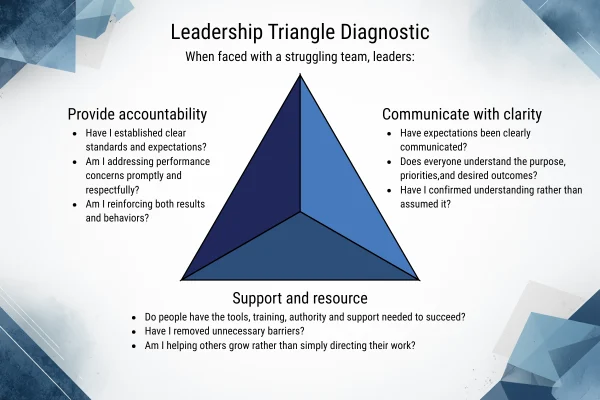
The Leadership Triangle, a framework popularized by Dr. Justin Irving and widely utilized in executive coaching, posits that leadership efficacy is predicated on three interdependent competencies: clear communication, robust support and resourcing, and consistent accountability. When these three elements are balanced, organizations report higher levels of engagement and productivity; however, when one side of the triangle is neglected, the structural integrity of the team begins to fail.
The Evolving Landscape of Organizational Leadership
To understand the necessity of the Leadership Triangle, one must examine the chronology of management theory over the last century. In the early 20th century, the "scientific management" approach favored by Frederick Taylor focused almost exclusively on efficiency and output. By the mid-century, the "human relations" movement began to acknowledge the social needs of workers. Today, the landscape is defined by "volatility, uncertainty, complexity, and ambiguity" (VUCA).
Recent data from Gallup’s "State of the Global Workplace" report indicates that employee disengagement costs the global economy approximately $8.8 trillion annually. Furthermore, Deloitte’s Human Capital Trends report suggests that 80% of executives rate "leadership" as a high priority, yet only 41% believe their organizations are ready to meet leadership requirements. This gap highlights a critical need for a return to fundamental principles that can be applied across diverse industries and remote, hybrid, or in-person work environments.
Pillar One: The Mandate for Radical Clarity in Communication
The first side of the Leadership Triangle is the responsibility to communicate with clarity. In a journalistic analysis of corporate failures, a common thread is often the "illusion of communication"—the belief that because a message was sent, it was also received and understood.
Effective communication in a leadership context is not merely the dissemination of information but the creation of shared understanding. According to data from the Economist Intelligence Unit, poor communication has been cited by 44% of respondents as a cause for the failure to finish projects, while 31% cited it as a cause for low morale. Clear communication must address several critical queries for every employee:
- What is the overarching mission and the immediate priority?
- How does my specific role contribute to these objectives?
- What are the metrics for success?
- What changes are occurring, and why are they happening now?
Leadership development professionals argue that leaders frequently overestimate the clarity of their directives. While a leader may feel they are being repetitive, research into "the curse of knowledge" suggests that employees often perceive information as insufficient or fragmented. For Chief Learning Officers (CLOs), the challenge lies in training leaders to move beyond simple announcement-making and toward active listening, storytelling, and feedback loops that ensure alignment across all levels of the hierarchy.
Pillar Two: Resourcing as a Catalyst for Performance
Clarity alone is insufficient if the workforce lacks the tools to execute. The second side of the triangle—support and resourcing—represents a shift from the leader as a "commander" to the leader as an "enabler." This competency is deeply rooted in the philosophy of servant leadership, where the leader’s success is measured by the growth and success of their subordinates.
In the current economic climate, many organizations are attempting to "do more with less," leading to record-high levels of employee burnout. A 2023 study by Aflac found that 59% of American workers are experiencing at least moderate levels of burnout. This phenomenon is often the direct result of a "resourcing gap," where expectations are communicated clearly, but the necessary time, budget, technology, or training is withheld.

Support and resourcing can be categorized into three distinct areas:
- Technical Resourcing: Providing the software, hardware, and physical tools required for modern tasks.
- Developmental Resourcing: Investing in continuous learning and skill-upgrading, particularly as AI shifts job descriptions.
- Emotional and Psychological Support: Cultivating an environment of psychological safety where employees feel empowered to take calculated risks without fear of retribution.
When leaders prioritize resourcing, they remove the structural barriers to performance. Analysis of high-performing teams at firms like Google and Pixar shows that the most effective managers are those who focus on "unblocking" their teams, allowing the talent they hired to function at peak capacity.
Pillar Three: The Stewardship of Accountability
The final side of the leadership triangle—accountability—is often the most difficult for leaders to implement consistently. In many corporate cultures, "accountability" has become a euphemism for punishment. However, in the Leadership Triangle framework, accountability is viewed as an act of stewardship and respect.
Without accountability, the first two sides of the triangle are undermined. If expectations are clear and resources are provided, but there are no consequences for poor performance or rewards for excellence, the organizational culture begins to erode. This leads to several negative outcomes:
- Resentment among high performers: When top-tier employees see underperformance tolerated, their motivation decreases.
- Erosion of trust: Team members lose faith in the leader’s ability to maintain standards.
- Strategic drift: The organization slowly moves away from its stated goals as individual behaviors diverge from the mission.
The most effective leaders employ a "care and candor" approach. They maintain high standards because they believe in the potential of their team members. Data from the Harvard Business Review suggests that "feedback-rich" environments, where accountability is a daily habit rather than an annual event, see a 14% higher turnover of low performers and a significant increase in the retention of high-potential talent.
The Triangle as a Diagnostic and Systemic Tool
The utility of the Leadership Triangle extends beyond individual behavioral coaching; it serves as a robust diagnostic tool for organizational health. When a department is underperforming, executives can use the triangle to identify the source of the friction. Is the team confused (Communication)? Are they overwhelmed and ill-equipped (Support)? Or have they become complacent due to a lack of standards (Accountability)?
For human resources and talent management professionals, this framework offers a consistent language for the entire employee lifecycle:
- Selection: Interviewing candidates for their ability to demonstrate all three sides of the triangle.
- Onboarding: Setting a precedent for clear communication and resource availability from day one.
- Succession Planning: Evaluating future leaders not just on their individual results, but on how they have supported and held their teams accountable.
Broader Impact and Future Implications
As organizations look toward the future, the integration of the Leadership Triangle will likely become a necessity for survival in a highly competitive global market. The transition to decentralized and autonomous workforces requires leaders who can provide a "north star" through clear communication, the fuel for the journey through resourcing, and the guardrails for the path through accountability.
Industry analysts suggest that the next decade will see a "flight to quality" in leadership. As automation handles more administrative and technical tasks, the "human" element of leadership—managing the delicate balance between support and demand—will become the primary differentiator for successful firms.
In conclusion, the Leadership Triangle offers a return to the fundamentals in an era of overwhelming complexity. By consistently applying these three competencies, leaders can move beyond firefighting and toward the creation of resilient, high-performing cultures. The framework serves as a reminder that while the tools of business may change, the fundamental needs of the people driving that business remain constant: they need to know what to do, they need the means to do it, and they need to know that their performance matters.






