The promise of artificial intelligence has captivated industries worldwide, driving unprecedented investment and innovation. However, a growing chorus of industry analysts and business leaders is raising a red flag: the cost of accessing and utilizing AI tools is poised for a dramatic increase, potentially ushering in a period of significant disruption for businesses across all sectors. This surge in expenses is not a hypothetical scenario but a logical consequence of the immense financial outlays required to build and maintain the foundational infrastructure powering today’s advanced AI models.
The Unseen Cost of AI: A Data Center Arms Race
At the heart of the escalating AI expenses lies the colossal investment in data center infrastructure. The sheer computational power and storage capacity required to train and run sophisticated AI models necessitate vast networks of specialized hardware, including high-performance processors, advanced memory, and robust networking solutions. This demand has far outstripped traditional technology infrastructure spending.
Data center expenditures, even adjusted for inflation, have already surpassed the cost of building the entire 47,000-mile U.S. highway network over four decades, a figure estimated at $670 billion. The investment landscape over the past twelve months reveals the scale of this acceleration. The "Big Four" hyperscalers – Amazon, Alphabet (Google), Microsoft, and Meta – collectively invested an estimated $370 billion to $410 billion in 2025. Projections for 2026 indicate this figure could escalate to approximately $650 billion, according to a Reuters report citing Bridgewater’s estimates.
When expanding the scope to include emerging players and dedicated AI infrastructure builders like Oracle, CoreWeave, and Elon Musk’s xAI/SpaceX, the annualized investment in recent times approaches $500 billion, with projections for 2026 indicating a run-rate spending of $700 billion to $750 billion or more. This excludes broader market commitments, such as multi-year "Stargate-style" deals, which represent contracted capacity rather than immediate capital expenditure.
The equation becomes even more staggering when factoring in the supply chain giants that underpin this digital infrastructure. Companies like Nvidia, TSMC, Micron, Intel, SK Hynix, and Seagate are collectively injecting an additional $200 billion to $300 billion into the ecosystem. This cumulative investment pushes the projected 2026 run-rate for AI infrastructure spending close to an astonishing $1 trillion.

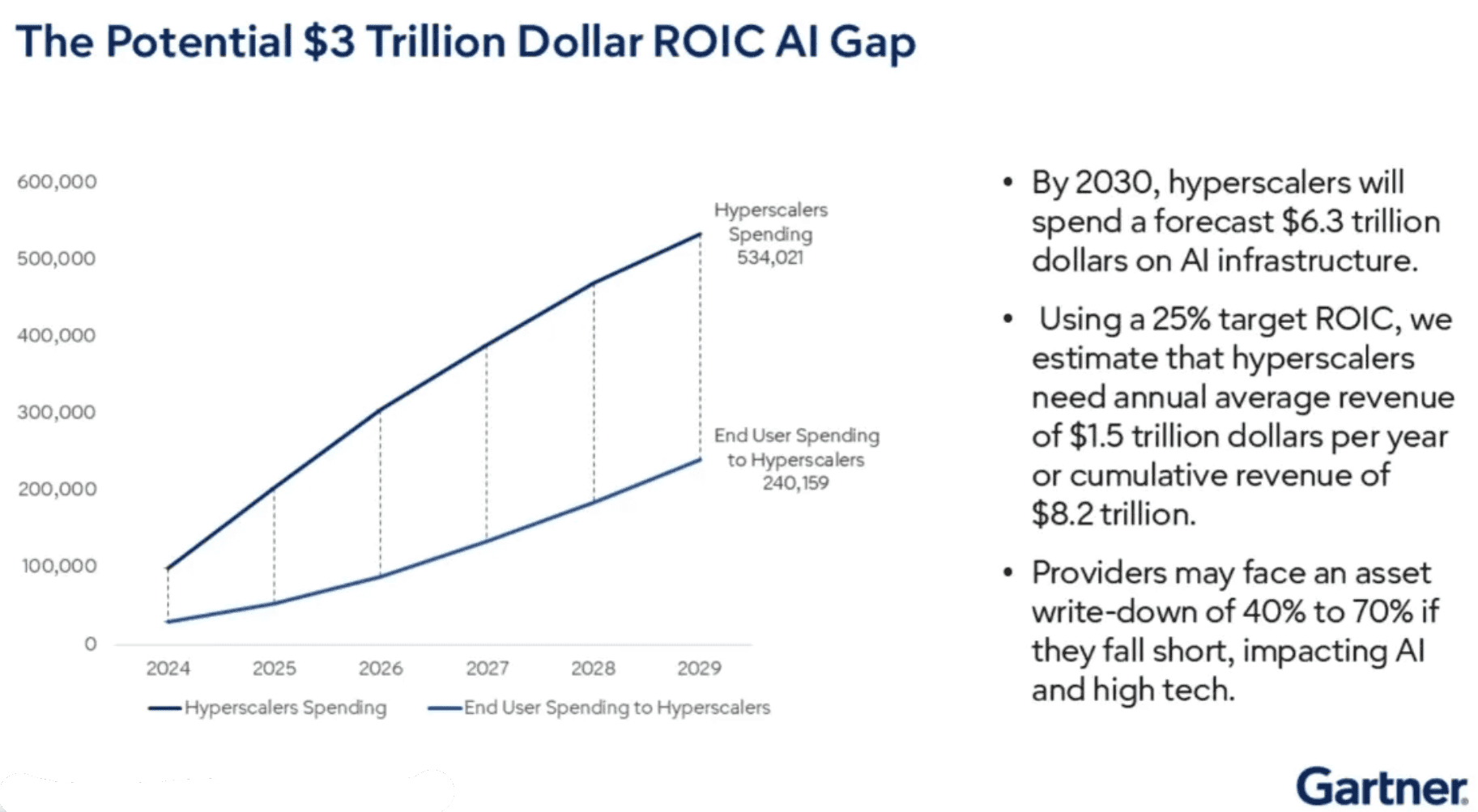
Looking further ahead, the outlook suggests an even more pronounced upward trend. Gartner forecasts that global spending on AI infrastructure and related services could reach $6.3 trillion by 2030, underscoring the sustained and accelerating nature of this financial commitment.
The Pricing Power Play: How AI Providers Will Recoup Costs
The immense capital expenditure by AI developers and infrastructure providers inevitably translates into pressure to monetize these investments. With many AI companies, such as Anthropic and OpenAI, increasingly operating as public entities or seeking significant investor returns, demonstrating profitability and positive gross margins becomes paramount.
Anthropic, for instance, is reportedly nearing positive gross margins, a crucial milestone for its financial sustainability. This drive for profitability, coupled with the substantial ongoing costs of AI development and deployment, is leading to a reassessment of pricing models. The trend indicates a move away from flat-fee subscriptions towards usage-based pricing, a shift that could significantly impact businesses with high AI utilization.
A recent report from The Information highlighted Anthropic’s pivot to a pricing model that charges enterprise customers based on the volume of AI usage. This change, driven by a "compute crunch" and the adoption of new technologies like advanced tokenizers for its latest models, means that companies heavily reliant on Anthropic’s Claude products are likely to see their bills escalate considerably.
This pricing power is not confined to a single provider. As more AI companies mature and face market scrutiny, the inclination to pass on infrastructure costs to customers will likely become a widespread phenomenon. The SaaS (Software as a Service) industry, encompassing major players like SAP, Workday, Oracle, Salesforce, and Adobe, will also be under pressure to demonstrate strong financial performance, potentially leading to increased pricing for their AI-integrated solutions.
Customer Reactions: Navigating the Rising Tide of Expenses
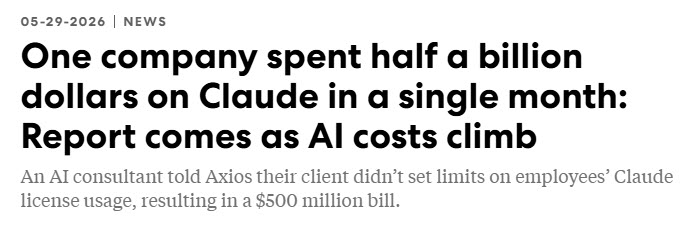
The impending price hikes are already prompting strategic reevaluations within businesses. Chief Information Officers (CIOs) and Chief Human Resource Officers (CHROs) are beginning to explore alternative strategies to manage escalating AI costs. In conversations with clients in New York City, the author of the original piece noted that discussions about the high costs of AI tools like Claude Code frequently led to considerations of "outsourcing" AI development to engineers in regions with lower labor costs, such as India.
Eric Johnson, CIO at PagerDuty, a company that assists software engineers in responding to technical outages, expressed his preparedness for volatile AI costs. As PagerDuty’s 1,200 employees integrate Anthropic’s AI coding and other tools to accelerate software development and other tasks, Johnson anticipates unexpected expenses. "I am preparing myself to be surprised by the bills," he stated. "We believe that there’s a lot of value here. Unfortunately, it’s fairly new technology, so there’s some open questions that we’re gonna be working through around its costs and getting a return on the investment."
While many technology firms and large enterprise customers acknowledge the potential for soaring costs, a significant portion plan to absorb these expenses. Their rationale stems from the perceived productivity gains and competitive advantages that AI can offer, particularly in areas like software engineering and sales automation. The belief is that the value derived from increased efficiency and innovation will outweigh the higher operational costs.
The Price-Performance Battle: A New Frontier in AI Economics
The competitive landscape of AI is rapidly evolving, with a new focus on the price-performance ratio. The recent announcement of Google’s Gemini 3.5 Flash, reportedly priced at ten times less than Opus 4.7, signals the official commencement of a fierce competition to offer more cost-effective AI solutions. This development is a direct response to the growing concern over AI expenses and suggests that providers will increasingly differentiate themselves not only on capability but also on affordability.
Quantifying the Cost: The Trillion-Dollar Revenue Imperative
To comprehend the magnitude of the required revenue, consider the financial implications for AI providers aiming for a 15% compound return on their investments, assuming a conservative five-year depreciation period. This scenario necessitates obtaining at least $1 trillion in new annual revenue. Given the typical margins in the AI sector, this figure could realistically be even higher.
This substantial revenue stream will likely be sourced from both consumer and business markets. On the consumer side, the current global internet advertising market is valued at approximately $750 billion. To cover a significant portion of the AI infrastructure costs through advertising alone would require a doubling, or more, of ad spending, potentially leading to an increase in "junky ads" across platforms.
On the business side, global enterprise software spending stands at around $1.2 trillion, according to Gartner. A doubling of this market to accommodate AI costs would represent a seismic shift in enterprise IT budgets.
Broader Revenue Streams and the End of "Moore’s Law" Computing
Beyond consumer and enterprise software, other significant revenue sources are anticipated, including U.S. government spending on military applications and the burgeoning fields of bio-research and energy research, which are leveraging AI for breakthroughs. This diversification of revenue streams suggests a broader integration of AI across societal and economic spheres.
However, the prevailing notion that computing power will continue to become cheaper, akin to the historical trajectory of Moore’s Law, appears unlikely in the near term. The substantial upfront investment in AI infrastructure fundamentally alters this economic dynamic.
A historical perspective on computing costs can be illustrative. The original IBM PC, priced at $1,565 in 1981 (without a hard disk), would cost approximately $5,700 in today’s inflationary-adjusted dollars. While modern laptops and desktops often retail for around $3,000, this figure does not account for the integrated ecosystem of devices like smartphones, which also represent a significant "cost of computing." Over 45 years, the overall cost of computing has not seen a dramatic decrease, and the current AI investment surge suggests a reversal of the trend towards cheaper computing.
Implications for Businesses and the Economy

The increasing cost of AI technology implies that businesses will likely face higher operational expenses, whether through direct software licensing, cloud computing services, or increased advertising costs. For these investments to be economically viable, they must translate into tangible benefits such as increased productivity, enhanced health outcomes, or other previously unseen advantages.
Companies like Nvidia, Oracle, Microsoft, and Workday are not merely aiming to replace existing revenue streams with AI; they are seeking growth. Similarly, Google, Meta, SpaceX, Amazon, and Apple are focused on expanding their market presence and revenue. Jensen Huang, CEO of Nvidia, has succinctly articulated this business model: "AI compute is revenue." This statement suggests a departure from traditional seat-based licensing models towards a more direct correlation between AI usage and revenue generation.
The economic implications of this shift are profound. Businesses will need to carefully assess the return on investment for their AI adoption strategies. The expectation is that AI will drive significant productivity gains, enabling companies to absorb higher costs and potentially fuel new economic growth. However, the transition may be challenging, with some businesses potentially struggling to adapt to the new pricing structures and investment demands.
The era of readily accessible, inexpensive AI is likely drawing to a close, at least in the short to medium term. As the infrastructure supporting this transformative technology continues to expand at an unprecedented pace, businesses and consumers alike must prepare for a future where the cost of artificial intelligence plays a more prominent role in their financial planning and operational strategies. The coming years will likely be defined by a delicate balance between harnessing the immense potential of AI and managing its escalating economic realities.