Think about the last important document you worked on. Chances are it lived in Google Docs, Microsoft Word, or another collaborative tool where everyone could suggest edits, leave comments, and track every change in real-time. This ubiquitous standard of digital collaboration has transformed how teams across finance, marketing, and operations function, fostering efficiency and accuracy. Yet, within the crucial realm of human resources, specifically in the creation and management of job descriptions (JDs)—documents inherently demanding extensive collaboration—many organizations remain tethered to outdated methodologies. The paradox is stark: job descriptions, which are arguably among the most collaborative documents in HR, are still frequently being passed around as disparate Word files, email attachments, and competing versions, leading to inefficiency, frustration, and significant operational risks.
The Stagnation of a Critical HR Process
For years, HR professionals, recruiters, compensation teams, hiring managers, legal advisors, and Diversity, Equity, and Inclusion (DEI) specialists have voiced a consistent request: "Can we review job descriptions like we do in Google Docs?" This seemingly simple query underscores a profound gap in much of today’s job description software. While advancements have been made in applicant tracking systems (ATS) and HR information systems (HRIS), the fundamental process of authoring, reviewing, and finalizing JDs has often been overlooked, leaving teams to cobble together workflows using general-purpose office software never designed for this specific, multi-stakeholder challenge.
The shift from individual, siloed document creation to cloud-based, real-time collaborative editing has been one of the most significant technological advancements in modern workplaces. Tools like Google Docs, Microsoft 365, and various project management platforms have set a new benchmark for team productivity. They have demonstrated that true collaboration extends far beyond mere version history; it encompasses a dynamic environment where multiple contributors can simultaneously interact with a document, providing granular feedback and tracking every alteration. The persistence of manual, fragmented processes for JDs stands in stark contrast to this widespread adoption of collaborative tools, creating a bottleneck in an otherwise increasingly digitized HR landscape.
The Unseen Army Behind Every Job Description
The common misconception is that job descriptions are solely the domain of recruiters. In reality, a high-quality, legally compliant, and effective enterprise job description is a product of extensive cross-functional input. Its authorship belongs to a diverse group of stakeholders, each bringing a unique and indispensable perspective. Consider the typical review chain for a single enterprise JD:
- Recruiters: Initiate the process, understand market demand, and translate hiring needs into attractive language. They focus on candidate appeal and searchability.
- Hiring Managers: Provide the core technical and functional requirements, outlining day-to-day responsibilities and desired qualifications based on team needs.
- HR Business Partners (HRBPs): Ensure alignment with organizational structure, internal policies, and broader talent strategies. They bridge the gap between business needs and HR practices.
- Compensation Teams: Validate salary ranges, ensure internal equity, and verify external market competitiveness. Their input is critical for attracting and retaining talent.
- Legal Counsel: Scrutinize language for compliance with labor laws, anti-discrimination regulations, and contractual obligations, mitigating potential legal risks.
- Diversity, Equity, and Inclusion (DEI) Professionals: Review for inclusive language, bias mitigation, and alignment with organizational DEI goals, ensuring a fair and equitable hiring process.
- Talent Leaders/Executives: Provide strategic oversight, ensuring JDs align with long-term business objectives and talent pipeline strategies.
- Marketing/Employer Branding Teams: Sometimes review JDs to ensure they reflect the company’s brand voice and value proposition to external candidates.
Each of these individuals contributes vital elements. The hiring manager ensures technical accuracy, the compensation team validates financial viability, legal counsel prevents compliance missteps, and DEI professionals promote fairness. The challenge, therefore, is not merely collecting these diverse inputs, but managing their integration without descending into chaos and inefficiency.
The Collaboration Conundrum: A Hidden Drain on HR Resources
Most companies, particularly larger enterprises, continue to manage job description reviews with methods that have seen little evolution over the past decade. The typical workflow is a manual, multi-step process fraught with potential for errors and delays:
- A recruiter drafts a JD, often starting from an outdated template or a previous role description, and downloads it as a Word document.
- The Word document is emailed to the hiring manager, who makes edits, saves a new version (e.g., "JD_Role_v2_HM_edits.docx"), and emails it back.
- This cycle repeats with legal, who might send yet another version (e.g., "JD_Role_v3_Legal_review.docx") with redline comments.
- Compensation teams may make their edits in a completely separate spreadsheet or internal system, providing their feedback via email or a different file.
- Other stakeholders might simply leave comments in an email chain, referring to specific sections of an attached document without direct integration.
- Finally, one person—typically the recruiter or an HR partner—is tasked with the laborious and error-prone process of merging all these disparate inputs into a single, cohesive document.
This fragmented approach invariably leads to critical questions and inefficiencies: Which is the most current version? Who made that specific change? Why was this section removed? Was that comment addressed? Is this final document legally compliant, accurately compensated, and reflective of the hiring manager’s true needs? The larger and more complex the organization, the more pronounced and costly this problem becomes, leading to extended time-to-fill, increased administrative burden, and a heightened risk of errors that can impact candidate experience, compliance, and ultimately, the quality of hire. Industry estimates suggest that HR professionals can spend up to 30% of their time on administrative tasks, a significant portion of which is often consumed by manual document management and reconciliation.
Version History vs. Track Changes: A Critical Distinction
Many existing job description platforms boast "version history" as a feature, which is indeed useful for auditing and basic recovery. Version history typically answers one fundamental question: "What did this document look like at a specific point in the past?" It allows users to revert to an earlier state of the document, showing what the entire document contained previously.
However, true collaborative editing, epitomized by "Track Changes" functionality, offers a far more dynamic and impactful capability. Track Changes answers a much broader and more granular set of questions:
- Who made this specific edit?
- When was this change implemented?
- What was the original text before this modification?
- Has this suggested change been reviewed and approved or rejected?
- What comments or discussions are associated with this particular section or phrase?
These are two fundamentally different capabilities. Version history is about restoring the past, acting as a digital archive. Track Changes, conversely, is about facilitating active collaboration in the present, enabling real-time discussion, negotiation, and precise modification management. Without Track Changes, the "version history" feature in a fragmented workflow simply becomes a record of the chaos, rather than a tool to prevent it.
Envisioning the Future: Seamless JD Collaboration
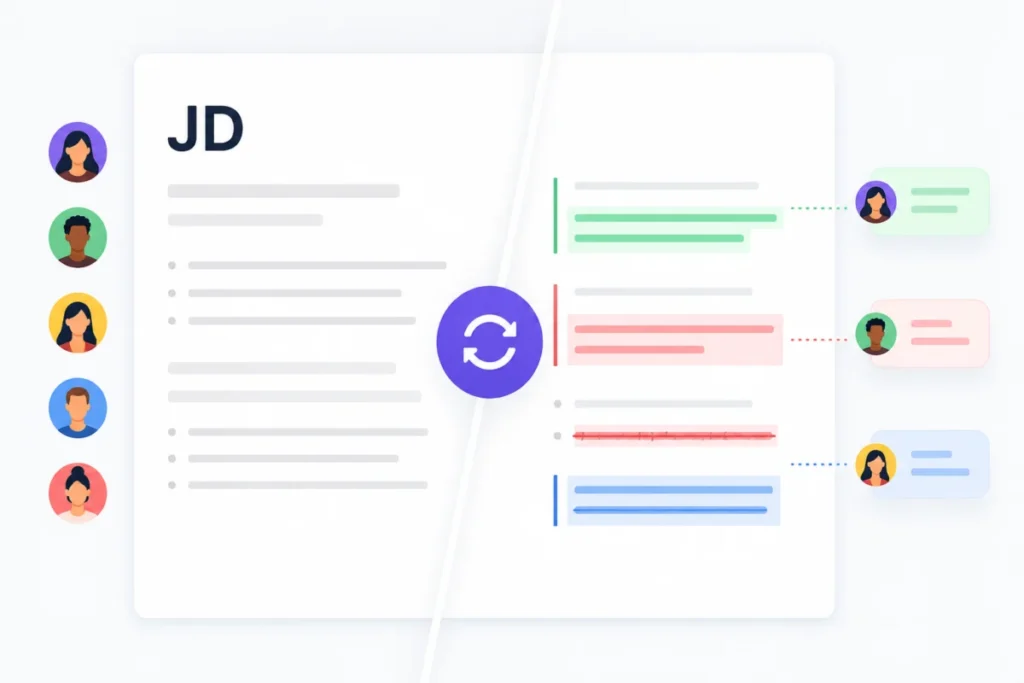
Imagine applying the same sophisticated collaborative experience found in Google Docs or Microsoft Word to the creation and review of job descriptions. In such an environment, users wouldn’t overwrite someone else’s work. Instead, they would:
- Suggest Edits: Propose changes directly within the document, which are visibly marked as suggestions, preserving the original text until approved.
- Leave Targeted Comments: Attach comments to specific words, phrases, or sections, fostering contextual discussions.
- Engage in Threaded Conversations: Respond to comments, creating dialogue streams that keep all communication related to a particular point consolidated and easily traceable.
- Accept or Reject Changes: Granularly approve or decline individual suggestions, maintaining full control over the final content.
- Track Every Contributor: Instantly see who made which suggestion or comment, enhancing accountability and transparency.
- Work Concurrently: Multiple stakeholders can be in the document at the same time, seeing each other’s contributions as they happen, eliminating sequential bottlenecks.
Bringing this level of collaborative functionality to job descriptions would revolutionize HR workflows. Recruiters could initiate drafts, knowing that hiring managers could immediately refine technical skills, compensation could verify salary bands, and legal could flag compliance issues—all within a single, live document. This centralized approach drastically reduces the back-and-forth of emails and file attachments, eliminating the risk of working on outdated versions and ensuring that the final JD is a meticulously crafted, fully vetted representation of the role.
The Broader Impact: Efficiency, Compliance, and Candidate Experience
The implications of robust collaborative editing for job descriptions extend far beyond mere convenience. They touch upon critical aspects of organizational performance and risk management:
- Enhanced Efficiency: Streamlined review processes significantly reduce the time-to-fill for open positions, a key metric for talent acquisition teams. Less time spent on administrative reconciliation means more time for strategic sourcing and candidate engagement.
- Improved Compliance: With legal teams able to track and approve every word change, the risk of non-compliant or discriminatory language is drastically reduced. This protects the organization from potential lawsuits and regulatory penalties.
- Greater Accuracy and Quality: Collaborative input from all relevant stakeholders ensures that JDs are precise, comprehensive, and accurately reflect the role’s requirements, compensation, and cultural fit. This leads to better-qualified applicants and a stronger talent pipeline.
- Superior Candidate Experience: Clear, consistent, and well-written job descriptions are the first touchpoint for potential candidates. A streamlined creation process ensures that JDs are attractive, informative, and free of contradictions, enhancing the employer brand.
- Data Integrity and Analytics: Centralized, collaboratively edited JDs provide a clean, consistent dataset for HR analytics, allowing organizations to better understand hiring trends, skill gaps, and compensation benchmarks.
- Scalability: For growing organizations, manual JD management quickly becomes untenable. A collaborative platform allows for scaling operations without exponentially increasing administrative burden.
While most organizations already employ approval workflows, dictating who reviews first, who signs off next, and who gives final approval, this structured process often breaks down once the document is "opened" for actual content input. Traditional software tends to focus on the routing of the document rather than the interaction within the document. Modern workflows must bridge this gap, making it effortless for everyone to work together inside the same digital space. Approval, while necessary, is often not the hardest part anymore; effective, real-time collaboration is where the true friction lies.
The Next Evolution: Collaborative Editing as a Core Feature
The persistent demand from enterprise customers for advanced collaborative editing features underscores a fundamental truth: this isn’t merely a "nice-to-have" add-on. It represents the logical and necessary next step in the evolution of job description management software. Customers are not just asking for version history; they are requesting the same intuitive, efficient editing experience they utilize daily for other critical business documents. They want the ability to:
- Suggest changes directly within the text.
- Add comments that are anchored to specific content.
- Engage in real-time discussions with other reviewers.
- Accept or reject individual edits with full visibility.
- Maintain a clear, auditable trail of all modifications and approvals.
This collective feedback highlights that collaborative editing is essential for modernizing HR operations. Just as cloud-based platforms transformed how teams collaborate on presentations, spreadsheets, and reports, the same paradigm shift is overdue for job descriptions. Companies like Ongig are recognizing this need, developing solutions that integrate these advanced collaborative capabilities directly into JD management platforms. This innovation promises to free HR teams from administrative drudgery, empower cross-functional collaboration, and elevate the strategic importance of well-crafted job descriptions in attracting and securing top talent. The future of job description workflows is unequivocally centered on better collaboration, promising a more efficient, compliant, and ultimately more effective talent acquisition ecosystem.
FAQs
Q: What’s the fundamental difference between version history and track changes?
A: Version history allows users to view and restore previous full versions of a document. Track Changes, conversely, enables reviewers to suggest specific edits, leave contextual comments, and then individually accept or reject those proposed changes within the current document, creating a transparent audit trail of all modifications.
Q: Who benefits most from integrating track changes into job description software?
A: Virtually all stakeholders involved in the job description lifecycle benefit, including recruiters, hiring managers, HR Business Partners, compensation teams, legal counsel, DEI professionals, and talent leaders. It streamlines their individual contributions and improves collective output.
Q: Why is simply having version history insufficient for effective JD collaboration?
A: Version history shows what changed between document saves, but it doesn’t facilitate how those changes were made, who made them, or why. It doesn’t enable real-time discussion, negotiation, or granular approval of individual edits, making the collaboration process itself cumbersome and prone to error.
Q: How can track changes functionality specifically improve overall hiring workflows?
A: By consolidating all reviews and edits into a single document, track changes significantly reduces manual merging, eliminates duplicate files, enhances accountability for specific content, and accelerates the approval process for job descriptions. This directly contributes to faster time-to-fill, reduced administrative overhead, and more consistent, legally compliant hiring practices.
July 9, 2026 by Heather Barbour Fenty in Job Descriptions