Employee recognition stands as one of the most potent and scalable tools available to organizations aiming to shape behavior, foster engagement, and drive tangible business results. Each instance of recognition serves as a clear communication channel, signaling to employees what the organization values, which contributions are deemed most significant, and what future efforts should be prioritized. Businesses that integrate recognition as a continuous driver of behavior, rather than a sporadic reward, are the ones consistently demonstrating measurable improvements across critical metrics such as employee engagement, retention rates, and overall productivity.
At its core, employee recognition is the practice of acknowledging and appreciating an individual’s contributions, efforts, or achievements. This deliberate act serves to reinforce positive behaviors, deepen an employee’s connection to their work and the organization, and cultivate a pervasive culture of appreciation within the workplace. In today’s dynamic business landscape, where talent acquisition and retention are paramount, the strategic implementation of recognition programs has become not just beneficial, but essential.
The Urgency of Employee Recognition in the Modern Workplace
The current emphasis on employee recognition stems from a fundamental truth: employees learn what an organization truly values by observing what behaviors and achievements are acknowledged and celebrated. This makes recognition a cornerstone of effective HR strategy. When employees receive recognition that is genuine, meaningful, and consistently applied, rather than being an infrequent occurrence or an annual afterthought, their engagement levels rise, their productivity increases, and their likelihood of remaining with the company significantly improves.
Data from the Achievers Workforce Institute (AWI) underscores this point, revealing that employees who are recognized on a weekly basis are five times more likely to feel connected to their company culture. This profound impact highlights that recognition is not merely a feel-good initiative; it is a strategic mechanism that directs employee attention and effort towards actions and achievements that align with organizational objectives. By consistently recognizing behaviors that mirror company values, organizations create a powerful feedback loop that ensures employee daily actions are in sync with overarching business goals.
The Scientific Underpinnings of Effective Recognition
While the positive emotional impact of recognition is undeniable, its effectiveness is also deeply rooted in scientific principles. The underlying psychology of recognition suggests that it operates as a powerful motivator by fulfilling fundamental human needs for validation and appreciation. Research consistently points to a common theme: recognition is most impactful when it is directly tied to specific behaviors and outcomes.
David Bator, Managing Director of the Achievers Workforce Institute, elaborates on this in his reflections on research featured in The Recognition Effect. He highlights findings from studies, including those published by the Harvard Business Review (HBR), which indicate that the true power of recognition lies not just in acknowledging past accomplishments, but in its capacity to influence future actions. By reinforcing the behaviors that employees associate with success, organizations create a clear roadmap for what constitutes valuable contribution. When these behaviors are consistently recognized and rewarded, they become more ingrained, leading to stronger alignment with organizational values and goals, and ultimately, a more productive and cohesive workforce.

This behavioral reinforcement is critical for driving business impact. When employees understand that specific actions leading to positive outcomes are consistently acknowledged, they are more likely to repeat those actions. This creates a virtuous cycle where desired behaviors become the norm, directly contributing to improved performance and the achievement of strategic objectives.
Navigating Common Recognition Pitfalls
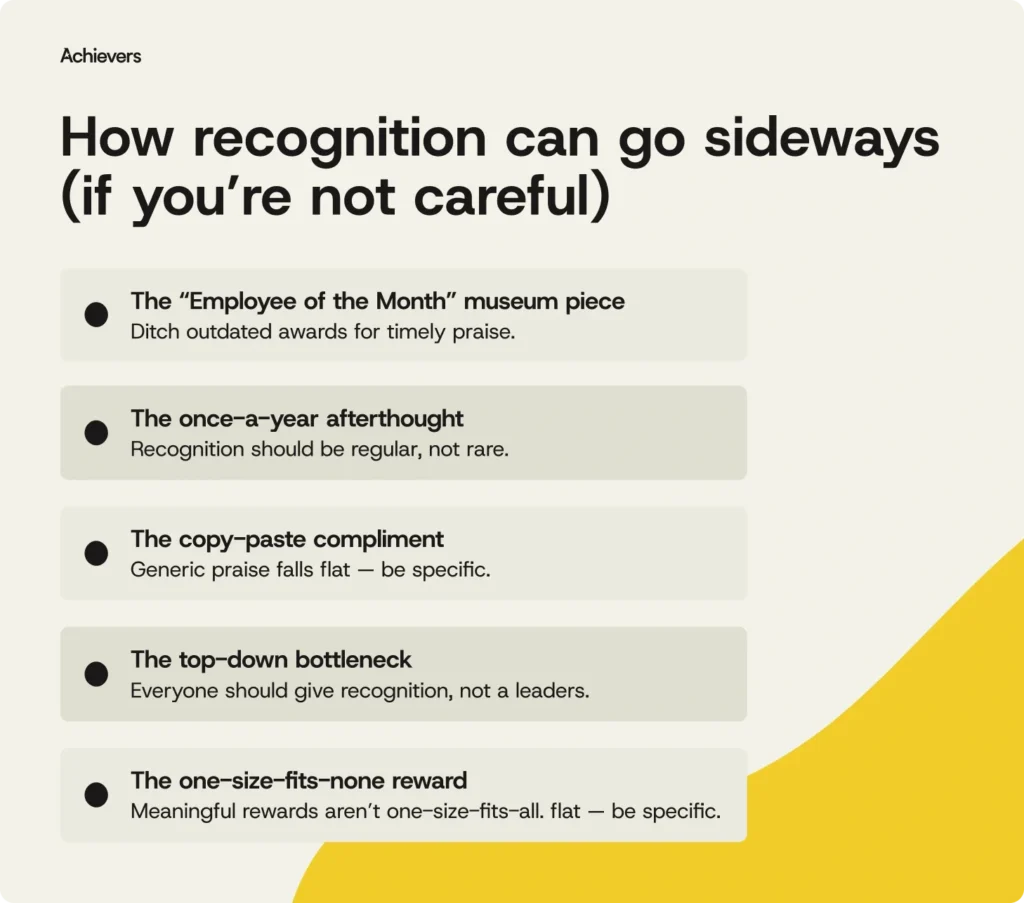
Despite its clear benefits, the implementation of employee recognition programs can often fall short of their potential due to common, yet avoidable, pitfalls. Understanding these missteps is the first step toward designing and executing programs that truly resonate and deliver results.
The "Employee of the Month" Relic
While the intent behind recognizing top performers is commendable, the traditional "Employee of the Month" award, often symbolized by a breakroom plaque, can feel antiquated and disconnected from the modern workforce. Employees today seek timely, relevant, and specific feedback that directly links to their accomplishments. Relying on outdated rituals can alienate employees and undermine the perceived value of recognition. Modern approaches prioritize real-time acknowledgment that is meaningful and resonates with individual contributions.
The Infrequent Afterthought
Recognition that is relegated to annual reviews or year-end celebrations often loses its potency. For recognition to be truly effective, it needs to be frequent and integrated into the daily fabric of the workplace. When appreciation is delayed or reserved for rare occasions, its motivational impact diminishes significantly. Organizations must strive to make recognition a routine aspect of company culture, rather than a calendar-bound event. Consistent, timely appreciation fosters a sustained sense of value and motivation.
The Generic Compliment
Vague affirmations such as "Good job!" or "Thanks for your hard work," while better than silence, offer minimal motivational value. Generic praise can feel transactional and impersonal, failing to convey genuine appreciation or highlight specific contributions. The true power of recognition lies in its specificity. Effective praise clearly identifies the behavior, explains its positive impact, and ideally, connects it to broader company values or objectives. If a compliment could apply to any employee, it is unlikely to have a lasting or meaningful effect on the individual receiving it.
The Top-Down Bottleneck
When recognition is exclusively a managerial prerogative, it limits its reach and impact. A truly effective recognition culture embraces peer-to-peer appreciation, fostering a sense of collective acknowledgment and reinforcing the idea that everyone’s contributions matter. Empowering all employees – including colleagues, cross-functional team members, and even external stakeholders like clients – to recognize contributions in real-time creates a more dynamic, authentic, and sustainable culture of appreciation. The more voices involved in the recognition process, the more ingrained and impactful it becomes.
The One-Size-Fits-All Reward
While tangible rewards like gift cards or company-branded merchandise can play a role, recognition should ultimately feel personal and tailored to the individual. Generic, mass-produced rewards often fail to capture the unique preferences and motivations of employees. Modern, effective recognition programs offer a variety of reward options and, ideally, involve employees in determining what forms of appreciation are most meaningful to them. Understanding individual motivators, rather than defaulting to convenient bulk orders, ensures that rewards are perceived as genuine gestures of appreciation.
Modernizing Recognition for Measurable Impact
The evolution of employee recognition necessitates a shift away from outdated practices towards more dynamic and integrated approaches. Modernizing recognition and rewards programs involves moving beyond infrequent awards, manager-exclusive acknowledgment, and standardized rewards. Instead, the focus is on creating continuous, visible, and seamlessly integrated recognition experiences that are woven into the daily employee journey.
Research from Harvard Business Review Analytic Services highlights that organizations with highly effective recognition programs are significantly more likely to design their initiatives with the explicit goal of driving specific employee behaviors. A compelling 88% of such organizations reported this intentional design, compared to only 28% of organizations with less effective programs. This indicates that modern recognition is not an arbitrary act of praise, but a strategic lever used to reinforce the actions and behaviors that organizations deem essential for daily success.
Leading companies are embedding recognition into the very fabric of their operations. For example, Workday’s integration of recognition data into its HR systems resulted in a remarkable 70% year-over-year increase in the availability of employee feedback for managers. This provided them with a more comprehensive understanding of individual performance, enabling more informed decision-making and targeted support. Such integration ensures that recognition data is not siloed but actively contributes to a holistic view of employee contributions and development.
Recognition as a Catalyst for Business Results
The question of whether employee recognition truly matters is unequivocally answered with a resounding "yes." Its importance, however, extends far beyond its capacity to make employees feel good. Recognition is a proven and powerful tool that organizations can leverage to shape behavior, fortify company culture, and ultimately, drive significant business results.
At Achievers, a leading platform dedicated to employee recognition and engagement, the focus is on enabling organizations to deliver frequent, meaningful, and frictionless recognition. This approach is designed to fuel performance and enhance retention by making the act of appreciation a natural and integrated part of the workday. What may begin as a simple expression of gratitude, such as a "thank you," can, through a well-structured and strategically implemented program, culminate in measurable and impactful business outcomes. By providing a platform that facilitates consistent, visible, and behavior-aligned recognition, Achievers empowers companies to transform appreciation into a quantifiable driver of success.