The promise of artificial intelligence revolutionizing workplace productivity has long been a compelling narrative. Initial research from GoTo and Workplace Intelligence suggested a tangible benefit, with employees reporting an average daily time saving of 2.3 hours due to AI tool adoption. This positive outlook was further reinforced by the overwhelming consensus among both employees and IT leaders, with over 90% indicating that their companies should maintain or even increase their investment in AI technologies. This sentiment underscores a widespread belief in AI’s potential to streamline operations and enhance efficiency across various business functions.
However, a deeper examination of the data reveals a more nuanced and complex reality, suggesting that the perceived productivity gains may be partially offset by emerging challenges. The same employees who report saving time also estimate that they still dedicate 2.6 hours daily to tasks that AI is already capable of handling. This persistent gap, which has remained unchanged from the previous year, points to a critical disconnect. It suggests that employees either lack the understanding or the directive to effectively integrate AI tools into their specific job roles, or that the tools themselves are not yet optimally configured for broader application.
This gap in practical application is further highlighted by the stark contrast in perceptions between employees and IT leaders. A significant 69% of employees acknowledge their unfamiliarity with the practical applications of AI in their day-to-day work. Conversely, only 29% of IT leaders share this view, indicating a potential blind spot within IT departments regarding the actual level of AI literacy and adoption at the frontline of the workforce. This discrepancy raises questions about the effectiveness of current training and support mechanisms for AI implementation.
The Unforeseen Cost of AI Oversight
Beyond the challenges of adoption and integration, a second, perhaps more unexpected, drag on productivity has emerged: the necessity of human oversight for AI-generated outputs. As AI-driven work becomes more prevalent, a significant portion of employees find themselves responsible for reviewing the work produced by their AI-assisted colleagues. More than half of employees report regularly engaging in this oversight function, with 50% dedicating time to it on a weekly basis.
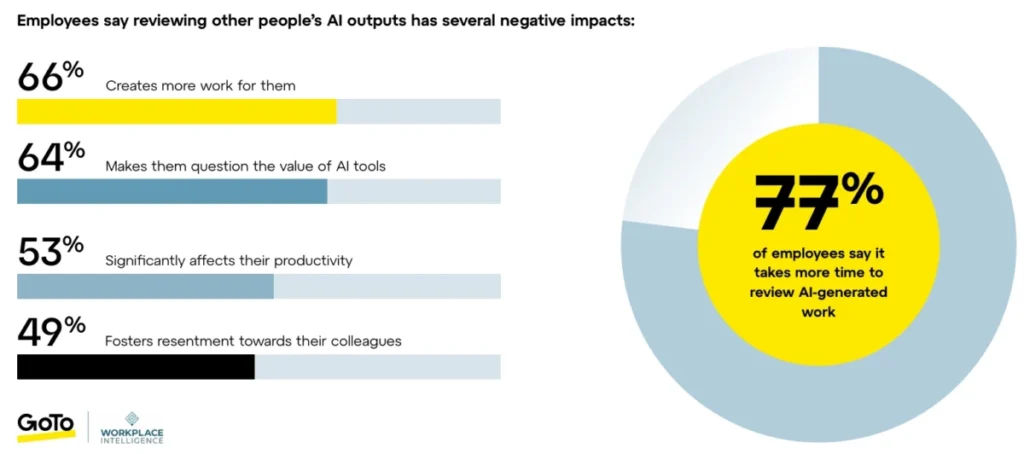
The implications of this oversight are significant. Among those tasked with reviewing AI outputs, a striking 79% regularly encounter work that is of low quality or contains errors. Furthermore, 77% find that the process of reviewing AI-generated content takes longer than reviewing work produced by human colleagues. This suggests a concerning trend where the time saved by one employee through AI utilization can be effectively negated by the time another employee expends in correcting or validating that AI-generated output. This creates a "productivity wash," where the net gain is diminished, and in some cases, could even lead to a net loss of efficiency if not managed effectively.
The visual data from the GoTo and Workplace Intelligence report, depicting employees reviewing AI outputs with a sense of concern, underscores this sentiment. The image implies a workload characterized by scrutiny and a potential undercurrent of frustration, as employees grapple with the responsibility of quality control for automated processes. This aspect of AI implementation was likely an underestimation in initial productivity projections, highlighting the need for a more holistic view of AI’s impact on workflows.
Broader Industry Trends: AI Integration Accelerates
The challenges and opportunities presented by AI in the workplace are not isolated incidents but part of a broader industry-wide evolution. Major technology providers are actively developing and deploying AI solutions designed to embed intelligence more deeply into business processes.
At the recent SAP Sapphire event, enterprise software giant SAP unveiled its "Autonomous Enterprise" vision. This initiative aims to anchor AI agents within core business processes through a new unified platform. For HR leaders, this translates to the impending introduction of over 50 domain-specific AI assistants designed to enhance human capital management workflows. This move signals SAP’s commitment to leveraging AI for more sophisticated and automated HR functions, from recruitment to employee development and administration. The underlying principle is to create a self-optimizing business environment where AI agents can proactively manage and execute tasks, thereby freeing up human resources for more strategic endeavors.
In the realm of payroll and human capital management (HCM), Paychex has launched WISE, an agentic AI solution. Built upon five decades of HR data, WISE is designed to move beyond passive assistance to autonomously complete workforce tasks. This embedded intelligence aims to guide decisions and execute processes for HR and operations teams, promising a significant uplift in efficiency by automating routine administrative and analytical functions. The ability of WISE to learn from extensive historical data suggests a sophisticated approach to problem-solving and task execution within the HR domain.
Absorb Software has also entered the AI-driven learning and development space with its new Aura platform. This platform is specifically engineered to connect learning initiatives directly to measurable business outcomes. By utilizing specialized AI agents, Aura aims to integrate employee development directly with the operational systems where performance is tracked. This approach promises to transform corporate training from a content-delivery mechanism into a truly results-driven function, demonstrating a clear understanding of the need for tangible ROI from employee development programs. The platform’s focus on measurable outcomes suggests a move towards a more data-centric approach to talent management.

Market Expansion and Evolving Workforce Needs
The increasing complexity of managing workforces, particularly in the context of rapid AI adoption, is driving market expansion and innovation in HR technology. HiBob, a platform for HR, payroll, and finance, has announced the opening of a new office in Toronto. This expansion into the Canadian market reflects a growing demand from mid-sized companies grappling with intricate workforce needs. As AI adoption makes managing people and business data more challenging within siloed systems, companies are seeking integrated solutions that can provide a unified view and enhanced control over their human capital. HiBob’s expansion signals an acknowledgment of these evolving market demands and a strategic positioning to address them.
Further Innovations Shaping the Future of Work
The influence of AI and evolving economic conditions is reshaping various aspects of employment and financial management.
Global payroll platform Deel has introduced a significant enhancement to its services by enabling employers to offer stablecoin salary payouts alongside traditional payment methods. This feature, operating within a single compliance layer, is currently available to U.S. and Eurozone customers and requires no additional vendor relationships, with employees opting in for free. This innovation taps into the growing interest in digital currencies and offers a new avenue for compensation, potentially appealing to a globally distributed workforce and addressing the complexities of cross-border payments. The move by Deel suggests a proactive approach to integrating emerging financial technologies into established payroll systems.
For plan sponsors navigating fiduciary obligations, Betterment at Work has rolled out an updated 401(k) dashboard. This redesigned interface incorporates an AI-powered benchmarking tool that compares participation and contribution rates against national averages. The objective is to identify opportunities for improving employee retirement savings behavior. This data-driven approach empowers plan sponsors with actionable insights, moving beyond basic reporting to strategic intervention for enhancing employee financial well-being. The use of AI in this context highlights its potential to drive better decision-making in financial planning and employee benefits.
The recruitment sector is also witnessing AI-driven transformation. The new platform Contrario has achieved remarkable growth, reaching $6 million in annualized revenue in under six months. Contrario combines expert recruiters with AI agents that handle operational hiring tasks. This hybrid model appears to be highly effective, with the platform already in use at over 200 fast-growing companies that are actively competing for talent in a competitive market. The success of Contrario underscores the value of leveraging AI to augment human expertise in critical business functions like talent acquisition, especially in high-demand industries.
In a move signaling expansion and strategic growth, EvoluteIQ, an enterprise automation company, has announced two key leadership hires. Paul Maguire has been appointed Chief Growth Officer, and Abhinaya S R has joined as Chief Human Resources Officer. This leadership reinforcement comes as EvoluteIQ expands its operations across North America, Europe, and the Asia-Pacific region, following a substantial $53 million capital raise in September 2025. These developments indicate a strong investor confidence in the company’s automation solutions and a clear strategy for global market penetration.
Analysis of Implications and Future Outlook
The research from GoTo and Workplace Intelligence, while highlighting significant reported time savings from AI tools, also brings to the fore critical implementation challenges. The persistent gap between potential AI application and actual employee utilization suggests that the success of AI integration hinges not just on the technology itself, but on effective strategy, training, and organizational alignment. Companies investing in AI must move beyond simply deploying tools to actively fostering an environment where employees are empowered and educated to leverage these technologies to their fullest potential.
The emergence of the "productivity wash" due to AI output review highlights a crucial area for improvement. Organizations need to develop robust protocols for AI quality assurance, potentially through more advanced AI models capable of self-correction or through optimized human-in-the-loop processes that minimize the time burden on reviewers. This could involve investing in AI tools that are more accurate out-of-the-box or redesigning workflows to make the review process more efficient.
The broader industry news, showcasing advancements from SAP, Paychex, Absorb Software, and others, demonstrates a clear trajectory towards more sophisticated and embedded AI solutions. These developments signal a future where AI is not just an add-on tool but an integral component of business operations, influencing everything from strategic decision-making to day-to-day task execution. However, the success of these advanced AI systems will undoubtedly depend on addressing the foundational issues of employee understanding, skill development, and the management of AI-generated work.
As AI continues to evolve and integrate into the fabric of the workplace, the focus for HR leaders and business strategists must shift from simply adopting AI to strategically optimizing its deployment. This involves a continuous cycle of assessment, training, and adaptation to ensure that AI truly serves as a catalyst for enhanced productivity and sustainable business growth, rather than becoming a source of hidden inefficiencies. The ongoing dialogue around AI’s impact underscores the dynamic nature of work and the imperative for organizations to remain agile and informed in their technological adoption strategies.