
A recent comprehensive analysis conducted by Ongig, a leader in job description optimization software, has identified "strong," "lead," and "independently" as the most prevalent masculine-biased words in job postings from January 1 to July 13, 2026. The findings underscore a persistent challenge in recruitment: the subtle linguistic cues that can inadvertently deter female applicants and impede organizational diversity initiatives. This ongoing research by Ongig, which leverages advanced AI and social science principles, aims to provide actionable insights for companies striving to build more inclusive talent pipelines.
Unpacking the 2026 Findings
Ongig’s Text Analyzer software, a specialized tool for detecting gender bias in recruitment language, processed a significant dataset of 48,246 random job descriptions from U.S.-based companies of varying sizes. The analysis revealed that beyond the top three, other frequently flagged masculine-biased terms included "strengthen," "competitive," "leaders," "analyze," "champion," "analysis," and "independent." The consistent appearance of such words in job advertisements, according to Ongig’s data, correlates with lower application rates from women, despite their qualifications.
The study’s methodology relies on a proprietary masculine vocabulary library, continuously updated with insights from social science and artificial intelligence research. This dynamic approach ensures that the identified words reflect current linguistic trends and their subtle psychological impacts on job seekers. The goal is not to eliminate these words entirely from the professional lexicon, but rather to highlight their potential to create an unwelcoming environment for certain demographic groups in the context of job applications.
The Evolving Landscape of Biased Language
The 2026 data not only reinforces previous findings but also introduces new observations regarding the shifting nature of biased language. "Strong" and "lead" continue to be perennial offenders, appearing consistently in Ongig’s annual analyses. These words, while seemingly innocuous and descriptive of desired traits, carry connotations that, statistically, resonate more with masculine self-descriptors, thereby subtly influencing who feels qualified or encouraged to apply.
Notably, "strengthen" and "champion" have emerged as new entrants in the top 10 list for 2026. These terms are frequently found in job advertisements for leadership and strategy-focused roles, often perceived as embodying proactive, assertive qualities. While valuable attributes, their inclusion can inadvertently bias job descriptions. Conversely, words like "objectives" and "decisions," which featured in earlier analyses, have dropped off the current top 10 list, indicating a dynamic shift in common linguistic patterns within job postings. This evolution necessitates regular re-evaluation and adaptation of inclusive language strategies.
The Business Imperative for Gender-Neutral Language
The impact of gendered language on recruitment outcomes is not merely anecdotal; it is substantiated by robust research and empirical data. A pivotal study conducted in late 2022 saw Ongig partner with a global employment website to investigate the relationship between gendered language, other biased words, and application rates. The findings were compelling: job descriptions optimized using Ongig’s scoring system, which identifies and addresses biased language, resulted in a 13% increase in total application starts and a significant 21% boost in application starts from female candidates across various industries.
Further demonstrating this impact, a pilot program utilizing Ongig’s Text Analyzer within a firm operating in traditionally male-dominated sectors—engineering and finance—yielded remarkable results. Following the systematic updating of gender-biased words in their job advertisements, the firm reported a 22% increase in female applicants. These statistics provide a strong business case for adopting gender-neutral language, highlighting its direct correlation with enhanced talent acquisition and diversity metrics.
Academic Foundations of Linguistic Bias
The premise that certain words in job advertisements can sustain gender inequality is firmly rooted in academic research. A seminal study titled "Evidence That Gendered Wording in Job Advertisements Exists and Sustains Gender Inequality," published in the Journal of Personality and Social Psychology, provides a critical foundation for understanding this phenomenon. Led by researchers Danielle Gaucher, Justin Friesen, and Aaron C. Kay from Duke University and the University of Waterloo, the study meticulously demonstrated how exposure to masculine-biased language in job advertisements can lead women to perceive themselves as less belonging and less competent for the role, subsequently reducing their likelihood of applying.
This research underscores that the issue is not about the individual capabilities of women, many of whom are undeniably "strong" and effective "leaders," but rather about the collective psychological impact of specific linguistic patterns on a marketing cohort. The data consistently shows that, as a group, women apply to jobs at a lower rate when postings are saturated with these masculine-coded terms. The findings from this academic work have even inspired practical applications, such as Kat Matfield’s free online tool, the "Gender Decoder," which allows users to identify gender-coded words in their own texts.
Practical Strategies for Inclusive Job Descriptions
To counteract the subtle biases identified, Ongig advocates for the deliberate replacement of masculine-biased words with gender-neutral alternatives. The analysis for 2026 provides a clear roadmap for recruiters and hiring managers:
- "Strong" can be replaced with "able," "proven," "exceptional," "sound," "steady," "excellent," or "solid."
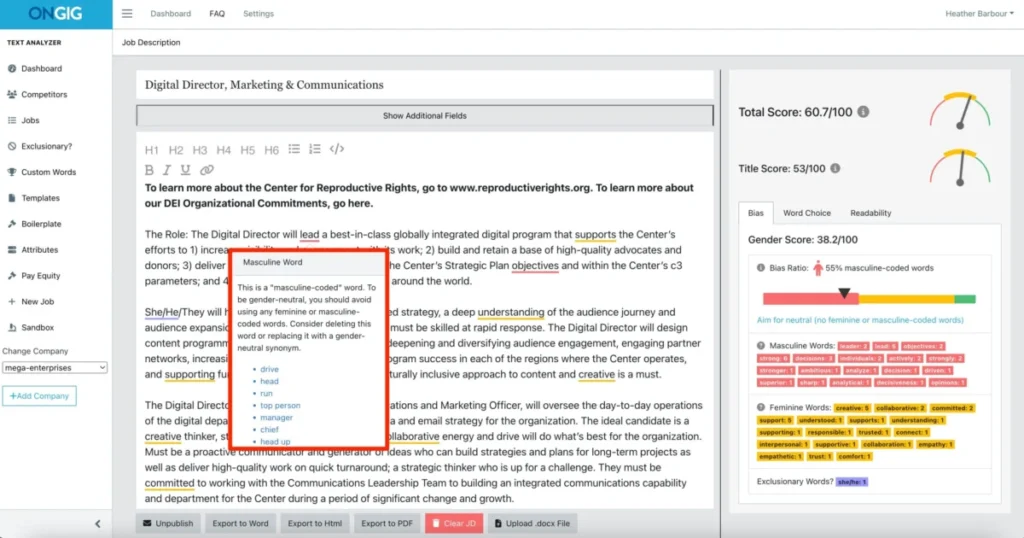
- "Lead" can be substituted with "drive," "head," "run," "chief," "manage," "steer," or "guide."
- For "independently," alternatives include "alone," "exclusively," "unaided," or "unsupervised."
- "Strengthen" can become "build," "reinforce," "improve," "develop," or "grow."
- Instead of "competitive," consider "attractive," "fair," "results-oriented," "enthusiastic," or "comparative."
- "Leaders" can be rephrased as "managers," "people," "stars," "pioneers," "principals," "mentors," or "top people."
- "Analyze" can be broadened to "parse," "examine," "review," "study," "dissect," "break down," "research," or "evaluate."
- "Champion" can be replaced by "support," "advocate for," "promote," or "back."
- For "analysis," use "investigation," "study," "test," "testing," "research," or "data."
- "Independent" can be swapped for "self-directed," "autonomous," or "self-sufficient."
These substitutions are not merely cosmetic; they are strategic linguistic adjustments designed to broaden the appeal of job descriptions to a wider and more diverse talent pool. Ongig’s Text Analyzer automates this process by flagging masculine words in real-time and providing pop-up suggestions for gender-neutral synonyms, streamlining the creation of inclusive job postings.
Broader Implications for Diversity, Equity, and Inclusion (DEI)
The continuous identification of gender-biased language in job descriptions highlights a critical aspect of broader Diversity, Equity, and Inclusion (DEI) efforts within organizations. An inclusive hiring process begins with the language used to define opportunities. By inadvertently alienating potential candidates through biased wording, companies risk perpetuating homogeneous workforces, missing out on diverse perspectives, and ultimately hindering innovation and problem-solving capabilities.
In today’s competitive talent market, where skilled professionals are highly sought after, expanding the applicant pool by removing subtle barriers is not just an ethical imperative but a strategic business advantage. Companies that proactively address linguistic biases in their recruitment materials are better positioned to attract a wider array of talent, enhance their employer brand, and foster a culture of inclusivity from the very first interaction with a potential employee.
Ongig’s Commitment to Transforming Recruitment Language
Rob Kelly, the author of the original analysis and a representative for Ongig, reiterated the company’s core mission: to transform job descriptions into powerful tools for inclusive hiring. "Our ongoing research, exemplified by the 2026 findings, consistently shows that conscious language choices can dramatically impact who applies for a role," Kelly stated. "It’s about leveling the playing field and ensuring that every qualified candidate feels encouraged to pursue opportunities, regardless of subtle linguistic biases. We believe that by providing clear data and practical tools, we can help organizations build truly diverse and equitable teams."
Ongig’s commitment extends beyond gender-neutral language. The company also conducts research and provides resources on identifying and replacing feminine-biased words and a broader array of exclusionary words that can deter non-binary individuals, people with disabilities, people of color, and other underrepresented groups. This holistic approach aims to ensure that job advertisements are welcoming and accessible to all potential candidates, reflecting a genuine commitment to comprehensive inclusion.
Conclusion
The 2026 analysis from Ongig serves as a crucial reminder of the pervasive, yet often overlooked, influence of language in the recruitment process. The continued prevalence of masculine-biased words like "strong," "lead," and "independently" in job descriptions presents a tangible barrier to achieving gender diversity in the workplace. By embracing data-driven insights and adopting gender-neutral language, organizations can dismantle these subtle linguistic obstacles, broaden their talent pools, and move closer to realizing truly equitable and inclusive hiring practices. The proactive adoption of tools and strategies to refine job descriptions is not just a trend; it is an essential component of modern, responsible talent acquisition.






